
Do you find yourself holding back in relationships, constantly scanning for signs of betrayal or disappointment? Perhaps you push away kindness out of a deep-seated fear, or feel a profound sense of isolation, wondering why connection feels so complicated. This exhausting pattern is not a flaw in your character. For many women, it is a learned survival response, a deep-seated difficulty trusting others after childhood that continues to shape adult relationships and leave you feeling guarded and alone.
If this resonates, please know you are not broken. This guide was created to offer a safe space to begin understanding the roots of these protective walls. Together, we will gently navigate the path from suspicion to security. You will discover actionable steps to help you rebuild a sense of safety, learn to identify trustworthy individuals, and, most importantly, begin the vital journey of reconnecting with and trusting your own intuition again. Healing is possible, and it starts here.
Key Takeaways
- Understand how your earliest relationships formed a ‘blueprint’ for connection, shaping how you relate to others as an adult.
- Recognize how specific childhood events can lead to difficulty trusting others after childhood, and identify the patterns that may be impacting your relationships today.
- Discover why rebuilding a sense of safety and trust within yourself is the essential first step toward forming healthier connections with others.
- Learn how a safe, professional therapeutic relationship provides the secure foundation needed to gently navigate your fears and rebuild your capacity for trust.
Why Your Childhood Is the Blueprint for Trust
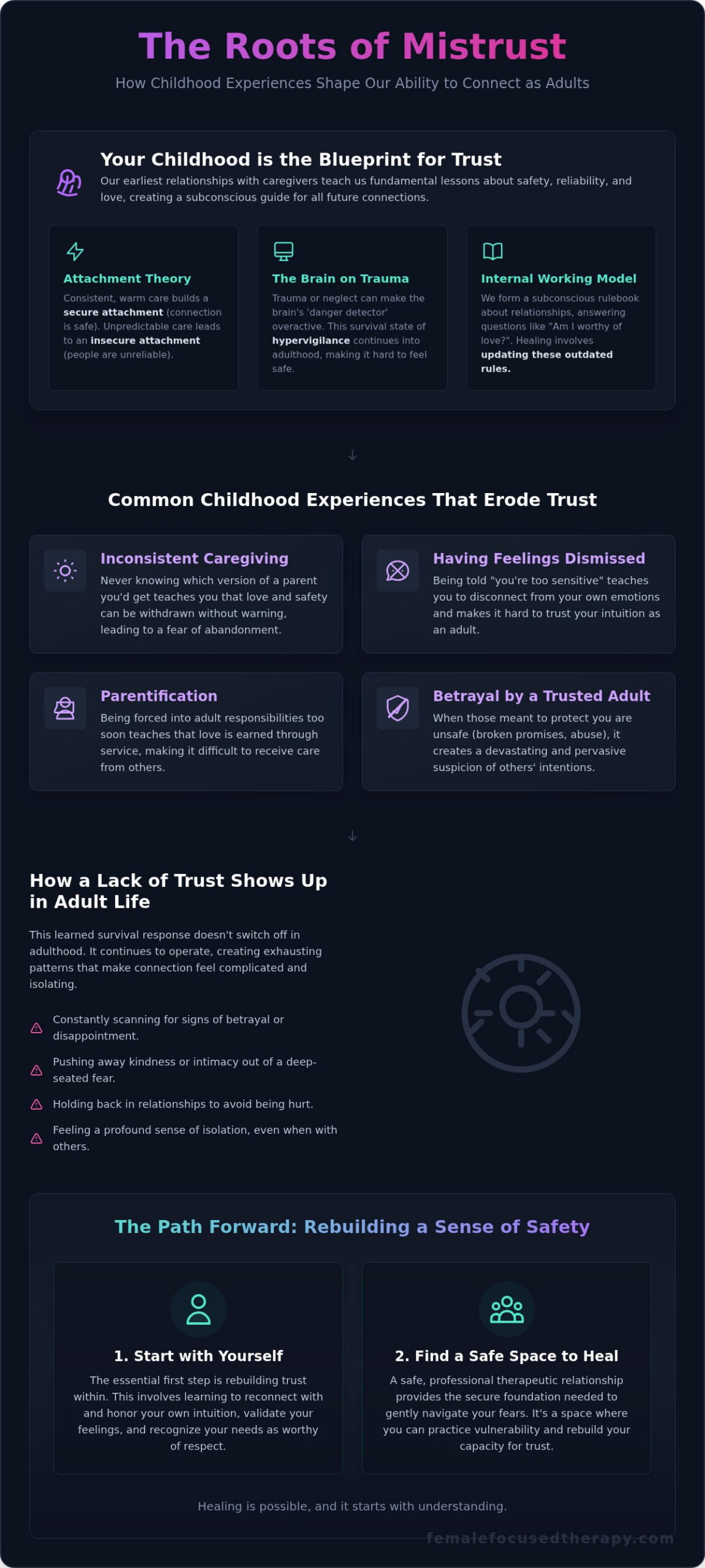
If you find it hard to let your guard down or truly rely on others, you are not alone. The roots of this struggle often reach back to our very first relationships. From the moment we are born, our interactions with caregivers teach us fundamental lessons about safety, reliability, and love. These early experiences create a blueprint that our brains use to navigate every future connection. Understanding this foundation is the first gentle step in addressing the deep-seated difficulty trusting others after childhood. It’s not about assigning blame, but about gaining clarity on why you feel the way you do.
Attachment Theory in Simple Terms
Psychologists refer to this foundational learning process as Attachment theory. When a child’s needs are met with consistency and warmth, they form a secure attachment, learning that connection is safe. However, if care is unpredictable or neglectful, an insecure attachment can develop. This often leads to a persistent feeling of mistrust, as the world has taught you that people are unreliable. The important thing to remember is that your attachment style is not a life sentence; it’s a pattern that can be understood and healed.
The Child’s Brain on Trauma and Neglect
A difficult childhood can physically shape the developing brain. When a child experiences trauma or neglect, their brain’s ‘danger detector’ (the amygdala) can become overactive. To survive, you learned to be on high alert, constantly scanning for threats and anticipating abandonment or harm. This state of hypervigilance was a brilliant survival strategy then, but it doesn’t simply switch off in adulthood. It continues to operate, making it incredibly challenging to feel safe and relaxed in relationships, even when no real threat exists.
Your ‘Internal Working Model’ of Relationships
Based on these early experiences, we all create a subconscious set of rules-an ‘internal working model’-about how relationships work. This model answers questions like, “Am I worthy of love?” and “Will people be there for me?” If you were taught that love was conditional or that you had to be perfect to avoid criticism, your internal rulebook will reflect that. A significant part of healing the difficulty trusting others after childhood involves gently and consciously updating these outdated rules to align with the secure, supportive connections you deserve now.
8 Common Childhood Experiences That Erode Trust
The roots of your difficulty trusting others after childhood are often found in experiences that were confusing, painful, or frightening. These events don’t have to be overtly traumatic; they can also be subtly damaging patterns that slowly wore away your sense of safety. Many women we support in our Singapore practice initially dismiss their past, thinking, ‘it wasn’t that bad.’ But your feelings are the most important guide. Recognizing what happened is the first step to understanding why you feel the way you do. In fact, large-scale research confirms a direct link between adverse childhood experiences and trust in adulthood.
Inconsistent or Unpredictable Caregiving
When you grow up never knowing which version of a parent you are going to get-the loving one or the angry, distant one-you learn that the world is unstable. This inconsistency teaches a child that love, affection, and safety can be withdrawn without warning. As an adult, this can manifest as a deep-seated fear of abandonment and an inability to feel secure in relationships, as you are always waiting for the other shoe to drop.
Having Your Feelings Dismissed or Minimized
Were you ever told “stop crying,” “you’re too sensitive,” or “you’re overreacting”? When a child’s genuine emotions are consistently invalidated, they learn a damaging lesson: my feelings are wrong. This teaches you to disconnect from your own emotional reality. As a woman, this can make it incredibly hard to trust your own intuition, advocate for your needs, or believe that your emotional responses are valid and worthy of respect.
Parentification: Being a Caretaker Too Soon
Parentification happens when a child is forced to take on adult responsibilities, whether practical (like managing household finances) or emotional (like being a parent’s confidante). You learned that your value came from what you could do for others, and that love had to be earned through service. This often leads to emotional over-functioning in adulthood, where you excel at caring for everyone but find it almost impossible to receive care yourself.
Betrayal by a Trusted Adult
This is one of the most direct assaults on a child’s ability to trust. It can range from consistently broken promises and shared secrets being used against you, to more severe forms of emotional, physical, or sexual abuse. The core lesson is devastating: the very people who were supposed to protect you are unsafe. This can create a lasting and pervasive suspicion of others’ motives, making it feel dangerous to let anyone get close.
How a Lack of Trust Shows Up in Your Adult Life
The patterns we learn in childhood to keep ourselves safe don’t simply disappear as we grow up; they adapt. What was once a necessary survival skill can become a source of pain in our adult lives. If you experience difficulty trusting others after childhood, you may notice its echo in your relationships, career, and even in how you see yourself. Recognizing these signs is a courageous first step toward change. Please remember, these are coping mechanisms born from your experiences-not character flaws.
In Romantic Relationships
In your love life, a lack of trust might manifest as a constant state of high alert. You may find yourself searching for signs of dishonesty, bracing for betrayal, or finding it incredibly challenging to be truly vulnerable with a partner. This fear can lead to pushing loved ones away to avoid being hurt, or clinging tightly for fear of abandonment. This pattern is often a sign of unresolved relationship trauma, which can be gently navigated and healed with professional support.
In Friendships and at Work
This struggle isn’t limited to romance. In your professional life, you might assume colleagues are trying to undermine you or take credit for your work. With friends, you may keep an emotional distance, sharing only surface-level details to protect yourself from potential judgment. Simple interactions can feel complicated as you overthink comments and search for hidden meanings, making it hard to feel secure and connected in what should be supportive environments.
In Your Relationship with Yourself
Perhaps the most profound impact is on your relationship with yourself. A childhood where trust was broken can leave you with persistent self-doubt, making it hard to believe in your own judgment. You might struggle to accept compliments or acknowledge your own worth, feeling you are somehow not enough. Often, a harsh inner critic develops-a voice that mimics the criticism or neglect from your past, keeping you from embracing self-compassion and rebuilding trust in your own capabilities.
The First Steps to Rebuilding Trust: Starting with Yourself
If you’re navigating the world with a deep-seated difficulty trusting others after childhood, the path to healing doesn’t begin “out there.” It starts right here, within you. It’s a foundational truth of emotional wellbeing: you cannot give to others what you have not first cultivated for yourself. Before you can extend trust to someone else, you must first build a safe and reliable relationship with the one person who will always be there-you. This gentle process is about becoming the consistent, compassionate caregiver you may have never had, learning to create a sense of safety from the inside out. Remember to be patient; this is a journey of reconnection, not a race.
Practice Radical Self-Compassion
Radical self-compassion means acknowledging the depth of your pain without judgment. It’s about treating yourself with the same warmth and kindness you would offer a dear friend who was struggling. Your challenges with trust are not a flaw; they are a completely understandable survival strategy that helped you get through an unsafe past. By meeting your own vulnerability with empathy, you begin to rewire the inner critic and create a foundation of inner safety and acceptance.
Learn to Set and Hold Boundaries
Think of boundaries not as walls that shut others out, but as clear, loving statements of what you need to feel safe. For those of us who grew up in environments where our needs were ignored, setting boundaries can feel terrifying. Start small. Perhaps it’s saying “no” to a small request from a colleague or ending a phone call when you feel drained. Each time you successfully hold a boundary, you send a powerful message to yourself: “I can protect myself. I am worthy of safety.”
Reconnect with Your Body and Intuition
Childhood trauma often teaches us to disconnect from our bodies as a way to survive overwhelming feelings. Healing involves a gentle reconnection with your physical self. Practices like mindfulness help you notice the subtle signals your body sends-that tightness in your chest, the flutter in your stomach. These ‘gut feelings’ are your intuition speaking. Learning to listen to and trust this inner wisdom is the very core of rebuilding self-trust. Explore our free therapy resources to find simple exercises to get started.
These first steps-self-compassion, boundaries, and intuitive reconnection-are the bedrock of healing. They are acts of profound self-respect that create a stable inner ground from which you can begin to safely connect with the world. This journey is deeply personal, and if you feel you need support, exploring therapy at femalefocusedtherapy.com can provide a safe, confidential space to navigate this path.
How Therapy Creates a Safe Space to Heal and Trust Again
If you are navigating life after a difficult childhood, the path to rebuilding trust can feel overwhelming and isolating. While self-reflection is valuable, untangling deep-seated relational patterns is challenging to do alone. A professional therapist provides a confidential, secure base-a safe harbour where you can explore your fears and wounds without judgment, and at a pace that feels right for you.
The therapeutic relationship itself becomes a powerful tool for healing. It is a unique space where you can learn new, healthier ways of relating to both yourself and others, gently rewriting the relational scripts you learned long ago.
What is Trauma-Informed Therapy?
This is a compassionate approach that recognises the widespread impact of trauma on a person’s life and wellbeing. The focus is always on creating an environment of physical and emotional safety, choice, and collaboration. A trauma-informed therapist’s guiding question is not ‘What’s wrong with you?’ but rather, ‘What happened to you?’ This fundamental shift validates your experiences and opens the door for profound healing.
Building a Corrective Emotional Experience
The consistent, reliable, and empathetic connection with your therapist can help repair old attachment wounds. In this relationship, you have the chance to experience being truly heard, validated, and respected-perhaps for the first time. This creates a “corrective emotional experience,” providing a new, healthy blueprint for what a safe relationship feels like. This new model of trust can then be carefully generalized to your relationships outside of therapy.
Finding the Right Support for You
Finding the right person to walk alongside you is the most important step. When you have difficulty trusting others after childhood, feeling safe and understood by your therapist is non-negotiable.
- Look for a therapist who specialises in childhood trauma and attachment.
- It is perfectly acceptable to have a consultation to see if you feel a connection.
- Trust your intuition; the therapeutic relationship is the foundation for your healing journey.
See who we work with to learn if our female-focused approach feels like a supportive fit for you. Reaching out is a courageous first step toward reconnection and trust.
Begin Your Journey to Rebuilding Trust
Navigating the echoes of your past is a courageous act. As we’ve explored, your childhood experiences form the blueprint for connection, and the path to healing begins with the gentle, essential work of rebuilding trust in yourself. Acknowledging that your difficulty trusting others after childhood is a valid protective response-not a personal failing-is a powerful and liberating first step.
You don’t have to walk this path alone. At Female Focused Therapy, we specialize in supporting women through this delicate process of reconnection. In our confidential online and in-person sessions, we use a trauma-informed and evidence-based approach to help you navigate your experiences and build a foundation for healthier relationships.
Ready to build safer connections? Let’s talk. Book a confidential consultation.
Reclaiming your sense of safety and learning to build secure, fulfilling relationships is entirely possible. Your journey toward clarity and confidence can begin today.
Frequently Asked Questions About Trust After a Difficult Childhood
Is it truly possible to learn to trust again after severe childhood trauma?
Yes, healing is absolutely possible. Rebuilding trust is a gentle, gradual journey, not an overnight fix. It involves understanding how your past experiences shaped your present and learning to feel safe in your body and in relationships again. With patience and self-compassion, you can navigate this path and cultivate secure, supportive connections. This process is about slowly learning that a different, safer way of relating is possible for you.
What is the difference between healthy caution and a genuine trust issue?
Healthy caution is about discernment in the present moment. You might notice inconsistent behaviour in someone and wisely decide to be careful. A genuine trust issue, however, is often rooted in the past. It’s a persistent expectation of betrayal that can surface even in safe, stable relationships. It’s the difference between responding to a current red flag and having a default internal setting that assumes everyone will eventually let you down.
I want to heal, but can I overcome trust issues without going to therapy?
While self-help resources like journaling and supportive friendships are valuable parts of the healing journey, navigating deep-seated trust issues alone can be overwhelming. Professional therapy offers a confidential, trauma-informed space to explore these patterns safely. A therapist provides guidance to help you untangle complex emotions and build a secure foundation for self-trust and trust in others, at a pace that feels right for you.
How can I explain my trust issues to my partner without scaring them away?
Choose a calm moment and speak from your heart using “I” statements. You could say, “Because of things in my past, I sometimes find it hard to feel fully secure in relationships. This is my own healing work, but I wanted to share it with you so you understand.” This frames it as your personal journey, not a criticism of them. It invites them to be a supportive part of your healing, rather than feeling blamed or pushed away.
Why do I feel like I always attract or choose untrustworthy people?
This is a common and painful pattern often linked to our earliest relationships. We can unconsciously recreate familiar dynamics because, even if they were unhealthy, they feel known to our nervous system. Healing involves developing self-awareness around this pattern and learning what a secure, respectful connection truly feels like. It’s about gently teaching yourself that you are worthy of-and can choose-people who are genuinely supportive.
My childhood wasn’t abusive, just emotionally distant. Could that still cause trust issues?
Yes, absolutely. Emotional neglect can profoundly impact your ability to trust. When your needs for emotional connection and validation weren’t consistently met, you may have learned that you cannot rely on others for support. This creates a deep-seated difficulty trusting others after childhood, as the foundational belief becomes “I am on my own.” It teaches you to be hyper-independent and wary of vulnerability, as it wasn’t safe in your formative years.

Article by
Cheryl Kennedy MacDonald MA BA (Hons) Pg. Dip. SAC BACP
Cheryl Kennedy MacDonald is a psychotherapist specialising in women’s mental health, relationships, and life transitions. She works with women navigating trauma, relationship breakdown, identity shifts, and midlife change, helping them rebuild self-trust, emotional stability, and a clear sense of who they are and what they want.
With over 20 years’ experience working with women internationally, Cheryl is the founder of YogaBellies, a global women’s yoga school, and the creator of the Birth ROCKS method. Her work sits at the intersection of psychotherapy and embodiment, integrating evidence-based therapeutic approaches with somatic, body-based practices that support deep, lasting change.
Known for her grounded and direct approach, Cheryl moves beyond surface-level insight to address the patterns held in the body and nervous system. Her work supports women to regulate, reconnect, and respond to their lives from a place of clarity, strength, and self-respect.
She is a published author in academic journals and has written multiple books on women’s health, pregnancy, and midlife wellbeing, available on Amazon and leading book retailers worldwide.