
You may be here because a quiet, persistent anxiety hums beneath the surface of your relationships. Perhaps it shows up as a constant need for reassurance, a deep-seated worry that you are ‘too much,’ or a pattern of pushing away the very love you crave. This undercurrent of unease, this feeling that you are always one wrong step away from being left, is the exhausting reality of navigating the fear of abandonment relationships.
For those navigating these challenges within a marriage, it can be helpful to explore the unique dynamics at play. If you want to dive deeper, you can find out more about The Mystery of Marriage and how to build a stronger foundation together.
If this experience resonates with you, please know you are not alone, and that genuine healing is possible. This compassionate guide is designed to be a safe space for you to gently explore the roots of these fears. Together, we will navigate how they impact your connections and uncover effective steps you can take to start rebuilding self-trust. Our goal is to support you in moving from a place of anxiety to one of calm security, empowering you to build the healthy, lasting connections you truly deserve.
Key Takeaways
- Uncover the connection between your childhood experiences and adult relationship patterns to understand the deep-seated roots of your anxiety.
- Recognize the subtle ways the fear of abandonment relationships can manifest, often leading to behaviours that unintentionally sabotage the connection you crave.
- Learn gentle communication strategies to share your fears with your partner, fostering understanding and support instead of blame.
- Discover actionable steps you can begin taking today to heal, build self-trust, and cultivate the secure, loving partnership you deserve.
What is Fear of Abandonment? A Gentle Introduction
If you’ve found your way here, you may be carrying a heavy weight—a persistent, quiet hum of anxiety that your loved ones will eventually leave. This is so much more than a fleeting worry; it’s a deep-seated fear that can colour your entire experience of connection, intimacy, and trust. The fear of abandonment in relationships often acts like a filter, causing you to interpret neutral actions as signs of rejection and to constantly doubt the security of even the most loving bonds.
Before we go any further, it’s important to hold this truth: this is not a personal failing. This profound fear is often a completely understandable response to past hurts, whether from childhood, family dynamics, or painful adult relationships. It represents the crucial difference between a healthy concern for a relationship’s wellbeing and a pervasive, chronic dread that feels like it’s always waiting just beneath the surface, undermining your ability to feel truly safe and secure with another person.
Core Feelings and Anxieties
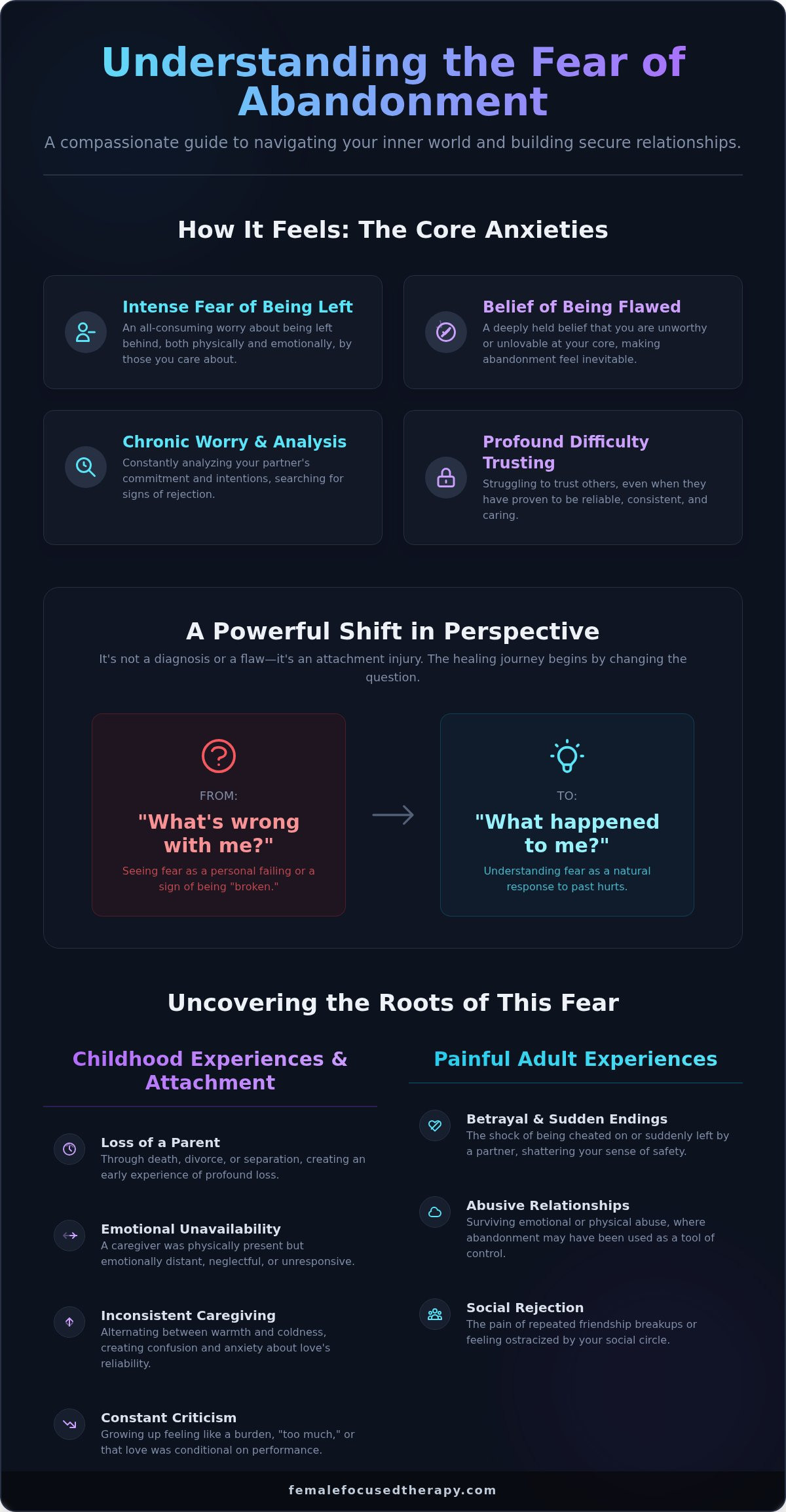
When this fear is active, it doesn’t just stay in your head. It often manifests as a cluster of painful emotions and recurring worries that can feel overwhelming. You may recognise some of these patterns in yourself:
- An intense, often all-consuming fear of being left, both physically and emotionally.
- A deeply held belief that you are somehow flawed, unworthy, or unlovable at your core.
- Chronic worry and analysis of your partner’s commitment, feelings, and intentions.
- A profound difficulty trusting others, even when their actions have proven them to be reliable, consistent, and caring.
It’s Not a Diagnosis, It’s an Attachment Injury
In our work together, we gently reframe this experience. It can be tempting to label this fear as a flaw or a sign that you are “broken,” but it’s more compassionate and accurate to see it as an attachment injury. This fear is a hallmark of insecure attachment styles—often anxious or fearful-avoidant—which are intelligent patterns we develop to cope when our early needs for safety and connection weren’t consistently met. While it can be connected to other conditions, the fear itself is not a formal diagnosis. It is a wound, a deeply human response to the primal fear of emotional abandonment. Shifting our focus from “What’s wrong with me?” to “What happened to me?” is the first, powerful step toward healing, clarity, and rebuilding a foundation of self-trust.
The Roots of Abandonment Fears: Understanding Your Story
If you live with a deep-seated fear of being left, it’s important to know that this feeling did not appear from nowhere. It is not a flaw in your character, but a learned response to your life experiences. Understanding where this fear comes from is a powerful, compassionate first step toward healing. It allows us to move away from self-blame and toward self-awareness, creating a foundation for rebuilding trust in yourself and others.
Childhood Experiences and Attachment
Our earliest relationships form the blueprint for how we expect to be treated in the future. As children, our survival depends on our caregivers, and our brains are wired to adapt to the love and security we receive—or don’t. Research from the National Institutes of Health has shown how these early attachment patterns profoundly influence our adult responses to connection and stress. Your fear may be rooted in experiences like:
- The loss of a parent through death, divorce, or separation.
- Emotional unavailability or neglect from a caregiver who was physically present but emotionally distant.
- Inconsistent caregiving that alternated between warmth and coldness, creating confusion and anxiety.
- Growing up with constant criticism, making you feel like a burden or “too much.”
Past Relationship Trauma
While childhood is foundational, the fear of abandonment in relationships can also be created or intensified by painful adult experiences. These events can shatter our sense of safety and trust, leaving behind deep emotional wounds. Trauma isn’t always a single, dramatic event; it can be a slow erosion of your sense of self-worth over time. This can be especially true in experiences with narcissistic abuse, where abandonment is often used as a tool of control. Other significant experiences include:
- The shock and betrayal of being cheated on or suddenly left by a partner.
- Surviving an emotionally or physically abusive relationship.
- The pain of repeated friendship breakups or feeling rejected by your social circle.
Your story is valid. Acknowledging these roots is not about dwelling in the past, but about honouring your journey and understanding the protective mechanisms you developed to survive. This is where the work of healing begins.
How Fear of Abandonment Shows Up in Your Relationships
The most painful irony of navigating a fear of abandonment in relationships is that the anxiety it creates often triggers behaviours that, instead of securing a connection, can push a partner away. Internally, it can feel like a constant, quiet panic. Your mind may race with a relentless monologue: “Did I say something wrong?” “They seem distant today, they must be losing interest.” “I knew this was too good to be true; they’re going to leave me.” This internal turmoil is deeply exhausting and can make you feel powerless over your reactions.
These responses are not a reflection of your character, but rather deeply ingrained protective strategies. Often rooted in an insecure attachment style developed earlier in life, these behaviours typically fall into two main categories: attempts to pull your partner closer (protest) or efforts to push them away before they can hurt you (avoidance).
Protest Behaviors: Trying to Pull Your Partner Closer
When the fear of disconnection becomes overwhelming, you might engage in behaviours designed to close the perceived distance and regain a sense of safety. You may find yourself:
- Needing constant reassurance: Frequently asking “Do you still love me?” or needing verbal confirmation that everything is okay in the relationship, even without any evidence to the contrary.
- People-pleasing: Sacrificing your own needs, opinions, and boundaries to avoid conflict or disapproval. You might agree to things you don’t want to do, simply to keep the peace and ensure they stay happy with you.
- Becoming jealous or watchful: Monitoring your partner’s social media, questioning their friendships, or feeling intense anxiety when they interact with others, seeing them as threats to your connection.
- Struggling with time apart: Feeling a deep sense of unease, anxiety, or even emptiness when your partner is away, making it difficult to function or enjoy your own time.
Avoidant & Self-Sabotaging Behaviors: Pushing Them Away First
For some, the anticipated pain of being left is so great that the subconscious goal becomes to control the ending—by initiating it. This is a form of self-protection that unfortunately reinforces the core belief that you are destined to be abandoned.
- Ending things prematurely: Breaking up with a partner at the first sign of a problem or perceived flaw, believing it’s better to leave than to be left.
- Creating emotional distance: Withdrawing, becoming unavailable, or putting up walls when the relationship deepens. You might shut down during important conversations to avoid true vulnerability.
- ‘Testing’ their commitment: Subconsciously starting arguments or creating drama to see if your partner will fight for the relationship, which can exhaust and confuse them.
- Choosing unavailable partners: Repeatedly entering into relationships with people who are emotionally unavailable, non-committal, or live far away, which validates the underlying belief that abandonment is inevitable.
Navigating Your Inner World: Gentle Steps Toward Healing
True healing from the fear of abandonment in relationships begins not by trying to control your partner’s actions, but by turning inward to build a foundation of safety within yourself. It’s a gentle shift from seeking external validation to nurturing your own inner world. This is a journey of self-compassion, not a race to perfection. Below are some practical, supportive techniques you can begin exploring today to navigate these feelings with more kindness and confidence.
Acknowledge and Name the Fear
The first step is simply to notice. When that familiar wave of panic or anxiety rises, try to pause and acknowledge it without judgment. Naming the feeling—”This is my fear of abandonment speaking”—can create a small but powerful space between you and the emotion. This practice helps you separate the feeling of fear from the fact of your current situation.
- Keep a journal: Gently track what triggers these feelings and how you react. Over time, you’ll begin to see patterns and understand your emotional landscape more clearly.
- Separate feeling from fact: Ask yourself, “Is my partner’s action of being late a sign of rejection, or could it just be traffic?” This helps ground you in reality.
Learn to Soothe Your Nervous System
When fear takes hold, your body often enters a state of high alert. Learning to calm your physical self is crucial for emotional regulation. These are not about suppressing the fear, but about supporting your body as it moves through it. Consider creating a ‘self-soothe’ kit with items like a calming essential oil, a soft blanket, or a favourite tea to have on hand.
- Grounding exercise: Notice 5 things you can see, 4 things you can touch, 3 things you can hear, 2 things you can smell, and 1 thing you can taste. This brings you back to the present moment.
- Box breathing: Inhale for 4 seconds, hold for 4, exhale for 4, and hold for 4. Repeat until you feel a sense of calm returning.
Challenge Anxious Thoughts
The mind often creates worst-case scenarios when the fear of abandonment in relationships is triggered. The goal is not to fight these thoughts, but to gently question them and offer a more compassionate alternative. This is about rebuilding self-trust and learning that you can hold your own fears without letting them dictate your reality.
- Question the narrative: When your mind spirals, ask, “What is another, more balanced possibility here?”
- Gather evidence: Actively look for small, concrete examples that contradict your fear—a kind text, a shared laugh, a moment of connection.
- Practice self-compassion: Instead of self-criticism, try saying, “It makes sense that I feel this way given my past, and I am capable of handling this feeling.”
Navigating Your Relationship While Healing
Healing from the fear of abandonment relationships is not a journey you must walk alone. In fact, involving your partner can be a powerful catalyst for both personal growth and a deeper, more secure connection. When approached with compassion and a shared commitment, navigating this challenge together can transform your bond, rebuilding it on a foundation of trust and mutual understanding.
Communicating Your Needs and Fears
The key to involving your partner is learning to express your feelings without blame or accusation. This creates emotional safety for both of you. Instead of reacting from a place of fear, you can learn to respond with vulnerability. Try these gentle approaches:
- Use ‘I feel’ statements: Clearly own your emotions. For example, “I feel anxious when I don’t hear from you for a while,” is much easier for your partner to hear than, “You never text me.”
- Explain your triggers calmly: Help your partner understand your inner world. You might say, “When plans change last minute, it triggers my fear of being forgotten. It’s an old feeling, but it comes up strongly for me.”
- Ask for specific reassurance: Be clear about what helps you feel secure. This could be as simple as asking, “Could you send a quick text when you arrive?” or “I just need a hug and to hear that we’re okay.”
Working Together as a Team
When your partner understands your struggle, they can become your greatest ally. A supportive partner can help co-regulate your nervous system in moments of high anxiety, offering a calming presence that reminds you that you are safe. By exploring patterns together without blame, you can both gain clarity on how the fear of abandonment impacts your dynamic and work collaboratively to create new, healthier ways of relating.
These conversations can be challenging to navigate alone. Sometimes, professional couples therapy provides a confidential and structured space to explore these dynamics safely. A therapist can help facilitate communication in a way that ensures both partners feel heard and understood.
It’s important to differentiate between healthy support and unhealthy dependence. The goal is not for your partner to ‘fix’ you, but to support you as you learn to soothe yourself and rebuild self-trust. This teamwork strengthens your relationship, fostering a secure attachment where both of you can thrive.
How Therapy Can Help You Heal for Good
While self-help resources offer valuable insights, navigating the deep-seated roots of attachment anxiety on your own can feel overwhelming. Professional therapy provides something different: a consistent, confidential relationship with a compassionate expert dedicated to your growth. A therapist acts as a secure base, creating a safe, non-judgmental space where you can explore your most vulnerable fears without the risk of being misunderstood or dismissed.
This is particularly vital when healing the fear of abandonment in relationships, which is often connected to past hurts. A trauma-informed approach ensures that we move at a pace that feels safe for you, gently untangling the past so it no longer dictates your future. The goal is not just to manage symptoms, but to help you build the lasting, secure attachment with yourself and others that you have always deserved.
What to Expect in Therapy for Abandonment Issues
In our sessions together, we will work collaboratively to help you move forward with clarity and confidence. The process is tailored to you and often includes:
- Identifying the root causes of your fears in a supportive environment, connecting past experiences to present-day patterns.
- Learning new, healthy coping strategies to manage anxiety and communicate your needs effectively in relationships.
- Gently processing past trauma, allowing you to release its emotional weight and reclaim your sense of safety.
- Rebuilding your self-worth and a fundamental trust in your own judgment, which is the foundation of secure relationships.
Our Female-Focused, Integrative Approach
We understand that women often experience and internalise relationship trauma in unique ways. Our female-focused therapy is designed to honour your specific journey with the fear of abandonment in relationships. We use an integrative model, blending evidence-based talk therapies with mindfulness and somatic (body-based) practices to support your whole self—mind, body, and spirit.
Our goal is to help you stop reacting from a place of fear and start living from a place of security, confidence, and inner peace. You don’t have to navigate this alone. Book a confidential consultation today to take the first step toward healing.
Embracing Secure Connections: Your Path Forward
Understanding that the fear of abandonment is rooted in your personal story is the first, most compassionate step you can take. By gently recognising how these anxieties manifest, you create the space to choose new, healthier ways of connecting with others. Healing your fear of abandonment relationships is not about erasing your past, but about learning to navigate your present with greater self-trust and clarity.
You do not have to walk this path alone. At Female Focused Therapy, we provide warm, confidential support through trauma-informed psychotherapy for women. Specialising in relationship trauma and rebuilding self-trust, we are here to help you feel secure in yourself and your bonds. For professional guidance available online and in Singapore, we invite you to take the next step. Ready to build secure, loving relationships? Let’s talk.
A future filled with deep, fulfilling connections is not just possible—it is waiting for you.
Frequently Asked Questions About the Fear of Abandonment
Can fear of abandonment ever be fully cured?
Healing is a journey, not a destination. While the memory of past hurts may remain, you can absolutely heal the wound of abandonment. The goal is to reduce the fear’s power over your thoughts and actions, allowing you to build secure, trusting connections. Through therapy and self-compassion, you can learn to navigate relationships with confidence and a stronger sense of self, so the fear no longer dictates your choices.
How do I know if my fears are valid or just my abandonment issues talking?
This is a powerful question that gets to the heart of rebuilding self-trust. A helpful step is to gently separate the feeling from the facts. Ask yourself: Is my fear based on my partner’s current, consistent behaviour, or is it a familiar echo from my past? If the anxiety feels outsized for the situation or follows a recurring pattern in all your relationships, it may be rooted in past abandonment wounds.
I’m single. How can I work on my fear of abandonment before I start dating again?
This is a wonderful time for healing and self-reconnection. You can begin by strengthening the most important relationship: the one with yourself. This involves identifying your triggers, practicing self-soothing techniques, and building a life rich with supportive friendships and fulfilling activities. Working with a therapist can provide a safe space to explore these patterns and build a foundation of self-worth before you navigate a new partnership.
How do I explain my fear of abandonment to a new partner?
Choose a calm, connected moment to share, rather than during a conflict. You could say something like, “Because of past experiences, I sometimes struggle with a fear of being left. It’s something I’m actively working on. It would be really supportive if you could offer reassurance when I’m feeling insecure.” This frames it as your journey and invites them to be a supportive partner, not a rescuer.
What’s the difference between fear of abandonment and an anxious attachment style?
Think of them as deeply connected. The fear of abandonment is the core wound—a deep-seated terror of being left alone or losing connection. An anxious attachment style is one of the primary ways this fear shows up in relationships. It often involves behaviours like seeking constant reassurance, feeling preoccupied with your partner, and worrying that they will leave. The fear is the ‘why,’ and the attachment style is the ‘how.’
Can this fear develop in adulthood, or does it always start in childhood?
While the foundations are often laid in childhood through inconsistent caregiving, the fear of abandonment in relationships can certainly develop or be intensified in adulthood. A significant loss, a sudden breakup, or a betrayal by a trusted partner can create a new wound or reactivate an old one. This type of relational trauma can deeply impact your sense of safety and trust, making future connections feel precarious.

Article by
Cheryl Kennedy MacDonald MA BA (Hons) Pg. Dip. SAC BACP
Cheryl Kennedy MacDonald is a psychotherapist specialising in women’s mental health, relationships, and life transitions. She works with women navigating trauma, relationship breakdown, identity shifts, and midlife change, helping them rebuild self-trust, emotional stability, and a clear sense of who they are and what they want.
With over 20 years’ experience working with women internationally, Cheryl is the founder of YogaBellies, a global women’s yoga school, and the creator of the Birth ROCKS method. Her work sits at the intersection of psychotherapy and embodiment, integrating evidence-based therapeutic approaches with somatic, body-based practices that support deep, lasting change.
Known for her grounded and direct approach, Cheryl moves beyond surface-level insight to address the patterns held in the body and nervous system. Her work supports women to regulate, reconnect, and respond to their lives from a place of clarity, strength, and self-respect.
She is a published author in academic journals and has written multiple books on women’s health, pregnancy, and midlife wellbeing, available on Amazon and leading book retailers worldwide.