
What if your inability to let go isn’t a sign of weakness, but your brain’s way of trying to protect you from a perceived threat? I know that heavy, aching feeling in your chest when you wake up, and the way your mind loops through old conversations until you feel like you’re losing your grip. It’s exhausting to keep asking yourself, why cant I accept the relationship is over? when every logical part of you knows it’s time to move on.
I understand how lonely this space feels, especially when you think you should be “over it” by now. You aren’t “crazy” or failing at healing. Your body and mind are simply responding to a significant loss in the only way they know how. I will help you understand the biological and emotional reasons you feel stuck, so you can begin to gently move forward at your own pace.
In this article, we’ll explore how your nervous system handles heartbreak and look at practical ways to quiet the mental noise. My goal is to help you understand the physiology of your pain so you can stop the rumination and start rebuilding a sense of internal safety and self-trust.
Key Takeaways
- I will help you validate that heavy feeling of being stuck so you can stop wondering why your heart won’t listen to your head.
- We will look at the science of “love withdrawal” to answer the question, why cant I accept the relationship is over? from a physiological perspective.
- I will gently guide you through recognizing the invisible threads of trauma bonding that often make painful relationships the hardest to leave.
- You will learn how to use your breath and somatic movement to help your body feel safe and grounded as you navigate this transition.
- We will explore how to grow around your grief so you can move toward a future where you feel restored and whole again.
That heavy feeling of being stuck in a door that has closed
I know that specific, suffocating feeling where your head has already processed the facts, but your heart refuses to listen. You wake up, and for a split second, everything is fine. Then, the weight of the loss hits your chest like a physical blow. You spend your day in a loop, wondering, “why cant I accept the relationship is over?” while the rest of the world tells you to just keep busy.
It is incredibly exhausting to carry this. There is a distinct difference between healthy grieving, which feels like a slow, painful movement, and this “stuckness” that feels like a trap. When you’re stuck, you aren’t just sad; you’re held captive by the memory of what was or what you hoped it could be. People might tell you to “just move on,” but that is often the least helpful thing to hear when your internal compass is spinning.
The disconnect between your logic and your emotions
I see this so often in my practice with the intelligent, high-functioning women I support. You can list every reason why they weren’t right for you; perhaps they were unkind, or the relationship was draining. Yet, you still find yourself craving their presence or checking your phone for a message. This creates a painful state of cognitive dissonance, where your beliefs about the relationship don’t align with your emotional reality.
Please know that you aren’t “weak” for wanting to reach out. Your brain is trying to resolve a conflict that doesn’t have a simple answer. You are essentially fighting a battle between your rational prefrontal cortex and your emotional limbic system. It’s a tiring way to live. It is okay to acknowledge that your feelings haven’t caught up to your facts yet.
Why time alone hasn’t been the healer you were promised
We’ve all heard that “time heals all wounds,” but I’ve found that time alone is rarely enough. If you are stuck in survival mode, your emotional clock actually pauses. You might be six months or even two years out from the breakup, but if your nervous system still feels under threat, the pain remains as fresh as day one. Healing requires more than just the passing of days; it requires a feeling of safety.
Your brain isn’t trying to hurt you by keeping you in this loop. In a strange way, it’s trying to protect you. By not letting go, it’s attempting to avoid the finality of the loss because that finality feels dangerous or overwhelming. Understanding that your “stuckness” is a survival mechanism, rather than a character flaw, can be the first step toward finding a sense of peace.
Why your brain treats a breakup like a physical withdrawal
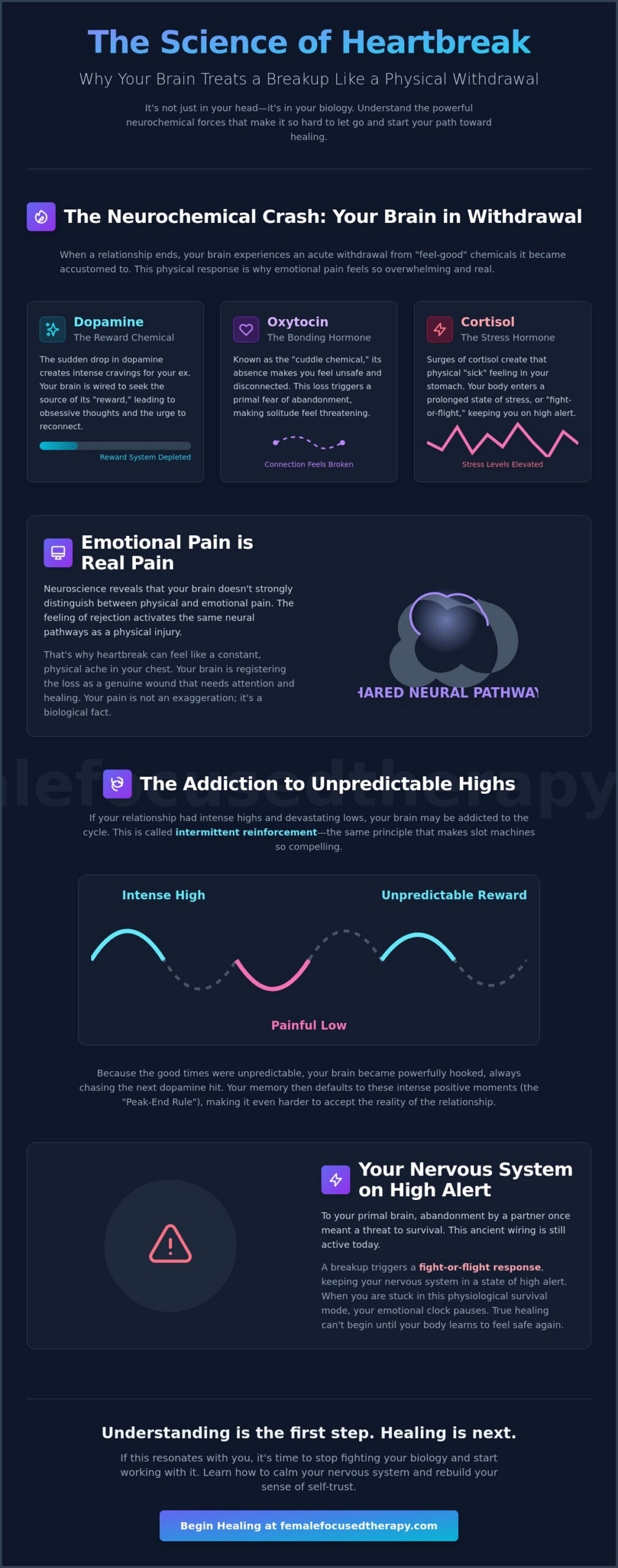
If you feel like you are physically aching for your ex, it is because you are. When we are in a relationship, our brains are flooded with feel-good chemicals like dopamine and oxytocin. Dopamine is the reward seeker; it is what makes you crave their touch or a text from them. Oxytocin is the bonding hormone, the “cuddle chemical” that makes you feel safe and connected.
When that person is suddenly gone, your brain doesn’t just feel sad. It goes into a state of acute chemical withdrawal. This neurochemical crash is the primary reason you find yourself asking, why cant I accept the relationship is over? even when you know it is for the best. Your brain is physically wired to seek out the source of those chemicals to stop the pain.
That hollow, “sick” feeling in your chest or stomach is often a surge of cortisol, the stress hormone. It is your body’s way of telling you that you are in danger. Research into the neurobiology of heartbreak shows that the same areas of the brain light up during a rejection as they do during physical injury. Your pain is not imaginary; it is a biological reality.
The addiction to the “highs” of the relationship
If your relationship had intense highs and lows, you might be experiencing intermittent reinforcement. This is the same psychological trick that keeps people playing slot machines. Because the good times were unpredictable, your brain became even more hooked on them. I often see women struggle with the “Peak-End Rule,” where your memory focuses on the most intense positive moments rather than the average daily reality. Your brain filters out the bad parts to keep the bond alive.
Your nervous system in a state of alarm
For our ancestors, abandonment by a partner often meant death. Because of this, your nervous system interprets this loss as a direct threat to your survival. It triggers a primal fight-or-flight response that keeps you in a state of high alert. When you are in this physiological state, you cannot easily access the rational, “acceptance” part of your brain.
Emotional withdrawal is a physiological reality, not a lack of willpower. It takes time for your nervous system to learn that you are safe on your own. If you feel like you need professional support to regulate this response, exploring these feelings in individual therapy sessions can help you find your footing again.
Recognizing the invisible threads of trauma bonding and narcissistic abuse
I want to talk very gently about why it is so much harder to walk away from a relationship that was actually quite painful. If you have been in a dynamic involving relationship trauma and narcissistic abuse, the end of the partnership doesn’t feel like a normal goodbye. It feels like an amputation. You might be berating yourself, wondering, “why cant I accept the relationship is over?” when that person treated me so poorly?
The truth is, your difficulty in letting go is often a direct result of the tactics used within the relationship. One of the most confusing parts of this is “hoovering.” This is when an ex tries to “suck” you back into the dynamic with promises of change or sudden displays of affection. Every time this happens, it resets your emotional progress. It makes you question your decision and keeps you tethered to a cycle that was never meant to sustain you. Your self-trust feels broken because the person you loved also became the source of your deepest pain.
What is a trauma bond?
A trauma bond is essentially a chemical glue created by a cycle of intense love followed by intense pain. These extreme fluctuations create a powerful physiological link that is very difficult to break. You might feel “addicted” to the person even if you didn’t like how they treated you on a daily basis. It is vital to recognize that this feeling of being stuck is a symptom of the abuse you endured, not a reflection of your character or your true desire to be with them.
Reclaiming your intuition
Gaslighting is a hallmark of narcissistic dynamics. It systematically erodes your ability to trust your own senses. When you have been told for years that your feelings are “wrong” or that you are “too sensitive,” accepting the end of the relationship feels impossible because you no longer trust your own judgement. You are constantly looking for external validation for a reality that you already know is true deep down.
I often work with women on rebuilding their “internal compass.” This is the quiet voice inside that knows the truth, even when your ex says otherwise. To start trusting yourself again, try writing down three specific things that happened in the relationship that you know were real, even if your partner denied them. Read these back to yourself whenever you feel the urge to reach out. Validating your own version of the story is a small but powerful step toward emotional freedom.
Simple ways to help your body feel safe again
While we have explored the neurochemistry of loss, true healing happens when we move from the mind back into the body. You might find yourself stuck in a loop, asking, “why cant I accept the relationship is over?” while your body remains in a state of high alert. This is because emotional pain is often stored in our tissues and nervous system long after the logical mind has understood the facts of the situation.
I believe that healing isn’t just something we think our way through. It is something we breathe and move through. Integrating somatic movement and yoga for women can help release the physical “stuckness” that often accompanies a difficult breakup. When the obsessive thoughts start to spiral, grounding yourself in the present moment is the most compassionate thing you can do for your physical self.
Somatic tools for emotional overwhelm
A simple but powerful tool I often recommend is the “box breath.” Inhale for a count of four, hold for four, exhale for four, and hold for four. This rhythmic breathing sends a direct signal to your nervous system that you are safe in this moment. It helps lower the cortisol levels we discussed earlier, giving your brain the space it needs to process the loss without feeling constantly under siege.
Gentle, rhythmic movement, like a slow walk or intuitive stretching, helps move the stagnant energy of grief. If you feel overwhelmed right now, try this one minute grounding exercise. Press your feet firmly into the floor and notice the texture of the ground. Name three things you can see and two things you can hear. This pulls your awareness away from the “what ifs” and back into the safety of the “here and now.”
Rest as a radical act of recovery
Your brain is doing an incredible amount of heavy lifting right now, and it needs more sleep than usual. This is a time for intentional restorative rest, which is very different from “numbing out” with a screen. Create a “safety nest” in your home with soft textures, low lighting, and warmth. This physical environment reinforces the message to your brain that the “threat” of the breakup is not an immediate danger to your survival.
Your body often stores the “no” that your heart can’t quite say yet, showing up as a tight jaw or a heavy chest. If you are finding it difficult to regulate these physical symptoms on your own, you can book a session with me to explore how somatic therapy can support your recovery and help you find your peace.
Moving toward a future where you feel whole and restored
I want to be very clear about one thing. Finding peace doesn’t mean the pain suddenly vanishes or that you forget what happened. Instead, it means you grow around the grief. It is perfectly normal if you still catch yourself wondering, “why cant I accept the relationship is over?” on a random Tuesday afternoon. Acceptance is simply about building a life that is finally big enough to hold the memory of what happened without being entirely consumed by it.
When I work with clients through life transitions and therapy for women in Singapore, we focus on integration. A 2024 survey by Relationships Australia found that 44% of people experienced ongoing mental health issues following a relationship breakdown. This confirms that what you are feeling is a significant life event that requires real time and support to process. We work on identifying the lessons you’ve learned without forcing a positive spin on your pain.
Rebuilding your identity is often the most profound part of this journey. Through individual psychotherapy, we can slowly peel back the layers of who you were told to be. We look at the roles you were forced to play and the parts of yourself you had to hide to keep the peace. This is about finding the woman who existed before the partnership became your full-time job and your only focus.
Restoring your sense of self
I often help women rediscover their own voice after a long period of silence or suppression. This journey isn’t about “leveling up” to make someone else regret their choices; that approach still keeps your ex at the centre of your world. True restoration happens when you become the centre of your own world again. It starts with finding small, quiet pockets of joy that belong only to you.
These moments might be as simple as a specific book, a walk in a park you like, or a hobby you let go of years ago. These activities have nothing to do with being a partner or being “good enough” for someone else. They are solely about being you. As you reclaim these pieces of yourself, the “stuck” energy of the breakup begins to shift into something more manageable.
Your next gentle step
Please try to avoid making any massive life changes just yet. Your nervous system is still settling after the neurochemical withdrawal we discussed earlier. Focus only on the next hour or the next meal. Acknowledge that some days will still feel heavy, and that is a natural part of the process. Healing is rarely a straight line; it is a spiral that slowly, gently moves you toward a more stable version of yourself.
If you feel ready to talk about your specific situation and want to explore why cant I accept the relationship is over? in a safe, compassionate space, I invite you to book a consultation with me. We can work together to quiet the mental noise, process the somatic weight of your loss, and help you rebuild a sense of internal confidence and self-reliance.
Taking your first step toward internal restoration
I hope you now see that your struggle isn’t a lack of strength. It’s a complex response involving your neurochemistry and your nervous system’s need for safety. We’ve explored how “love withdrawal” creates physical pain and how trauma bonds can keep you tethered to the past. Understanding these layers is the beginning of answering that painful question, why cant I accept the relationship is over?
Healing happens when we stop fighting our feelings and start listening to what our bodies need. As a Registered Integrative Psychotherapist specializing in relationship trauma and narcissistic abuse, I use a trauma-informed, mind-body approach to help you rebuild your self-trust. You don’t have to carry this heavy weight alone.
When you feel ready to move from survival mode back into a life of peace, I am here to hold that space for you. You deserve to feel whole, restored, and steady once again. I believe in your ability to find your way back to yourself.
Book a calm, confidential consultation with me today.
Common questions about finding your peace
Why does it feel like I am grieving a death even though they are still alive?
Your brain processes the loss of a significant attachment as a threat to your survival. You aren’t just grieving a person; you’re grieving the death of the future you imagined and the version of yourself that existed within that bond. It is a form of ambiguous loss where the person is physically here but psychologically absent. This is often why you feel stuck asking, why cant I accept the relationship is over? while your heart catches up.
How long should it take to get over a long-term relationship?
There is no set timeline for healing, but the 2024 survey by Relationships Australia shows that 44% of people experience ongoing mental health issues after a breakdown. Some people hit a “3-Month Wall” where the initial shock wears off and the reality of the loss truly sinks in. Your recovery depends on the depth of the bond and your nervous system’s sense of safety. I encourage you to focus on the quality of your rest rather than the calendar.
Can my ADHD make it harder to accept that the relationship is over?
Yes, ADHD can absolutely complicate the process due to emotional dysregulation and the tendency to hyperfocus. Your brain may latch onto the loss as a source of intense stimulation, making it much harder to pivot your attention away from your ex. It’s common to struggle with the question, why cant I accept the relationship is over? when your neurodivergent mind is stuck in a loop of rejection sensitivity. I often help women navigate this specific ADHD-related “stuckness.”
Is it normal to still check their social media every day?
It is a very common response to the dopamine withdrawal your brain is experiencing right now. Checking their profile provides a tiny, temporary hit of connection that briefly soothes the ache of the loss. However, this habit often keeps your nervous system in a state of high alert and prevents true restoration. I recommend gently reducing the frequency rather than demanding an immediate stop. Try to notice how your body feels after you look at their page.
What if I am the one who ended it but I still can’t let go?
Initiating the breakup doesn’t protect you from the pain of the loss. You are still losing a significant part of your life, and you may be experiencing dumper’s remorse or simply grieving the hope you once had. It’s possible to know with 100% certainty that a person is wrong for you while still deeply missing their presence. Your logic made the decision, but your nervous system still needs time to adjust to the new silence.
How do I stop the constant obsessive thoughts about my ex?
You stop them by redirecting your focus to your physical body rather than trying to “think” your way out of them. When the thoughts spiral, try the grounding exercises we discussed, like box breathing or noticing the weight of your feet on the floor. This pulls your energy out of the mental loop and back into the safety of the present moment. It’s about moving from your head into your breath to create a sense of internal stability.
Will I ever be able to trust someone again after this?
You will be able to trust again, but the first person you need to rebuild trust with is yourself. Healing from a difficult relationship is about restoring your own internal compass and learning to listen to your intuition. As you rebuild your sense of self-reliance through somatic work and therapy, the idea of trusting another person will eventually feel less like a risk. You are learning how to create safety within your own skin first.

Article by
Cheryl Kennedy MacDonald MA BA (Hons) Pg. Dip. SAC BACP
Cheryl Kennedy MacDonald is a psychotherapist specialising in women’s mental health, relationships, and life transitions. She works with women navigating trauma, relationship breakdown, identity shifts, and midlife change, helping them rebuild self-trust, emotional stability, and a clear sense of who they are and what they want.
With over 20 years’ experience working with women internationally, Cheryl is the founder of YogaBellies, a global women’s yoga school, and the creator of the Birth ROCKS method. Her work sits at the intersection of psychotherapy and embodiment, integrating evidence-based therapeutic approaches with somatic, body-based practices that support deep, lasting change.
Known for her grounded and direct approach, Cheryl moves beyond surface-level insight to address the patterns held in the body and nervous system. Her work supports women to regulate, reconnect, and respond to their lives from a place of clarity, strength, and self-respect.
She is a published author in academic journals and has written multiple books on women’s health, pregnancy, and midlife wellbeing, available on Amazon and leading book retailers worldwide.