
What if the exhaustion you feel isn’t just about a busy schedule, but the heavy weight of constantly monitoring someone else’s mood? You might find yourself searching “am I in a toxic relationship” in the quiet hours of the night, wondering if the chronic self-doubt you feel is actually a warning sign from your body. I understand how lonely it feels to be walking on eggshells daily, and I want you to know that your experience is valid.
I’ve spent years supporting women through relationship trauma, and I know that toxicity isn’t just about what they do; it’s about the erosion of your self-trust. You might be here because you’re feeling a physical exhaustion that sleep doesn’t fix, a deep depletion that comes from over-functioning for two. It’s hard to trust your intuition when it’s been muffled by months or years of subtle manipulation.
I will help you recognise the subtle signs of toxicity and understand how to begin trusting your own intuition again. We’ll explore a clear framework to identify these damaging patterns, providing you with the clarity and calm needed to find your way back to yourself. It’s time to move away from the confusion and start rebuilding the self-trust you deserve, at a pace that feels safe and sustainable for you.
Key Takeaways
- Recognise that toxicity is a consistent pattern that undermines your emotional health rather than just a few “bad days.”
- Understand that if you’re asking “am I in a toxic relationship,” your intuition is likely trying to signal that your sense of self is being eroded.
- Identify if you’ve fallen into the “over-functioning” trap, where you carry the entire weight of the relationship’s success on your own.
- Learn to interpret your body’s physical warnings, like that persistent heaviness in your stomach, as a guide toward your own truth.
- Discover the first steps toward rebuilding self-trust and reclaiming the clarity you need to move forward with confidence.
What Does a Toxic Relationship Actually Feel Like?
I want to start by acknowledging just how heavy this feels. It isn’t just about the big, dramatic blow-ups; it’s that quiet, persistent thrum of anxiety that sits in the background of your day. You might be asking yourself, “am I in a toxic relationship,” because you’ve noticed your emotional wellbeing is being consistently undermined rather than supported.
Toxicity is rarely a one-off event. It’s a climate of fear, guilt, or sheer exhaustion that follows you from room to room. I often describe this as the “eroding self.” It’s that slow, painful realisation that you’re becoming a smaller, quieter version of the woman you used to be, losing your spark just to accommodate someone else’s shadows.
In my work with women navigating relationship trauma, I see how this erosion happens in tiny increments. It starts with a dismissed comment or a “joke” that stings, and eventually, you find yourself second-guessing every word you speak. It’s a state of being where you’re always “on,” waiting for the next shift in the atmosphere.
The Difference Between a Rough Patch and Toxicity
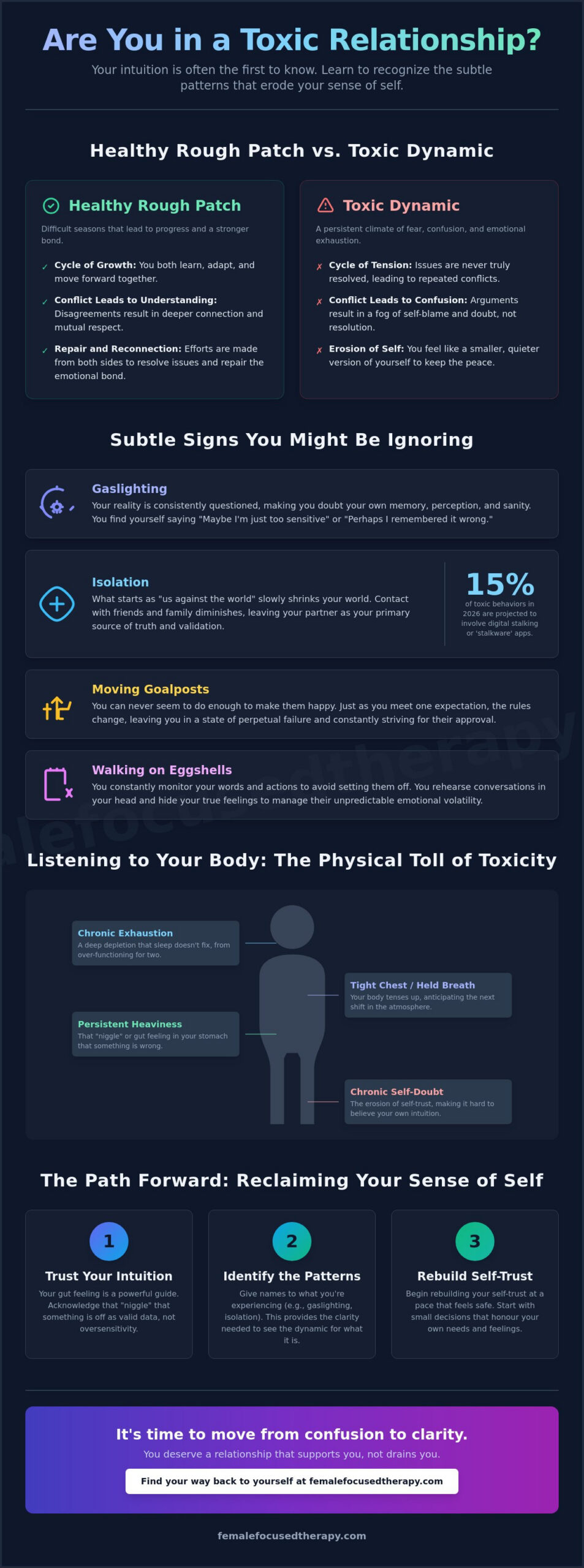
I often see high-functioning women confuse “working on a relationship” with simply “surviving” one. Every couple goes through difficult seasons, but a healthy rough patch usually involves a cycle of growth. You both learn, you repair, and you move forward together. In a toxic dynamic, you’re caught in a cycle of tension that never truly resolves.
Healthy conflict leads to a deeper understanding, but toxic conflict leads to a fog of confusion and chronic self-blame. This persistent psychological abuse can be incredibly subtle. It makes you feel like you’re the problem, even when you’re the one doing all the emotional labour to keep things afloat.
When Your Intuition is Telling You Something is ‘Off’
I believe your gut feeling is your most powerful tool, even if it feels a bit quiet or muffled right now. You might feel a “niggle,” that tiny, persistent voice suggesting things aren’t as they seem. We often talk ourselves out of our own truth just to keep the peace or avoid a confrontation that we know will be turned back on us.
If you’re constantly questioning your own memory or reality, it’s a sign that your boundaries are being crossed. Your body often registers this before your mind is ready to name it. That tight feeling in your chest or the way you hold your breath when they walk into the room is your intuition trying to speak to you. It’s safe to start listening again.
Recognising the Patterns: Subtle Signs You Might Be Ignoring
I’ve noticed that toxicity in adult relationships often hides behind a mask of ‘concern’ or ‘jokes’ that leave you feeling unsettled. It isn’t always about a visible explosion. Sometimes it’s the slow, quiet drip of being told you’re too sensitive or that you’re remembering things wrong. If you’re asking “am I in a toxic relationship,” it’s often because these patterns have already begun to blur your sense of reality.
Gaslighting is one of the most damaging patterns I see. It’s when your partner questions your reality so consistently that you stop trusting your own memory. You might find yourself checking old texts or asking friends for confirmation because your own perception feels shaky. You can learn more about relationship trauma and narcissistic abuse to see how these tactics are used to maintain control.
Isolation often starts as something romantic, framed as ‘just the two of us against the world.’ Over time, your world narrows. You might notice you’ve stopped seeing friends or family because it’s easier than dealing with your partner’s subtle disapproval. Digital monitoring is also on the rise, with 15 percent of toxic relationship behaviours in 2026 involving digital stalking or ‘stalkware’ apps. It’s a way of keeping you tethered to them as your only source of truth.
Then there are the ‘moving goalposts.’ It’s that exhausting feeling that you can never quite do enough to make them happy. Just as you think you’ve met their latest demand, the rules change. This leaves you in a state of perpetual failure, which is a common tactic used to keep you working harder for their approval while your own needs go unmet.
Walking on Eggshells and Emotional Volatility
Do you find yourself rehearsing conversations in your head before you speak? This is a clear sign of walking on eggshells. You’re trying to predict every possible reaction to avoid a blow-up. This constant mood-monitoring keeps your nervous system in a state of high alert, never allowing you to truly rest or feel safe in your own home.
The Silent Treatment and Conditional Love
The silent treatment is a particularly painful tool used to punish you for setting a boundary. It creates a feeling that affection is a reward for compliance rather than a baseline of the relationship. I want you to know that love should never feel like a performance you have to win. If you feel ready to explore these patterns in a safe space, you can book a session with me to find some clarity.
The ‘Over-Functioning’ Trap: Why Intelligent Women Stay
I work with so many high-functioning women who apply their brilliant ‘fix-it’ mindset to a broken relationship. You’re used to solving problems at work, managing complex schedules, and being the person everyone relies on. It’s only natural that you’d try to apply those same skills to your partnership, believing that enough effort can bridge any gap.
This is what I call the over-functioning trap. You start taking 100 percent of the responsibility for the relationship’s success. You might think that if you can just explain your needs more clearly, or find the right book, or try just a little bit harder, they will finally understand. In a healthy partnership, responsibility is a shared weight; in a toxic one, you’re carrying it all alone.
If you’re asking “am I in a toxic relationship,” consider how often your empathy is weaponised against you. Because you can see their “wounded child” or understand their past trauma, you excuse behaviours that hurt you. Your partner knows you’ll keep trying, which effectively gives them permission to stay exactly as they are while you burn yourself out for both of you.
The Hope of ‘Potential’ vs. the Reality of Today
It’s very easy to fall in love with who someone could be rather than who they are showing you they are right now. You’re holding onto a future version of them that only exists in your imagination. I often ask my clients a difficult but necessary question: if nothing changed for the next five years, could you survive this? It’s a sobering thought that cuts through the noise.
The ‘sunk cost’ fallacy often keeps us tethered to situations that no longer serve us. You think about the years you’ve already invested and the life you’ve built together. You might feel like leaving would mean all that effort was for nothing. But staying based on past investment rather than current happiness only increases the price you pay with your own wellbeing.
ADHD and the Intensity of Toxic Cycles
For my neurodivergent sisters, these cycles can be incredibly intense. The dopamine ‘highs’ of a toxic reconciliation can be addictive to a brain that craves stimulation. When you’re understanding ADHD and emotional intensity, you see how the ‘break up and make up’ cycle provides a rush that temporarily masks the underlying damage.
Rejection sensitivity (RSD) also plays a huge role here. The fear of a breakup or the perceived rejection from a partner can feel physically painful, like a wound that won’t heal. This can make you stay much longer than you should, as the temporary relief of staying feels safer than the visceral agony of being ‘rejected’ or being alone.
Listening to Your Body: The Somatic Toll of Toxicity
I believe your body often knows the truth before your mind is ready to accept it. You might spend hours debating “am I in a toxic relationship” in your head, while your physical self has already reached a verdict. Have you noticed a tight chest or a heavy stomach the moment you hear their key in the door? That isn’t just stress; it’s your nervous system sounding an alarm.
When you’re in a damaging environment, your body can become permanently stuck in ‘fight or flight’ mode. This leads to a state of physical exhaustion that sleep simply cannot fix. Your adrenal system is constantly taxed, leaving you feeling depleted and foggy. Trauma-informed therapy helps you reconnect with these physical signals, teaching you to trust what your body is telling you.
The Nervous System in a Toxic Environment
I often see the ‘freeze’ response in women who have been over-functioning for years. You might feel numb or find yourself unable to make simple decisions, like what to eat for dinner. This paralysis is common when you’re constantly asking “am I in a toxic relationship” but feel too drained to answer. It’s as if your brain has gone offline to protect you from the constant emotional noise.
Chronic stress also manifests as physical ailments that doctors often can’t find a clear cause for. You might suffer from frequent headaches, digestive issues, or a jaw that’s always clenched. These are somatic expressions of a boundary that’s being repeatedly crossed. Your body is trying to communicate the distress that your mind is trying to rationalise away.
I encourage you to take a slow breath right now and just notice where you feel tension in your body. Is it in your shoulders? Your throat? Acknowledging these sensations without judgement is the first step toward reclaiming your physical space. It’s about learning to feel safe in your own skin again.
Finding Stillness Amidst the Chaos
Rest is a radical act of self-care when you’ve spent years in survival mode. It’s not just about lying down; it’s about giving your nervous system permission to stand down. I use somatic movement and yoga for healing to help women process the ‘stuck’ emotions of relationship trauma.
Gentle movement allows you to move through the physical memory of the stress without needing to find the perfect words for it. It creates a bridge back to yourself, helping you release the heavy stomach and the tight chest. This mind-body reconnection is vital because healing happens in your cells just as much as it happens in your thoughts.
If you feel ready to start this reconnection in a professional, safe space, you can explore individual therapy options with me. We can work together at a pace that feels sustainable for your body and your mind, helping you find the calm you’ve been missing.
Reclaiming Your Sense of Self: The Path Forward
I want to reassure you that healing is entirely possible. It starts with a single, quiet step toward yourself. If you’ve been asking “am I in a toxic relationship” for a long time, the path forward can feel daunting. It’s really about reclaiming the parts of you that were tucked away just to keep the peace.
The journey of rebuilding self-trust is a gentle, unhurried process. It involves learning to listen to your ‘yes’ and your ‘no’ again without needing to justify them to anyone else. This reconnection is the foundation of your recovery. You are essentially learning to become a safe person for yourself once more.
Setting boundaries isn’t about trying to change their behaviour or forcing them to see your point of view. It’s about protecting your own peace and deciding what you will no longer tolerate in your emotional space. You can find out more about how I work with women in Singapore and online to help you navigate this transition with clarity.
I often see women who feel guilty for wanting to leave or for finally saying enough is enough. Please know that choosing your wellbeing is never a selfish act. It is a necessary one. Rebuilding your life after toxicity requires patience, but the sense of freedom on the other side is worth every step.
Choosing Your Support System
It’s important to have a confidential, professional space where you don’t have to ‘manage’ anyone else’s feelings. While friends mean well, they often want to ‘fix’ the situation or offer immediate advice. This can sometimes feel like another form of pressure when you’re already overwhelmed.
A therapist holds space for you without an agenda. I am here to support you at a pace that feels safe and sustainable for you personally. In our sessions, your experience is the only one that matters. You don’t have to worry about being “too much” or making me feel uncomfortable with your truth.
One Realistic Next Step
I don’t expect you to have all the answers today. Healing doesn’t happen in a single leap; it happens in small, manageable moments. A simple exercise I often suggest is to write down three times this week you felt ‘drained’ and three times you felt ‘light’. This helps you start recognising your own internal compass again.
If you’re still wondering “am I in a toxic relationship,” consider booking a quiet, no-pressure consultation. It’s an opportunity to just be heard and to see if my approach feels right for you. There is no urgency. We can simply start by acknowledging where you are right now and where you’d like to be.
Finding Your Way Back to Your Own Truth
Asking “am I in a toxic relationship” is often the hardest part of the journey. It requires a brave admission that your current reality isn’t supporting the woman you know yourself to be. We’ve explored how toxicity hides in subtle patterns and how your body carries the weight of this stress long before your mind is ready to act. You’ve learned that over-functioning isn’t a solution; it’s a trap that keeps you tethered to a version of a person who may never truly appear.
As a Registered Integrative Psychotherapist with years of experience in relationship trauma, I use a trauma-informed, female-focused approach to help you navigate these complex emotions. Whether you see me for in-person sessions in Singapore or we connect online globally, my goal is to provide a safe space where you can finally stop managing others and start listening to yourself.
Book a confidential consultation with me to begin your journey of reclaiming your self-trust. You don’t have to carry this heavy burden alone anymore. There is a version of you waiting on the other side of this clarity, and she is worth the effort it takes to find her.
Frequently Asked Questions
Can a toxic relationship ever become healthy again?
It is only possible if both partners are fully committed to individual change and professional support. Toxicity is usually a fixed pattern of power, and it doesn’t shift just because one person works harder. If your partner isn’t taking full accountability for their actions, the cycle will likely continue. Real change requires a sustained, visible shift in behaviour over a long period, not just temporary apologies after a conflict.
What is the difference between gaslighting and a simple disagreement?
A disagreement is a difference of opinion; gaslighting is a systematic attempt to make you doubt your own perception. In a healthy disagreement, both people can say “I see it differently.” Gaslighting involves your partner telling you that your memory is wrong or that you’re “crazy” for noticing a specific behaviour. It leaves you feeling fundamentally unsettled and unsure of your own mind, which is a key marker of psychological abuse.
Is it my fault if I keep attracting toxic partners?
It is never your fault that someone else chooses to behave in a toxic or abusive way. You aren’t “attracting” them; rather, toxic individuals often target women who have high levels of empathy and a strong “fix-it” mindset. We can work together to understand why your internal alarm system might be muffled. This isn’t about blaming you, but about empowering you to recognise and act on red flags much earlier.
How do I know if I am the toxic one in the relationship?
The fact that you are self-reflecting enough to ask this often suggests you aren’t the source of the toxicity. If you’re asking “am I in a toxic relationship” because you’ve started acting out of character, you might be experiencing reactive abuse. This is a survival response to prolonged stress. In therapy, we can look at these reactions with compassion and help you find a way back to your grounded, authentic self.
What should I do if I feel unsafe but I’m not ready to leave yet?
Your immediate safety is the most important thing, even if you aren’t ready to end the relationship. I recommend reaching out to local domestic violence resources to create a confidential safety plan. It’s helpful to know that legislative protections are increasing; for instance, Tennessee’s Savanna’s Law became effective on 1 January 2026 to track repeat offenders. You deserve to feel safe in your own home while you navigate your next steps.
How does narcissistic abuse differ from a ‘normal’ toxic relationship?
Narcissistic abuse is a specific form of psychological manipulation that targets your very identity. While all toxic relationships are exhausting, narcissistic dynamics usually follow a rigid cycle of idealisation, devaluation, and discard. It’s less about a “rough patch” and more about one person using the other for emotional supply. This type of trauma often requires a specialised, trauma-informed approach to help you untangle the deep confusion and rebuild your shattered self-trust.
Can therapy help me if my partner refuses to go to couples counselling?
Individual therapy is actually often more beneficial than couples counselling when navigating a toxic dynamic. You don’t need your partner there to begin answering the question “am I in a toxic relationship” for yourself. Focusing on your own needs allows you to rebuild self-trust without the pressure of managing their reactions. Many women find that individual support provides the clarity they need to set firm, healthy boundaries.
How long does it take to heal after leaving a toxic relationship?
Healing is a non-linear process that happens at its own pace rather than following a strict calendar. For some women, the initial relief is followed by a period of deep exhaustion as the nervous system finally exits “fight or flight” mode. It’s common for the body to need more rest as it processes the somatic toll of the relationship. I support my clients in moving through this at a pace that feels safe and sustainable.

Article by
Cheryl Kennedy MacDonald MA BA (Hons) Pg. Dip. SAC BACP
Cheryl Kennedy MacDonald is a psychotherapist specialising in women’s mental health, relationships, and life transitions. She works with women navigating trauma, relationship breakdown, identity shifts, and midlife change, helping them rebuild self-trust, emotional stability, and a clear sense of who they are and what they want.
With over 20 years’ experience working with women internationally, Cheryl is the founder of YogaBellies, a global women’s yoga school, and the creator of the Birth ROCKS method. Her work sits at the intersection of psychotherapy and embodiment, integrating evidence-based therapeutic approaches with somatic, body-based practices that support deep, lasting change.
Known for her grounded and direct approach, Cheryl moves beyond surface-level insight to address the patterns held in the body and nervous system. Her work supports women to regulate, reconnect, and respond to their lives from a place of clarity, strength, and self-respect.
She is a published author in academic journals and has written multiple books on women’s health, pregnancy, and midlife wellbeing, available on Amazon and leading book retailers worldwide.