
You’re sitting across from your partner after another argument about a missed chore or a forgotten date, and that familiar voice in your head starts whispering that you’re just “too much” to handle. I know that heavy exhaustion when you try so hard to meet traditional expectations, only to feel like your brain is constantly working against you. It’s easy to feel like a burden when you’re simply trying to navigate a world that wasn’t built for your unique rhythm.
Understanding the impact of adhd in women on relationships is often the first step toward healing the rift between who you are and who you feel you “should” be. I want to help you see that your struggles are neurological, not character flaws. I’ll guide you through how your neurodivergent brain shapes your connections and show you how to move from a place of deep shame into a space of genuine, lasting intimacy.
I’ll share why emotional volatility and chronic overwhelm happen and how you can communicate your needs without the weight of guilt. You’ll discover that a healthy, balanced relationship isn’t just a dream; it’s a possibility when you start working with your brain instead of against it.
Key Takeaways
- Understand why your exhaustion is neurological rather than a character flaw, helping you release the heavy weight of “trying harder.”
- Identify how Rejection Sensitive Dysphoria (RSD) triggers a physical reaction to criticism so you can find calm during difficult conversations.
- Learn about the impact of adhd in women on relationships and how to stop the “parent-child” cycle from draining the romance from your life.
- Access simple communication scripts and dopamine-friendly date ideas designed to foster novelty and deeper mutual respect.
- Discover how a mind-body approach to therapy helps you move from internalised shame toward a place of genuine, lasting intimacy.
Understanding the invisible weight of ADHD on your heart
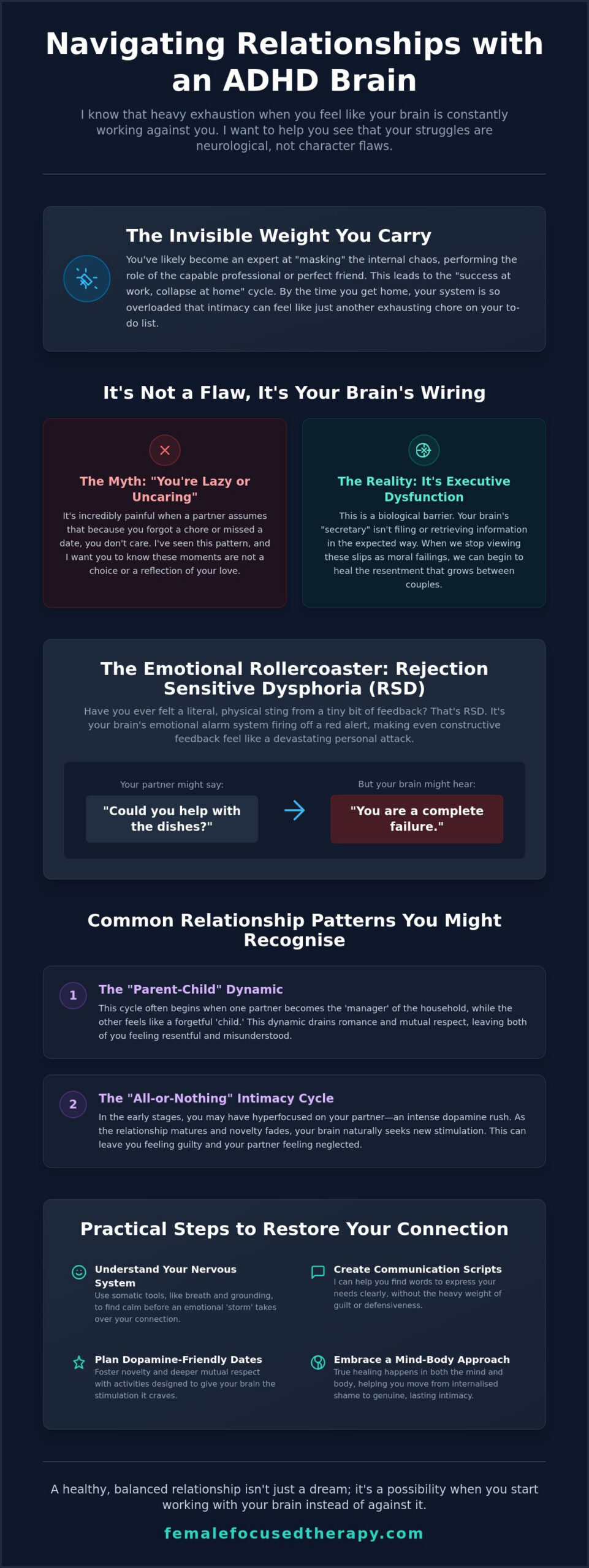
I want to start by acknowledging how utterly exhausted you probably feel. For years, you’ve likely been told to just “try harder” or “get a planner,” but I know that you’re already trying harder than everyone else in the room. The impact of adhd in women on relationships often begins with this silent, internal struggle that your partner might not even see. You’re carrying a heavy weight of expectation that your brain simply isn’t wired to meet in the traditional way.
While many still think of Attention deficit hyperactivity disorder as a condition for young boys who can’t sit still, for us, it often manifests as a relentless internal chaos. It’s the feeling of having fifty browser tabs open in your mind at once, all playing different music. You’ve likely become an expert at “masking” this chaos, performing the role of the capable professional or the perfect friend, only to find you’ve nothing left for the person you love most when you finally get home. This masking leads to a deep, soulful burnout that can make intimacy feel like just another chore on your list.
The ADHD relationship gap is a mismatch of neurological expectations, not a lack of love.
The myth of the ‘lazy’ or ‘uncaring’ partner
It’s incredibly painful when a partner assumes that because you forgot to put the laundry in the dryer or missed a significant date, you don’t care about them. I’ve seen this pattern play out in my own life and in my work with women in ADHD-focused therapy. These moments aren’t a choice; they’re the result of executive dysfunction. This is a biological barrier where your brain’s “secretary” isn’t filing or retrieving information correctly. When we stop viewing these slips as moral failings, we can begin to heal the resentment that often grows between couples.
Why high-functioning women struggle the most
Many of the women I support are high-achievers who manage complex careers and families, yet they feel like they’re failing behind closed doors. You might experience the “success at work, collapse at home” cycle, where you spend every ounce of cognitive energy staying organised in public. By the time you reach your front door, your system is completely overloaded. This pressure to “do it all” creates a resentment loop where your partner feels neglected and you feel deeply misunderstood. I want you to see your struggle not as a character flaw, but as a clear sign of an overloaded system that deserves rest and compassion.
The emotional rollercoaster: RSD and regulation
Have you ever felt a literal, physical sting when your partner offers a tiny bit of feedback? It’s like a sudden, sharp ache in your chest or a hollow feeling in your stomach. This is often Rejection Sensitive Dysphoria (RSD), a central but often unnamed player in your relationship. It makes the impact of adhd in women on relationships feel like a constant state of high alert, where even the smallest perceived slight can feel like a devastating blow to your self-worth.
This emotional lability can lead to “stormy” dynamics that feel completely out of your control. One moment you’re enjoying a quiet evening, and the next, you’re caught in a spiral of defensiveness or withdrawal. My approach to ADHD therapy focuses on helping you understand these intense spikes. We work together to find somatic tools, like breath and grounding, to calm your nervous system before the “storm” takes over your connection.
When ‘constructive feedback’ feels like a personal attack
It’s incredibly difficult to hear a partner’s request when your brain interprets “could you help with the dishes?” as “you are a complete failure.” I want to offer a gentle perspective; your reaction isn’t “dramatic” or “sensitive.” It’s actually your amygdala, the brain’s emotional alarm system, firing off a red alert. In an ADHD brain, this alarm is often hypersensitive, signalling a life-threatening emergency during mundane conversations. Understanding this biological quirk can help you move away from defensiveness and toward self-compassion.
The ‘All or Nothing’ approach to intimacy
In the early stages of dating, you likely hyperfocused on your partner, making them your primary source of dopamine. Everything felt electric and intense. However, as the relationship matures and the novelty fades, your brain might naturally start looking for the next hit of stimulation elsewhere. This shift can leave you feeling guilty and your partner feeling neglected. An Exploration Into the Experience of Romantic Relationships highlights how these shifts in attention are a common part of the neurodivergent experience.
Maintaining a connection when the initial spark settles requires intentionality. You can chase that dopamine together by trying new activities or changing your routine. If you feel stuck in these “all or nothing” patterns and want to find a more stable middle ground, you might find it helpful to book a session with me to explore your unique relationship rhythm.
Common relationship patterns and how to break them
One of the most painful patterns I see in my practice is the ‘Parent-Child’ dynamic. It happens so subtly. One partner takes on the mental load of the household, becoming the ‘nag’, while you end up feeling like the ‘naughty child’ who can’t quite get things right. This shift isn’t just about who does the dishes; it’s a fundamental erosion of mutual respect.
When you feel like you’re being managed rather than loved, sexual attraction often evaporates. It’s hard to feel desire for someone you feel you’re constantly disappointing or who treats you like a project to be fixed. The impact of adhd in women on relationships is particularly sharp when there’s a history of relationship trauma.
If you’ve been with an unsupportive partner who used your neurodivergence against you, the shame can feel insurmountable. I’ve found that traditional couples therapy often misses the mark here. If the therapist isn’t neuro-informed, they might suggest tools that work for neurotypical brains but feel like a setup for failure for you. We need to look at the brain first, not just the behaviour.
The ‘Nag-Withdraw’ cycle
Friction usually starts with the small things like the pile of mail, the forgotten bin day, or the budget that won’t stay balanced. When your partner nags, your brain might actually ‘tune out’ as a survival mechanism. It’s a response to sensory and emotional overload, not a lack of caring.
I often suggest moving away from ‘fixing’ the ADHD partner and toward collaborative problem-solving. It’s about building a system that supports both of you, acknowledging how ADHD is more challenging for women due to the heavy social expectations we carry. The impact of adhd in women on relationships means we often work twice as hard just to feel ‘normal’ in our own homes.
Sensory overload and physical intimacy
Intimacy is another area where your neurodivergent brain plays a huge role. After a day of being ‘on’, managing work, kids, or even just the noise of the world, touch can feel ‘too much’. You might find yourself flinching when your partner tries to hug you, not because you don’t love them, but because your nervous system is overstimulated.
It’s vital to validate the need for ‘sensory breaks’. This isn’t a rejection of your partner; it’s a way to reset so you can actually enjoy their presence. These sensory issues often amplify during life transitions. I see this frequently during menopause, where hormonal shifts make the world feel even louder and touch even more intense.
Practical steps to restore your connection and yourself
I want to give you some concrete tools to shift the dynamic in your home. We’ve talked about the patterns, but how do we actually change the day-to-day impact of adhd in women on relationships? It starts with changing how you communicate your internal experience to your partner. Instead of saying “I forgot,” try: “My brain didn’t file that information today, can we use a shared reminder?” Or, when you’re overwhelmed: “I love you, but I’m hit with sensory overload and need ten minutes of quiet so I can be present with you.”
We also need to look at how you spend time together. Traditional “dinner and a movie” can sometimes feel under-stimulating or even stressful if you’re struggling to sit still. I always encourage “dopamine-friendly” dates that involve novelty or movement. Try a pottery class, a hike, or even a scavenger hunt in a new part of town. These activities engage your brain’s reward system, making it easier to connect without the pressure of forced, stationary conversation.
In my work, I often combine therapy with somatic movement and rest. This helps you get out of your head and back into your body.
Rest is not a reward for productivity; it is a neurological necessity for the ADHD brain to function in love.
Creating a neuro-inclusive home
The power of somatic grounding
When you feel a Rejection Sensitive Dysphoria (RSD) spike coming on, your body usually knows before your mind does. You might feel your heart race or your jaw tighten. Simple breathwork, like exhaling twice as long as you inhale, can signal to your nervous system that you’re safe. Movement is also a wonderful way to process the “stuck” energy that lingers after a relationship argument. A simple stretch or a short walk can help move that “fight or flight” energy out of your muscles.
A quick mind-body check-in before a difficult talk can change everything. If you’re feeling overstimulated, it’s okay to postpone the chat until you’ve had a moment to ground yourself. If you’re ready to move beyond just “coping” and want to build a relationship that truly honours your neurodivergence, you can book a session with me here to start that journey.
Finding a safe space to heal and grow
I want you to take a deep breath and let it out slowly. After exploring the impact of adhd in women on relationships, you might feel a mix of relief and a little bit of sadness for your younger self. It’s a lot to process. My ADHD-focused therapy is designed to be a soft landing place for these feelings, where we can look at your life through a lens of compassion rather than judgment.
We use an integrative approach that honours both your neurodivergent wiring and your unique trauma history. Many women I work with have spent years being told they are “difficult” or “too much” in their partnerships. We work together to peel back those labels and look at how your brain actually functions in the real world. This isn’t about fixing you; it’s about helping you find a rhythm that feels sustainable and kind.
You are not broken. I see so many women who arrive in my practice feeling like they’ve failed at being a partner because they can’t meet neurotypical expectations. You don’t need a “fix”; you simply need a different map for navigating a world that wasn’t built for your specific speed. We look at the impact of adhd in women on relationships as a puzzle to solve together, finding tools that actually work for your life.
If you’re not quite ready for a full session yet, that’s perfectly okay. I invite you to explore my free therapy resources as a gentle first step. These are designed to give you a bit of space to breathe and reflect on your own terms.
Working with a therapist who ‘gets’ it
There is something powerful about working with someone who truly understands the internal noise of ADHD. My own ADHD journey informs every part of my practice, and I know the specific exhaustion that comes from a lifetime of masking. In our sessions, we focus on your strengths and your innate wisdom rather than just a list of deficits. We work on rebuilding your self-trust, helping you listen to your own intuition after years of being told your perspective was “wrong.”
We don’t just talk about planners and schedules. We look at the somatic side of your experience, exploring how your body feels when you’re overwhelmed and finding ways to bring you back to a state of calm. This mind-body connection is vital for restoring your internal confidence and helping you feel grounded in your relationship.
Your next step toward restoration
Healing doesn’t have to be a giant leap that leaves you feeling even more overwhelmed. It can start with one small, realistic action today. Perhaps that’s just giving yourself five minutes of intentional rest without any screens or expectations. It could be as simple as noticing when your jaw is tight and choosing to soften it. These tiny moments of self-care are the building blocks of a more compassionate life.
When you feel ready for deeper, personalised support, you can book a consultation with me. We can chat about your experiences and see if we’re a good fit to work together. You are worthy of a love that understands you, and you are worthy of a relationship where you can truly be yourself without the weight of shame.
Restoring your heart and your home
You’ve spent a long time feeling like you’re failing at love because your brain works differently. We’ve explored how the impact of adhd in women on relationships often shows up as invisible exhaustion and emotional storms. But knowing that your struggles are neurological, not moral, is where your real healing begins. By using somatic grounding and neuro-inclusive communication, you can start to move away from the “parent-child” dynamic and back toward a partnership of equals.
As a Registered Integrative Psychotherapist and specialist in ADHD and relationship trauma, I bring both professional expertise and my own lived experience as a woman with ADHD to our work. I know how heavy the shame can feel, and I know how to help you find your way back to yourself. You don’t have to navigate this journey alone, and you don’t have to keep “trying harder” in a system that wasn’t built for you.
Book your consultation with me to start your journey toward a neuro-inclusive relationship. Take a moment today to simply breathe and acknowledge how hard you’ve been trying. You’re worthy of a connection that honours your unique wiring, and I’m here to help you find it.
Frequently Asked Questions
How do I explain my ADHD symptoms to my partner without making excuses?
You can explain your symptoms by focusing on the biological reality of how your brain processes information differently rather than just listing what went wrong. I often suggest using “I” statements that describe the neurological barrier, such as “My brain struggled to prioritise that task today,” while still taking responsibility for finding a solution together.
It’s about showing your partner that your actions aren’t a choice or a lack of affection. When you shift the conversation from character flaws to brain wiring, it allows both of you to tackle the problem as a team rather than as opponents.
Can ADHD cause me to fall out of love more easily?
ADHD doesn’t necessarily make you fall out of love, but the transition from the intense “spark” of a new relationship to a stable, long term partnership can feel more jarring for a dopamine-seeking brain. When the initial novelty fades, you might feel a sense of boredom or restlessness that you mistake for a loss of love.
I’ve found that many women I work with simply need more intentional novelty to keep their connection feeling “bright.” Understanding this need for stimulation can help you and your partner find ways to keep the relationship engaging without questioning your fundamental commitment.
Why do I get so angry or upset when my partner gives me feedback?
You likely experience an intense reaction because of Rejection Sensitive Dysphoria (RSD), which causes your brain to perceive even minor feedback as a devastating rejection. This isn’t you being “dramatic”; it’s a physical survival response where your nervous system feels under threat.
In my practice, I help women recognise the physical sensations that happen just before this “spike” occurs. By catching the feeling early, you can use simple somatic tools to ground yourself before the emotional response takes over the conversation.
Is it possible for two neurodivergent people to have a successful relationship?
Absolutely, and many neurodivergent couples find a deep sense of relief in being with someone who “gets” their internal chaos. You might find that you have a higher level of empathy for each other’s struggles with chores or time management because you’re both living it.
The challenge usually lies in the “double executive dysfunction” where neither partner feels like the “organised one.” By acknowledging these gaps early, you can build a home that relies on external systems and shared calendars rather than expecting one person to be the neurotypical manager.
How can I stop the ‘Parent-Child’ dynamic in my marriage?
Stopping this dynamic requires a shift from “managing” each other to collaborating on a shared system that works for your specific brain. The impact of adhd in women on relationships often means we fall into the “child” role because we feel we can’t keep up with the mental load of the household.
I encourage couples to externalise the problem. Instead of your partner nagging you, let a shared digital app or a visual whiteboard be the “nag.” This restores the balance of power and allows you to be partners again rather than a supervisor and a subordinate.
What should I do if my partner refuses to believe ADHD is real?
If your partner is sceptical, I suggest focusing on the functional impact of your challenges rather than getting stuck on the clinical label. You can say, “I know you’re unsure about the diagnosis, but can we agree that I genuinely struggle with remembering these specific tasks?”
Focusing on the lived experience and the emotional toll it takes on you can sometimes open a door that a medical debate cannot. However, it’s also important to set boundaries around your need for support and validation in your own home.
Does ADHD medication help with relationship problems?
ADHD medication can be a helpful tool for improving focus and emotional regulation, which often softens the impact of adhd in women on relationships by reducing daily friction. When you feel more capable of managing your tasks and your temper, you naturally have more energy for intimacy.
However, medication isn’t a “magic fix” for communication issues or long term resentment. I’ve seen the best results when medication is paired with therapy to help you unlearn the old patterns of shame and rebuild a healthy, balanced connection.
How can I manage sensory overload so I can still enjoy physical intimacy?
Managing sensory overload starts with being honest about your “sensory bucket” and taking proactive breaks throughout the day. If you’ve spent the whole day being touched by children or overwhelmed by office noise, your nervous system might be in a state of “red alert” by bedtime.
I recommend a “sensory reset” before intimacy, such as a quiet bath or five minutes of deep breathing. Communicating your needs to your partner is vital; tell them that you need a moment to ground yourself so that you can actually enjoy their touch rather than flinching from it.

Article by
Cheryl Kennedy MacDonald MA BA (Hons) Pg. Dip. SAC BACP
Cheryl Kennedy MacDonald is a psychotherapist specialising in women’s mental health, relationships, and life transitions. She works with women navigating trauma, relationship breakdown, identity shifts, and midlife change, helping them rebuild self-trust, emotional stability, and a clear sense of who they are and what they want.
With over 20 years’ experience working with women internationally, Cheryl is the founder of YogaBellies, a global women’s yoga school, and the creator of the Birth ROCKS method. Her work sits at the intersection of psychotherapy and embodiment, integrating evidence-based therapeutic approaches with somatic, body-based practices that support deep, lasting change.
Known for her grounded and direct approach, Cheryl moves beyond surface-level insight to address the patterns held in the body and nervous system. Her work supports women to regulate, reconnect, and respond to their lives from a place of clarity, strength, and self-respect.
She is a published author in academic journals and has written multiple books on women’s health, pregnancy, and midlife wellbeing, available on Amazon and leading book retailers worldwide.