
You are standing in the middle of the kitchen, staring into the fridge, and for the life of you, you cannot remember what you were looking for. Perhaps you are in a meeting and a colleague’s name, someone you have worked with for years, simply vanishes into a thick, grey mist. I know that heart-sinking feeling of looking at your keys and wondering where they belong, or the sudden anxiety that perimenopause brain fog is blunting your professional edge.
It feels like your mind has been stuffed with cotton wool, and it is incredibly isolating to feel dimmed down compared to your younger self. I want you to know right now that you are not losing your mind, and you certainly aren’t going crazy. What you are experiencing is a very real physiological transition where your brain is changing how it processes energy.
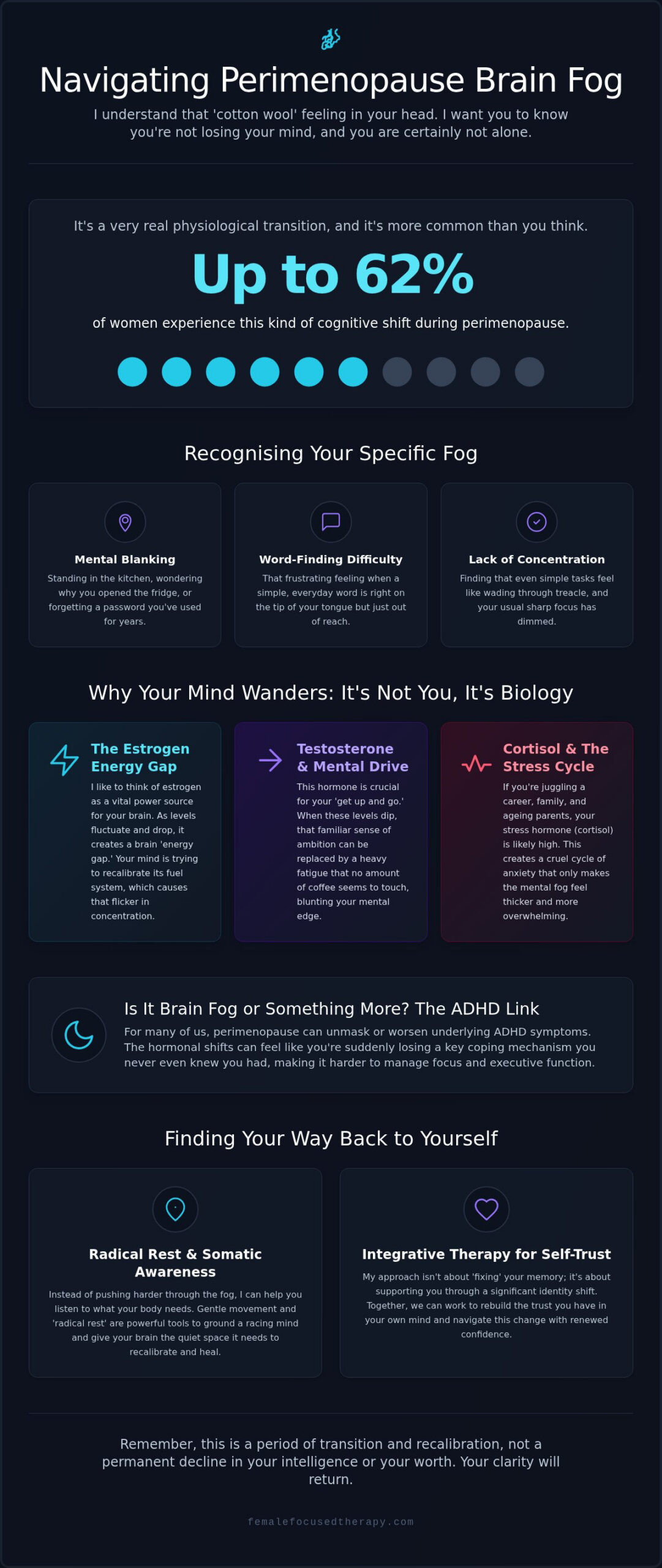
Statistics suggest that up to 62% of women experience this kind of cognitive decline during perimenopause, so you are far from alone. In this post, I will help you understand why your memory feels so fuzzy and how we can use gentle, somatic-informed support to regain your clarity. I will share practical ways to clear the fog and help you restore your confidence in both your professional and personal life.
Key Takeaways
- Understand that the “cotton wool” feeling is a real physiological transition, not a sign that you are losing your mind or developing dementia.
- Discover how fluctuating estrogen affects your brain’s energy supply and why perimenopause brain fog is a temporary shift in how your cells process fuel.
- Learn how this life stage can often unmask or worsen ADHD symptoms and how to tell the difference between various cognitive changes.
- Explore how I use somatic movement and “radical rest” to help you ground a racing mind and clear the mental mist.
- Find out how integrative therapy can support you in rebuilding self-trust and navigating this significant identity shift with renewed confidence.
Does Your Brain Feel Like Cotton Wool Lately?
I want to start by telling you that the fuzzy, disconnected feeling you are experiencing is real. You aren’t imagining it, and you certainly aren’t alone in this. Perimenopause brain fog is a temporary cognitive shift caused by fluctuating hormones that impacts how your brain functions day-to-day.
You might find yourself standing in the middle of the kitchen, wondering why on earth you opened the cupboard, or perhaps you’re staring at your computer screen unable to recall a password you’ve used for years. For high-functioning women, these moments are more than just inconvenient; they feel like a betrayal of the sharp, capable person you’ve always been.
When you’ve spent your life being the one who remembers everything for everyone, this sudden “dimming” feels incredibly distressing. It’s common to feel like your mental edge has been blunted, leaving you feeling vulnerable in spaces where you used to feel most confident.
The Emotional Weight of Forgetting
In my practice, I often talk with women who feel a deep sense of shame when they experience a cognitive blip during a high-stakes meeting. It isn’t just about the forgotten word; it’s the fear that others will think you’re no longer competent. This often triggers a terrifying worry that you might be facing early-onset dementia.
This fear creates a cruel cycle of anxiety. When we are anxious, our bodies produce cortisol, which only makes the clouding of consciousness feel even thicker. Many women I support feel they are losing their identity, as if the very things that define them, like their wit or their reliability, are slipping away. It’s a heavy emotional burden to carry while you’re simply trying to get through your to-do list.
Recognising Your Specific Fog
Not all fog looks the same, and identifying your version can be the first step toward feeling grounded again. For some, it is a frustrating “word-finding” difficulty where a simple noun sits just out of reach. For others, it is a general lack of concentration that makes even simple tasks feel like wading through treacle.
There is a distinct difference between actual memory loss and this “dimming” of mental energy. You might feel like your brain is “full” or “noisy” even when you’ve done very little. This perimenopause brain fog often feels like being perpetually overwhelmed by the data of daily life, leaving you with no room to think clearly or make decisions with your usual ease.
The Science of Why Your Mind is Wandering
To understand why your thoughts feel like they are slipping through your fingers, we have to look at what is happening under the hood. I like to think of estrogen as a vital power source for your brain cells. It is the hormone that helps your neurons grab hold of glucose and turn it into the energy you need to think, focus, and remember.
During perimenopause, your estrogen levels begin to fluctuate and eventually drop. This creates what researchers often call a brain energy gap. Your brain is essentially trying to recalibrate its entire fuel system while it is still expected to perform at 100%. It is a bit like trying to switch a car engine from petrol to electric while you are driving down the motorway.
This biological shift is why you might experience perimenopause brain fog alongside hot flushes. Both symptoms often stem from the same metabolic struggle within the brain. It is helpful to remember that this is a period of transition and recalibration, not a permanent decline in your cognitive abilities or your intelligence.
We also need to consider the impact of falling testosterone. While we often think of it as a male hormone, it is crucial for a woman’s mental drive and her “get up and go.” When these levels dip, that familiar sense of ambition and focus can feel replaced by a heavy, physical fatigue that no amount of coffee seems to touch.
If you feel like your brain is working twice as hard just to stay in the same place, reaching out for professional support can help you navigate these changes without feeling like you are doing it alone.
Estrogen and the Brain Energy Gap
When the brain can’t access glucose as easily, it has to find alternative energy sources. This transition can be clunky and slow, leading to those moments where your mind simply goes blank. It’s a physiological “flicker” in the power supply that affects your concentration and your ability to process complex information quickly.
The Role of Cortisol and Stress
Many of the women I work with are part of the “sandwich generation.” You are likely juggling the needs of growing children and ageing parents while maintaining a demanding career. This constant pressure keeps your cortisol levels high, which acts like static on a radio line, making it hard for your brain to tune into short-term memories.
When you feel emotionally overwhelmed, your brain can sometimes “shut down” as a protective measure. It is its way of saying it has no more capacity to process data. This isn’t a failure of your character; it’s a physiological response to a system that is currently overtaxed by both your hormones and your life circumstances.
Is It Brain Fog, ADHD, or Something Else?
I hear this question so often in my therapy room: “Am I developing early-onset dementia?” It is a terrifying thought that can keep you awake at night, but I want to reassure you right now. Research shows that over 60% of women experience perimenopause brain fog at some point during this transition. It is a recognized, temporary symptom of hormonal change rather than a sign of permanent cognitive decline.
For many of the women I support, perimenopause doesn’t just bring new symptoms; it “unmasks” or worsens lifelong ones. If you have always felt a bit more scattered or impulsive than your peers, you might find those traits suddenly becoming unmanageable. This happens because dropping estrogen leads to a drop in dopamine, the chemical your brain needs for focus and reward.
If you are noticing these lifelong patterns becoming more intense, you might find my ADHD support page a helpful place to start. We also have to consider the impact of poor sleep. If night sweats are waking you up several times a night, your brain hasn’t had the chance to perform its nightly “clean up,” leaving you feeling sluggish and disconnected the next morning.
The Perimenopause and ADHD Overlap
I work with many neurodivergent women who find this stage particularly challenging. When your dopamine levels are already naturally lower, the hormonal shift feels like a double blow to your system. The coping mechanisms you have used for decades to stay organised might suddenly fail you. This is why many women are first diagnosed with ADHD during their perimenopause years; the effort of masking their symptoms simply becomes too much to bear.
How to Tell the Difference
It helps to look at the specific nature of your forgetfulness. Forgetting where you put your keys or walking into a room and blanking on why you are there are classic hormonal symptoms. In contrast, forgetting what keys are for, or how to use them, would be a reason for a different kind of clinical conversation. Word-finding difficulties, where a common word is on the tip of your tongue but won’t surface, is another hallmark of the hormonal shift.
If you are feeling a lack of concentration or a sense of “dimming,” it is often helpful to consult a professional. Getting a clinical perspective can offer the validation and peace of mind you need to stop the cycle of anxiety. You aren’t “going crazy”; you are simply navigating a complex biological and neurological shift that deserves gentle, expert support.
Restoring Clarity Through Rest and Somatic Awareness
When perimenopause brain fog descends, our natural instinct is often to push harder, drink more caffeine, or try to force our way through the mist. I have found that the most effective way to clear the fog isn’t through more thinking, but through the body. Somatic movement offers a way to ground your system when your mind feels like it is floating away in a grey cloud.
It is about moving from the “noisy” headspace into the physical sensations of your feet on the floor or the rhythm of your breath. This shift doesn’t just feel better; it actually helps settle the nervous system and lowers the background hum of anxiety. You can explore these practices further through Somatic Movement and Yoga, which focus on regulation rather than just exercise.
We also need to embrace the idea of “radical rest.” This is different from just trying to get more sleep at night. Radical rest involves intentional periods of non-doing throughout your day. It gives your brain a chance to go “offline” so it can process the significant energy shifts I mentioned earlier without being bombarded by new data.
Gently Grounding Your System
A simple way to lower cortisol in the moment is through extended exhales. Try breathing in for a count of four and out for a count of six. This sends a direct signal to your brain that you are safe. I often find that a gentle stretch or a slow walk clears the “cobwebs” far more effectively than a third cup of coffee, which often just adds jitters to the fog.
Pacing your mental energy is also vital during this transition. If you know you are sharper in the morning, do your “heavy” thinking then. Save the admin or the gentle, repetitive tasks for when the afternoon fog usually rolls in. Learning to work with your rhythm rather than against it is a form of self-kindness that pays dividends in mental clarity.
Brain-Friendly Habits for Midlife
I live by the “write it down immediately” rule. Don’t trust your brain to hold onto a grocery list or a meeting note right now. Externalising your memory reduces the cognitive load and lowers the pressure you feel to “perform.” It is a practical way to support a brain that is currently busy recalibrating its fuel system.
Multitasking is the absolute enemy of the perimenopausal brain. Try to do one thing at a time, even if it feels slower at first. I also suggest creating a “sensory sanctuary” at home. This is a quiet space with soft lighting and no distractions where you can retreat for ten minutes when the world feels too loud or overwhelming.
If you are feeling overwhelmed by these changes and need a safe space to process the shift, you can book a session with me here to start rebuilding your internal confidence and clarity.
Finding Your Way Back to Yourself
Living with perimenopause brain fog is about so much more than just a few forgotten names or misplaced keys. It is a profound shift in how you experience yourself and your place in the world. When the mental sharpness you have always relied on starts to flicker, it can feel like your very identity is under threat.
I believe that psychotherapy is a vital tool for navigating this midlife transition with grace and self-compassion. It provides a dedicated space where you don’t have to “perform” or pretend you have it all together. Through midlife and menopause therapy, we can work together to process these changes and rebuild the self-trust that often gets eroded during this time.
My goal is to help you move from a state of being constantly overwhelmed to a place of feeling restored and grounded. We look at the whole picture, combining emotional support with somatic awareness to help you feel like yourself again. You aren’t broken; you are simply in a season of intense recalibration that requires a different kind of support than you’ve needed before.
Rebuilding Trust in Your Mind
There is often a hidden sense of grief that comes with perimenopause. You might be mourning the version of yourself who was “the sharpest person in the room” or the one who could juggle twenty tasks without dropping a single ball. It is okay to acknowledge that loss. In our sessions, we hold space for that grief while also looking toward what comes next.
I often talk to my clients about the “Second Zest.” This is the period of renewed clarity and purpose that follows the hormonal turbulence of perimenopause. Once your system has finished its recalibration, many women find a new kind of focus that is deeper and more grounded than what they had in their younger years. You can learn more about me and my integrative approach to see if this feels like the right fit for your journey.
A Gentle Next Step
If you are reading this and feeling the weight of the fog, I want to encourage you to stop trying to “fix” yourself today. You don’t need another supplement or a more complex productivity app. Sometimes, the most productive thing you can do is embrace a “rest first” approach, allowing your nervous system to settle before you try to tackle the next big task.
When you feel ready to talk through the mist, I am here to listen. You don’t have to wait until you are “better” to reach out; the best time to seek support is when you are right in the middle of it. You can book a consultation here to find a safe, boundaried space where we can begin finding your way back to yourself together.
Step Into the Clarity of Your Second Zest
I know how unsettling it is to feel like your thoughts are slipping away, but please remember that perimenopause brain fog is a season of change, not a life sentence. We have explored how your brain is simply recalibrating its energy and how somatic grounding can help you find your feet when the world feels too loud. You don’t have to navigate this “dimming” of your mental energy alone or feel like you are losing the essence of who you are.
As a Registered Integrative Psychotherapist specialising in midlife transitions, I offer warm, boundaried, and trauma-informed support to help you reclaim your internal stability. We can work together to process the identity shifts of this life stage and move toward the “Second Zest” that awaits on the other side of this transition. My approach is designed to help you feel seen and understood as you move through these complex biological changes.
If you are ready to stop fighting the mist and start finding your way back to yourself, I invite you to book a consultation to find clarity in the fog. You deserve a safe, compassionate space to talk through what you are experiencing and begin your journey toward restoration. Be gentle with yourself today.
Frequently Asked Questions
Is perimenopause brain fog permanent?
No, perimenopause brain fog is not a permanent state. It is a temporary cognitive shift that happens while your brain recalibrates to changing estrogen levels. For most women, these symptoms resolve once they move through the transition and their system settles into a new baseline. It is a season of change rather than a sign of lasting decline.
Can HRT help with brain fog and memory loss?
Yes, Hormone Replacement Therapy can often help clear the mental mist for many women. By stabilising your estrogen levels, it supports your brain cells in processing energy and maintaining focus. While I don’t prescribe medication, I see many women in my practice who find that combining HRT with integrative therapy helps them regain their mental clarity.
How long does perimenopause brain fog usually last?
The duration varies for every woman, but it is typically linked to the years leading up to and just after menopause. Some find it lasts for a couple of years, while for others, it is a shorter, more intense phase. Focusing on somatic grounding and lowering your cortisol can help make this period feel much more manageable while your body adjusts.
Why do I forget names and words in my 40s?
Forgetting names and words is a very common result of dropping estrogen levels. This hormone is vital for the parts of your brain that handle verbal memory and word retrieval. When levels fluctuate in your 40s, the connection between your thoughts and the words you need can feel momentarily severed. It is a physiological glitch, not a failure of your intelligence.
Can stress and anxiety make brain fog worse during menopause?
Yes, high levels of stress and anxiety definitely thicken the cognitive fog. When you are stressed, your body produces cortisol, which interferes with how your brain retrieves information. In midlife, when you are often juggling career and family, this extra cortisol acts like static on a radio line, making it even harder to think clearly through the hormonal shifts.
Is brain fog a sign of early-onset dementia?
It is very unlikely that your perimenopause brain fog is a sign of dementia. While the symptoms can feel frighteningly similar, this fog is a metabolic transition in the brain, not a permanent structural change. If you are forgetting where you put your keys or why you walked into a room, that is typical of this life stage. A clinical conversation can often provide the reassurance you need.
How can I explain my brain fog to my partner or boss?
I suggest being direct and using the recalibration analogy. You might say, “My brain is currently going through a hormonal transition that affects my short-term recall, so I am writing more things down to stay on track.” Explaining that it is a temporary, physiological shift helps others understand that you aren’t less capable; you are simply adjusting your workflow to support your current needs.
Does ADHD get worse during perimenopause?
Yes, many neurodivergent women find their ADHD symptoms become much more intense during this time. Since estrogen helps regulate dopamine, the drop in hormones can make focus and organisation feel much harder than before. It is common for women to seek support for the first time during perimenopause because their old coping strategies are no longer enough to manage the change.

Article by
Cheryl Kennedy MacDonald MA BA (Hons) Pg. Dip. SAC BACP
Cheryl Kennedy MacDonald is a psychotherapist specialising in women’s mental health, relationships, and life transitions. She works with women navigating trauma, relationship breakdown, identity shifts, and midlife change, helping them rebuild self-trust, emotional stability, and a clear sense of who they are and what they want.
With over 20 years’ experience working with women internationally, Cheryl is the founder of YogaBellies, a global women’s yoga school, and the creator of the Birth ROCKS method. Her work sits at the intersection of psychotherapy and embodiment, integrating evidence-based therapeutic approaches with somatic, body-based practices that support deep, lasting change.
Known for her grounded and direct approach, Cheryl moves beyond surface-level insight to address the patterns held in the body and nervous system. Her work supports women to regulate, reconnect, and respond to their lives from a place of clarity, strength, and self-respect.
She is a published author in academic journals and has written multiple books on women’s health, pregnancy, and midlife wellbeing, available on Amazon and leading book retailers worldwide.