
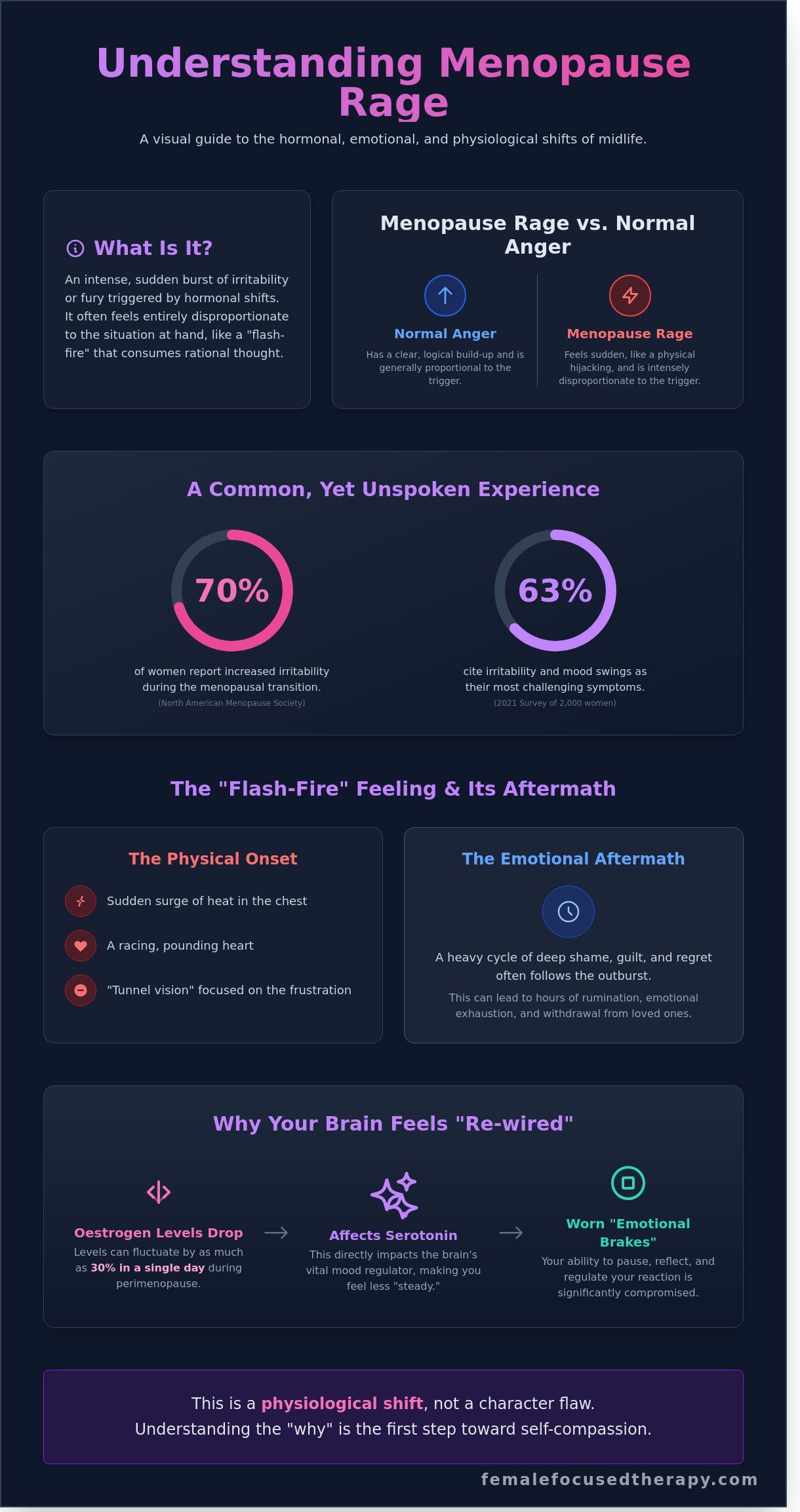
You’re standing in your kitchen after a long day, perhaps just as the evening humidity settles over Singapore, when a small comment from your partner or a misplaced dish triggers a white-hot explosion of fury that feels entirely foreign to who you are. This isn’t just a typical bad mood. It’s the visceral, bone-deep experience of menopause rage that leaves you shaking and, moments later, drowning in a sea of heavy guilt. Data from the North American Menopause Society suggests that up to 70 percent of women report increased irritability during this transition. I know how frightening it is to feel like you’ve lost the steering wheel to your own emotions, especially when you’re already navigating the physical exhaustion of midlife. You aren’t losing your mind, and you certainly aren’t a bad person for feeling this surge of heat.
I want to offer you a compassionate look at why these “flash-fire” moments happen and, more importantly, how you can begin to find your way back to a sense of internal quiet. We will explore the biological link between your shifting hormones and your daily stress levels. I’ll also share practical, gentle ways to soothe your nervous system when you feel that familiar spark of irritability starting to catch. You deserve to feel like yourself again. Understanding the “why” behind the anger is the first step toward rebuilding your self-trust and finding a sustainable pace for your wellbeing.
Key Takeaways
- Understand that menopause rage is a sudden, hormonal response and why it feels so much more intense than regular anger.
- Explore how decades of “emotional over-functioning” and putting everyone else’s needs first can act as the fuel for midlife outbursts.
- Discover the specific link between dropping oestrogen and ADHD, and why your symptoms might feel like they have suddenly doubled.
- Learn gentle, practical grounding techniques to help you create a little more space to breathe when you feel a storm of irritability rising.
- See how a safe, non-judgemental therapeutic space can help you navigate this transition and rebuild your sense of self-trust.
What is menopause rage and why does it feel so overwhelming?
I want to start by acknowledging that sudden, white-hot anger can feel incredibly frightening. You might be a woman who has always been known for your composure, only to find yourself gripped by a fury so intense it feels like a physical hijacking. This isn’t a personality flaw or a sign that you are “losing it.” In my practice, I see many high-functioning women who are deeply distressed by these outbursts, often describing a sensation of being trapped inside a version of themselves they don’t recognise.
When we talk about menopause rage, we are defining an intense, often sudden burst of irritability or fury triggered by significant hormonal shifts. It is quite different from “normal” anger. While typical anger usually has a clear, logical build-up, this specific rage often feels entirely disproportionate to the situation at hand. A 2021 survey of 2,000 women found that 63% cited irritability and mood swings as their most challenging perimenopausal symptoms, yet it remains one of the least discussed aspects of midlife.
This experience is particularly jarring because it is so hard to suppress. I often see women who are shocked by their own behaviour, feeling like they have become a stranger to themselves. Living in a high-pressure environment like Singapore, where we are often juggling demanding careers and family commitments, only adds to the emotional weight. You might find yourself snapping at a colleague or losing your patience with a partner over something minor, leaving you wondering where your “old self” has gone.
The “flash-fire” feeling: Recognising the symptoms
For many, the physical onset of menopause rage is immediate. You might feel a sudden surge of heat in your chest, a racing heart, or a “tunnel vision” effect where the world narrows down to the source of your frustration. It feels like a flash-fire that consumes your rational thought before you have a chance to intervene. This physiological response is your nervous system moving into a state of high alert, often without a genuine external threat.
The emotional aftermath is frequently the hardest part to carry. Once the fire dies down, it is usually followed by a heavy cycle of deep shame or regret. You might spend hours ruminating on what you said or how you acted, leading to a sense of exhaustion. This cycle can impact every corner of your life, from feeling disconnected at work to withdrawing from your loved ones to avoid another “explosion.” Understanding What is menopause? and how it impacts the body is the first step in moving away from self-criticism.
Why your brain feels “re-wired” during midlife
The drop in oestrogen during this transition directly affects your serotonin levels, which are vital for mood regulation and feeling “steady.” Research published in the journal Menopause in 2023 indicates that oestrogen levels can fluctuate by as much as 30% in a single day during perimenopause. These fluctuations hit the brain’s emotional processing centres hard. I often explain to my clients that our “emotional brakes” can feel worn down. When your serotonin is low, your ability to pause and reflect before reacting is significantly compromised.
During this time, it helps to view your feelings through a lens of Female Focused Therapy, where we look at the whole picture of your life. Recognising that this is a physiological shift, rather than a character defect, can help lower the initial wall of self-blame. When you understand that your brain is essentially being re-wired, you can begin to navigate these midlife changes with more compassion for yourself. It is about rebuilding that sense of self-trust that feels so fragile right now.
If you’d like to find out more about working with Cheryl Kennedy MacDonald, you can email her at cheryl@femalefocusedtherapy.com or go ahead and book an appointment here: https://www.femalefocusedtherapy.com/book-now/
The intersection of hormones, history, and the invisible load
While fluctuating oestrogen levels are often the spark for menopause rage, the fuel is usually a lifetime of emotional over-functioning. I find that many high-functioning women I see in my practice have spent decades putting everyone else’s needs before their own. You might have spent years managing your household, excelling in your career, and being the emotional anchor for your family without ever stopping to ask what you actually need.
This self-neglect creates a deep well of resentment that finally overflows when our hormones shift. In Singapore, this pressure is particularly intense. Many women in their 40s and 50s are part of the “sandwich generation,” caring for ageing parents while still supporting children or young adults. When you add the high-stress environment of a global business hub, it’s no surprise that the internal pressure cooker starts to whistle.
I often think of menopause as a truth serum. It makes it impossible to continue ignoring your own boundaries or the ways you’ve been squeezed by the invisible load of domestic and professional life. It forces us to confront the reality of our exhaustion. Instead of seeing this as a breakdown, we can view it as a necessary breakthrough in how we care for ourselves and manage our energy.
The “Good Girl” fallout: Why we stop being polite
From a young age, many of us are taught to be calm, nurturing, and polite. We’re conditioned to keep the peace at all costs. When menopause rage arrives, it can feel like a personal failure or a loss of control because it contradicts everything we’ve been told about how a woman should behave. I encourage you to see this anger as a vital signal rather than a symptom to be suppressed.
It’s an invitation to look at where you’ve been over-extending yourself. Instead of asking “What is wrong with me?”, I invite you to ask “What is this anger trying to tell me?”. Perhaps it’s telling you that you’re exhausted by the S$2,000 monthly grocery bills you manage alone, or the lack of support at work. When we stop being “polite” to our own detriment, we start the process of reclaiming our space.
It’s about moving from self-blame to a place of curious self-enquiry about your own limits and needs. This shift is essential for your long-term wellbeing and mental health. By listening to what your anger says, you can begin to set boundaries that actually protect your energy and help you feel more grounded in your daily life.
When old trauma meets new hormonal shifts
Hormonal changes can sometimes lower our internal defences against past relationship trauma or neglect. I often work with women who find that menopause brings up unresolved feelings from their past that they thought were long buried. Research into the emotional and psychological symptoms of menopause shows that these intense feelings are deeply tied to your physiological state and your unique life history.
If you find that old wounds are resurfacing, individual psychotherapy can help untangle these complex layers in a safe, professional space. We can look at the context of your life together, from the “sandwich generation” pressure to the subtle ways you’ve been taught to ignore your own voice. Understanding these triggers is a crucial step toward reconnecting with your true self and finding a sense of calm that lasts.
Why menopause rage feels different if you have ADHD
If you are a woman living with ADHD, the transition into perimenopause can feel like the volume on your symptoms has suddenly been turned up to a deafening level. Many women I speak with in my practice describe it as their ADHD “doubling” overnight. It is an incredibly taxing experience. You may have spent decades developing clever systems to keep your life on track, only to find those reliable tools no longer support you. I see many women in their 40s and 50s who only receive their ADHD diagnosis during this transition because they can no longer “mask” their struggles through sheer willpower.
Emotional dysregulation is a core part of the ADHD brain that often goes unrecognised until midlife. While younger women might be labelled as “sensitive” or “dramatic,” the hormonal shifts of menopause strip away the ability to internalise those feelings. This is why menopause rage can feel so explosive for neurodivergent women. It is not just a mood swing; it is a neurological response to a brain that is struggling to maintain its equilibrium without its usual chemical support.
I often find that the “stuck” feeling my clients describe is actually a combination of executive dysfunction and hormonal depletion. When you can’t start a simple task or keep track of your keys, the resulting frustration builds up until it boils over. It is a cycle of self-blame that I help women break at Female Focused Therapy, moving away from “why can’t I just do this?” toward a place of self-compassion.
The dopamine-oestrogen connection
Oestrogen plays a vital role in how your brain uses dopamine. It essentially helps your brain’s neurotransmitters stay active for longer, which is why your ADHD symptoms might have felt manageable for years. As oestrogen levels drop during perimenopause, your dopamine levels follow suit. This makes it significantly harder to find that vital “pause” before you react to a situation. Without that split-second buffer, an annoying comment or a minor inconvenience can trigger an immediate, intense burst of menopause rage.
For those taking ADHD medication like Ritalin or Concerta, which are commonly prescribed here in Singapore, you might notice your usual dosage feels less effective. This happens because the medication has less natural dopamine to work with. It is a biological shift, not a failure of character. You can read more about how these layers intersect on my ADHD support page, where I go deeper into the unique ways neurodivergence presents in women.
Finding strategies that work for neurodivergent brains
Traditional advice for menopause often misses the mark for neurodivergent women. Telling someone with ADHD to “just use a planner” or “try to stay calm” isn’t helpful when your nervous system is in a state of sensory overload. In our humid Singapore climate, the physical discomfort of a hot flush combined with the sensory “noise” of a busy office or home can lead to a total system shutdown. What might look like an angry outburst is often actually a sensory meltdown or ADHD overwhelm.
I focus on helping you identify these sensory triggers before they reach a breaking point. We look at how to adapt your environment to reduce the “friction” in your daily life. Whether it is using noise-cancelling headphones or changing how you approach your to-do list, these small shifts make a massive difference. You can learn more about how I support neurodivergent women in who I work with to find tools that actually respect how your brain is wired.
If you’d like to find out more about working with Cheryl Kennedy MacDonald, you can email her at cheryl@femalefocusedtherapy.com or go ahead and book an appointment here: https://www.femalefocusedtherapy.com/book-now/
Practical ways to navigate the storm and find your calm
I want to offer you some gentle, realistic steps to help manage the intensity of these moments. These aren’t about “fixing” you, because you aren’t broken. Instead, we’re looking at creating enough space for you to breathe again. When the pressure builds, having a plan can make all the difference to how you feel.
Managing the physical heat is often the first step in managing the emotional heat. In our humid Singapore climate, a hot flush can quickly spiral into a moment of menopause rage. When your body feels like it’s under attack from internal heat, your brain’s alarm system goes off. Cooling down your physical self is a way to signal to your mind that you’re safe.
We’ll also look at how to communicate with those around you. It helps when they understand what you’re experiencing, rather than just seeing the reaction. This isn’t about making excuses, but about building a bridge of understanding during a difficult transition. At Female Focused Therapy, I often see how much relief comes from simply being able to name the experience.
Immediate tools for the “heat of the moment”
Step 1 is the “Physical Exit.” As soon as you feel the heat rising in your chest or your jaw tightening, leave the room. You don’t need to finish the sentence or win the argument. Just 10 seconds of physical distance can stop the nervous system from reaching a point of no return. You can say, “I’m feeling overwhelmed and need a moment,” then walk away.
Step 2 involves sensory grounding. This is a quick way to reset your nervous system when it feels hijacked. Try running cold water over your wrists for 60 seconds or holding an ice cube. If you’re at home, a weighted blanket can provide the deep pressure your body needs to feel grounded. These physical sensations help pull you out of the “rage fog” and back into the present.
Step 3 is the “Five-Minute Rule.” When you feel a perceived slight or a surge of irritation, commit to delaying your response by 300 seconds. Hormonal spikes are often intense but short-lived. By waiting five minutes, you allow the peak of the chemical surge to pass. Usually, the thing that felt like a 10/10 emergency feels much more manageable once the spike has subsided.
Long-term shifts: Boundaries and self-trust
Learning to say “no” to small things is essential for your wellbeing. If you’re already at capacity, saying yes to an extra task at work or a social obligation is like adding fuel to a fire. I recommend practicing 3 small “no’s” every week. This preserves your energy so you don’t explode at the big things later. It’s about protecting your peace before it’s threatened.
I believe that rebuilding self-trust is the most important part of healing from menopause rage. Many women feel a deep sense of shame after an outburst, which erodes their confidence. Healing starts when you stop blaming yourself and start understanding your physiology. When you trust yourself to handle the “big” feelings, the fear of losing control begins to fade.
Your “menopause toolkit” should be a living thing. It includes prioritising 7 to 8 hours of rest, nourishing your body, and perhaps exploring focused intensive therapy. These tools aren’t just luxuries; they are necessary supports for your mental health. If you feel like you need a dedicated space to process these changes, you can book a session with me here to find your way back to calm.
How therapy provides a safe space for the midlife transition
When you are in the middle of a hormonal storm, it can feel as though you have lost the map to your own personality. You might worry that your family or colleagues see you as “difficult” or “unstable,” which only adds a layer of guilt to the fire. It is important to remember that therapy isn’t about me telling you that your feelings are wrong or that you need to be fixed. Instead, I act as a witness to this profound transition. I provide a confidential, professional space where we can explore the “why” behind your anger without a hint of judgement.
In my practice, we look at the biological reality of what is happening. Research suggests that up to 20 percent of women in Singapore experience significant mood disturbances, including irritability and menopause rage, as they navigate the perimenopausal years. When we name what is happening, the shame begins to lose its power. We work together at a pace that feels sustainable for you, ensuring you don’t feel overwhelmed by the process of healing. This isn’t about rushing toward a “solution,” but about helping you reconnect with the woman you are becoming during this second half of life.
Midlife can be a time of incredible growth and reclamation. Once we move past the heavy shame of the symptoms, we often find a new sense of freedom. You are no longer required to “people-please” or over-function at the expense of your own wellbeing. This transition, while difficult, offers a rare opportunity to rebuild your life on your own terms, rooted in a stronger sense of self-trust and clarity.
Moving from shame to clarity
Many women I work with feel a deep sense of grief for their “old self.” You might miss the patience you once had or the predictable energy levels of your thirties. Talk therapy helps you process this grief rather than pushing it down. We use an integrative approach, combining mindfulness and CBT techniques to help you catch those “rage thoughts” before they take over your afternoon. By focusing specifically on life transitions and menopause, we can create a practical toolkit for your daily life.
This process is about more than just managing menopause rage; it is about understanding the boundaries you may have ignored for decades. When your hormones shift, your tolerance for being undervalued often disappears. We work on communicating these needs clearly, ensuring your relationships evolve alongside you. This clarity allows you to move through Singapore’s high-pressure environment with more ease and less internal friction.
A small, realistic next step for you
You do not have to figure out the next ten years of your life today. In fact, you don’t even have to figure out next week. Just acknowledging to yourself that you are struggling is a brave and vital start. I invite you to be as kind to yourself today as you would be to a dear friend going through the exact same thing. Self-compassion is often the first thing to go when we feel out of control, but it is the most important tool we have for staying grounded.
If you feel like you are constantly walking on eggshells around your own emotions, please know that support is available. You don’t have to carry the weight of this transition alone. Whether you are looking for specific coping strategies or a quiet place to be heard, Female Focused Therapy is here to support you whenever you feel ready to reach out. Taking that first step is an act of profound self-care.
Finding your way back to yourself
You don’t have to carry the weight of this transition alone. We’ve explored how menopause rage is often a signal that your capacity is overstretched. This is especially true when you’re balancing the invisible load of midlife with a brain that might already process the world a bit differently. It’s about more than just hormones; it’s about your history and your need for a safe space to be heard.
As a Registered Psychotherapist with specialised midlife experience, I’ve helped women in Singapore navigate these volatile shifts for over 10 years. My approach is trauma-informed and ADHD-aware, combining professional expertise with my own warm Scottish empathy. We can work together to rebuild your self-trust and find a pace that feels sustainable for your life.
If you’re feeling stuck or exhausted, please reach out. You can learn more about how I work with ADHD in women or visit the Female Focused Therapy homepage. You deserve to feel like yourself again.
If you’d like to find out more about working with Cheryl Kennedy MacDonald, you can email her at cheryl@femalefocusedtherapy.com or go ahead and book an appointment here: https://www.femalefocusedtherapy.com/book-now/
Meta Title: Menopause Rage FAQ: Understanding Midlife Anger | Cheryl
Meta Description: Are you struggling with menopause rage? Learn why it happens, how long it lasts, and how therapy can help you regain control and find calm during midlife.
Frequently Asked Questions
Is menopause rage a real medical symptom or just stress?
Menopause rage is a documented physiological symptom caused by the 90% drop in oestrogen levels that occurs during the transition to midlife. It isn’t just “stress” or a lack of patience on your part. When your hormones fluctuate, your brain’s ability to regulate mood and the “fight or flight” response changes. In my practice, I see many women who feel blindsided by this sudden, intense anger. It’s a real biological shift that requires compassion and support, not self-blame.
How long does the irritability and anger usually last during menopause?
The irritability and anger typically persist through the perimenopause phase, which can last anywhere from 4 to 10 years on average. For most women in Singapore, these feelings peak in the late 40s and begin to subside once they reach post-menopause. However, every woman’s journey is unique. If you feel stuck in this cycle, I can help you navigate these transitions at Female Focused Therapy.
Can menopause rage be a sign of depression or anxiety?
Menopause rage can certainly overlap with depression or anxiety, as hormonal shifts often trigger underlying emotional vulnerabilities. About 20% of women experience new or worsening depressive symptoms during this time. It’s important to look at your overall wellbeing rather than just the anger in isolation. If you’re feeling overwhelmed, therapy offers a safe space to untangle these complex feelings and rebuild your sense of self and confidence.
Will HRT (Hormone Replacement Therapy) stop my anger issues?
Hormone Replacement Therapy (HRT) can be very effective, with approximately 80% of women reporting a significant reduction in mood-related symptoms like menopause rage. While HRT helps stabilise the biological triggers, it doesn’t always “fix” the external stressors or old patterns in your life. Many of my clients find that a combination of medical support and specialised menopause support through therapy provides the most lasting relief and clarity.
How can I explain my menopause rage to my partner and children?
You can explain your feelings to your family by describing them as a temporary “system overload” caused by changing hormones. Try saying, “My body is going through a massive chemical shift right now, and sometimes I feel angry without a clear reason.” Being honest about your experience helps your partner and children understand that your reactions aren’t about them. This honesty can preserve your relationships during what can be a very difficult year for the whole household.
Is it normal to feel like I want to leave my job or relationship during menopause?
It’s incredibly common to feel like walking away from your current life; in fact, a 2023 study found that 1 in 10 women left their jobs due to menopause symptoms. These feelings of wanting to escape often stem from a deep, unmet need for rest and boundaries. Before making life-altering changes, it helps to explore these urges in a professional, non-judgmental space. I can help you determine if these feelings are a temporary symptom or a sign of needed growth.
What is the difference between menopause rage and bipolar disorder?
The main difference is that menopause rage is directly tied to hormonal fluctuations, whereas bipolar disorder involves distinct cycles of mania and depression unrelated to midlife changes. Bipolar disorder usually first appears earlier in life, while menopause symptoms typically start in your 40s. While both involve mood shifts, the “rage” you feel now is likely part of the perimenopausal transition. If you’re concerned, a psychiatrist in Singapore can provide a formal assessment for peace of mind.
Can lifestyle changes like diet and exercise really help with midlife anger?
Specific lifestyle changes like reducing refined sugar and prioritising 150 minutes of weekly exercise can lower cortisol levels and improve your mood. In Singapore’s fast-paced environment, it’s easy to neglect these basics. While diet isn’t a “cure” for menopause rage, supporting your body physically makes it much easier to manage the emotional waves. Small, sustainable shifts in your daily routine can lead to more confidence and a stronger sense of emotional stability.
If you’d like to find out more about working with Cheryl Kennedy MacDonald, you can email her at cheryl@femalefocusedtherapy.com or go ahead and book an appointment here: https://www.femalefocusedtherapy.com/book-now/