
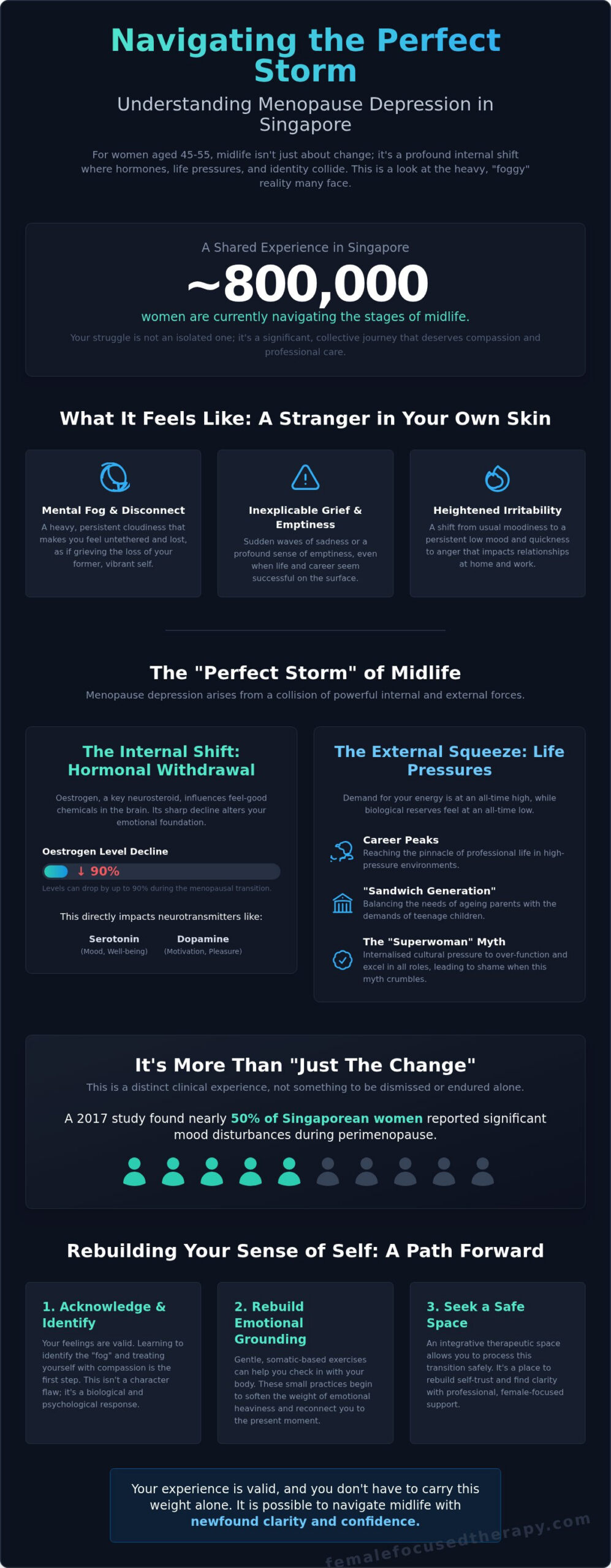
Imagine standing in a bustling FairPrice, staring at a grocery list you’ve written a thousand times, and suddenly feeling a wave of inexplicable grief so heavy you have to grip the trolley to stay upright. For many women in Singapore aged 45 to 55, this isn’t just “stress”; it’s the lived reality of menopause depression. You might find yourself snapping at your partner over small things or feeling a profound sense of emptiness even while your career is at its peak. It’s a disorienting experience that makes you feel like a stranger in your own skin. With nearly 800,000 women in Singapore currently navigating the various stages of midlife, your struggle is a significant, shared experience that deserves professional care.
You’re likely here because you’re tired of being told your feelings are just a phase. It’s exhausting to balance family expectations and professional demands when you feel emotionally hollow inside. I want you to know that your experience is valid, and you don’t have to carry this weight alone. I’ll help you understand the heavy emotional shift of this transition and how we can work together to rebuild your sense of self. We will explore the path toward emotional stability and provide practical tools to help you navigate midlife with newfound clarity and confidence.
Key Takeaways
- Learn to identify the heavy, “foggy” feeling of midlife transitions and why feeling like a stranger to yourself is a valid experience that requires compassion.
- Discover how hormonal shifts intersect with the “perfect storm” of life in Singapore—balancing career peaks with family care—to impact your emotional regulation.
- Understand why menopause depression is a distinct experience that shouldn’t be dismissed as “normal” or something you must simply endure without support.
- Explore gentle, somatic-based grounding exercises that help you check in with your body and begin softening the weight of emotional heaviness.
- Learn how a safe, integrative therapeutic space can help you navigate this transition and rebuild a stronger, more authentic sense of self-trust.
Why You Might Feel Like a Stranger to Yourself
You wake up, but the world feels muted. The vibrant, capable woman you were just a few short years ago seems to have retreated behind a thick, grey veil. For many women in Singapore, this transition isn’t just about physical changes like hot flashes; it’s a profound internal shift that feels like losing your compass. This heavy, persistent fog is often a sign of menopause depression, a distinct emotional experience that occurs during the midlife transition. It’s a time when the hormonal shifts of perimenopause collide with the immense pressures of life, leaving you feeling like a stranger in your own skin.
At my practice, I see women who have spent decades keeping it all together while navigating high-pressure careers and demanding family lives. They come to me feeling a deep sense of disconnect. They aren’t just tired; they are grieving the loss of their former selves. You aren’t alone in this. Many women I work with describe this exact feeling of being untethered and lost. This is why I created Female Focused Therapy, to provide a warm, professional space where you can explore these feelings and begin the process of reconnection.
The Difference Between “The Change” and Clinical Depression
It’s easy to dismiss your feelings as just hormones, but the reality is far more complex. While the drop in estrogen affects neurotransmitters like serotonin, the resulting psychological symptoms are deeply valid experiences that require attention. You might wonder when your usual irritability shifted into a persistent low mood that won’t lift. A 2017 study involving Singaporean women found that nearly 50 percent reported significant mood disturbances during this stage. If your moodiness has become a constant companion that interferes with your work at the office or your relationships at home, it has likely moved into the realm of menopause depression. The term perimenopausal mood disturbance often feels far too clinical and detached for the profound sadness you’re actually feeling.
The Internalised Shame of Midlife Sadness
The superwoman myth is particularly strong in our culture. We are taught to over-function, excel in our careers, and put everyone else’s needs first. When this myth crumbles during midlife, it often brings a wave of intense shame. You might find yourself shoulding all over your life: I should be over this by now, or I should be strong enough to handle this. This self-blame acts as a massive barrier to seeking the support you deserve. It’s important to realize that your struggle isn’t a character flaw or a sign of weakness. It is a biological and psychological response to a massive life transition. Rebuilding self-trust starts with acknowledging that you don’t have to carry this weight by yourself. We can work together to move through this fog at a pace that feels safe and sustainable for you.
The Quiet Intersection of Hormones and Life Transitions
Oestrogen acts as a powerful neurosteroid in the female brain, influencing the production of serotonin and dopamine. When these levels begin to fluctuate and eventually drop by up to 90% during the transition to menopause, the biological foundation for joy and stability can feel like it’s shifting beneath your feet. This hormonal withdrawal doesn’t just cause physical discomfort; it directly alters how your brain processes emotions. Research from Johns Hopkins Medicine explores the critical question: Can Menopause Cause Depression? The answer lies in the unique vulnerability some women have to these rapid chemical changes, which can trigger a profound sense of low mood or anxiety.
Midlife often presents a “perfect storm” of external pressures that collide with these internal shifts. In Singapore, women in their 40s and 50s frequently find themselves in the “sandwich generation,” balancing the needs of ageing parents with the emotional demands of teenage children. At the same time, many are reaching the pinnacle of their careers in high-pressure environments like the CBD or tech hubs. This accumulation of stress leaves very little internal “bandwidth” to manage the physiological changes occurring within. It’s a season of life where the demand for your energy is at an all-time high, yet your biological reserves feel at an all-time low.
There is also a specific, often unspoken grief that accompanies the end of your reproductive years. Even if you never planned to have more children, or chose not to have them at all, the closing of that biological door represents a significant life transition. It marks a shift in how society views you and how you view yourself. Acknowledging this loss is a vital part of the healing process. When we name this feeling as grief rather than just “moodiness,” we create space for genuine self-compassion and understanding.
Consider the experience of Sarah, a 49-year-old executive navigating these shifts. She felt like she was constantly “faking it” at work while feeling completely hollow inside. By working through her menopause depression at a pace that felt sustainable, she began to separate her true self from her symptoms. She learned that her lack of joy wasn’t a character flaw or a permanent state, but a response to a complex biological and situational transition. This clarity allowed her to rebuild her confidence without the weight of self-blame.
When Your Body and Mind Speak Different Languages
Physical symptoms like hot flushes and night sweats are more than just a nuisance; they are drivers of emotional exhaustion. Chronic insomnia, which affects approximately 40% to 60% of women during perimenopause, strips away your ability to use the coping mechanisms you’ve relied on for decades. Without restorative sleep, the brain remains in a state of high alert. You might find your mind feels “noisier,” making it difficult to focus on simple tasks or stay present in conversations. This cognitive fog often fuels the cycle of menopause depression, as the frustration of not being “on top of things” leads to further emotional withdrawal.
Navigating Life Transitions in Singapore and Beyond
In Singapore’s fast-paced culture, there’s an unspoken expectation for women to “age gracefully” while maintaining peak productivity. For high-achievers and the expat community, the pressure to keep up appearances can be isolating. Cultural narratives often silence the reality of the struggle, making you feel as though you’re the only one failing to manage it all. My work in life transitions and menopause therapy focuses on breaking this silence. We provide a confidential space to explore these feelings without judgment. If you feel like the fog is becoming too heavy to carry alone, you may find it helpful to connect with a professional who understands the unique intersection of your biology and your life stage.
Moving Beyond the “Normal” Label of Midlife Sadness
In many circles across Singapore, there is a lingering expectation for women to “tahan” or simply endure the hardships of midlife. You might have been told by well-meaning friends or even doctors that feeling low, anxious, or flat is just a standard part of the transition. This “normal” label is a heavy burden. It suggests that menopause depression is a mandatory tax you must pay for aging. It isn’t. When we dismiss profound emotional distress as a typical milestone, we silence the very real need for support and healing.
The average age of menopause for women in Singapore is 49.1 years. This often coincides with the “sandwich generation” pressure of caring for aging parents while managing growing children or demanding careers. If you are struggling to find joy or motivation, it’s not a sign that you are failing at this life stage. It’s a signal from your system that the load has become too heavy. Reclaiming your right to wellbeing means refusing to settle for a life lived in the shadows of a persistent fog. Clarity and vitality are still yours to claim, even as your biology shifts.
Choosing to seek therapy during this time is an act of courage, not a confession of weakness. Many women fear that stepping into a therapeutic space means they’ve lost their “strength.” In reality, professional support provides the scaffolding you need to navigate these changes with your dignity intact. You deserve a space where your experiences are validated rather than minimized as “just a phase.”
The Myth of “Just Hormones”
While the drop in estrogen significantly impacts brain chemistry, labeling your experience as “just hormones” is reductive. Clinical research, such as this review on Depression or Menopause?, indicates a marked increase in the risk of major depressive episodes during the perimenopausal transition. A purely medical approach, like using HRT alone, might stabilize the biological shifts but often leaves the psychological wounds unaddressed. I use a trauma-informed perspective because menopause frequently acts as a catalyst, bringing old, unresolved hurts to the surface. We must look at the whole person, not just the hormone levels, to foster true healing.
Rebuilding Self-Trust When You Feel Unsteady
Menopause can feel like a form of emotional hijacking. One day you are confident in your boardroom in the CBD, and the next, you are second-guessing a simple decision or feeling an inexplicable surge of rage. This inconsistency makes it hard to trust your own intuition. My focus is on helping you reconnect with that steady inner voice that feels currently muffled. Through an integrative approach, we work to ground you back in your body and your values. Therapy isn’t about “fixing” you; it’s about rebuilding the self-trust that menopause depression has tried to erode, allowing you to move forward with a renewed sense of agency.
Small Ways to Begin Rebuilding Your Emotional Grounding
Healing doesn’t require a total life overhaul. When you’re in the thick of menopause depression, even the thought of “self-care” can feel like an exhausting chore. We start instead with tiny, realistic anchors. These are small moments designed to stop the slide into the fog. I often ask my clients to begin with somatic awareness. This is the simple act of noticing where the “heaviness” lives in your physical body right now. Perhaps it’s a persistent tightness in your chest or a dull ache in your shoulders that hasn’t lifted since your last cycle changed. By naming these sensations, you create a tiny bit of distance between your “self” and the heavy mood you’re carrying.
Mindfulness in this context isn’t about clearing your mind or reaching a state of zen. It’s about becoming a gentle observer of your own experience. When a wave of low mood hits, try to watch it like a storm passing over the Singapore Strait. You don’t have to be swept away by the current. You can simply say, “I notice the fog is thick today,” without judging yourself for it. Prioritising non-negotiable rest is your next step. This isn’t a luxury; it’s a clinical requirement for a nervous system that’s currently processing significant hormonal shifts. Taking twenty minutes to lie in a quiet room without your phone isn’t “doing nothing.” It’s active recovery.
Creating a “Soft Landing” in Your Daily Life
We often find that women in their 40s and 50s are the “emotional shock absorbers” for everyone around them. In Singapore, many of my clients belong to the “sandwich generation,” managing the needs of teenagers while coordinating medical care for elderly parents. You might be “emotional over-functioning,” which means taking on the stress and responsibilities of others at the expense of your own wellbeing. Setting boundaries is self-preservation. This might look like saying “no” to an extra project at work or letting your family know you’re unavailable for an hour each evening. Protecting your limited energy is the only way to ensure you have enough left to rebuild your own foundations.
The Power of Gentle Movement and Connection
Exercise looks different during this transition. While you might have spent years pushing through high-intensity workouts, those can sometimes backfire now by increasing your cortisol load. When your body is already stressed by menopause depression, adding intense physical stress can leave you feeling more depleted. I recommend gentle movement, like a slow walk through the Botanic Gardens or restorative yoga. It’s about moving to feel grounded, not to burn calories. Connection is equally vital. Isolation thrives in the dark, so finding “your people”—other women who truly understand the physical and emotional reality of this phase—is transformative. You aren’t “crazy” or “failing”; you’re navigating a significant biological event.
One grounding technique I frequently share with my clients in Singapore involves the “5-4-3-2-1” method, but with a local sensory focus. Find a quiet spot and name five things you can see (perhaps the green of a rain tree), four things you can touch (the fabric of your clothes), three things you can hear (the distant hum of traffic or a bird), two things you can smell (the humidity or a nearby cafe), and one thing you can taste. This pulls your brain out of the depressive spiral and back into the safety of the present moment. A 2021 study indicated that just 15 minutes of intentional grounding can reduce cortisol levels by up to 25%, providing a much-needed reprieve for your system.
If you feel like you’ve lost your sense of self in the fog, remember that you don’t have to find your way back alone. You can book a consultation for menopause support to begin reclaiming your emotional clarity in a safe, professional space.
Finding a Safe Space to Process This Transition
Living through menopause depression can feel like walking through a thick, coastal mist that refuses to clear. It’s isolating, especially when the world around you in Singapore expects you to keep performing at a high level, managing both career demands and family life without missing a beat. You don’t have to keep a brave face here. Therapy provides a confidential, professional space where you can finally be honest about the exhaustion, the irritability, and the quiet loss of joy. It’s a sanctuary where your voice is the only one that matters, away from the noise of daily expectations.
I use an integrative approach because I know that a single method rarely fits the complexity of a woman’s life. By combining Cognitive Behavioural Therapy (CBT) with a deep, professional understanding of the female experience, we address both the patterns of your thinking and the systemic pressures you face. It’s about more than just managing symptoms; it’s about a total reconnection with your identity. This isn’t a clinical, cold process. It’s a partnership rooted in empathy and my own Scottish warmth, designed to help you rebuild self-trust during a time when your body might feel like it’s betraying you.
Viewing therapy as an investment is a vital shift in mindset. In Singapore, we often prioritize professional development or family needs over our own internal wellbeing. However, addressing your mental health now ensures you aren’t just surviving the coming years, but thriving in them. It’s the groundwork for your next chapter. I invite you to see who I work with to see if my specific approach resonates with your current journey and the challenges you’re facing.
What to Expect from Our Sessions Together
Our sessions focus on your lived experience and your feelings, not just diagnostic labels or medical checkboxes. We move at a pace that feels safe, sustainable, and deeply respectful of your personal history. Whether we are untangling the roots of your anxiety or processing the grief of this life change, the work is always collaborative. The ultimate goal is for you to move forward with clarity, confidence, and a much stronger sense of self than when you first walked through the door.
Taking the First Small Step
Reaching out for support takes immense courage. It’s not a sign of weakness; it’s an act of self-preservation and strength. In a busy hub like Singapore, finding time for self-care can be difficult. Online therapy offers a convenient safe space from the comfort of your own home, removing the stress of a commute. You don’t have to navigate this fog alone. This period of your life is a transition, not a permanent state, and it does not have to be lived in the dark. Better days are entirely possible, and they start with a single conversation.
Step Into a Brighter Chapter
You don’t have to navigate the heavy fog of menopause depression alone. This transition is more than just a hormonal shift; it’s a profound life change that requires a safe, professional space to process. By moving beyond the common label of midlife sadness, you can begin to rebuild your emotional grounding and rediscover a sense of self that feels authentic. Cheryl Kennedy MacDonald is a Registered Psychotherapist with years of experience supporting women through these specific transitions in Singapore. She utilizes an integrative, trauma-informed approach that combines evidence-based psychotherapy with somatic practices. This holistic method ensures you aren’t just managing symptoms but are actually reconnecting with your own inner strength and self-trust.
If you’re ready to find your way back to clarity, expert support is available. You can email Cheryl directly at cheryl@femalefocusedtherapy.com or book an appointment here to start your journey. You deserve to move through this season with a steady heart and a renewed sense of wellbeing. It’s time to feel like yourself again.
Frequently Asked Questions
Is it menopause or depression? How can I tell the difference?
It is often both, but you can distinguish them by looking at the consistency of your symptoms. Clinical depression usually involves a persistent loss of interest in all activities for more than 14 days, while menopause-related moods often fluctuate alongside physical symptoms like hot flashes. In Singapore, a 2021 study showed that 40% of midlife women struggle with these overlapping symptoms. If your “flat” mood persists even when physical symptoms ease, it is time to seek professional support.
Can menopause cause depression even if I have never been depressed before?
Yes, you can experience new-onset depression during this transition even without a prior history of mental health struggles. Research indicates that women are 2 to 4 times more likely to experience a major depressive episode during perimenopause than during their younger years. Fluctuating estrogen levels directly impact serotonin and norepinephrine in your brain. This biological shift creates a vulnerability that didn’t exist in your 20s or 30s, making professional guidance essential for navigating the change.
How long does menopause-related depression usually last?
The symptoms of menopause depression typically last through the perimenopausal transition, which averages 4 to 10 years for most women. While your mood generally stabilizes once you have been postmenopausal for 12 consecutive months, the psychological impact can linger if left unaddressed. Seeking therapy early in the process can significantly reduce the duration of your distress. It helps you rebuild self-trust and develop coping mechanisms that shorten the period of emotional turbulence.
Will therapy help if my depression is caused by hormonal changes?
Therapy is highly effective because it addresses the way you process the emotional load that accompanies hormonal shifts. While hormones trigger the biological dip, therapy helps you manage the 35% increase in life stressors often reported by women in Singapore during midlife. At Female Focused Therapy, we use an integrative approach to help you navigate these changes. This provides a safe, confidential space to develop strategies that medication or hormones alone cannot provide. For those who feel they need a higher level of care, you can explore Partial Hospitalization Program (PHP) options, which offer more intensive, structured support.
What are the most common signs of perimenopausal depression in high-functioning women?
High-functioning women often experience emotional over-functioning, where they remain productive at work but feel completely hollow inside. You might notice a sharp decline in your ability to handle small stressors or a sudden 50% increase in brain fog during meetings. Other signs of menopause depression include chronic self-blame and a persistent feeling that you’re performing a role rather than living. It’s a quiet, heavy exhaustion that persists despite your external professional success.
How do I explain what I am going through to my partner or family?
Start by explaining that your brain chemistry is currently undergoing a significant biological recalibration. You can tell them that your estrogen levels have dropped by up to 90%, which directly affects how you process stress and joy. This shifts the conversation from a personal failing to a medical reality they can understand. Asking for specific support, like 20 minutes of quiet time after your commute, helps them support you without feeling blamed for your struggle.
Can mindfulness and CBT really help with hormonal mood swings?
Evidence-based practices like CBT and mindfulness are proven to reduce the distress associated with hormonal mood swings by 40% to 60%. These tools don’t stop the hormone fluctuations, but they change how your nervous system responds to them. By practicing somatic techniques, you can learn to ground yourself when a surge of irritability hits. This helps you maintain clarity and confidence even when your body feels unpredictable and your energy feels low.
Is it too late to start therapy if I am already postmenopausal?
It’s never too late to seek support and rebuild your sense of self. Many women in Singapore wait until their mid-50s or 60s to address the emotional fog that settled during their transition. Therapy at this stage focuses on reconnection and finding growth in your next chapter. Investing S$180 to S$250 per session in your mental wellbeing now can prevent long-term isolation. It allows you to move forward with a stronger sense of self and renewed clarity.

Article by
Cheryl Kennedy MacDonald MA BA (Hons) Pg. Dip. SAC BACP
Cheryl Kennedy MacDonald is a psychotherapist specialising in women’s mental health, relationships, and life transitions. She works with women navigating trauma, relationship breakdown, identity shifts, and midlife change, helping them rebuild self-trust, emotional stability, and a clear sense of who they are and what they want.
With over 20 years’ experience working with women internationally, Cheryl is the founder of YogaBellies, a global women’s yoga school, and the creator of the Birth ROCKS method. Her work sits at the intersection of psychotherapy and embodiment, integrating evidence-based therapeutic approaches with somatic, body-based practices that support deep, lasting change.
Known for her grounded and direct approach, Cheryl moves beyond surface-level insight to address the patterns held in the body and nervous system. Her work supports women to regulate, reconnect, and respond to their lives from a place of clarity, strength, and self-respect.
She is a published author in academic journals and has written multiple books on women’s health, pregnancy, and midlife wellbeing, available on Amazon and leading book retailers worldwide.