
What if a therapy goal didn’t need to be a neat plan, but could simply be a direction you want to move towards? You might know you feel exhausted, lost or caught between what you need and what others expect, yet struggle to say what you hope will change. That’s a real place to begin.
I’m Cheryl Kennedy MacDonald, a psychotherapist who has spent over 20 years supporting women through relationship changes, burnout, ADHD, loss and shifts in identity. I see therapy goals for women as a way to make room for what matters to you, not another standard you have to meet. You don’t need to arrive with the perfect words or a measurable target.
In this article, I’ll share relatable examples of goals connected to relationships, self-trust, ADHD and life transitions, and explore how a broad hope can gradually take shape in therapy. You may want to feel more able to speak up, understand what you need, or find your footing after a change. We can begin with that, gently, at a pace that respects your needs.
Key Takeaways
- Therapy goals for women can begin as a direction, even when you don’t yet know exactly what you need.
- Explore goal examples around relationships, boundaries, self-trust, motherhood, midlife and emotional overwhelm without feeling you have to copy them.
- A broad hope or a small, observable step may both offer a useful starting point, depending on what feels right for you.
- You can notice what feels hard, name what matters and bring your uncertainty into therapy without turning reflection into a scorecard.
- I offer psychotherapy and counselling in person in Singapore and online globally, and you don’t need a finished goal to begin.
What therapy goals for women can hold when you feel stuck
You can know something isn’t right without knowing what you want to ask for. Perhaps you’re tired of carrying on as usual, but can’t yet see what needs to change. If you’re thinking about therapy goals for women, you don’t need to arrive with a clear plan. Feeling uncertain can be the first honest thing you bring.
I think of a therapy goal as a direction for exploring, changing or understanding something that matters to you. It might involve a relationship, the way you speak to yourself, or a feeling you can’t quite name. You may have a question rather than an answer. “Why do I feel stuck?” is a real place to begin.
A therapy goal offers direction, not a promise or a checklist. It can help you notice what you want to give attention to, without setting a standard you have to meet. The broader aims of psychotherapy can include understanding and change, but your own reasons for coming are personal. I want your goals to reflect what matters to you, not what you think you’re supposed to want.
When you know what hurts but not what you want
You might feel drained after repeatedly putting everyone else first. You may be managing work, family and the everyday details, while your own needs keep slipping to the bottom of the list. You can describe the exhaustion without knowing what would help. That doesn’t make your concern too vague for therapy.
You could start with, “I want to understand why I feel stuck.” From there, I can help you explore what that feeling means in your life, and what you’d like to understand or experience differently. You don’t have to resolve the uncertainty before talking about it. I can make room for it in the conversation.
A direction is not a demand to change quickly
Choosing a direction isn’t the same as demanding a particular outcome from yourself. You might want to feel more able to say what you need, for example, without knowing yet how that would look in a difficult conversation. There’s no need to turn that hope into a deadline or judge yourself by how quickly things change.
As you learn more about your feelings, needs and past experiences, the goal may shift. What first sounded like “I need to be less overwhelmed” might become a wish to understand why you take on so much, or to find more space to rest. That isn’t failing to stick to a plan. It’s paying closer attention to what feels true for you.
Sometimes words don’t come easily at first. I may invite you to notice what happens in your body as you talk about feeling stuck, alongside the thoughts and emotions that come up. That can offer another gentle way into your experience. If this mind-body perspective feels relevant, my somatic movement work with women also reflects the value of listening beyond words.
You don’t need to make your goal sound impressive or have it all worked out. You can begin with what feels hard, a question you keep returning to, or simply the sense that something needs attention. That is enough to start exploring a direction that feels like your own.
Therapy goal examples for women navigating relationships and change
As you consider therapy goals for women, you might notice that relationships, identity, caring for others and life changes overlap. I offer the examples below as starting points, not instructions to copy. You can notice which words feel familiar and change them until they sound like your own.
Goals around relationships, boundaries, and self-trust
You might begin by noticing what happens to your needs when you’re trying to keep a relationship calm. Perhaps you agree to something, then feel resentful or disconnected from yourself. If relationship trauma or difficult patterns are part of your story, I can make space to explore them with care through support for relationship trauma.
- Relationship patterns: You could notice when you silence yourself to avoid tension, then explore what you might want to say instead.
- Boundaries: You might find words for a boundary while staying connected to what you feel and need.
- Self-trust: You could explore how to hear your own preferences when you’re used to looking to others for reassurance.
- Emotional overwhelm: You might look at what tends to build up before you feel overloaded, and consider what could help you respond with more care.
You don’t have to make your goal “make the relationship work” or “leave”. I can help you explore your feelings and choices without rushing you towards a decision. I find a softer, more curious starting point can help you hear yourself.
Goals through motherhood, ADHD, and midlife shifts
You may find that becoming a mother reshapes your routines and sense of identity, or that midlife and menopause bring changes you want to understand. I can support you in exploring what feels different, and what you might want to reclaim or make room for now, without treating these experiences as something wrong with you.
- Motherhood: You could explore what you miss about your earlier self, alongside what matters to you in your life as it is today.
- ADHD and overwhelm: You might seek to understand how attention, energy or organisation affect daily life, and find responses that respect your experience rather than add to self-blame. My ADHD support for women makes room for this kind of exploration.
- Midlife and menopause: You can put words to shifts in mood, relationships or identity, and consider what support or change feels meaningful to you.
I don’t offer these examples as diagnoses or targets you need to copy. You can use them to open a conversation about what matters to you. The Therapy 101: Understanding Therapy Goals resource also describes working on goals collaboratively with a therapist. I bring that spirit of curiosity to our work, so your aims can take shape in your own words.
If one of these themes feels close to home, you could bring it into an initial therapy conversation as a starting point, not a commitment to a fixed plan.
Flexible therapy goals or specific targets: what may feel right for you?
You might feel comforted by a broad goal, or find that a small, clear step gives you something to hold on to. Either can be useful. I don’t see therapy goals for women as a test of how organised or motivated you are. The shape of a goal can depend on what feels supportive now, and it can change as you understand more about yourself.
A useful goal should feel meaningful to you, not impressive on paper. Some goal-setting approaches encourage specific, measurable targets. That can help when you want to focus on something observable. But you don’t have to turn every hope into a formal target. Reflection may be more helpful if your feelings or needs are still becoming clear.
A broad direction
“I want to understand why I lose myself in relationships.”
This gives you room to explore what the words mean in your life. You might talk about a recent interaction, a familiar feeling or what you notice yourself doing. You don’t have to decide in advance where the conversation should lead.
A smaller, observable step
“I want to pause before agreeing to something, so I can notice what I want.”
This offers one action you can try in an everyday moment. You can reflect on how it felt, without treating the result as proof of success or failure.
When a broad goal gives you enough direction
“I want to understand why I lose myself in relationships” can open a conversation without fixing its destination. I might invite you to explore what “lose myself” means to you, and what you feel or notice in particular situations. You can be curious without needing to settle on an explanation straight away.
A broad goal can suit you when several things feel tangled together, or when you’re not sure what you need yet. It can also leave room for your priorities to become clearer in therapy. You aren’t choosing to stay vague. You’re giving yourself space to find the right words.
When a smaller step makes a goal easier to hold
If you’d like something more concrete, you could take one part of a broader wish and make it smaller. For example, if you want to feel more connected to your own needs, you might pause before agreeing to a request and ask yourself, “What am I feeling just now?” That pause is an option, not an assignment you have to get right every time.
A small step can make a hope easier to notice in daily life, but it isn’t a measure of your worth or how well therapy is going. You might try it and find it doesn’t fit. You can adjust it, choose another step, or return to reflection. I want the goal to support your understanding, not become another demand on your time and energy.
You can also move between these approaches. A broad direction may come first, with a small step emerging later, or you may find that a concrete focus helps you begin. There’s no single format you need to follow. I’m interested in what feels useful and kind to you at this point in your life.
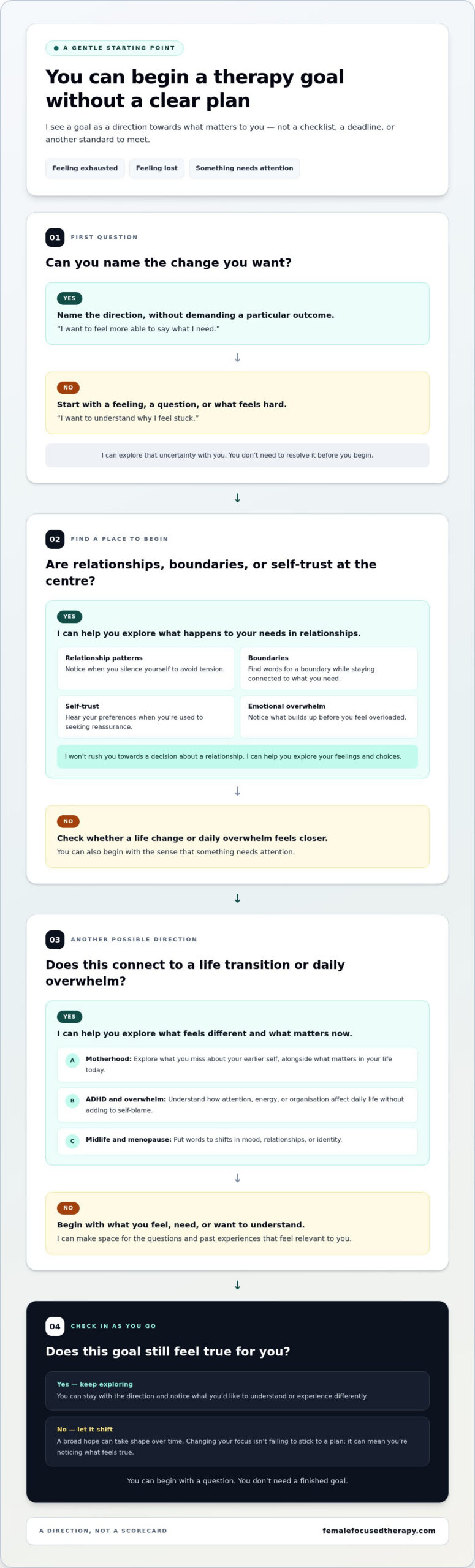
How I can help you find words for therapy goals
You don’t need to arrive with a clear explanation or a polished goal. I can help you slow things down and notice what feels hard, what matters to you, and what you might want to understand. These aren’t steps you have to complete perfectly. They’re gentle ways to begin making sense of what’s happening in your life.
Questions I might sit with before a session
You might find it helpful to sit with an open question, or simply notice what comes to mind. What has been taking up the most emotional space lately? Is there something you wish you could say, feel or do differently? You don’t need to answer everything. These prompts aren’t a scorecard or a way to assess yourself. They’re invitations to listen with curiosity.
If you’re unsure, you could bring one unfinished thought. “I keep going over a conversation and I don’t know why it’s stayed with me” is enough to begin exploring. You might notice a feeling, a memory, a worry, or even a blankness. I won’t expect you to turn it into a neat goal before we can talk about it.
What we can do when your goal changes
Your sense of what matters may shift as you talk. I can revisit the direction with you as your needs become clearer, rather than asking you to stay loyal to a goal that no longer fits. Sometimes the first thing you want to explore is only one part of a bigger picture. Changing focus can be a way of paying attention to yourself.
My approach is trauma-informed, feminist and integrative. That means I make space for your own history and perspective, while drawing on different ways of understanding what you’re experiencing. ACT can help you explore what matters and how you want to act in line with it. CBT can help you notice links between thoughts, feelings and everyday responses. Psychodynamic work can explore how earlier experiences may shape patterns in the present. Somatic and mindfulness-based practices can help you notice what’s happening in your body and bring attention to the moment you’re in.
I don’t assume one approach or one goal will suit every woman. What feels helpful can depend on your experiences, your circumstances and what you’re ready to explore. I’ll work with you to find a pace and direction that respect your needs, without promising a particular outcome.
If you’re wondering whether your experiences fit with my work, I share more about the women I work with. My psychotherapy and counselling for women also makes space for you to explore what matters, rather than treating you as someone who needs fixing.
If you’d like support finding words for what you’re carrying, you can book an appointment with me. You can begin with a question, a feeling, or simply the sense that something deserves your attention.
A gentle next step when you are considering therapy
You don’t need to have a finished goal before you begin. You might arrive with a question, a feeling that’s been hard to carry, or a pattern you’re ready to understand. We can start there. You don’t have to share more than feels right for you, or have everything neatly explained.
What starting can look like when you are unsure
Perhaps you’ve been saying, “I’m not sure what I need, but I can’t keep pushing this aside.” That can be enough for a first conversation. I can listen with care and help you explore what’s taking up space, without expecting you to reach a conclusion or commit to a particular goal.
Therapy is not a promise that you’ll feel different by a certain date. It’s a place to make sense of your experience and consider what matters to you, at a pace that respects your needs. A clarity session or appointment can be a gentle way to begin exploring whether this feels like the right support for you.
Finding support that reflects your experience
I’m Cheryl Kennedy MacDonald, a registered psychotherapist with over 20 years of experience. I’m registered with BACP and SAC, and my work with women is trauma-informed, feminist and integrative. I offer in-person psychotherapy and counselling in Singapore, as well as online sessions globally.
My integrative approach makes room for your thoughts and feelings, and for what you notice in your body. If it feels helpful to explore this embodied side, my somatic movement work for women offers another way to connect with your experience. This isn’t about finding one perfect method. I’ll work with you in a way that honours your circumstances and what feels manageable.
You can take a little time to notice what you might want to bring into a first conversation. It could be one question, one feeling, or simply the sense that you’d like some space to understand yourself. You don’t need to prepare a complete story or decide on a long-term direction before reaching out.
If you feel ready to take that small step, you can book an appointment with me. There’s no pressure to have all the answers before we begin.
If you’d like to find out more about working with Cheryl Kennedy MacDonald, you can email her at cheryl@femalefocusedtherapy.com or go ahead and book an appointment here: https://www.femalefocusedtherapy.com/book-now/ or lifestyle and yoga progammes, visit YogaBellies on www.yogabellies.com
Let your next step begin with what matters
You don’t have to know exactly where you’re going before you take a step. Sometimes the first change is simply giving yourself permission to notice what you need, even if you can’t yet put it into words. That quiet noticing can help you make choices that feel more like your own.
I see therapy goals for women as a way to keep your needs in the conversation, not another expectation to meet. You can arrive with uncertainty and let your direction take shape as you go. You’re allowed to pause, reconsider, or discover that something different matters now.
If you feel ready to explore what support could look like, you can book an appointment when you feel ready. There’s no need to prepare a perfect goal first. Begin with what feels possible today, and let that be enough for now.
Frequently Asked Questions
Do I need to know my therapy goals before my first session?
No, you can begin without knowing your therapy goals. If it helps, you might note what prompted you to consider therapy, such as feeling tense before family visits or replaying a conversation afterwards. You can bring that note, or simply tell me you’re unsure where to start. I can listen and help you explore what feels important, without expecting you to arrive with a prepared plan.
Can I have more than one therapy goal at the same time?
Yes, you can have several concerns in mind. You might want to feel less overwhelmed at work and understand why you find it hard to ask for help at home. We can explore how those experiences connect, then decide together what feels most pressing to focus on first. You don’t have to dismiss the other concerns. They can remain part of the picture as your priorities become clearer.
Is it okay if my therapy goal is simply to understand myself better?
Yes. Wanting to understand yourself better is a meaningful reason to begin therapy. You might become curious about why a particular comment stays with you, or why you feel different in certain relationships. Exploring those moments can help you make sense of your own reactions and needs. Therapy goals for women don’t have to be framed as fixing a problem; they can centre on self-understanding.
What happens if I feel embarrassed to share my therapy goal?
You can tell me that you feel embarrassed, without explaining the whole story straight away. I’ll meet that feeling with care, not judgement. You might start with a general description, such as “I’m finding something in my relationship difficult to talk about.” You’re allowed to choose how much detail to share and when. We can pay attention to what feels comfortable as the conversation unfolds.
Can therapy goals include setting boundaries with family?
Yes. You might want to explore how to respond when a family member asks for more than you can manage, or how to leave a conversation when you need a pause. A boundary goal can focus on what you choose to say or do, rather than trying to control someone else’s response. We can also make space for the feelings that may come up as you practise protecting your limits.
How can I tell whether a therapy goal feels like my own?
You might ask yourself whose approval you’re hoping to gain by choosing it. A goal can feel more personal when it connects with what you value, rather than only what you think you should do. For instance, “I want to stop disappointing my family” may carry a different meaning from “I want to understand what matters to me when I make family decisions”. You can explore that difference gently in therapy.
Can therapy goals change as I understand myself better?
Yes, your goals can change as you learn more about what you need. You may begin by wanting to manage a difficult situation, then notice you’d rather explore what makes it feel so hard. You can tell me when your focus shifts or an earlier aim no longer feels relevant. I won’t treat that as a failure. It gives us a chance to make space for what matters to you now.

Article by
Cheryl Kennedy MacDonald MA BA (Hons) Pg. Dip. SAC BACP
Cheryl Kennedy MacDonald is a psychotherapist specialising in women’s mental health, relationships, and life transitions. She works with women navigating trauma, relationship breakdown, identity shifts, and midlife change, helping them rebuild self-trust, emotional stability, and a clear sense of who they are and what they want.
With over 20 years’ experience working with women internationally, Cheryl is the founder of YogaBellies, a global women’s yoga school, and the creator of the Birth ROCKS method. Her work sits at the intersection of psychotherapy and embodiment, integrating evidence-based therapeutic approaches with somatic, body-based practices that support deep, lasting change.
Known for her grounded and direct approach, Cheryl moves beyond surface-level insight to address the patterns held in the body and nervous system. Her work supports women to regulate, reconnect, and respond to their lives from a place of clarity, strength, and self-respect.
She is a published author in academic journals and has written multiple books on women’s health, pregnancy, and midlife wellbeing, available on Amazon and leading book retailers worldwide.