
What if a good fit with your therapist isn’t about feeling an instant connection? If you’re trying to work out how to know if your therapist is a good fit, you may be listening closely to every feeling in the room, wondering whether uncertainty means something is wrong.
It makes sense to want to feel safe, understood and respected, especially when you’re sharing parts of yourself that are hard to talk about. I don’t expect you to trust me straight away or feel comfortable every moment. A connection can take time to grow, and some conversations may feel uncomfortable without the relationship being wrong for you.
I’m Cheryl Kennedy MacDonald, a registered psychotherapist, and I work with women using a trauma-informed, feminist and integrative approach. In this article, I’ll help you notice whether therapy feels collaborative and responsive to what you need, and how to raise it if something feels off. I’ll also share the difference between the stretching that can come with therapy and behaviour that doesn’t feel respectful, so you can consider a gentle next step at your own pace.
Key Takeaways
- Therapist fit can develop over time; you don’t need to feel instantly at ease to explore whether the relationship feels right.
- To consider how to know if your therapist is a good fit, notice whether you feel listened to, respected and included in decisions about your sessions.
- A difficult conversation can still happen within a respectful relationship; repeated dismissal or feeling unable to speak up deserves your attention.
- Reflect on what felt supportive, what felt difficult and what you might want to raise, without treating your feelings as a pass-or-fail test.
- I’ll share how my trauma-informed, feminist and integrative approach makes space for your perspective as you explore what you need from therapy.
When you wonder whether your therapist is a good fit
You may leave a first session feeling hopeful, guarded, awkward or unsure. Perhaps you said more than you expected, or found yourself holding back. I know it can be hard to tell whether that uncertainty is part of beginning therapy or a sign that something doesn’t feel right.
I think of fit as something that can develop: a growing sense that you’re treated with respect, listened to and included in the work. It doesn’t require instant ease or complete trust. You’re allowed to take time to decide what feels safe to share and notice how our conversations feel as you go.
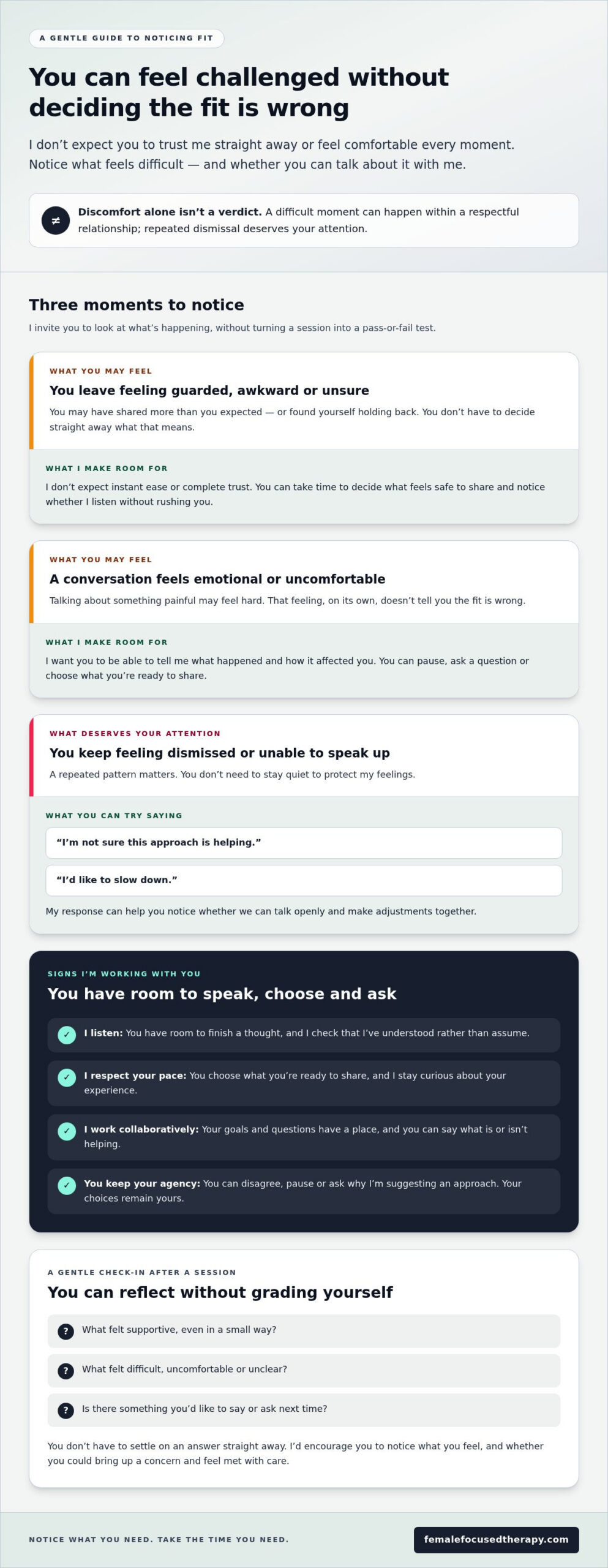
A difficult moment can happen within a respectful relationship; a repeated pattern of feeling dismissed deserves your attention. You might feel emotional or uncomfortable while talking about something painful. That doesn’t, on its own, tell you that the fit is wrong. I’d want there to be room for you to talk about what happened and how it affected you.
In my work, I may use different approaches to support our conversations. I also see the relationship between us as part of the therapy, not just the topics we discuss or tools I use. If you’re wondering whether your circumstances feel understood, you can explore the women I support in therapy.
Does a good therapist need to feel like an instant connection?
No. An immediate click can feel reassuring, but I don’t think it’s the only way to recognise a promising fit. If you’re cautious, or you’ve learnt to be careful about what you share, trust may grow through small moments of consistency. You might notice that I listen without rushing you, or respond thoughtfully when you’re unsure. Rather than treating your first impression as a final verdict, stay curious about what it may be telling you.
What should I notice after a therapy session?
Afterwards, you could gently ask yourself whether you felt listened to, respected and able to set your own pace. You don’t need to grade yourself or decide whether the session was “good”. Perhaps you felt rushed while explaining a concern, or relieved that I remembered something you’d mentioned. Those details may help you understand what supports you and what you’d like to raise next time.
If reflecting feels useful, keep it simple. You might note:
- What felt supportive, even in a small way?
- What felt difficult, uncomfortable or unclear?
- Is there something you’d like to say or ask at your next session?
You don’t have to settle on an answer straight away. I’d encourage you to notice your feelings without turning them into a pass-or-fail test of me or yourself. Give yourself room to consider what happened, including whether you could bring up a concern and feel met with care.
Signs your therapist listens, respects you and works with you
If you’re asking how to know if your therapist is a good fit, I’d look for small, observable moments rather than expect every session to feel easy. Do you have room to finish a thought, ask a question and share your perspective? I want you to be able to do those things, even when a conversation feels challenging.
You might notice these signs in different ways:
- Listening: I make space for you to speak without rushing you, and I check I’ve understood rather than assume I know what you mean.
- Respect: I stay curious about your relationships, identity and choices instead of judging or making quick assumptions. You can choose what you’re ready to share.
- Collaboration: I make room for your goals and questions, and I want you to be able to say what is or isn’t helping.
- Room for your perspective: You can disagree, pause or ask why I’m suggesting a particular approach. I want you to remain involved in decisions about your own life.
I don’t expect you to feel comfortable all the time. I may gently challenge you to look at something differently, but I don’t want you to feel shamed or as if I’m taking control of your choices. The American Psychological Association’s guide on choosing a psychologist also offers ideas for questions you can ask as you consider what you need.
I support women through a range of experiences, and I know your circumstances are your own. You can find more about how I work with women and the life experiences I support. I want to understand what matters to you rather than fit your story into assumptions.
Do you feel heard rather than judged?
You might notice whether I let you finish explaining before moving the conversation on. I may reflect back what I’ve heard and check whether I’ve understood you correctly. I aim to ask about your experience instead of assuming what your relationship, identity or decisions mean. You don’t have to share more than feels manageable, and you can let me know if you’d rather leave something for another time.
Can you give feedback and keep your own agency?
You can say, “I’m not sure this approach is helping,” or, “I’d like to slow down.” You don’t need to protect my feelings by keeping quiet. I want our work to make room for your goals and questions, while your choices remain yours. If you share feedback, my response can help you understand whether we can talk openly and make adjustments together.
If you’d like to explore what working together might feel like, I offer a bookable Clarity session. You can book a Clarity session as a gentle way to begin that conversation, without needing to know in advance what the fit will be.
How to tell a hard moment from an ongoing mismatch
Therapy can bring up feelings that are tiring, tender or unsettling, especially when you’re talking about something painful. Feeling upset after a session doesn’t prove that therapy is helping, and it doesn’t prove that the fit is wrong. I’d notice what happens when you express discomfort: can you say that something feels like too much, and does your therapist respond with care?
A useful challenge may leave you thinking, even if it feels uncomfortable. What matters is whether you still feel respected and able to respond. If you feel pushed to agree, shamed for your choices or unable to ask for a pause, those feelings deserve attention too.
Temporary discomfort can happen within a respectful relationship; recurring disconnection can gradually wear away trust.
A hard moment may sit alongside respect
- You feel tender after discussing a painful memory, and your therapist makes room for you to say so.
- You’re invited to consider another perspective, while your choices remain yours.
- You can ask to pause, clarify what was meant or return to the subject another time.
An ongoing mismatch may need attention
- You keep trying to explain a concern, but feel brushed aside or misunderstood.
- You leave sessions feeling you had to agree, share more than you wanted or defend your experience.
- You don’t feel able to raise what isn’t working, or your feedback is repeatedly dismissed.
What if therapy brings up difficult feelings?
After a hard session, you might feel drained on the journey home or find yourself turning a conversation over in your mind. You could take a little time to notice what you need before making sense of it. If you tell your therapist the session felt overwhelming, notice whether they listen and explore how to make the work feel more manageable for you.
What if you keep leaving sessions feeling dismissed?
Rather than judging one imperfect exchange, notice whether the same concern keeps returning. You might say, “I left feeling unheard when we moved on,” or, “I’m not sure I can explain it yet, but something didn’t feel right.” Your perspective matters even if the words aren’t clear. You can bring uncertainty into the conversation without needing to present a perfect explanation.
If you’re in Singapore, you can consider what support feels appropriate for your circumstances and what questions you’d like to ask. You don’t have to decide everything in one sitting. It may help to write down the concern in a few words, so you can return to it when you feel ready.
If you’d like to explore working with me, I offer a bookable Clarity session as a gentle way to talk about what you need. You can book a Clarity session without needing to know in advance what the fit will be.
A gentle checklist for reflecting on therapist fit
After a session, you may want a clearer way to hold what happened without reaching a quick verdict. I find it helpful to separate the experience into three parts: what supported you, what felt difficult, and what you might want to bring into the next conversation.
This isn’t a test, and you don’t need to come away with a definite answer about how to know if your therapist is a good fit. Your notes are simply a way to hear yourself more clearly. You might jot down a few words on your phone or think them through on the journey home. Leave anything blank if it doesn’t feel useful.
What could you ask yourself after a session?
I’d keep the questions open and kind. Could you speak honestly, or did you find yourself editing your words? Were you able to pause, ask what something meant or say you weren’t ready to continue? Did the conversation connect with what matters to you now, even if it brought up difficult feelings? There’s no right answer. You’re noticing, not scoring.
- What felt supportive? Perhaps your therapist made space for a thought you usually keep to yourself.
- What felt difficult? Maybe you left unclear about a suggestion, or a topic moved on before you felt ready.
- What would you like next? You might want more explanation, a slower pace or time to sit with something.
A note can be as simple as, “I felt more settled when I had time to finish,” or, “I’m still thinking about that question.” Try not to use how you felt after one conversation as a measure of your progress. Your mood, energy and circumstances can shape how a session lands, too. The point is to make room for your own response.
How can you raise a concern with your therapist?
If it feels right, choose one manageable point rather than trying to explain everything at once. You could say, “I felt unsure when we moved on from that,” or, “Could we slow down and come back to this?” You can also ask for clarification if you’re not sure what your therapist meant. Your words don’t need to sound polished.
You might feel nervous about saying it. That doesn’t mean you have to stay quiet. A considered response can help you understand whether you can talk openly and shape the work together. If your therapist listens, asks what would help and makes space for your view, that gives you something useful to notice. If the conversation leaves you feeling more confused or brushed aside, that matters too. You don’t have to settle the question immediately.
If you’d like to explore your own hopes and questions with me, I offer a bookable Clarity session as a gentle starting point. You can book a Clarity session without needing to decide in advance whether we’re the right fit.
How I help you explore whether therapy feels right
I’m Cheryl Kennedy MacDonald, a registered psychotherapist supporting women. I know that choosing to talk about personal parts of your life can feel like a big step. You don’t need to arrive already certain about what you need, or know whether therapy with me will feel right. We can make space to explore that together, at a pace that feels manageable for you.
I bring over 20 years of experience to my work, and I’m registered with BACP and SAC. My approach is trauma-informed, feminist and integrative. Those words describe how I try to meet you: with care for what you’ve lived through, respect for your choices and attention to the parts of your experience that matter to you.
What does my integrative, women-focused approach mean for you?
I draw on ACT, CBT, psychodynamic therapy, somatic and mindfulness-based practices. In everyday terms, that means I may explore what’s happening in your thoughts and relationships, as well as what you notice in your body and emotions. I don’t use one way of working for everyone. I want to understand your experience with you, rather than decide what it means for you.
My work is focused on women, including women dealing with trauma, relationship changes, ADHD, menopause and shifts in identity. Your life isn’t a set of symptoms to fix. I’ll listen for what feels important to you, and we can talk about what kind of support seems useful. An integrative approach doesn’t promise a particular result; it gives us different ways to consider your needs.
For me, understanding whether therapy feels right includes noticing whether you can ask questions, say when something doesn’t fit, and take part in decisions about the work. You don’t have to agree with every suggestion. Your perspective belongs in the conversation, including when you’re still finding the words for it.
What is a gentle next step if you are still unsure?
You don’t need a perfect explanation of what’s troubling you before reaching out. You might simply have a sense that something feels tangled, or want to talk through what you hope could change. If you’re wondering how to know if your therapist is a good fit, a conversation can be a place to share those questions without treating them as a commitment to continue.
I offer a bookable Clarity session as an introductory opportunity to explore working together. You could bring one question, a few thoughts you’ve been carrying, or simply your uncertainty. We can use the conversation to consider what you need and whether my way of working feels appropriate for you. It can help you gather information, but it can’t guarantee how you’ll feel over time.
If taking that small step feels right, you can book a Clarity session. There’s no need to have everything worked out first.
If you’d like to find out more about working with Female Focused Therapy, you can email Cheryl at cheryl@femalefocusedtherapy.com, book an appointment directly, or visit YogaBellies for lifestyle and yoga programmes.
Take the next step at your own pace
You don’t have to make a final decision about therapy today. You can give yourself permission to stay curious, notice what matters to you and take one small step when you feel ready. Asking how to know if your therapist is a good fit can be part of learning to trust your own perspective, not a test you need to pass.
If you’re considering working with me, you can bring your questions or uncertainty into a Clarity session. You don’t need to have everything neatly explained. We can use the conversation to explore what you’re looking for and whether beginning therapy together feels like a reasonable next step. It’s an opportunity to talk, not a promise about what you’ll decide or how therapy will unfold.
Explore a Clarity session with me whenever it feels right. You’re allowed to move thoughtfully, and your needs deserve a place in that decision.
Frequently Asked Questions
Is it normal not to feel an immediate connection with my therapist?
Yes. You may need time to settle into a new relationship, and an instant click isn’t required for therapy to be useful. You might notice that you’re quieter than usual at first, or that it takes a while to decide what you want to talk about. I’d stay curious about how the conversations develop and whether you can gradually bring your questions and preferences into them.
Can I feel nervous and still be with the right therapist?
Yes. Nervousness can come with doing something unfamiliar, such as making space to talk about experiences you usually keep private. It doesn’t decide the question of fit on its own. You could notice what happens when you say, “I’m feeling nervous and I’m not sure where to start.” You’re allowed to take a breath, gather your thoughts and begin with something small.
How do I tell my therapist that something does not feel right?
You can start with one sentence, such as, “I felt unsure when we moved on from that.” You don’t need to give a perfect explanation or have a solution ready. You might ask to revisit the subject, slow down or hear more about why a particular direction was suggested. I’d pay attention to whether the conversation leaves space for your experience and helps you work out what you need.
Can I disagree with my therapist and still have a good fit?
Yes. You can have a different view and still continue a useful conversation. For example, you might say, “That doesn’t quite match how I see it,” or explain that a suggestion doesn’t feel right for your circumstances. I’d notice whether you can speak honestly without feeling pressured to change your mind. You don’t have to accept every interpretation for your own perspective to remain part of the work.
What if I find it hard to trust my feelings about therapist fit?
You don’t have to make a decision from one difficult feeling. If it helps, write down a few words after a session, such as “felt understood”, “confused” or “wanted more time”. Looking back may help you notice whether a concern was a one-off or keeps returning. You can also share that you’re unsure, even if you can’t yet explain why. It’s information to explore, not a test.
Can online therapy feel like a good fit if we are not in the same room?
Yes. Online therapy can offer space to talk and reflect, even when you and I aren’t in the same room. I offer online psychotherapy and counselling to women globally, as well as in-person sessions in Singapore. You might notice whether you can speak freely through the screen, feel engaged in the conversation and ask for a pause when you need one. Those details can help you decide whether this way of meeting suits you.

Article by
Cheryl Kennedy MacDonald MA BA (Hons) Pg. Dip. SAC BACP
Cheryl Kennedy MacDonald is a psychotherapist specialising in women’s mental health, relationships, and life transitions. She works with women navigating trauma, relationship breakdown, identity shifts, and midlife change, helping them rebuild self-trust, emotional stability, and a clear sense of who they are and what they want.
With over 20 years’ experience working with women internationally, Cheryl is the founder of YogaBellies, a global women’s yoga school, and the creator of the Birth ROCKS method. Her work sits at the intersection of psychotherapy and embodiment, integrating evidence-based therapeutic approaches with somatic, body-based practices that support deep, lasting change.
Known for her grounded and direct approach, Cheryl moves beyond surface-level insight to address the patterns held in the body and nervous system. Her work supports women to regulate, reconnect, and respond to their lives from a place of clarity, strength, and self-respect.
She is a published author in academic journals and has written multiple books on women’s health, pregnancy, and midlife wellbeing, available on Amazon and leading book retailers worldwide.