
It might begin as a quiet thought. Maybe it happens when you catch your reflection unexpectedly in a shop window, or when you realise you’re no longer the youngest person in the room, but one of the oldest. It’s a subtle shift, a private acknowledgment that things are changing. Then one day, that quiet thought feels deafening.
If you’re reading this, you probably know that feeling well. It’s that sudden, startling moment when the cultural pressure to stay young feels overwhelming, and the grief for a version of yourself that no longer exists becomes tangible. This is where the fear of ageing for women can feel most intense, leaving you feeling anxious, invisible, and disconnected from your own identity.
I want you to know that your feelings are completely valid. In this article, I will help you understand the roots of your anxiety about getting older and show you how to rebuild self-trust during this significant life transition. We’ll explore how to navigate these changes with compassion, so you can reconnect with your inner confidence and find a sense of calm acceptance for the chapter ahead.
Key Takeaways
- Understand the complex roots of your anxiety about getting older, from societal pressures to deeply personal experiences.
- Learn why the cultural fear of ageing women is often linked to a loss of self-trust, and discover how you can begin to rebuild it.
- Uncover the surprising connection between your emotional state and your physical wellbeing as you navigate your middle years.
- Find actionable ways to strengthen your inner confidence, creating a more grounded and trusting relationship with yourself.
Understanding that heavy feeling when you look in the mirror
It might be a quiet hum of anxiety you feel in the morning, or a sudden, heavy feeling that settles when you catch your reflection unexpectedly. For many high-functioning women I speak with, it’s a difficult feeling to name. You’re capable, you’re successful, yet there’s this background noise of dread about getting older. I want you to know that you’re not alone in this, and in our conversations, I always aim to bring a bit of my Scottish warmth to these tough topics, creating a space where it’s safe to be honest.
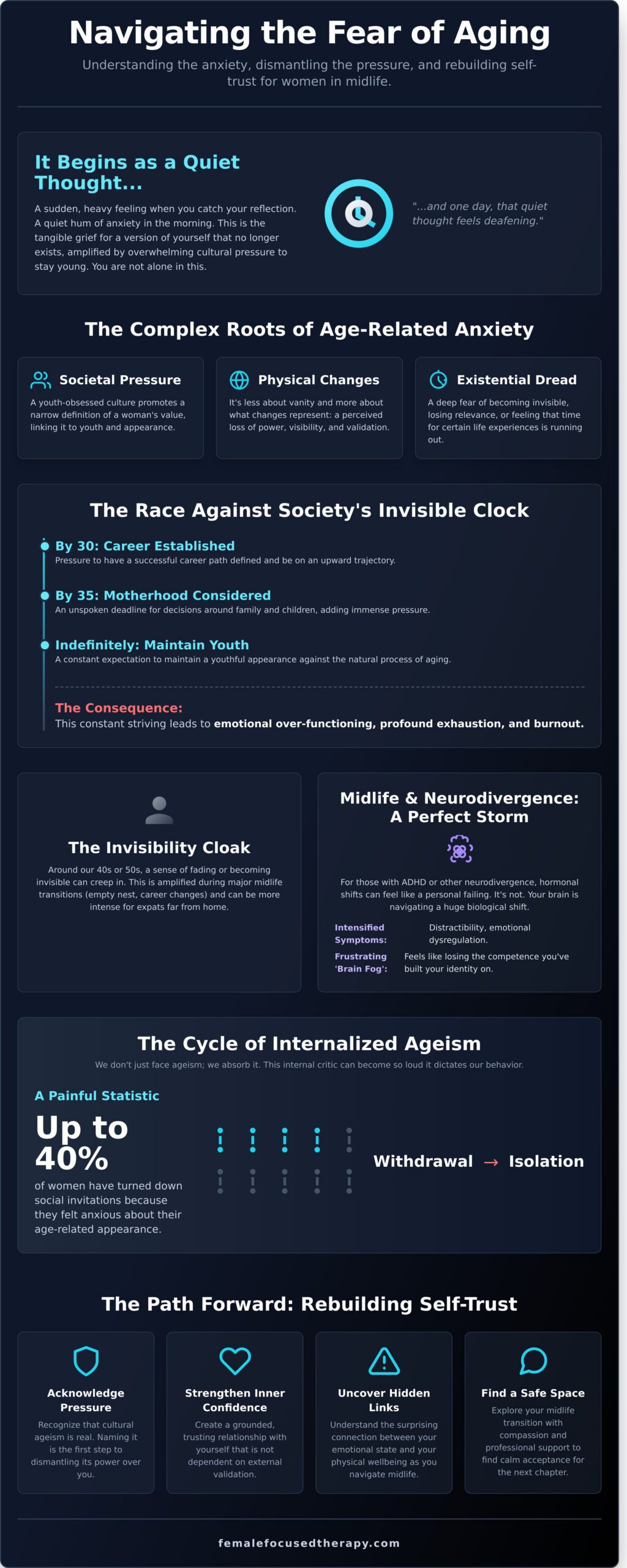
This feeling isn’t simple. The fear of ageing women experience is a complex blend of social pressure, physical changes, and a deep existential worry. It’s the fear of becoming invisible, of losing relevance, or of running out of time. When you live in a youth-obsessed culture, feeling stuck in this anxiety is a perfectly normal response. It’s a sign that you’re paying attention to the world around you, a world that unfortunately promotes a very narrow definition of a woman’s value.
The difference between vanity and existential dread
Let’s be clear: feeling a pang of sadness about a new wrinkle or a change in your body isn’t shallow. It’s human. This grief is often less about vanity and more about what those changes represent. We are conditioned from a young age to understand that society grants a certain type of power, visibility, and validation to young women. The fear of losing that is a natural response to internalised social pressure, something we often explore in my Female Focused Therapy practice.
When the milestones start to feel like deadlines
Do you ever feel like you’re in a race against an invisible clock? Society sets up these unspoken timelines for women: build a career by 30, consider motherhood by 35, and maintain a certain look indefinitely. This constant pressure can lead to emotional over-functioning, where you’re always striving, planning, and doing more, trying to outrun the clock. The result is often profound exhaustion and burnout.
I’ve spoken with so many brilliant women who feel this. Imagine a successful lawyer in Singapore, celebrated in her field, who privately panics that she’s ‘behind’ because her friends are married with children. She works harder to compensate, pushing herself to the brink, all while grappling with the fear that her time for certain life experiences is running out. This is a heavy burden to carry, especially when you’re already navigating so much.
This intense cultural messaging, a form of cultural ageism, tells us our worth diminishes over time. Acknowledging this pressure is the first step toward dismantling its power over you.
Why our culture makes us feel like we are disappearing
Have you ever felt it? That subtle shift in how the world sees you. It’s like one day you wake up and realise you’re wearing an invisibility cloak you never asked for. This feeling often creeps in around our 40s or 50s, and it’s a core part of the fear of ageing women experience. It’s not just in your head; it’s a reflection of a culture that relentlessly celebrates youth and often pushes experienced, powerful women to the sidelines.
This sense of fading can be amplified during major midlife transitions. Perhaps your children have left home, you’re contemplating a career change, or you’re navigating the end of a long-term relationship. These moments can leave you feeling untethered. For many of my clients living as expats here in Singapore, this feeling is even more intense. Far from the familiar support systems of home, the pressure to constantly adapt in a new culture can make you feel even more isolated and unseen.
The intersection of midlife and neurodivergence
If you have ADHD or another form of neurodivergence, this period can feel like a perfect storm. The hormonal fluctuations of perimenopause and menopause can intensify symptoms like distractibility and emotional dysregulation. The frustrating ‘brain fog’ can feel like a personal failing, especially if you’ve built your identity on being the competent, organised one who holds everything together. Please know that you’re not failing; your brain is simply navigating a huge biological shift on top of its unique wiring.
Internalised ageism and the “shunning” fear
We don’t just face ageism from the outside world; we absorb it. We internalise the thousands of messages from media and advertising that tell us we are ‘past our prime’. This internalised critic can become so loud that it dictates our behaviour. In fact, multiple surveys have found that up to 40% of women have turned down social invitations because they felt anxious about their age-related appearance. This withdrawal creates a painful cycle of isolation, which the World Health Organization identifies as a key risk factor for our mental health in later life.
I invite you to gently notice when that harsh inner voice appears. Is it yours, or is it an echo of a magazine cover or a thoughtless comment you overheard? Recognising the source of this pressure is the first step towards reclaiming your confidence. This is often the quiet, foundational work we do in therapy, learning to separate our own truth from the noise of the world. It’s about building a sense of self that is not dependent on external validation, something we can explore together at Female Focused Therapy.
The hidden link between your anxiety and your wellbeing
You might feel that the constant worry about getting older lives entirely in your mind. It’s a loop of thoughts, a flicker of panic when you see a new line in the mirror, or a sense of unease about the future. But what if that anxiety isn’t just in your head? What if your body is listening to every worried thought?
It’s not just a feeling. Research from institutions like NYU’s Grossman School of Medicine has shown that chronic psychosocial stress can actually speed up our biological ageing process. This isn’t meant to add another worry to your list. Instead, it’s a powerful reminder that tending to your emotional wellbeing is one of the most profound things you can do for your physical health.
When the fear of ageing in women becomes a source of chronic anxiety, it creates a physiological stress response. For women who are already navigating patterns of people-pleasing or deep-seated self-blame, this adds another heavy layer. Your body doesn’t know the difference between a real-life threat and a recurring fear; it just knows it’s time to be on high alert.
How your body holds the stress of time
Think of your body as having two ages: a chronological one (your birthday) and a biological one. Scientists sometimes refer to this biological age as our “epigenetic clock,” and it can tick faster or slower depending on our environment, lifestyle, and stress levels.
When you’re caught in cycles of chronic self-criticism, your body is in a constant, low-grade state of alert. This stress is compounded by the cultural pressure and the very real invisibility of older women in society, which can deepen feelings of anxiety. Your subjective experience of ageing directly impacts your objective health.
Moving from “fixing” to “holding” your fears
The natural instinct is often to fight or “fix” these uncomfortable feelings. But what if the goal wasn’t to delete the fear, but to learn how to hold it safely, without letting it steer your life?
This is where my integrative approach comes in. Together, we use somatic and mindfulness practices not to erase anxiety, but to gently calm your nervous system. This creates the space you need to think clearly and feel more grounded in your own skin, at any age.
We aren’t trying to build a wall against fear. Instead, I help women build an internal foundation of safety and self-trust. It’s about developing the capacity to be with your discomfort without becoming completely overwhelmed by it. This is a quiet, powerful form of resilience that supports your whole being.
Rebuilding self-trust as you navigate your middle years
When you feel a knot of anxiety tighten in your stomach as another birthday approaches, it’s rarely just about the new lines around your eyes. It’s often about a deeper sense of uncertainty. Who am I becoming? What is my place in the world now? The antidote to this anxiety isn’t a new skincare routine; it’s the quiet, steady work of rebuilding trust in yourself.
For so many of us, self-trust has been chipped away over years. It can happen subtly in relationships where our needs were dismissed, or more profoundly through experiences of narcissistic abuse, where our reality was constantly questioned. We learned to silence our own intuition and prioritise the needs and emotions of others to keep the peace. This is why the fear of ageing women often feel is so potent; it’s a fear of facing an unknown future without your most essential guide: your own inner compass.
Reclaiming that sense of self doesn’t happen overnight. It begins with small, intentional acts of turning your attention back towards yourself. Here are a few gentle places to start:
- Reconnect with a past joy. What did you love doing before life became so demanding? Pick up a paintbrush, a book by a favourite author, or put on music you once loved. Spend just 15 minutes with it.
- Notice your own physical needs. Are you thirsty? Is your back aching? Do you need to stretch? Acknowledge the need and, if you can, meet it immediately. This is a foundational act of self-care.
- Practise a ‘gentle no’. You don’t have to start with a big, confrontational boundary. Start by saying, “Let me think about that and get back to you,” instead of an automatic “yes”.
Healing the “good girl” and the “over-functioner”
Many of us have spent decades wearing the mask of being “everything to everyone.” We became the reliable daughter, the supportive partner, the organised colleague. Dropping this mask feels terrifying because it has become our identity. But setting boundaries is a vital part of ageing with confidence. It’s how you teach yourself, and others, that your energy, time, and wellbeing have value. It’s time to start asking: “What do I actually want for this next chapter?”
Practical steps for emotional regulation
When a “birthday panic” hits, that wave of anxiety can feel overwhelming. Instead of pushing it away, try a simple grounding exercise. Look around you and name five things you can see. Then, notice four things you can physically feel. Listen for three sounds. Identify two different smells. Finally, what is one thing you can taste? This brings you back to the present moment. Acknowledging and navigating these feelings is so much easier when you have a confidential, professional space to talk. This journey of reconnection is at the heart of the work I do, supporting the women who I work with as they find their footing again. Remember, change happens at a pace that feels sustainable for you.
Finding a safe space to explore your midlife transition
If you have journeyed through this article, it’s likely because a part of you is seeking a different way to experience this chapter of your life. I want to invite you to think of therapy not as a last resort, but as a proactive, powerful gift to yourself. It’s the creation of a dedicated space and time, just for you, to honour the significance of this transition.
Midlife can feel incredibly lonely. Even with supportive friends, these conversations can be difficult. Everyone is navigating their own changes, and it can be hard to find someone who can simply hold space for your uncertainty without trying to fix it. The internal monologue of worries, combined with external pressures to remain youthful, is a heavy burden to carry alone.
At Female Focused Therapy, my entire practice is built to be a sanctuary from that noise. It is a warm, confidential, and deeply empathetic space where you can show up exactly as you are. You can bring your grief for the woman you were, your confusion about the woman you are becoming, and your anxieties about the future, knowing that all of it is welcome here.
Working with a therapist who specialises in the very challenges you’re facing can make all the difference. We can unpack why the fear of ageing women so often feel is potent and culturally ingrained. My focus on life transitions and menopause goes beyond symptom management. Together, we can gently dismantle the societal narratives that tell you your value is fading and rebuild a life based on your own wisdom, not on outdated expectations. This is how we begin to soften the fear and replace it with a quiet confidence.
Please know, you do not have to navigate this “dark period” on your own.
What to expect in our sessions together
Our sessions together have a calm, non-judgmental rhythm. Think of it as a space to finally exhale and untangle your thoughts without interruption. We move at a pace that feels safe and sustainable for you. The flexibility of online therapy means you can create your own private sanctuary for our sessions, whether it’s a quiet corner of your home in Singapore or anywhere else in the world. The goal is always to help you move forward with greater clarity, self-compassion, and a stronger sense of who you are now.
A small next step
Before you move on with your day, I invite you to try a small reflection. Think of one moment this past week where you felt truly yourself. Perhaps it was a moment of quiet wisdom, a flash of your unique humour, or an act of kindness. Hold onto that feeling. It’s a reminder of the core self that exists beyond age and appearance. When you feel ready for dedicated support, please know that I’m just an email away. My professional, grounded expertise, combined with my Scottish warmth, is here to help you find your footing.
Finding Your Way Forward, Together
That heavy feeling in front of the mirror is real. It’s often a quiet echo of a culture that tells us we’re disappearing as we get older. But recognising that your anxiety is connected to these outside pressures is a powerful first step toward reclaiming your story and rebuilding trust in yourself.
The journey through this midlife transition is deeply personal. The societal fear of ageing women can feel overwhelming, but you don’t have to navigate it by yourself. Finding a safe space to be seen and heard can make all the difference.
As a Registered Psychotherapist with international experience, I offer a confidential, trauma-informed space to explore these feelings. My integrative approach is designed to support women through female-centric transitions and neurodivergence, helping you find your footing again at a pace that feels right for you.
If you’re ready to move from feeling unseen to feeling grounded, I invite you to find out more about working with me. This next chapter can be your most authentic one yet.
Frequently Asked Questions
Is it normal to feel a sudden fear of ageing in my 30s?
Yes, it’s completely normal to feel a sudden fear of ageing in your 30s. This decade often brings a new awareness of physical changes and societal timelines. You might be navigating career pressures, relationship milestones, or questions about starting a family. These feelings are a valid response to both internal shifts and the intense external pressure women face. It’s a transition period, and it’s okay for it to feel unsettling as you recalibrate your sense of self.
How can therapy help with the emotional impact of menopause?
Therapy offers a confidential space to process the emotional impact of menopause, which can include anxiety, low mood, and identity shifts. We can use evidence-based approaches like Cognitive Behavioural Therapy (CBT), which the British Menopause Society recommends for managing symptoms like anxiety and hot flushes. Together, we can untangle these feelings, develop coping strategies, and help you reconnect with your sense of self during this significant life transition, ensuring you feel supported and understood.
What is the connection between ADHD and midlife anxiety in women?
The link between ADHD and midlife anxiety is often hormonal. Oestrogen helps regulate key neurotransmitters like dopamine, which are already lower in ADHD brains. As oestrogen levels decline during perimenopause, ADHD symptoms like emotional dysregulation and executive dysfunction can intensify, leading to increased anxiety. Many women I work with receive a late ADHD diagnosis during this time, finally finding an explanation for lifelong struggles that have suddenly become unmanageable.
Can fear of ageing actually make you age faster?
Yes, studies suggest the chronic stress from a deep fear of ageing in women can accelerate biological ageing. A well-known 2004 study from the University of California, San Francisco, showed that persistent psychological stress is linked to shorter telomeres, the protective caps on our chromosomes. Shorter telomeres are a key biomarker of cellular ageing. This doesn’t mean a fleeting worry will add wrinkles, but it highlights how managing our mindset is a crucial part of our long-term wellbeing.
How do I know if my anxiety about getting older requires professional help?
It may be time to seek professional support if your anxiety about ageing is negatively affecting your daily life. For example, are you avoiding social events, spending excessive time and money on anti-ageing treatments, or finding your thoughts are consumed by worry about your appearance or health? If the fear feels persistent, overwhelming, and stops you from enjoying your life, speaking with a therapist can provide you with the tools and support to navigate these feelings.
What does “rebuilding self-trust” look like in a therapeutic setting?
In therapy, rebuilding self-trust is a gentle process of reconnecting with your inner voice. It often starts with learning to identify your own feelings and needs, separate from the expectations of others. We might practice setting small, manageable boundaries in your relationships or work on making decisions, even minor ones, without seeking constant external validation. Each step is about proving to yourself that your intuition is a reliable guide, helping you feel more grounded and confident.