
You catch a glimpse of yourself in a shop window and for a split second, you don’t recognise the woman staring back. The reflection feels unfamiliar, like a distant relative you haven’t seen in years, and a quiet sense of disconnection settles in.
If this sounds familiar, I want you to know you’re not alone. It’s a deeply unsettling feeling, and it’s one of the most common, yet least talked about, challenges of midlife. The grief for the body you once knew, mixed with frustration over changes that feel completely out of your control, can make navigating your body image in menopause feel like an incredibly isolating journey.
My goal in this article is to help you gently unpack the emotional shift behind this experience. I want to support you in understanding how you can begin to rebuild a trusting, compassionate relationship with yourself. Together, we’ll explore why your body can feel like a stranger during this transition and look at practical steps you can take to move through this time with more clarity and confidence.
Key Takeaways
- Understand the emotional significance behind the physical changes you see in the mirror and why they can feel so deeply unsettling.
- Discover the direct link between hormonal shifts and your self-perception, validating that these feelings are not just “in your head.”
- Learn how self-compassion can help you navigate the complex feelings around body image in menopause and move beyond lifelong societal pressures.
- Explore gentle, practical ways to shift from critically “looking at” your body to mindfully “feeling from” within it again.
That moment the mirror starts telling a different story
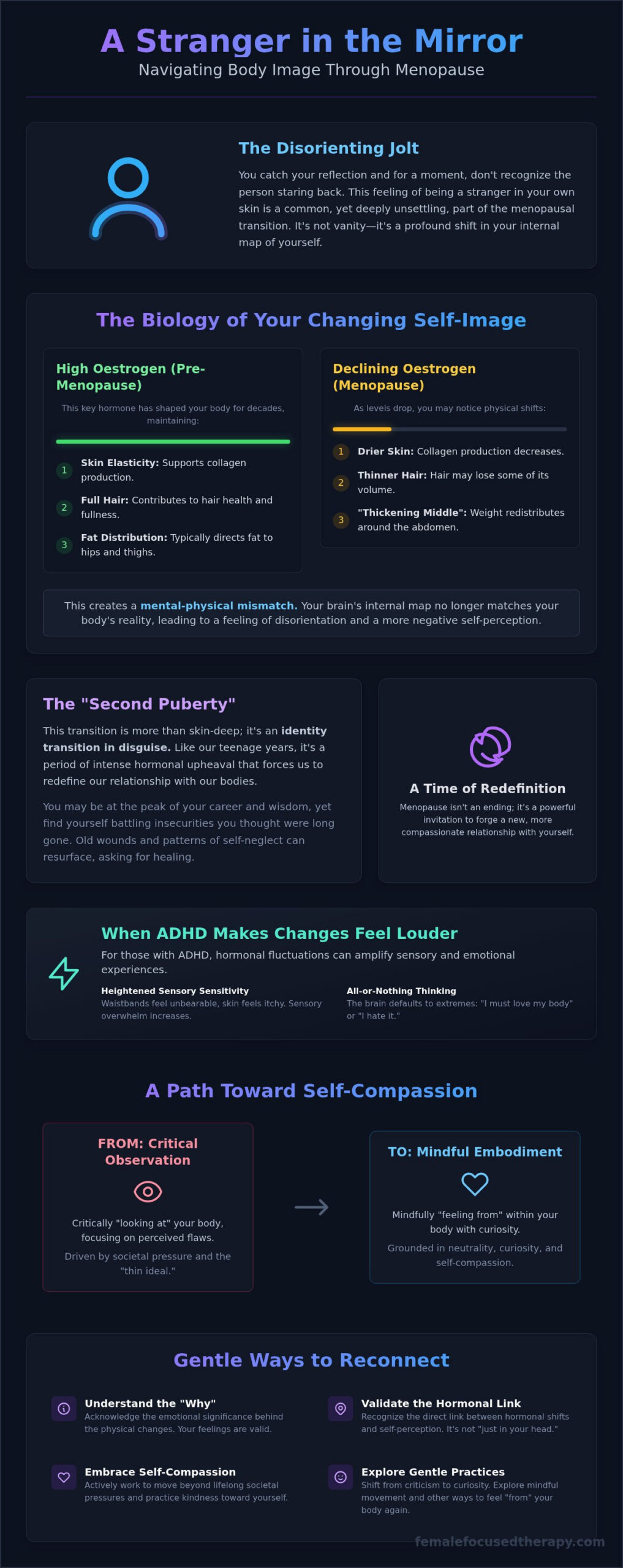
It often happens without warning. You catch your reflection in a shop window or the bathroom mirror and for a split second, you don’t recognise the person looking back. It’s a quiet, disorienting jolt that can leave you feeling like a stranger in your own skin.
This experience is a common, yet rarely discussed, part of navigating your body image in menopause. It’s not about vanity. It’s a profound shift in your internal map of yourself, a change in your personal body image that feels both sudden and deeply unsettling.
For many women I work with, the most challenging change is the “thickening middle.” It’s a redistribution of weight that feels stubborn and unfamiliar. This isn’t just about the number on the scales; it represents a loss of control and predictability over a body you’ve known your entire life.
As a capable, high-functioning woman, your first instinct might be to fix it. You might research a new diet, create a demanding exercise plan, or book a consultation. You try to manage your body like a project that’s gone off-track, applying the same logic and determination that has served you so well in your career.
But underneath the action plan, there is often a quiet grief. It’s the mourning for a silhouette you knew and trusted. Please know it is entirely valid to feel that loss. This journey of reconnection is central to the work we do at Female Focused Therapy.
The invisible pressure of midlife expectations
Society often sends the message that we are somehow “failing” at aging if we don’t do it invisibly. This pressure creates a difficult paradox. You may be at the peak of your career, feeling more wise and capable than ever, yet your internal dialogue has become hijacked by harsh “fat talk” and “old talk” that undermines your confidence.
When ADHD makes sensory changes feel louder
If you live with ADHD, the physical transitions of perimenopause and menopause can feel amplified. Fluctuating hormones can heighten sensory sensitivities, making the waistband on your jeans suddenly feel unbearable or your skin feel constantly itchy and irritated. The overwhelm of managing new health data, alongside a life that already feels busy, can feel like one more impossible task for a brain that craves simplicity.
The ADHD brain often leans towards all-or-nothing thinking. You might feel you must either love your new body unconditionally or you hate it. The truth is, there is a gentle, more sustainable space in between: a space of neutrality, curiosity, and self-compassion.
Why the shift in menopause feels so deeply personal
If you feel like the changes in your body are hitting you on a much deeper level than you expected, you are not alone. It’s not just about a few extra pounds or new lines on your face. The experience can feel like a fundamental shift in who you are, leaving you feeling unsettled and disconnected from yourself.
This isn’t vanity. It’s a profound psychological process tied directly to our biology. The hormonal fluctuations of perimenopause and menopause don’t just affect us physically; they directly impact our mood, our stress response, and how we see ourselves in the world.
The biology of your changing self-image
Oestrogen is a powerful hormone that has shaped your female body for decades. It helps maintain skin elasticity by supporting collagen production, keeps hair full, and influences where your body stores fat. As oestrogen levels decline, you might notice your skin feels drier, your hair thins, and weight settles around your middle in a way it never did before.
Your brain has spent a lifetime creating a mental map of your body. Suddenly, that internal map no longer matches the physical reality you see and feel. This mismatch can be deeply disorienting. It’s a scientifically observed phenomenon; a recent systematic review on menopause and body image confirmed a strong link between menopausal symptoms and a more negative self-perception. What you’re feeling is real and valid.
The “Second Puberty” and the search for identity
I often refer to this time as a “second puberty.” Like our teenage years, it’s a period of intense hormonal upheaval that forces us to redefine our relationship with our bodies. The difference is, this time we’re doing it with the full weight of our life experiences behind us.
This creates a strange paradox. You may be at the peak of your career, a wise mother, or a grounded partner, yet you find yourself battling insecurities you thought you’d left behind in your teens. This struggle with body image in menopause is often an identity transition in disguise. Old wounds or a history of neglecting your body’s needs can resurface now, asking to be healed.
In my practice, I support women as they navigate these life transitions. We work together to make sense of these feelings and find a way back to a sense of wholeness.
Understanding that this is more than skin deep is the first step. It’s about grieving the body you knew and learning to build a new, compassionate relationship with the woman you are becoming. This journey of reconnection is at the heart of the work we do at Female Focused Therapy.
Moving beyond the thin ideal toward a kinder perspective
For decades, many of us have carried around an invisible rulebook. It’s one that says our value is tied to our dress size, that youth is a prize, and that thinness is the ultimate goal. This “thin-ideal internalization” is so deeply woven into our culture that we often don’t even notice it’s there. It’s simply the background noise we’ve lived with our entire lives.
When you’re navigating the complex world of body image in menopause, this old programming can become incredibly loud. The changes feel like a betrayal of the rules you’ve tried so hard to follow. But what if we could gently set that rulebook aside? What if we decided, right now, that our worth was never actually tied to our size in the first place?
The power of self-compassion
Self-compassion isn’t about forcing yourself to love your reflection when you feel low. It’s much quieter and kinder than that. It’s the simple act of meeting your own distress with warmth instead of criticism. When you feel that familiar wave of frustration in front of the mirror, it’s the voice that says, “This is a difficult moment,” instead of, “You’ve let yourself go.”
This practice is a powerful way to break the cycle of chronic self-blame. For so many women I work with, this internal criticism is connected to a lifetime of people-pleasing; we try to make our bodies acceptable to others. Offering yourself genuine kindness is a radical act of choosing your own wellbeing first. It’s acknowledging that this body, in all its changing forms, has carried you through every joy, every challenge, and every heartache of your life. It deserves your care, not your contempt.
Sometimes, the pressure to achieve “body love” can feel like just another standard we’re failing to meet. This is why many women find the concept of “body neutrality” more accessible. It’s a middle path. You don’t have to love your body every day, but you can respect it. You can appreciate it for its function and all it allows you to do. This shift can be a vital step in rebuilding self-trust and compassion.
Deconstructing the “Old Talk”
You know the conversations I mean. The casual remarks over coffee about new wrinkles, grey hairs, or needing to “be good” after a weekend. Without realising it, we often participate in ageist and fat-phobic conversations that reinforce the idea that aging is a problem to be solved. This kind of dialogue chips away at our confidence and is a key factor in why so many women struggle with their body image in menopause.
Extensive research on body dissatisfaction in menopause shows a strong link between these societal pressures and our internal distress. Challenging this “old talk” begins with reframing. What if those lines around your eyes weren’t flaws, but markers of every time you’ve laughed deeply? What if changing skin was evidence of a life fully lived, not a sign of decline?
It helps immensely to find a community of women who are also ready for a different kind of conversation. Seek out friends who value depth over surface, who celebrate wisdom, and who see your true worth. Creating a safe space where you can speak honestly about these changes is fundamental to healing. It’s a reminder that you are not alone on this journey, and therapy can be a wonderful place to start building that sense of support. You can learn more about my approach at Female Focused Therapy.
Gentle ways to reconnect with your changing self
When your body feels like a stranger, the instinct can be to scrutinise it from the outside, as if it’s an object separate from you. But true reconnection happens from the inside out. It’s a quiet shift from ‘how do I look?’ to ‘how do I feel?’. This isn’t about forcing positivity; it’s about gently returning home to yourself.
This process is a practice, built on small, compassionate moments. It’s about learning to inhabit your body with kindness, especially when navigating the complex feelings around your body image in menopause. It begins with listening.
Somatic practices for grounding
Somatic simply means ‘relating to the body’. These practices help calm a stressed nervous system and anchor you in the present moment, moving you out of anxious thoughts and into physical sensation.
- A settling breath. When you feel overwhelmed, try this. Place a hand on your belly. Breathe in slowly through your nose for a count of four, feeling your belly expand. Hold for a moment. Then, breathe out slowly through your mouth for a count of six. Repeat this just three to five times. That’s it. It’s a simple signal to your nervous system that you are safe.
- Movement as a gift. Many of us have used exercise as a tool for control or punishment. I invite you to explore movement that feels like a gift. It might be a slow, 15-minute walk without your phone, gentle stretching in the morning, or putting on your favourite song and just dancing in the kitchen. The goal isn’t to burn calories; it’s to feel alive and present in your skin.
- Honouring your need for rest. Your menopausal body is working incredibly hard. Fatigue is not a moral failing; it’s a clear signal. Learning to listen to its cues for rest, without guilt, is a profound act of self-care and respect.
Rebuilding self-trust one day at a time
It’s common to feel betrayed by your body during midlife. It doesn’t respond the way it used to, and that can erode your sense of self-trust. We can rebuild it, not with grand gestures, but with small, consistent promises you keep to yourself.
Start with something tiny and achievable. Perhaps it’s promising to drink a glass of water before your morning coffee, or to step outside for five minutes of fresh air in the afternoon. Each time you follow through, you send a message to yourself: ‘I am reliable. I can count on me.’
This journey of patience and kindness is the foundation of the work I do with women in therapy. It’s a core part of rebuilding self-trust and finding your footing again during a time of immense change.
You can also curate your environment to support your new identity. Unfollow social media accounts that make you feel ‘less than’. Put away clothes that no longer fit comfortably. Create a space in your home that feels calming and truly yours. These external shifts reinforce the internal work you are doing.
And for the inevitable ‘bad body days’? Have a plan. Don’t try to fight the feeling. Instead, meet it with compassion. Your toolkit might include a soft blanket, a comforting film, or a call with a friend who just gets it. The goal is to soothe, not to solve. If you feel you need support navigating your body image in menopause, learning to do so with kindness is something we can explore together in a safe, confidential space.
Finding a safe space to navigate these midlife shifts
If you’ve been trying to handle these feelings on your own, please know you’re not alone in that either. So many of us are taught to be resilient, to push through, and to believe we should be able to manage everything by ourselves. But menopause is a profound biological and psychological shift. The old rules don’t always apply, and it’s okay to need a different kind of support.
Talking to a therapist isn’t about admitting defeat; it’s about giving yourself a dedicated space to untangle the threads. It helps you unpick the complex feelings around body image in menopause, separating societal expectations from your own authentic experience. It’s a space to grieve the body you knew while learning to appreciate the one you have now.
My entire practice at Female Focused Therapy is built on creating this kind of holistic support for women. My integrative approach honours the deep connection between your mind and your body. We can’t talk about how you feel about your changing shape without also acknowledging the hormonal shifts, sleep disruptions, and anxiety that might be physically happening. Together, we can support your nervous system and your emotional wellbeing.
Sometimes, the most powerful part of this process is the profound relief that comes from being truly heard. Having your experience validated by a professional, without judgment or dismissal, can quieten that inner voice that tells you you’re overreacting. It affirms that what you’re going through is real, it’s significant, and you deserve support.
What to expect in a therapy session with me
We begin by creating a confidential, professional, and warm space where you can be completely honest. It’s a place to bring your fears, frustrations, and uncertainties without any pressure to be positive.
Using evidence-based tools like Cognitive Behavioural Therapy (CBT) and mindfulness practices, we’ll gently challenge the stuck thought patterns that fuel self-criticism. We work to build a kinder, more compassionate inner dialogue, especially when it comes to your body.
Most importantly, our sessions focus on your unique story. You are not just a list of menopausal symptoms. You are a whole person with a rich history, and our work together will always honour that. This creates a foundation for rebuilding self-trust as you navigate the challenges of body image in menopause.
Your next small step
You don’t have to have all the answers right now. You don’t need a perfectly formed plan or a clear idea of what “better” looks like. The most courageous step is often the smallest one: acknowledging that the overwhelm feels too much and it’s time to reach out.
If anything you’ve read here resonates with you, I invite you to explore more about who I work with and see if you recognise yourself in the women I support. It might just be the gentle step you need to start feeling more at home in yourself again.
Navigating This Chapter with Kindness
Feeling disconnected from the person in the mirror is a profound part of the midlife shift. Remember that it’s okay to feel grief for the body you once knew. It’s also possible to move forward with compassion, letting go of old ideals and gently reconnecting with the person you are becoming. Navigating your changing body image in menopause doesn’t have to be a solitary struggle.
Support can make all the difference. As a Registered Psychotherapist with years of experience in female-centric issues and midlife transitions, I offer a safe, trauma-informed, and ADHD-aware space to explore these feelings. My work is designed to help you rebuild self-trust at a pace that feels right for you. If you feel you could use a guide on this path, you can learn more about my approach at Female Focused Therapy.
You deserve to feel at home in your own skin again.
If you’d like to find out more about working with Cheryl Kennedy MacDonald, you can email her at cheryl@femalefocusedtherapy.com or go ahead and book an appointment here: https://www.femalefocusedtherapy.com/book-now/
Frequently Asked Questions
Is it normal to hate my body during menopause?
Yes, it’s incredibly common and understandable to feel this way. You are not alone. The physical changes from shifting hormones, such as weight redistribution and skin changes, can feel jarring and unfamiliar. When you combine this with a culture that often idealises youth, it creates a perfect storm for a difficult relationship with your body. Acknowledging that this is a shared experience for many women is the first step towards self-compassion.
How can I improve my body image during the menopausal transition?
You can begin to improve your body image by gently shifting your focus from what your body looks like to how it feels and what it can do. Try introducing mindful movement, like a gentle walk or stretching, to reconnect with its strength. It can also be helpful to wear clothes that feel comfortable and express who you are now, rather than trying to fit into a past version of yourself. This is a journey of reconnection, not a race.
Why am I suddenly so self-conscious about my appearance in midlife?
This sudden self-consciousness is often a response to both internal and external changes. Internally, declining oestrogen affects your skin, hair, and body composition. Externally, societal messaging can make you feel scrutinised as you age. This combination can leave you feeling exposed and uncertain in a body that suddenly feels different. It’s a very normal part of navigating the complex identity shifts that come with midlife.
Can therapy really help with menopause-related body image issues?
Yes, therapy provides a confidential, professional space to explore these feelings without judgment. Together, we can work to understand the root of your distress, challenge the critical inner voice that fuels negative self-talk, and develop practical strategies for self-acceptance. The goal isn’t to force you to love your body, but to help you find a more peaceful and compassionate way to live in it, rebuilding your self-trust along the way.
How do I deal with the weight gain associated with menopause?
A helpful approach is to focus on health-promoting behaviours rather than on weight loss as the primary goal. Your metabolism naturally slows during menopause, and restrictive diets can often increase stress and lead to cycles of shame. Instead, try focusing on adding nourishing foods, finding joyful ways to move your body, and prioritising sleep and stress management. This supports your overall wellbeing, which is far more important than a number on the scale.
For personalized medical guidance on managing these changes through an integrative approach, you can learn more about Dr. Tiffany Yeo-Reddy, a general practitioner with a special interest in women’s health and wellness.
What is body neutrality and how is it different from body positivity?
Body neutrality is about accepting your body as it is, without feeling the pressure to either love or hate it. While body positivity encourages loving your appearance, neutrality suggests simply respecting your body for its function. It’s about taking appearance out of the equation. For many women struggling with their body image in menopause, this can feel like a more achievable and less exhausting goal, offering a path to peace.
How do hormonal changes specifically affect my self-esteem?
The decline in oestrogen can directly impact your mood and self-perception. Oestrogen is linked to serotonin, the brain chemical that helps regulate mood. As levels drop, you may experience more anxiety, irritability, or feelings of sadness, which naturally colours how you see yourself. When you add in physical symptoms like hot flushes or poor sleep, it’s easy for your confidence and sense of control to feel deeply shaken.
What can I do when I feel invisible because of my age?
You can start to reclaim your visibility by consciously choosing where you invest your energy. Feeling invisible is a painful experience, but you can counteract it by reconnecting with passions and people that make you feel seen. This could mean joining a book club, taking a class, or volunteering for a cause you care about. By actively creating a life that reflects your values and interests, you build your own sources of validation and worth.

Article by
Cheryl Kennedy MacDonald MA BA (Hons) Pg. Dip. SAC BACP
Cheryl Kennedy MacDonald is a psychotherapist specialising in women’s mental health, relationships, and life transitions. She works with women navigating trauma, relationship breakdown, identity shifts, and midlife change, helping them rebuild self-trust, emotional stability, and a clear sense of who they are and what they want.
With over 20 years’ experience working with women internationally, Cheryl is the founder of YogaBellies, a global women’s yoga school, and the creator of the Birth ROCKS method. Her work sits at the intersection of psychotherapy and embodiment, integrating evidence-based therapeutic approaches with somatic, body-based practices that support deep, lasting change.
Known for her grounded and direct approach, Cheryl moves beyond surface-level insight to address the patterns held in the body and nervous system. Her work supports women to regulate, reconnect, and respond to their lives from a place of clarity, strength, and self-respect.
She is a published author in academic journals and has written multiple books on women’s health, pregnancy, and midlife wellbeing, available on Amazon and leading book retailers worldwide.