
What if building self-esteem isn’t about becoming someone new, but learning to stay connected to yourself? If you’re considering therapy for building self-esteem women, you may be wondering whether it could help you feel more secure in your choices and needs.
You might second-guess yourself, look to others for reassurance or work hard to keep the peace in your relationships. Perhaps you’re so used to putting other people first that it’s difficult to recognise what you want, what you’re good at or where your limits are. That can feel exhausting.
I’m Cheryl Kennedy MacDonald, a registered psychotherapist supporting women through relationship challenges, life changes and the work of finding their way back to themselves. In this article, I’ll explore how self-doubt can show up in everyday life and what therapy may offer, without pressure or promises. We’ll look at ways to listen to your needs and consider your choices with greater care, one step at a time.
Key Takeaways
- Notice how self-doubt affects your choices, the way you express needs and how you relate to your own worth.
- Consider how relationships or changing roles may shape your inner voice, without assuming there’s one simple cause.
- You don’t need to prove you’re struggling enough before exploring therapy for building self-esteem women.
- Therapy can offer space to notice patterns and explore approaches such as CBT and mindfulness.
- Write down one thing you’d like to feel more able to do or say. That can be a small place to begin.
When self-doubt takes hold: how therapy for building self-esteem in women can help
Doubting yourself can be quietly exhausting. You may keep functioning, caring for others and getting through the day while privately wondering if you’re good enough.
I think of self-esteem as the way you relate to your own value. It isn’t a label or a measure of how confident you seem. It can shape how you respond to mistakes, receive kindness and make room for your needs. You can read a broader definition in What is self-esteem, but what matters here is how it feels in your everyday life.
You might replay a conversation, searching for something you said wrong, or apologise for asking for help even when your need is reasonable. These moments can leave you feeling as though you have to earn your place or keep everyone else comfortable.
Therapy for building self-esteem in women can explore the beliefs and patterns that make it harder to trust your own worth, needs and choices. It isn’t about becoming a different person. It can be a space to understand what happens when self-doubt takes hold, with curiosity rather than judgement. You don’t need a perfect explanation of what feels difficult before you begin.
What self-doubt can look like in your everyday life
You might second-guess a decision you made carefully, minimise an achievement by calling it “nothing” or feel uncomfortable when someone offers a sincere compliment. Perhaps you look to others to confirm your choice is all right before you can settle. These experiences alone don’t diagnose you or define who you are. They may simply suggest you’re having a hard time feeling secure in yourself.
Why seeking support doesn’t mean something is wrong with you
You can be capable, thoughtful and outwardly managing life, yet still feel unsettled inside. Asking for support doesn’t mean you’re struggling enough to qualify or that something is wrong with you. Therapy can offer room to notice how you speak to yourself and what you need, without judging or rushing those discoveries.
Private reflection or a conversation with someone you trust may feel helpful. Therapy can offer a dedicated space to explore patterns that keep returning. Neither choice is a test. If you’re curious about how self-doubt can register in your body as well as your thoughts, I share more about somatic movement and yoga for women.
How relationships and life changes can affect the way you see yourself
It can help to get curious about the stories you’ve learned to tell yourself. Did you grow up feeling you had to get things right to be accepted? Have you been in a relationship where criticism or pressure became familiar? Has loss or a change in your role left you wondering where you fit now? These questions can open up reflection, but they don’t point to one certain cause.
When you start losing sight of your own needs
Keeping the peace can become so familiar that your own preferences are harder to hear. Perhaps you agree to meet somewhere you don’t enjoy because choosing feels as if it might cause friction. As you say yes, notice what comes up: relief, tension, resentment or something else. You don’t have to decide what it means straight away.
In therapy for building self-esteem women, I can help you explore how you respond in relationships and whether there’s room to express what matters to you. The focus isn’t on blaming anyone. It’s on making space for your experience and getting to know your needs with more kindness.
When a new life chapter shifts your sense of identity
Motherhood, midlife, menopause, divorce or relocation can change the shape of everyday life. You may feel more like yourself in some ways and less sure of yourself in others. A transition affects everyone differently. If you’re in a season of change, I share more about life transitions and menopause therapy.
You might also find it useful to read the Mayo Clinic’s steps to feel better about yourself. Reading can offer ideas; therapy gives you space to consider what fits your life and what doesn’t. If you’d like to explore support with me, you can find out about booking an appointment.
Do you need therapy for self-esteem or can you start alone?
You don’t need to prove that you’re struggling enough to deserve support. If you’re deciding whether to begin on your own or talk with a therapist, there’s no single right answer. Start with what feels manageable, then notice whether it helps.
Private reflection can give you space to hear your own thoughts. A trusted person may offer warmth and perspective. Therapy for building self-esteem women can offer something different: a dedicated, collaborative space to explore recurring patterns and what they mean in your life. You don’t need to arrive with a polished explanation. Uncertainty can be a starting point.
Option
What it may offer
When you might want more support
Private reflection
A quiet chance to notice your self-talk and what matters to you.
If reflecting leaves you feeling stuck or unsure what to do with what you notice.
Trusted support
A caring conversation with someone you feel safe talking to.
If the same worries keep returning or you need space beyond an everyday conversation.
Therapy
Time set aside to explore patterns with a trained professional.
If self-doubt keeps affecting your choices, relationships or sense of what you need.
What you might explore by yourself first
You could ask yourself: what do I say to myself when something goes wrong? Is there a boundary I find hard to express? When do I feel most like myself, even briefly? You don’t have to turn these questions into a checklist or find immediate answers. Sometimes noticing what comes up is enough for now. If you would like to explore mindset resources and subconscious reprogramming as part of your personal reflection, check out Salarah K Starre.
When talking with a therapist may feel useful
If self-doubt keeps returning or you notice a familiar pattern in your relationships, you might want a space to look at it with care. Therapy is something I explore with you, not a test you have to pass. You can begin with, “I’m not sure what I need, but I’d like to understand what’s going on.”
If you’re curious about how counselling can support self-esteem, Carlow University’s overview may be useful. Reading can be one starting point; it doesn’t have to decide what’s right for you. If you’d like to talk about individual therapy with me, you can find out about booking an appointment.
What you can expect when exploring self-esteem in therapy
You don’t need to arrive knowing exactly what to say. I may begin by asking what feels difficult now, such as finding it hard to accept a compliment or feeling uneasy after setting a boundary. From there, we can notice patterns and decide together what feels worth exploring. You can ask questions, change direction or pause. The pace and focus are collaborative.
How I might help you notice your inner voice
I won’t tell you what to think or ask you to replace every difficult thought with a positive one. I may help you slow down and look at what your inner voice is saying. If you hear, “I’m selfish for saying no,” we can consider whether that thought reflects your values or feels like a familiar response to disappointing someone. You can explore that without reaching an immediate conclusion.
My approach can include CBT, which helps you notice links between thoughts, feelings and actions in everyday situations. Mindfulness can help you pay attention to what’s happening in the moment rather than getting swept along by a familiar thought. Neither promises a particular outcome. They’re ways to explore what feels true and useful for you.
How your body can be part of the conversation
Self-doubt can show up in the body too. You might notice your jaw tightening when you’re about to speak up, or feel drained after spending the day trying to get everything right. I may invite you to notice these responses and consider whether a pause or some rest would help you feel more present. This isn’t a cure or a test; it’s another way to listen to yourself.
To read about how I include movement and body awareness in my work, explore somatic movement and yoga for women. In therapy for building self-esteem women can explore their experiences at their own pace, with room for questions and uncertainty. You don’t have to keep going if something doesn’t feel right. I can listen to what you’d like support with and take it from there.
If you’d like to explore this work with me, you can explore booking an appointment.
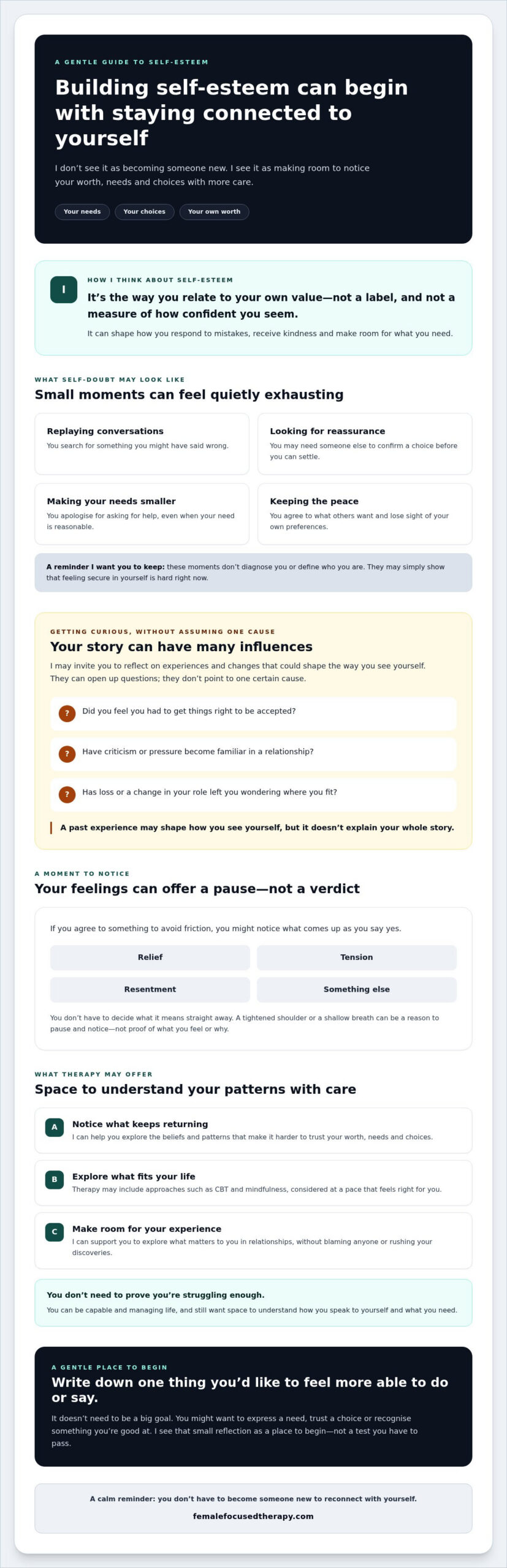
Choosing a gentle next step towards trusting yourself again
Learning to trust yourself isn’t a task you have to complete by a certain date. It can begin with small moments: noticing what you need, allowing yourself time to consider a choice or saying what matters to you. You don’t have to feel completely confident before you start.
For a gentle place to begin, write down what you hope to feel more able to do or say. Perhaps you’d like to voice a preference without immediately taking it back, or make a decision without needing everyone’s reassurance. There’s no need to turn this into a goal or measure your progress. Let it be a note to yourself about what you want more room for.
What to consider before you reach out
You might wonder what would help you feel safe and comfortable in a first conversation. You could ask about the way I work or simply say you’re unsure where to begin. You don’t need to prepare your full history or explain everything perfectly. One question is enough to open a conversation.
If you’d like to know more about my therapy practice for women, you can take a look in your own time. I offer individual psychotherapy for women in person in Singapore and online. You can decide what feels suitable and ask about anything you’d like to understand before taking a next step.
You can begin before you feel completely ready
Uncertainty can sit alongside curiosity. You might feel hesitant and still wonder whether it would help to talk. Hesitation isn’t a reason to push yourself, or something you need to overcome before reaching out. It’s all right to take time, ask questions and decide what feels comfortable.
If “therapy for building self-esteem women” is the phrase that brought you here, remember that support isn’t a promise to change who you are. It can be a space to explore how you relate to yourself, with care and at a pace that feels manageable. If you’d like to take that step, you can Book an appointment with Cheryl. You don’t need to have everything worked out first.
If you’d like to find out more about working with Cheryl Kennedy MacDonald, you can email her at cheryl@femalefocusedtherapy.com or book an appointment here: https://www.femalefocusedtherapy.com/book-now/ For lifestyle and yoga programmes, visit YogaBellies at www.yogabellies.com.
Take one gentle step towards trusting yourself
Self-doubt can show up in your choices, relationships and the way you speak to yourself. Noticing these patterns doesn’t mean something is wrong with you. It can be a starting point for understanding what you need and what might help you feel more connected to your values.
You don’t have to make sense of everything at once. You might begin by writing down one thing you’d like to feel more able to say or do. If you’re looking into “therapy for building self-esteem women”, remember that therapy is an option, not a test of how much you’re struggling.
I’m Cheryl Kennedy MacDonald, a registered psychotherapist. I offer individual psychotherapy for women in person in Singapore and online. If you’d like to explore whether working together feels right for you, you can book an appointment with me. You can bring a question, some uncertainty or simply a wish to understand yourself better.
Trusting yourself can take time, and there’s no deadline. Your next step can be small, and it can be yours.
Frequently Asked Questions
Can therapy help me build self-esteem?
Yes, therapy can give you space to explore how you speak to yourself and what you’d like to feel more able to trust. The phrase “therapy for building self-esteem women” may describe what you’re looking for, but I won’t promise a particular outcome. I can support you in considering experiences that may shape your self-view and keep our conversations focused on what feels relevant, at a manageable pace.
What type of therapy is used for self-esteem?
I use an integrative approach that may include CBT and mindfulness. CBT can help you notice links between thoughts, feelings and actions, such as how worrying about getting something wrong affects a decision. Mindfulness can help you pay attention to the present moment. I won’t assume one method suits everyone. We can discuss what feels useful and adapt the focus to your experience.
How long does therapy take to improve self-esteem?
I can’t give you a set timeline or promise when you’ll feel different. The pace depends on what you want to explore and how the work feels for you. You can ask questions about the process and review what seems helpful as you go. You don’t need to wait until you have a clear goal. We can begin with what feels difficult now, even if you’re unsure what you need.
Can I build self-esteem without therapy?
Yes, you may find private reflection, supportive relationships or small changes in how you respond to yourself helpful. Therapy isn’t the only possible route, and you don’t need to prove that you need it. If self-doubt keeps affecting your choices or relationships, I can offer a dedicated space to explore what’s happening and consider what support might feel right. You can take time to decide without treating therapy as a test.
What happens in a therapy session about self-esteem?
I may invite you to talk about a situation where you’ve doubted yourself, what you noticed in your thoughts or body, and what you’d like to understand better. You can start with one small example, such as finding it difficult to say no. You don’t have to share everything at once. You can ask questions, say what feels useful or let me know if you’d like to slow down.
Can relationship experiences affect my self-esteem?
They may influence how safe or confident you feel expressing your needs, but there isn’t one explanation that fits everyone. I can help you explore what you notice in your own experience without diagnosing another person or assuming a cause. If relationship trauma feels relevant, I can approach it carefully and at a pace that feels manageable. You can choose what you want to discuss and what feels right to leave for another time.
Is online therapy an option if I don’t live in Singapore?
Yes, I offer online therapy to a global clientele, as well as in-person sessions in Singapore. Whether online sessions suit your circumstances depends on practical arrangements, which I can clarify with you before you decide. You might consider what would help you feel comfortable speaking from your own space, such as privacy or a quiet place. You can ask me about the arrangements without deciding straight away.

Article by
Cheryl Kennedy MacDonald MA BA (Hons) Pg. Dip. SAC BACP
Cheryl Kennedy MacDonald is a psychotherapist specialising in women’s mental health, relationships, and life transitions. She works with women navigating trauma, relationship breakdown, identity shifts, and midlife change, helping them rebuild self-trust, emotional stability, and a clear sense of who they are and what they want.
With over 20 years’ experience working with women internationally, Cheryl is the founder of YogaBellies, a global women’s yoga school, and the creator of the Birth ROCKS method. Her work sits at the intersection of psychotherapy and embodiment, integrating evidence-based therapeutic approaches with somatic, body-based practices that support deep, lasting change.
Known for her grounded and direct approach, Cheryl moves beyond surface-level insight to address the patterns held in the body and nervous system. Her work supports women to regulate, reconnect, and respond to their lives from a place of clarity, strength, and self-respect.
She is a published author in academic journals and has written multiple books on women’s health, pregnancy, and midlife wellbeing, available on Amazon and leading book retailers worldwide.