
Have you ever looked in the mirror and felt like you’re staring at a stranger who just happens to be wearing your face? It’s a common, yet deeply lonely experience to feel like you’ve vanished into the roles of mother and partner. You might feel like a default parent with no personal space, constantly masking your burnout while feeling guilty for wanting a life of your own.
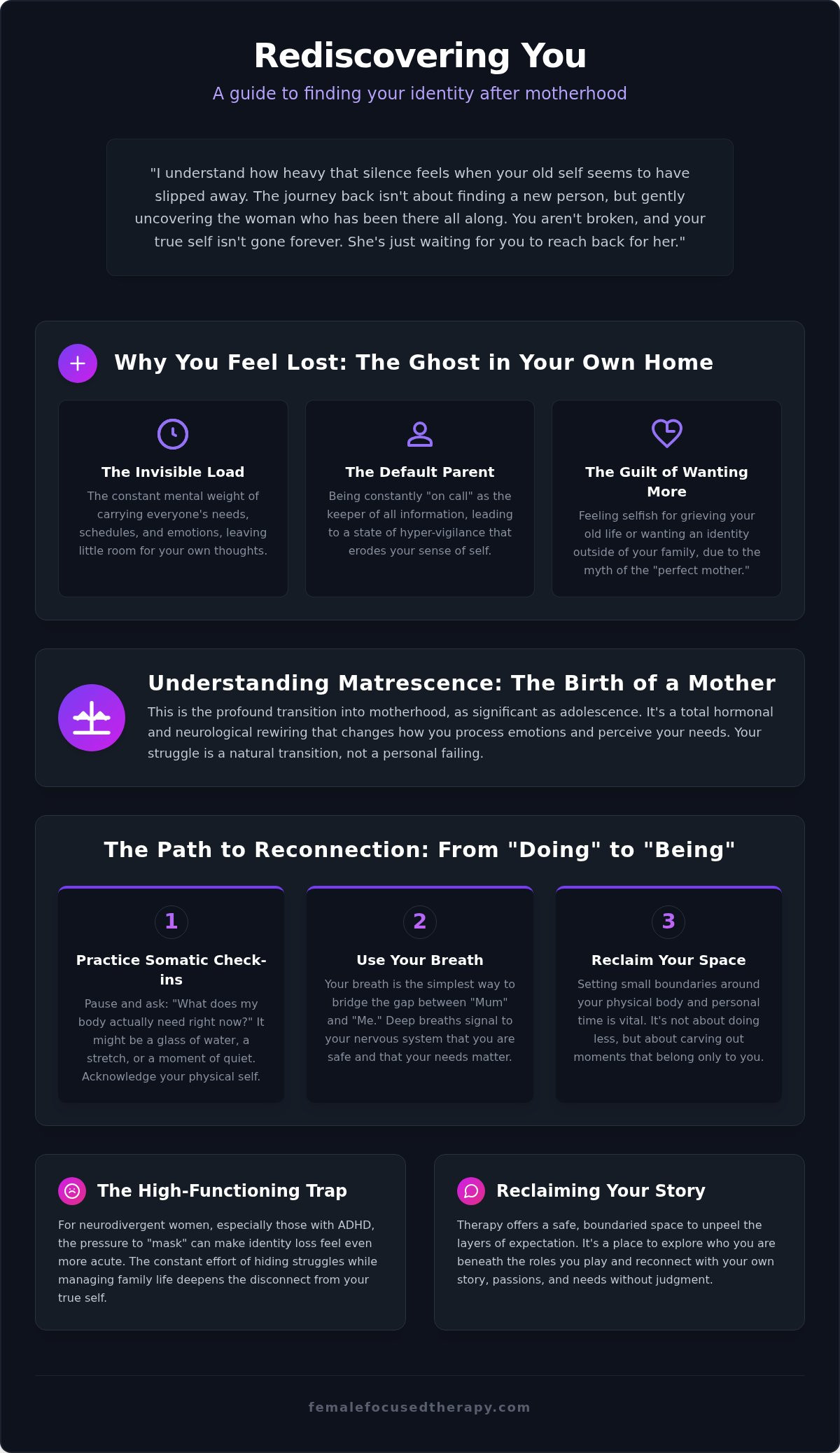
I understand how heavy that silence feels when your old self seems to have slipped away. Many of the women I work with describe a sense of grief for the person they used to be before the demands of family life took over. The journey of rediscovering identity after motherhood isn’t about finding a brand new person. It’s about gently uncovering the woman who has been there all along.
I want to help you understand why you feel so lost and show you how to reconnect with your body and mind. We’ll explore why this transition happens and look at practical, somatic ways to help you feel like yourself again. You aren’t broken, and your true self isn’t gone forever. She’s just waiting for you to reach back for her.
Key Takeaways
- I’ll help you understand why the “invisible load” makes you feel like a ghost in your own home and validate your natural desire for a life beyond your family roles.
- You’ll discover the concept of matrescence and how this total biological rewiring impacts your mind and body, helping you see your struggle as a transition rather than a failing.
- I’ll share how neurodivergent masking can make identity loss feel even more acute and offer gentle strategies for rediscovering identity after motherhood.
- We’ll explore how to move from “doing” to “being” by finding somatic micro-moments of restoration that fit into your actual, busy life.
- I’ll show you how we use a safe, boundaried therapeutic space to unpeel the layers of expectation and reconnect with the woman living beneath the roles.
The Invisible Ghost: Why You Feel Lost in Motherhood
I often hear women describe themselves as a “ghost” in their own homes. You’re physically there, moving from room to room, folding laundry, and answering every “Mum!” but you feel entirely unseen. It’s a strange, quiet kind of grief. You’re doing the most important work of your life, yet the woman you were before seems to have evaporated.
The “invisible load” is a term we hear often, but it’s more than just a list of chores. It’s the mental weight of carrying everyone else’s needs, schedules, and emotional states in your head at once. This constant cognitive labor leaves very little room for your own thoughts.
When your brain is full of school dates and grocery lists, there’s no space left for rediscovering identity after motherhood. This pressure is compounded by “intensive mothering,” a cultural ideal that demands you sacrifice every personal desire to be the perfect parent. I want you to know that your identity hasn’t died. It’s simply buried under layers of caretaking, waiting for a little bit of air.
The Weight of the Default Parent
Being the “default parent” means you’re the keeper of all things. You’re the one who knows where the spare batteries are and when the toddler last had a nap. This role makes you feel like you’re constantly “on call,” even when you’re technically off the clock. It’s an exhausting state of hyper-vigilance that erodes your sense of self over time.
In my work with women through life transitions, I see how this mental load acts like a barrier. You can’t think about who you want to be because you’re too busy being what everyone else needs. Breaking this cycle isn’t about doing less; it’s about acknowledging how much you’re actually carrying.
The Guilt of Wanting More
There’s a persistent “good mother” myth that suggests you should be entirely fulfilled by your children alone. If you aren’t, the myth implies you’re doing something wrong. I want to give you permission to feel grief for your pre-baby life. You can love your children deeply and still miss the woman who could leave the house with just a set of keys and a clear head.
This transition, often referred to as matrescence, is as significant and transformative as adolescence. It’s a total shift in your world, and it’s natural to feel disoriented. Wanting an identity outside of your family isn’t selfish; it’s actually a gift to your children. When you model a life full of passion and self-respect, you give them permission to do the same.
Rediscovering identity after motherhood starts with giving yourself grace. It begins by admitting that you are more than a set of roles. You’re a woman with her own story, and that story didn’t end when you became a mother. It just entered a new, complex chapter that we can navigate together.
Matrescence and the Body: Reconnecting Beyond the Role
I want to talk about a concept that often provides an immediate sense of relief for the women I work with. It is called matrescence. Matrescence is the birth of a mother alongside the birth of a child. It is a transition as profound as adolescence, involving a total hormonal and neurological rewiring that changes how you process emotions and perceive your own needs.
This shift isn’t just in your head; it lives in your nervous system. Your body stores the stress of this transition, often manifesting as a lingering sense of depletion or a feeling of being “touched out.” When you are in the thick of caretaking, your body becomes a tool for others’ survival. This makes rediscovering identity after motherhood feel like a physical challenge as much as a mental one.
I’ve found that when words aren’t enough, somatic movement can help you “feel” like yourself again. It allows you to move out of the analytical mind and back into the physical self. By focusing on how your body feels rather than what it can do for others, you begin to reclaim your own skin.
How Your Body Remembers You
We spend so much of our day “doing” for everyone else that we forget how to simply “be.” I encourage you to practice small, somatic check-ins during the day. Stop for a moment and ask: what does my body actually need right now? Sometimes the answer is a glass of water, a stretch, or just a minute of quiet.
Using your breath is the simplest way to bridge the gap between the role of “Mum” and the essence of “Me.” It signals to your nervous system that you are safe and that your needs matter. These micro-moments of connection are the building blocks of internal restoration.
Reclaiming Your Physical Space
Setting boundaries around your physical body is a vital part of rediscovering identity after motherhood. It is perfectly okay to claim your personal space or to let your family know when you need a break from physical contact. High-functioning women often struggle with this because they are used to masking ADHD symptoms or emotional burnout to keep the household running.
Rest is not something you earn after the to-do list is finished; it is a radical act of identity reclamation. My integrative approach combines traditional talk therapy with these body-based insights to help you find a steady sense of self-assurance. If you feel ready to explore this mind-body connection further, you can book a session with me to begin your own journey of restoration.
The High-Functioning Trap: ADHD and the Masking Mother
As a woman with ADHD, I know the heavy weight of trying to “mask” and appear perfect. I’ve lived through the exhausting effort of making sure everything looks seamless on the outside while feeling like a chaotic storm on the inside. For many of us, motherhood adds a layer of performance that feels impossible to maintain.
Neurodivergent overwhelm makes identity loss feel even more acute. When your brain is already processing sensory input at a higher intensity, the constant noise and demands of a family can lead to a specific type of burnout. You aren’t just tired; you’re neurologically overstretched. This state of survival makes rediscovering identity after motherhood feel like a distant luxury you can’t afford.
The “mental load” we discussed earlier is exponentially harder for the ADHD brain to manage. Executive dysfunction can make simple tasks feel like climbing a mountain. If you feel like you are failing to keep up with the “mummy groups” or the school run expectations, please hear this: your struggle is often just a lack of neuro-inclusive support in a world that wasn’t built for you.
The Exhaustion of Doing It All
High-functioning women are frequently the most likely to lose their sense of self. Because you are capable and intelligent, you find ways to compensate for your ADHD symptoms. You might over-function for weeks, being the “perfect” parent and partner, only to hit a wall of total exhaustion. This cycle of over-functioning and crashing is a thief of identity.
It leaves no room for your own desires because all your energy is spent maintaining the facade. Through ADHD-focused therapy, we can work together to find your unique rhythm. We look at how to support your brain’s needs so you can stop just surviving and start reconnecting with what brings you joy.
Stripping Away the Mask
Rediscovering identity after motherhood involves a brave process of stripping away the mask. We often perform the role of the “perfect mother” for friends, family, and even our partners. We hide the mess, the forgetfulness, and the sensory meltdowns because we fear being judged. But the woman you are looking for is the one who exists when no one is watching.
Finding her means being honest about your capacity and your needs. It’s about learning that you don’t have to be everything to everyone to be worthy of space. When we stop performing, we finally have the energy to remember who we were before the mask became our primary way of interacting with the world. This is the first step toward internal restoration and self-assurance.
Small Steps Toward Restoration: From Surviving to Being
When you are already exhausted, the idea of “finding a hobby” can feel like just another item on an impossible to-do list. I don’t want to give you more work. Instead, I want to guide you toward “micro-moments” of self. These are tiny pockets of time where you stop being a mother, a partner, or a professional and simply exist as a person.
We often focus so much on “doing” for others that we lose the ability to just “be.” Restoration isn’t about a massive life overhaul or picking up a complex new skill. It is about the quiet act of reclaiming your own presence. I want you to remember that rediscovering identity after motherhood is a slow, gentle unfolding, not a race to a finish line you’ve already missed.
The Power of Choice
Identity is built on agency, and the default parent role often strips that away. You can start to reclaim yourself through small, low-stakes decisions that are purely for you. This might be choosing a specific type of tea, listening to a podcast that isn’t about parenting, or wearing a colour that makes you feel bright.
You might also find joy in reconnecting with old interests, but do so without the pressure of “mastery.” If you used to paint, just doodle for five minutes. If you loved music, listen to an old album without worrying about being productive. You can explore my free therapy resources for more guidance on finding these small sparks of interest again.
Creating a “Me” Sanctuary
In a busy home, physical space is often shared or invaded. Creating a sanctuary doesn’t require a spare room; it can be a mental boundary or a specific chair where you sit for five minutes of quiet. This is where mindfulness becomes a practical tool for staying connected to your internal world amidst the external noise.
Rest is the essential first step in rediscovering identity after motherhood. You cannot find yourself if you are running on empty. True rest allows your nervous system to settle, which creates the mental space needed to remember who you are. If you are struggling to find that space alone, you can book a session with me to help you navigate these transitions.
Your realistic next step for today is simple. Try a five-minute daily check-in with your own heart. Sit quietly, place a hand on your chest, and ask yourself: “How am I actually feeling right now?” Don’t try to change the answer. Just listen to the woman who is still living beneath all those roles.
Reclaiming Your Story: How Therapy Helps You Find Your Way Back
I believe therapy is a gentle process of unpeeling the layers of who you think you “should” be. For years, you’ve likely prioritised everyone else’s needs, often at the expense of your own. In our work together, we create a safe, boundaried, female-focused space where you can finally put your own story first.
I often invite my clients to see therapy not as a way of “fixing” something that is broken, but as a path for “returning” to themselves. You aren’t a project to be managed. You’re a woman who has been navigating an intense life transition, and you deserve a place where your voice is the only one that matters. See who I work with and how I can support your transition.
A Safe Space for Your True Voice
Losing your sense of self can feel like a quiet trauma. It’s the slow erosion of your preferences, your time, and your energy. Talk therapy provides the necessary room to process this grief and acknowledge the weight of what you’ve been carrying without the fear of being judged for wanting more.
My integrative approach combines traditional psychotherapy with somatic insights, such as breath and movement. This mind-body perspective is vital for rediscovering identity after motherhood. We work together to ensure that changes are felt deeply in your nervous system, not just understood in your mind. Book a consultation with me in Singapore or online.
Moving Forward with Confidence
Rebuilding self-trust is a cornerstone of rediscovering identity after motherhood. After years of over-functioning, you might feel disconnected from your own intuition. We look at how to restore that internal compass so you can make decisions that align with your true values rather than external expectations.
The goal of this journey is internal restoration. It’s about finding a steady, grounded place within yourself that remains constant, even when the house is loud or the schedule is full. This sense of stability allows you to move through the world with a renewed sense of self-assurance and self-reliance.
I want to leave you with one final, reassuring thought. You are still in there. The woman you miss hasn’t vanished; she is simply waiting for the right conditions to emerge again. I’m here to hold that space for you and help you find your way back to her.
Your Journey of Returning to Yourself
You’ve carried the mental load and masked your own needs for a long time. But as we’ve explored, that woman you miss hasn’t gone anywhere; she’s simply waiting for you to create the quiet space for her to return. Whether it’s through understanding the neuro-biological shift of matrescence or finding somatic micro-moments of rest, every small step you take is a victory.
The path of rediscovering identity after motherhood is a slow and gentle process of internal restoration. As a registered integrative psychotherapist with over 20 years of experience, I specialise in supporting women through life transitions and the unique hurdles of ADHD. I know how to hold a safe, boundaried space where your voice finally becomes the priority.
You don’t have to navigate this transition alone. If you’re ready to find the woman beneath the roles, let’s talk. Book your session here. You’re still in there, and you’re worth the time it takes to find your way back to her.
Frequently Asked Questions
Is it normal to feel like I don’t know who I am anymore after having kids?
It is absolutely normal and expected to feel this way. The transition into motherhood, or matrescence, involves a total neurological and hormonal shift that can leave you feeling like a stranger in your own life. You are navigating one of the most profound identity changes a person can experience. I want you to know that feeling lost doesn’t mean you’ve failed; it simply means you’re in the middle of a major life transition.
How is identity loss different from postpartum depression?
Identity loss is often part of the natural, albeit challenging, process of matrescence, while postpartum depression is a clinical condition involving persistent low mood or anxiety. While they can overlap, feeling like you’ve lost your “self” is a common developmental experience for many mothers. If you’re struggling to function or feel a deep sense of hopelessness, it’s always worth exploring these feelings in a safe, therapeutic space to ensure you’re getting the right support.
I don’t have any hobbies; how do I even start finding myself?
You don’t need a big hobby or a grand passion to begin rediscovering identity after motherhood. I often suggest starting with tiny, low-stakes decisions that are just for you. This could be as simple as choosing a specific book, a scent, or a song that makes you feel like “you.” These micro-moments of choice are the building blocks of self-reclamation. You’re looking for the woman who exists beneath the roles, not a new list of tasks.
How can I find time for myself when my kids always need me?
Finding time often starts with creating a “mental sanctuary” rather than waiting for an empty house. I teach women how to use somatic check-ins and breath work to reconnect with their bodies even in the middle of a busy day. It’s about setting small, physical boundaries and reclaiming five-minute pockets of quiet. You deserve to occupy space in your own life, even when your children’s needs feel constant and overwhelming.
Can therapy really help me feel like “me” again?
Therapy provides a boundaried, female-focused space where you can finally put your own needs first. In my practice, I use an integrative approach that combines talk therapy with mindfulness to help you unpeel the layers of who you think you “should” be. We focus on internal restoration and rebuilding self-trust. This process isn’t about fixing you; it’s about helping you return to the woman who has been there all along, just waiting for the space to emerge.
What if I’m afraid that the old me is gone forever?
It is natural to feel this fear, but I promise that your true self hasn’t vanished. She has simply been buried under the heavy weight of caretaking and the “invisible load” of family life. Through the process of rediscovering identity after motherhood, we don’t look for a ghost of the past. Instead, we work on uncovering the resilient, evolved woman you are now. You are still in there, and she is worth the effort it takes to find her.

Article by
Cheryl Kennedy MacDonald MA BA (Hons) Pg. Dip. SAC BACP
Cheryl Kennedy MacDonald is a psychotherapist specialising in women’s mental health, relationships, and life transitions. She works with women navigating trauma, relationship breakdown, identity shifts, and midlife change, helping them rebuild self-trust, emotional stability, and a clear sense of who they are and what they want.
With over 20 years’ experience working with women internationally, Cheryl is the founder of YogaBellies, a global women’s yoga school, and the creator of the Birth ROCKS method. Her work sits at the intersection of psychotherapy and embodiment, integrating evidence-based therapeutic approaches with somatic, body-based practices that support deep, lasting change.
Known for her grounded and direct approach, Cheryl moves beyond surface-level insight to address the patterns held in the body and nervous system. Her work supports women to regulate, reconnect, and respond to their lives from a place of clarity, strength, and self-respect.
She is a published author in academic journals and has written multiple books on women’s health, pregnancy, and midlife wellbeing, available on Amazon and leading book retailers worldwide.