
What if feeling unlike yourself during menopause doesn’t mean you’re broken, but that you’re moving through a real change? Your body may be changing, while shifts in your mood, confidence or patience feel harder to explain. You might wonder whether therapy for menopause can help when some of what you’re experiencing is physical too. That’s a fair question.
I’m Cheryl Kennedy MacDonald, a registered psychotherapist with over 20 years of experience supporting women through life’s transitions. I know it can feel unsettling when familiar routines, relationships or parts of your identity no longer feel quite the same.
I’ll explore how therapy can give you room to make sense of these emotional shifts, and how they may be affecting your relationships and daily life. I won’t treat you as a problem to solve or promise to remove the physical effects of menopause. Instead, I’ll share how an integrative, trauma-informed and feminist approach can help you feel heard, understand what’s changing, and consider a gentle next step at your own pace.
Key Takeaways
- Feeling unlike yourself during menopause can be unsettling, and your experience doesn’t need to match anyone else’s.
- Therapy for menopause can offer space to explore emotional and relationship changes without treating you as broken.
- Psychotherapy can support your emotional wellbeing, but it doesn’t replace medical care for physical concerns.
- I tailor my trauma-informed, feminist and integrative approach to what feels relevant for you.
- You can begin gently by noticing what you’d most like to talk about, without needing to have it all worked out.
When menopause changes how you feel about yourself
You may still be getting through work, family life and the small tasks that fill your day. Inside, though, something may feel different. A familiar routine can suddenly take more effort, or your usual response to a minor frustration may surprise you.
I don’t assume menopause feels the same for every woman. It can coincide with changes in mood, relationships or how you see yourself, but there isn’t one explanation that fits every experience. Feeling affected by this transition doesn’t mean you’re broken or failing.
The quiet feeling of not quite being yourself
There can be a gap between how capable you appear and how stretched you feel in private. You may still be answering messages, showing up for others and keeping plans, while finding that you have less patience than you used to. Perhaps an ordinary evening routine feels unexpectedly demanding, or you need more quiet after a day that would once have felt manageable.
I’m interested in what that change feels like for you, rather than in fitting it into a label. You might feel unsettled, frustrated, sad, or simply unsure why familiar things seem to land differently. You don’t have to present a neat account of it. Sometimes it’s enough to notice, “This feels different from me,” and give that feeling a little room.
Why a life transition can touch more than one part of you
Changes in your body may sit alongside questions about identity, closeness, work or what you want from the years ahead. One part of you might be adapting to new physical experiences, while another wonders how your role in a relationship or family is changing. These parts can overlap, but I wouldn’t reduce a particular emotion to hormones or assume I know what it means for you.
If a clear overview would help you place your experience in context, you can read Understanding Menopause. I find it useful to keep general information separate from your personal story. Facts may offer a starting point, but they can’t tell you what this transition means in your life.
Emotional support can make room for the meaning of a transition, not just the changes you can name.
You could begin simply by noticing what feels different lately. Perhaps you miss your old ease with people, or you’re rethinking what you have energy for. You don’t need to explain it perfectly or share anything before you’re ready. If you’d like to understand how therapy for menopause and life transitions can hold these questions, I describe my approach there. For now, you can meet this uncertainty with curiosity rather than self-blame. It’s possible to feel changed and still be yourself.
What therapy for menopause can hold beyond symptom lists
I understand therapy for menopause as psychotherapy that offers you space to explore the emotional and relational experience of this transition. Rather than working through a fixed symptom checklist, I can begin with what feels most present for you, whether that’s a change in closeness, uncertainty about what comes next, or feelings you haven’t yet found words for.
A list can help you recognise what you’re experiencing, but it can’t tell the whole story of how those changes sit within your life. You might be managing your usual responsibilities while privately wondering why a conversation with someone close to you feels harder than it used to. In therapy, I can make room for the moment itself and what it means to you, without assuming there’s one right way to feel.
Making room for the feelings and questions underneath
You may be carrying uncertainty, a sense of loss for a former version of yourself, or questions about intimacy and connection. You might also feel none of these things. I won’t assume. A gentle conversation can help you put words to what feels unfamiliar, even if all you can say at first is, “I’m not sure what’s going on.”
Sometimes, having language for a change can make it easier to talk about in everyday life. The Menopause Symptoms and Mental Health resource offers information about symptoms, including mood changes. I can hold that general information alongside your own experience, without treating it as an explanation for everything you feel.
Where psychotherapy fits alongside medical care
I offer psychotherapy and counselling, not HRT, medication management or medical menopause treatment. If you have physical health concerns, I encourage you to raise them with an appropriate healthcare professional. Emotional support and medical care have different roles; they can sit alongside each other rather than compete.
Therapy can help you explore the emotional meaning of menopause; medical care addresses physical health concerns. I won’t promise to stop menopause-related changes, but I can support you in understanding how this period is affecting your relationships, sense of self and daily life. You can read about my menopause and life-transitions therapy to understand how I hold this work.
You don’t need to arrive with a clear goal or a polished explanation. I can begin with what you’d most like to have space for, and follow a pace that feels manageable. If you’d like to take that small step, you can book an appointment with me.
Is therapy for menopause the right kind of support for you?
I don’t treat menopause itself through psychotherapy. I can offer a place to explore the emotional experience around it, especially if changes are touching your sense of self, your relationships or your emotional steadiness. You don’t need to be in crisis or have a clear name for what’s happening before therapy might feel relevant.
It may help to think of psychotherapy and medical care as having different purposes. Neither has to replace the other. I’ve set out the distinction simply below.
When you want space to understand what is changing
You might feel overwhelmed by changes in your daily life, less connected to yourself, or unsure how to express what you need to someone close to you. These experiences don’t have to mean anything is wrong with you. They may simply be part of what you want to understand.
You don’t need a perfect explanation to begin. I can start with whatever feels easiest for you to say, even if it’s only that something feels different. I’ll make space for what matters to you and follow your pace, rather than pushing towards a ready-made answer.
For instance, you may find yourself withdrawing from a conversation because you can’t yet put your feelings into words. In therapy, we can take time to explore what you wanted to say, what felt difficult, and what you might need now. I won’t assume the answer or treat your reaction as a sign of a condition.
When medical questions need a different conversation
If you’re wondering about physical changes or medical treatment, that’s a different conversation from the emotional reflection I offer in psychotherapy. I don’t provide medical menopause treatment, and emotional support alone may not address every concern. You can bring physical health questions to an appropriate healthcare professional, while using therapy to explore how this period is affecting you.
Therapy and medical care can have different, complementary roles: one can support emotional reflection, while the other can address physical health concerns.
If you’re unsure whether therapy fits what you’re going through, you don’t have to decide everything at once. You might begin by noticing whether you’re looking for space to understand your feelings, help finding words for a relationship conversation, or support with a question about your physical health. That small distinction can help you choose what kind of conversation to have first. If you’d like to explore therapy with me, you can book an appointment.
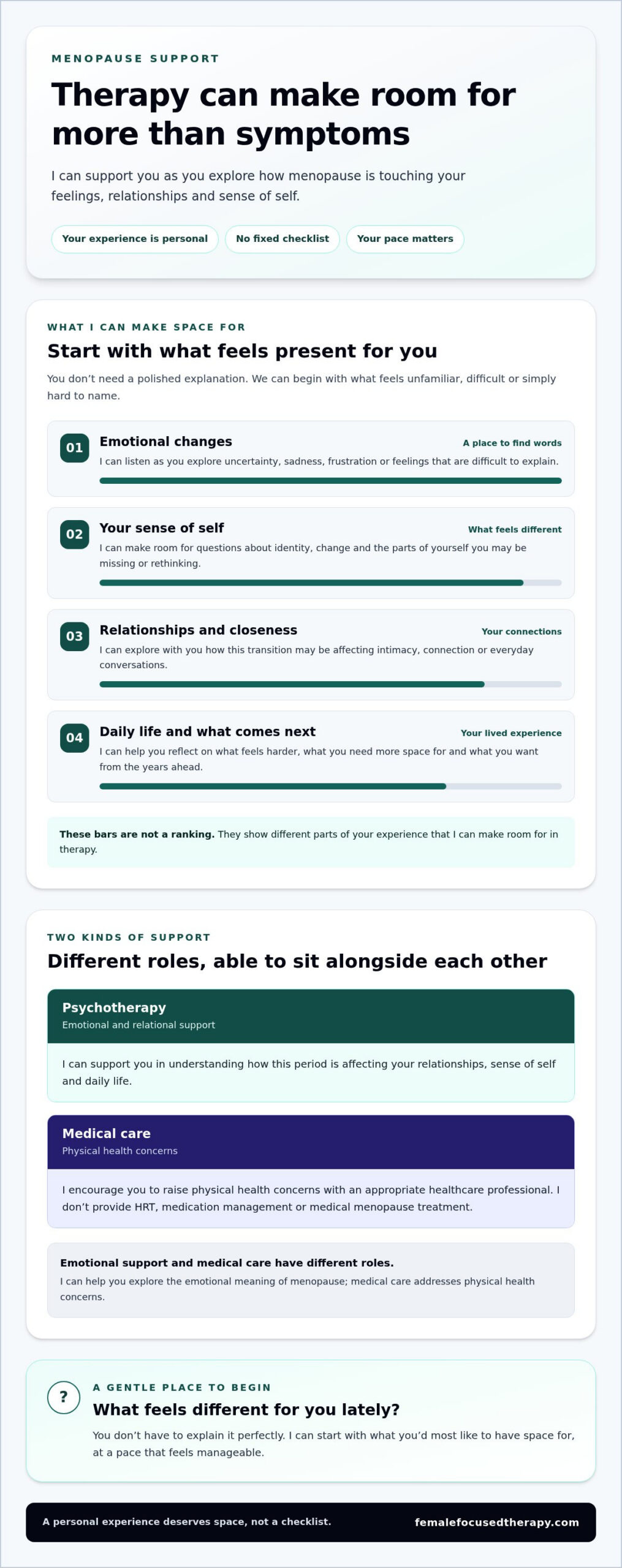
How I make space for your menopause experience in therapy
I bring a trauma-informed, feminist and integrative approach to therapy for menopause. That means I listen to your experience with care, respect the context of your life, and don’t assume there’s one right way to move through this transition. I’m not here to fix you or tell you what you should feel. I’m here to understand what matters to you and explore it with you.
Beginning with what feels most present for you
I begin by listening to what feels difficult or important now. You might be struggling to explain a change in a close relationship, or find that a conversation leaves you unsure what you wanted to say. You don’t need a diagnosis, a neatly defined goal or the perfect words. I can start wherever you are and stay with what feels manageable.
Listening to the mind and body together
Sometimes, noticing your breath, tension or need for rest can help you pay attention to what’s happening for you. I may include this kind of body awareness as part of my work, if it feels useful. It isn’t a prescribed exercise or a cure. It’s simply one way of making room for your experience, alongside talking and reflection.
My approach is collaborative. I’ll bring my experience and knowledge, while you remain the expert on your own life. I can help you notice what feels relevant and adjust the focus as your needs become clearer. You don’t have to follow a set programme or cover everything at once.
I can draw on different approaches depending on what you bring. ACT can help us explore what matters to you while making room for difficult thoughts and feelings. CBT can help us look at links between thoughts, feelings and actions in everyday situations. Psychodynamic therapy can offer space to consider how earlier experiences may shape what you’re facing now.
I may also draw on somatic and mindfulness-based practices, Coherence Therapy or Depth-Oriented Brief Therapy. In plain terms, these approaches can help us pay attention to your present experience, explore patterns and make sense of what feels emotionally important. I won’t assume one method suits everyone, or promise a particular result. I’ll talk with you about what feels helpful and why.
If you’re adjusting to menopause while also carrying changes in relationships, identity or daily life, I can hold those threads together without reducing your experience to a single cause. There’s room for uncertainty, mixed feelings and pauses. You can take your time deciding what you want to explore.
If you’d like to begin this kind of conversation with me, you can book a therapy appointment.
A gentle next step if menopause has left you feeling alone
If you’ve been trying to carry the emotional weight of menopause by yourself, needing support doesn’t mean you’re failing or broken. It may simply mean that something feels hard to hold without space to pause and make sense of it. You don’t need to wait until you’ve reached a breaking point, or be certain that therapy is the answer, before considering a conversation.
You do not need to have it all worked out first
You might feel confused, have mixed feelings, or find it difficult to explain what has changed. That’s all right. I can meet you with warmth and curiosity, not judgement, and listen without expecting you to arrive with a clear goal or a polished story.
If you’d like to understand how I work, you can read about my approach to therapy for women. I offer individual psychotherapy in person in Singapore and online globally. Whatever brings you to the conversation, I’ll pay attention to your experience and what feels important to you, rather than assuming what you need.
A small step towards feeling heard
You might gently ask yourself: what feels hardest to carry on your own right now? You don’t have to write it down, find the perfect words or share anything before you feel ready. Even noticing that a particular worry, relationship change or uncertainty is taking up space can help you recognise where you might want support.
There may be more than one answer, or no clear answer yet. You’re allowed to take your time. A first conversation doesn’t require you to explain every part of menopause or know what you want to change. It can begin with what feels possible to say today, and unfold at a pace that feels manageable to you.
I offer therapy for menopause as a space to explore the emotional side of this transition, not to fix you or promise a particular outcome. You can come with uncertainty, pauses and questions. You don’t have to prove that your feelings are serious enough to deserve care.
If you feel ready to take that step, you can book an appointment with me. There’s no need to have it all worked out first.
Take a gentle step towards feeling heard
You don’t have to know exactly what you need before you begin. You might start with one small thought, such as wanting more room to understand what feels different, or finding a way to talk about it with someone close to you. That can be enough for a first conversation. You can take your time and decide what feels useful as we go.
I’m Cheryl Kennedy MacDonald, and I offer trauma-informed, feminist and integrative psychotherapy for women. I’m registered with BACP and SAC, and I bring over 20 years of professional experience to my work. Therapy for menopause isn’t about fixing you. It can be a thoughtful space to explore what this transition means for you, with care and respect for your pace.
If you feel ready to begin, you can book an appointment with me. You deserve support that meets you as you are, and you can take the next step when it feels right.
Frequently Asked Questions
Can therapy help with menopause?
Yes, therapy can support you with the emotional and relationship changes you’re experiencing around menopause. In therapy for menopause, I can help you explore what’s weighing on you, such as feeling less sure of yourself at work or finding it harder to ask for space at home. You don’t need to know whether a feeling is “because of menopause” before talking about it. We can start with what feels important to you.
Is therapy for menopause the same as hormone replacement therapy?
No. Psychotherapy and hormone replacement therapy have different purposes. I offer psychotherapy and counselling, not HRT or medical treatment. I can help you think through how this transition feels and what support you want emotionally. For questions about physical changes or medical treatments, speak with an appropriate healthcare professional. You may choose to have both kinds of support, depending on your needs, without treating them as substitutes for each other.
Can therapy help if menopause is affecting my mood?
Yes, I can offer space to explore mood changes and how they’re affecting your day-to-day life. For example, you might want to understand why a small disagreement stays with you, or how you’d like to respond when you feel more easily frustrated. I won’t assume a particular cause or label your experience. Together, we can look at what you notice and what might help you feel more understood in your relationships.
What happens in a menopause therapy session?
I’ll invite you to begin with what feels most useful to talk about. You might bring a recent moment that’s been on your mind, a change in how you relate to someone, or a question you’re still trying to form. I’ll listen and respond to what you share, rather than work through a standard menopause checklist. You can let me know if you’d rather pause, change direction or take time to find your words.
Can online therapy support me through menopause?
Yes, I offer online therapy for women globally. Meeting online can make it easier to speak from a familiar setting, particularly if travel or a busy day makes an in-person appointment harder to fit in. You can use the conversation to focus on what’s happening in your life, just as you would in person. I provide psychotherapy and counselling online, not medical assessment or treatment for physical menopause concerns.
When might I consider therapy during perimenopause or menopause?
You might consider therapy if you’re finding it hard to make sense of your feelings, communicate what you need, or feel connected to yourself in everyday life. You don’t have to wait until things feel unbearable, and you don’t need to decide whether your experience is serious enough. If something keeps occupying your thoughts or affecting a relationship, that can be a reason to give yourself space to talk it through.

Article by
Cheryl Kennedy MacDonald MA BA (Hons) Pg. Dip. SAC BACP
Cheryl Kennedy MacDonald is a psychotherapist specialising in women’s mental health, relationships, and life transitions. She works with women navigating trauma, relationship breakdown, identity shifts, and midlife change, helping them rebuild self-trust, emotional stability, and a clear sense of who they are and what they want.
With over 20 years’ experience working with women internationally, Cheryl is the founder of YogaBellies, a global women’s yoga school, and the creator of the Birth ROCKS method. Her work sits at the intersection of psychotherapy and embodiment, integrating evidence-based therapeutic approaches with somatic, body-based practices that support deep, lasting change.
Known for her grounded and direct approach, Cheryl moves beyond surface-level insight to address the patterns held in the body and nervous system. Her work supports women to regulate, reconnect, and respond to their lives from a place of clarity, strength, and self-respect.
She is a published author in academic journals and has written multiple books on women’s health, pregnancy, and midlife wellbeing, available on Amazon and leading book retailers worldwide.