
What if feeling frozen says nothing about how much you care? When you’re trying to describe adhd paralysis what it feels like, you may mean wanting to start a task but feeling unable to take the first step. The minutes pass, the pressure builds, and self-criticism can creep in.
I know how painful that gap between wanting to act and feeling able to begin can be. I’m Cheryl Kennedy MacDonald, a psychotherapist and an adult woman with ADHD. I’m not here to judge you or turn one stuck moment into a diagnosis.
In this article, I’ll help you find words for the experience and explore why competing choices or demands can feel overwhelming. I’ll also explain why “ADHD paralysis” describes an experience, rather than proving you have ADHD.
Most of all, I want you to leave with a gentler way to meet yourself in that moment, and one small, realistic next step you can try without expecting yourself to solve everything at once.
- I’ll help you find words for the stuck feeling, including thoughts and body sensations that may come with it.
- You can care deeply about a task and still find the first step hard when demands or decisions feel tangled.
- I’ll share a gentle way to pause, notice what’s happening, and choose one visible next action to try.
- You’ll learn why “ADHD paralysis” describes an experience, not a diagnosis or a measure of your motivation.
- I’ll show how therapy can offer space to explore overwhelm and build self-trust, without treating you as someone who needs fixing.
When ADHD paralysis feels like wanting to act but feeling stuck
I can want to begin and still find myself unable to move towards a task. I might know what needs doing, care about getting it done, and even have time set aside. Yet the first step feels out of reach. From the outside, it may look as if nothing is happening. Inside, I may be trying hard to get moving.
I use “ADHD paralysis” as a common phrase for this stuck feeling. I don’t use it as a formal diagnosis or to mean that you’re physically unable to move. It describes a moment when starting feels difficult, even though the intention is there.
I don’t see feeling stuck as proof that you don’t care. I know how quickly self-judgement can fill the silence around a task. When I can’t begin, I try to meet the experience with curiosity rather than blame. Difficulty starting doesn’t mean I’m lazy, careless or choosing not to try.
The strange gap between intention and action
I might open a message from someone I genuinely want to reply to, read it, then leave it unanswered. I may even compose a response in my head. My care and intention are real, even though I haven’t sent the reply.
If you recognise this, I wouldn’t treat it as a diagnostic sign. I can’t tell whether you have ADHD based on one unanswered message. Instead, I can use a moment like this to notice the gap between wanting to act and feeling able to begin.
Why the word paralysis can feel so familiar
I understand why “paralysis” can sound strong. I use it to describe feeling frozen or stuck, not literal physical paralysis. Your experience may feel like a blank pause, while mine may feel different. You don’t have to experience it in one particular way for the word to help you describe what’s happening.
I find it useful to think of executive function as the everyday skills I use to organise and start tasks. If I want more context, I can explore Executive Dysfunction and ADHD Paralysis, while remembering that this phrase isn’t a diagnosis. I can take what feels useful and leave the rest.
For me, adhd paralysis what it feels like comes down to the gap between caring and starting. If that gap feels familiar to you, I share more about how I support women with ADHD on my ADHD support for women page. You don’t need to judge yourself before you’re allowed to understand your experience.
What ADHD paralysis can feel like in your mind and body
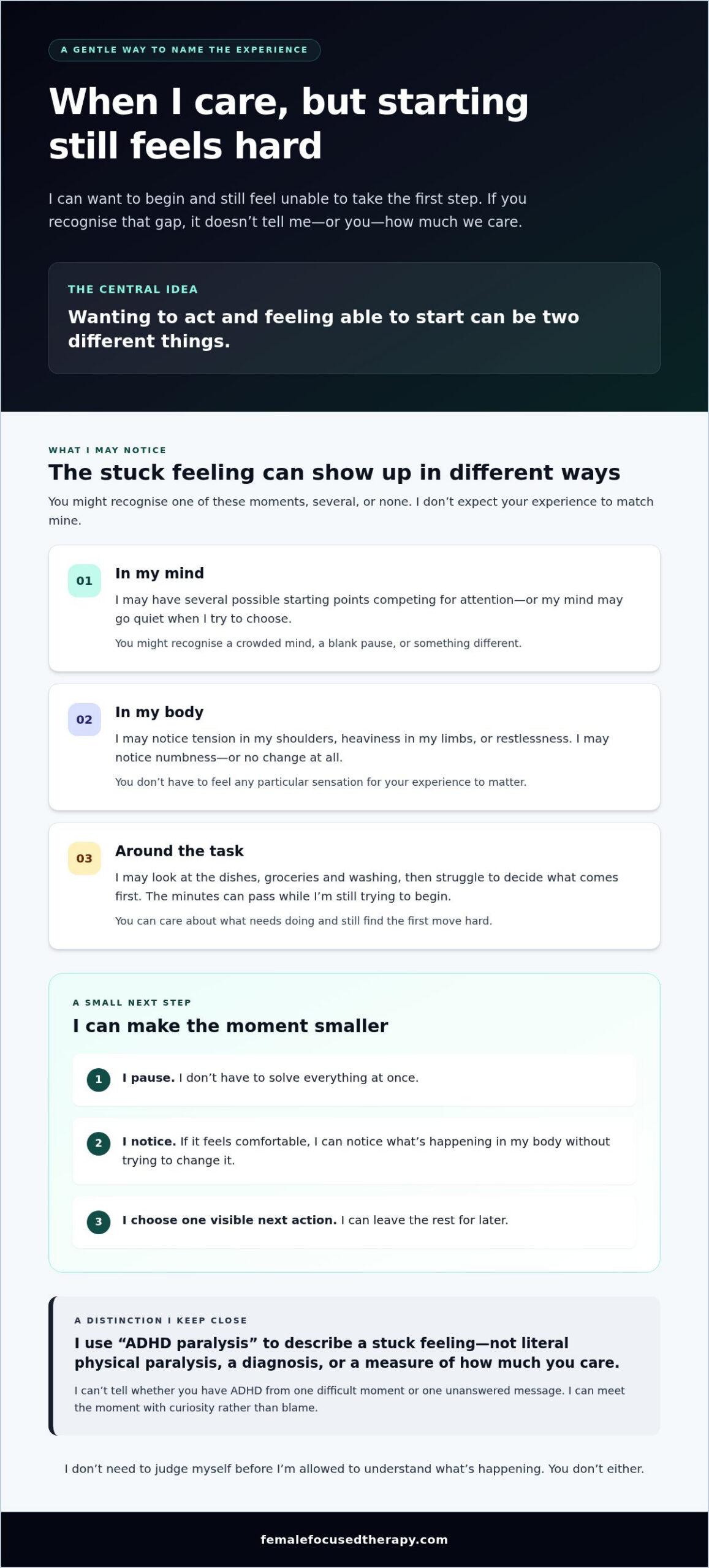
For me, the stuck feeling doesn’t always arrive as one clear thought. Sometimes my mind feels crowded, with several possible starting points competing for attention. At other times, I reach for the next step and find nothing there. I may know I have things to do, yet feel unable to sort them into an order. You might recognise one of these experiences, or have a different one altogether.
I might stand in my kitchen with washing, dishes and groceries still waiting. As I look around, I can struggle to decide what comes first. The minutes pass, and I may feel heavy or unsettled. If you’ve had a moment like this, I understand how confusing it can feel, especially if you expected yourself to get on with it.
When thoughts feel crowded or suddenly go quiet
I might hear several possible starts in my mind: do the dishes, put away the groceries, or deal with the washing first. Or, when I try to choose, my mind may go blank. These can feel like very different moments, yet either can make it hard to approach a task. You might recognise one, both, or neither.
I can use a feeling to describe a moment, but not as a checklist that proves ADHD. I keep that distinction close. If you’d like another perspective, you can read Understanding ADHD Paralysis from ADDA. You may find useful words there, but no single description explains everything you’re experiencing.
When your body seems to join the stuck feeling
I might notice tension in my shoulders, heaviness in my limbs, or restlessness that makes it hard to stay in one place. You might notice numbness, a different sensation, or no change in your body at all. I don’t take any of these feelings as proof of ADHD or evidence of one particular cause.
If it feels comfortable, I might simply notice what’s happening in my body. Is my jaw tight? Can I feel my breath, or not particularly? I don’t have to change anything or make a sensation go away. I’m inviting myself to be curious, rather than giving myself another task to get right. You can do the same, or leave it if it doesn’t feel useful.
When I think about adhd paralysis what it feels like, I make room for a busy mind, a quiet one, and a body that may feel tense, heavy, restless or unchanged. I don’t expect your experience to match mine. I want to meet what’s happening with care and let it be worth understanding.
Why getting started can feel hard even when you care
I can care deeply about something and still find it hard to begin. I might want to reply to an important email, prepare dinner, or finish a work task, yet feel unable to choose the first move. If you know that gap, I want to say this clearly: it doesn’t tell me how much you care or what you’re capable of.
I find it helpful to think of executive function as the everyday skills I use to organise, prioritise and start tasks. ADHD may affect these skills, but I wouldn’t assume they explain every difficult moment or that there’s one cause behind feeling stuck.
Difficulty starting is not a measure of how much you care or what kind of person you are. I know how quickly a delay can become a story about my character. But not having begun yet doesn’t erase the effort, concern or intention I’m bringing to the task.
When every task seems to need your attention
I might come home with groceries to put away, a message to answer and dinner still to plan. Each demand feels reasonable on its own, but together they compete for my attention. I can get caught trying to work out which one matters most, or which choice will cause the least trouble if I leave it until later.
You might recognise a similar tangle, or your overwhelm may come from somewhere else. I don’t need to find one neat explanation. When I’m unsure where to start, choosing a first task can feel like another task in itself.
When self-blame makes the stuck feeling heavier
“I should be able to do this by now” is a thought I know can creep in. I may compare myself with how easily I imagine someone else would manage, or remember a time when this kind of task felt simpler. That judgement can add pressure without making the next step any clearer.
If you hear that voice too, I’d invite you to notice it as a thought, not a verdict. A difficult moment doesn’t sum up your worth, your ability or the care you have for your life. You can be capable and still need support, time or a clearer starting point.
Sometimes I can loosen the knot by asking, “What is actually asking for my attention right now?” I don’t have to solve every demand or decide what my whole day should look like. I can notice whether one task is urgent, whether another can wait, or whether I need a moment to gather myself. That pause won’t always make starting easy, but it can help me meet the moment with less judgement.
When I think about adhd paralysis what it feels like, I keep returning to this tension: I may want to act and still not know how to begin. Understanding that distinction gives me a kinder place to start than self-blame.
What I can try when ADHD paralysis leaves me stuck
When I notice I’m stuck, I try not to turn the moment into a demand to catch up. I don’t need to solve the whole task or make myself feel ready before I begin. I might pause, notice what’s happening, then choose one visible action. It’s an invitation, not a rule, and it may not suit every moment.
If you’re wondering about adhd paralysis what it feels like, you may already know how quickly pressure can build when a task feels too big to approach. I find it helpful to make the next step smaller, while remembering that a pause can be useful too. Slow progress isn’t a failure.
Make the next step smaller and clearer
I might tell myself, “I need to sort out the whole kitchen,” and feel overwhelmed before I start. I can make the task more visible by choosing just one action, such as putting the clean cups away. I don’t have to commit to finishing the kitchen. I’m only choosing what I might do next.
You could try naming an action you can see or touch, like opening the document or placing one item where it belongs. If even that feels like too much, I can make the step smaller again or leave it for now.
Meet the moment before asking more of yourself
Before I choose a next step, I might notice what’s happening in my body. I can feel whether my shoulders are tight or simply notice my breath, without trying to change either. Then I might say, “This feels difficult right now. I can choose one small thing, or pause.”
You don’t have to use those exact words. I’m offering them as a way to meet yourself with a little less pressure. You might find that a small action feels possible; you might need rest or a different kind of support. Either response is allowed.
I know from my own experience as an adult woman with ADHD that finding a kind next step can take practice. If you’d like space to understand your overwhelm and build self-trust, I offer individual psychotherapy with a trauma-informed, feminist and integrative approach. You’re welcome to book an appointment with me if that feels right. There’s no need to have everything worked out before you begin.
How I can support you as you make sense of ADHD paralysis
I can offer a space to explore what feeling stuck means in your life, without treating it as a flaw to correct. We might look at the moments when overwhelm gathers, what self-doubt says afterwards, and how your own experience of ADHD fits into the wider picture. You don’t need to arrive with a neat explanation.
A space to understand your experience without judgement
I’m Cheryl, a psychotherapist and an adult woman with ADHD. My own experience helps me understand why this subject matters to me, but it doesn’t mean I assume your experience will be the same as mine. I’ll listen to what feels true for you, and we can make sense of it at a pace that feels manageable.
My approach is trauma-informed, feminist and integrative. I pay attention to the whole person, including the feelings and body sensations that may come with overwhelm. Therapy can be a place to notice patterns, gently question harsh self-judgements and build trust in your own understanding. I don’t diagnose ADHD or manage medication. Therapy isn’t about fixing you, and I can’t promise a particular outcome.
I offer psychotherapy in person in Singapore and online globally. If you’d like to know more about how I work with women, you can visit the Female Focused Therapy homepage. You’re welcome to take your time deciding whether support feels right for you.
A gentle way to explore working together
If you’re unsure where to begin, you might consider a clarity session as an introductory step. It can give you space to share what you’d like support with and get a sense of whether working together feels comfortable. You don’t need to prepare a perfect account or know exactly what you need before you book.
For now, one small step could be writing down a question you’d like to bring, or simply noticing what you hope might feel different with more understanding. If a first conversation feels helpful, you can book a clarity session with me. There’s no pressure to take that step before you feel ready.
If you’d like to find out more about working with Cheryl Kennedy MacDonald, you can email her at cheryl@femalefocusedtherapy.com or go ahead and book an appointment with Female Focused Therapy. For lifestyle and yoga programmes, you can also visit YogaBellies.
Give yourself room for a kinder next step
You don’t have to work out everything about yourself today. Perhaps it’s enough to notice what happens when you feel stuck, and meet that moment with a little less judgement. A small shift in how you speak to yourself can make space for a different choice, even if the task is still waiting.
I’m Cheryl Kennedy MacDonald, a registered psychotherapist with BACP and SAC. I’ve spent over 20 years working with women, and I bring both professional experience and my own perspective as an adult woman with ADHD to my work. I offer a thoughtful space to explore what feels difficult without expecting you to have all the answers.
If you’re still wondering about adhd paralysis what it feels like, you can keep noticing your own experience without treating a familiar description as a verdict. If you’d like to explore your next steps with me, you can arrange a clarity session. There’s no need to feel perfectly ready. You can begin with one honest question and take things from there.
Frequently Asked Questions
Can ADHD paralysis happen with tasks I enjoy?
Yes, I can enjoy something and still find it hard to begin. I might look forward to a creative project, yet feel unsure how to move from imagining it to setting things up. Enjoyment doesn’t always make the starting point obvious. I’d treat that moment as something to get curious about, not proof of ADHD or a measure of your enthusiasm. You can notice it without criticising yourself.
Is ADHD paralysis the same as burnout?
I wouldn’t use these terms as if they mean the same thing. I use “ADHD paralysis” for a feeling of getting stuck around a task or choice. Burnout is a broader experience of exhaustion, and the two may feel tangled in your life. I can’t tell from a short description what’s happening for you. If the difference matters to you, I can help you explore it in therapy.
Can ADHD paralysis affect everyday tasks as well as work?
Yes, the feeling can show up around ordinary parts of life, not only work or study. You might find it hard to book an appointment, sort out a personal form, or decide what to bring on an outing. I wouldn’t treat one difficult moment as proof of anything. You can consider whether it’s causing strain in your day-to-day life and what kind of understanding or support you want.
How can I explain ADHD paralysis to someone close to me?
I might say, “I want to do this, but I’m finding it hard to get started.” You could choose one recent, low-pressure example to make the experience easier to picture, such as a small job you meant to do at home. You don’t need to share more than feels comfortable or convince someone of your effort. A simple explanation can be enough; you can set a boundary if you’d rather not discuss it.
Can ADHD paralysis happen when I have several choices to make?
It can feel harder to move forward when a decision brings several possibilities to mind. I might find it useful to write down the choices, then mark which one actually needs attention now. If none needs an immediate answer, I can give myself permission to return to it later. This is one possible way to make a choice feel less tangled, not a rule about ADHD or a method that has to work for you.
Can I talk about ADHD overwhelm in therapy if I don’t know what to say?
Yes. You can begin with a few words about what has felt difficult lately, even if you’re unsure how to describe it. I can ask gentle questions and explore what the overwhelm means in your life, without expecting a tidy explanation. My work is trauma-informed, feminist and integrative. Therapy isn’t about fixing you; it’s a space to understand yourself with support and build self-trust at a pace that feels manageable.

Article by
Cheryl Kennedy MacDonald MA BA (Hons) Pg. Dip. SAC BACP
Cheryl Kennedy MacDonald is a psychotherapist specialising in women’s mental health, relationships, and life transitions. She works with women navigating trauma, relationship breakdown, identity shifts, and midlife change, helping them rebuild self-trust, emotional stability, and a clear sense of who they are and what they want.
With over 20 years’ experience working with women internationally, Cheryl is the founder of YogaBellies, a global women’s yoga school, and the creator of the Birth ROCKS method. Her work sits at the intersection of psychotherapy and embodiment, integrating evidence-based therapeutic approaches with somatic, body-based practices that support deep, lasting change.
Known for her grounded and direct approach, Cheryl moves beyond surface-level insight to address the patterns held in the body and nervous system. Her work supports women to regulate, reconnect, and respond to their lives from a place of clarity, strength, and self-respect.
She is a published author in academic journals and has written multiple books on women’s health, pregnancy, and midlife wellbeing, available on Amazon and leading book retailers worldwide.