
Did you grow up feeling like you were walking on emotional eggshells, constantly trying to predict a parent’s mood to keep the peace? You may have believed it was your job to manage their happiness, a role that has left you feeling emotionally exhausted and filled with a chronic self-doubt that you just can’t shake. It’s a confusing and often invisible burden to carry, especially when the world saw a perfectly normal family.
In this article, we will gently explore the subtle, often painful signs of a narcissistic parent. My promise is to help you find clarity and validation for your childhood experiences. We will illuminate a path forward, showing you how to begin the essential work of rebuilding your self-trust and reclaiming your own emotional wellbeing. Together, we’ll navigate these challenging dynamics and uncover the first steps toward healing and confidence.
Key Takeaways
- Learn to identify the subtle forms of conditional love and lack of empathy that you may have normalised as a child.
- Understand how the common signs of a narcissistic parent can manifest in your adult life as chronic self-doubt or a relentless drive to overachieve.
- Explore different approaches to setting healthy boundaries and find a path that feels sustainable for your emotional wellbeing.
- Discover the first steps toward rebuilding your self-trust and learn why naming your experience is a powerful part of the healing process.
The Quiet Weight of Growing Up with a Narcissistic Parent
You may be here because you carry a quiet, unnamed weight from your childhood. Home might have looked perfect from the outside, but inside, it felt like a minefield. You learned to navigate the terrain by “walking on eggshells,” a state of high alert that became your normal. This constant tension is one of the most common, yet confusing, signs of a narcissistic parent. It’s a profound sense of unease that settles deep in your bones, an experience made harder to name because there are often no visible scars to prove it happened.
It’s easy to dismiss these feelings. You might tell yourself your parent was just “difficult” or “had a lot of stress.” Every family has its challenges, right? But there is a fundamental difference between a parent who is imperfect and a dynamic that is narcissistic. A difficult parent may have moments of selfishness or anger, but they can also show remorse and prioritize your wellbeing. In contrast, a Narcissistic parent consistently structures the family environment around their own emotional needs, leaving you feeling unseen and emotionally unsafe. This dynamic slowly erodes your ability to trust your own perceptions and feelings, which is the deepest wound of all.
The Parent Who Competes Instead of Nurtures
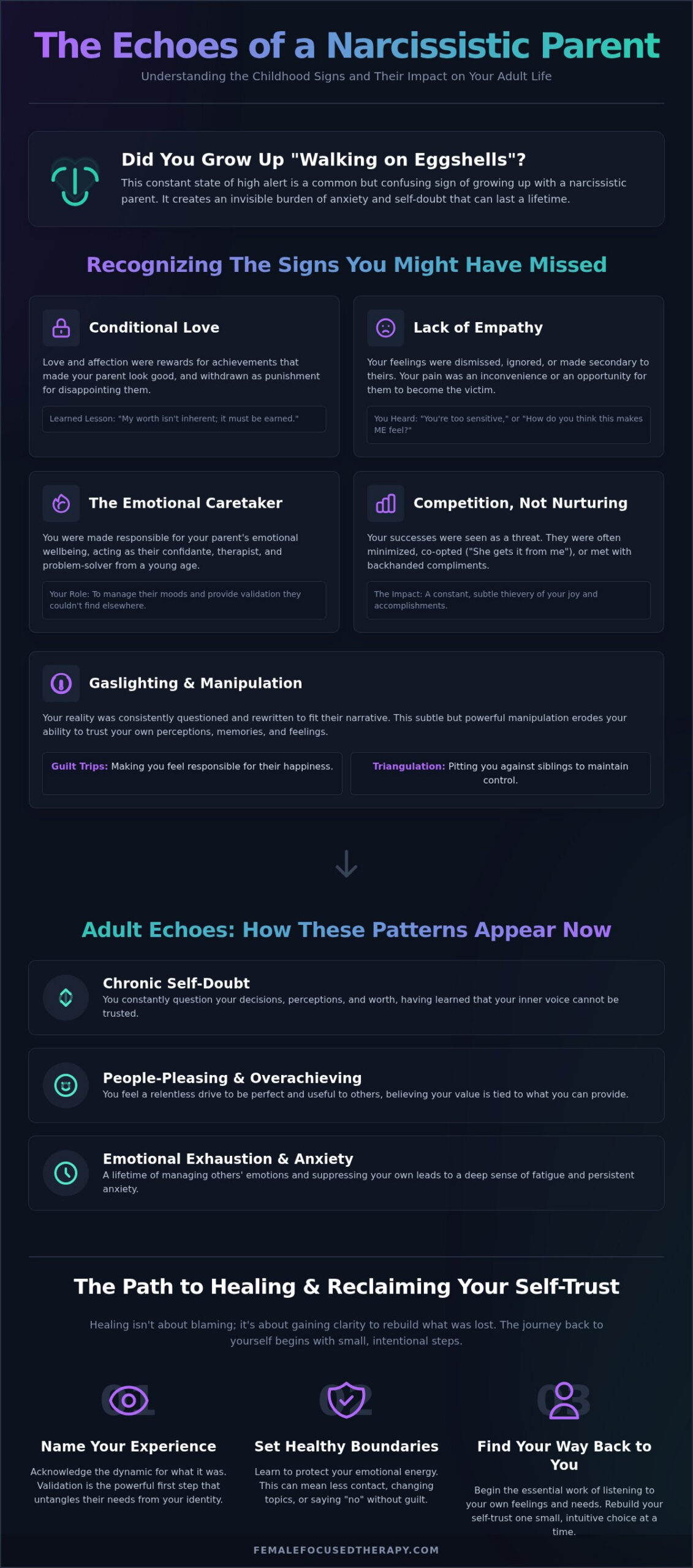
For a daughter, this often manifests as a strange and painful competition. Instead of celebrating your achievements, a narcissistic parent may see your light as a threat to their own. Your successes are either co-opted as their own (“She gets her intelligence from me”) or subtly minimized. They might change the subject right when you share good news or offer backhanded compliments that leave you feeling small. This constant, subtle competition is a thievery of joy in childhood.
Living in the Shadow of Their Needs
Did you feel more like a parent than a child? Many daughters of narcissistic parents are enlisted as an emotional confidante or caretaker far too early. Your role was to manage their moods, listen to their adult problems, and provide the validation they couldn’t find elsewhere. This emotional over-functioning is utterly exhausting. It teaches you that love is conditional and that your safety depends on your ability to anticipate and meet the needs of others, often at the expense of your own.
Recognizing these patterns isn’t about placing blame; it’s about gaining clarity. It’s the first, brave step toward understanding the source of your anxiety, people-pleasing, or chronic self-doubt. By naming these subtle signs of a narcissistic parent, you begin the essential work of untangling their needs from your own. This is how you start to navigate a path back to yourself, rebuilding the self-trust that was taken from you and finding a new sense of inner stability and peace.
Recognizing the Signs You Might Have Missed as a Child
As a child, your family is your entire world. It’s your definition of “normal.” You don’t have an external reference point to know that love isn’t supposed to be a transaction or that your feelings shouldn’t be dismissed. It’s often only in adulthood, when you begin to form relationships outside that bubble, that you look back with new clarity. You may start to realise that the confusing and often painful dynamics you grew up with were actually clear signs of a narcissistic parent.
One of the most foundational signs is experiencing conditional love. You felt cherished and seen when you achieved something that made your parent look good, like winning an award or getting top marks. But love was quickly withdrawn if you disappointed them or failed to meet their expectations. This teaches a damaging lesson: your worth is not inherent. It is something you must constantly earn by being useful or perfect.
This dynamic is often paired with a profound lack of empathy. A narcissistic parent struggles to hold space for your feelings if they don’t mirror or serve their own. Were you ever told you were “too sensitive” for being upset? Or did your parent make your pain about them, saying, “How do you think this makes me feel?” This emotional invalidation is a form of gaslighting, where your reality is consistently questioned and rewritten until you stop trusting your own perceptions and memory. You learn to silence your own emotional truth.
Another common tactic is triangulation, where a parent brings a third person into a dynamic to maintain control. They might compare you unfavourably to a sibling (“Why can’t you be more like your brother?”) or create conflict by sharing private information between family members. This fosters an environment of competition and mistrust, preventing siblings from forming a united front and ensuring the parent remains the central figure of power.
The Invisible Strings of Emotional Manipulation
Emotional manipulation in a narcissistic family is rarely overt. Instead, it operates through subtle but powerful tools. The “guilt trip” becomes a primary form of communication, making you feel responsible for the parent’s happiness. This is often followed by a confusing cycle of love-bombing, where you are showered with intense affection, only to have it replaced by cold withdrawal or the silent treatment. This behaviour is not love; it’s a strategy to keep you compliant and desperate for their approval.
When Your Boundaries Were Treated as Betrayals
In your childhood home, did privacy feel like a privilege rather than a right? A narcissistic parent often sees their child as an extension of themselves, leading to a complete disregard for personal boundaries. This could mean reading your diary, listening to your calls, or dismissing your need for emotional space. Saying “no” wasn’t seen as healthy self-assertion; it was framed as selfishness or a deep betrayal. This constant boundary violation can create a lingering fear of conflict in adulthood. A comprehensive systematic review on child well-being highlights how such adverse childhood experiences are directly linked to long-term relational difficulties and psychological distress.
If these patterns feel deeply familiar, please know that you are not alone and what you experienced was real. Understanding these foundational signs of a narcissistic parent is a courageous first step. Beginning to unpack these experiences in a safe, supportive space can help you start rebuilding the self-trust that was taken from you.
How These Childhood Patterns Show Up in Your Adult Life
The survival skills you developed as a child don’t simply disappear when you leave home. They become deeply ingrained blueprints for how you navigate the world. For many adult children of narcissists, this creates a painful paradox: you may be a high-achieving professional, a reliable friend, and the person everyone turns to, yet you feel a constant, quiet sense of emptiness or anxiety. The very strategies that kept you safe in childhood are often the ones causing you pain in adulthood. Recognizing these patterns is a crucial step beyond just identifying the signs of a narcissistic parent; it’s about understanding their lasting echo in your life today.
You might look incredibly successful on the outside, a classic “high-functioning” individual. Perhaps you excelled in school and built an impressive career, driven by a relentless need to prove your worth. This drive for perfection isn’t just ambition; it’s a deeply conditioned response to a childhood where love and approval were conditional, tied to your performance. The problem is, no amount of external achievement ever quiets the inner critic—the voice that sounds suspiciously like your parent, reminding you that you’re not quite good enough.
The Burden of Emotional Over-Functioning
Do you feel an overwhelming responsibility for the happiness and comfort of others? This pattern, known as emotional over-functioning, is a common legacy. As a child, you likely learned to be hyper-vigilant, constantly scanning your parent’s moods and working to manage their emotional state to avoid conflict. Now, as an adult, this translates into an automatic “people-pleasing” reflex. You might find yourself apologising for things that aren’t your fault or taking on far too much at work and home. This isn’t a character flaw; it’s a survival mechanism that has outlived its purpose, often leading to deep-seated relationship trauma and severe burnout, particularly as you navigate your 30s, 40s, and beyond.
Struggling with Self-Trust and Decision-Making
When your reality was constantly questioned as a child, it becomes incredibly difficult to trust your own judgment as an adult. This often manifests as “analysis paralysis,” where even small decisions feel monumental and fraught with risk. You may second-guess your intuition, seek constant external validation, and live with a persistent fear of making the “wrong” choice. This chronic self-doubt is one of the more painful signs of a narcissistic parent‘s influence. Research on the lived impacts of growing up with a narcissistic parent highlights these feelings of inadequacy and a fractured sense of self. It’s why you can receive a promotion at work and still feel like a fraud, waiting for someone to discover you don’t belong. The journey to healing from this is a gentle process of rebuilding self-trust, learning to listen to your inner voice again in a safe, supportive therapeutic space.
Navigating the Complex Choice of Setting Healthy Boundaries
Once you begin to recognise the signs of a narcissistic parent, a profound and often painful question emerges: What now? The path forward involves creating safety for yourself, which means setting boundaries. This isn’t an act of war; it is a gentle, firm, and necessary act of self-care. For many women, this is the most challenging part of the healing journey, as it goes against a lifetime of conditioning to please, appease, and manage the parent’s emotions.
You may find yourself caught in the “No Contact” versus “Low Contact” debate. There is no right answer, only the one that is sustainable and feels safest for you. Low Contact might mean limiting phone calls to once a week or only seeing them in public places. No Contact is a complete break. Your choice is valid, and it can change over time as you heal. This decision is often complicated by pressure from other family members, sometimes called “flying monkeys,” who may try to guilt or shame you into restoring the old, unhealthy dynamic. Remember, protecting your peace is your priority.
Creating a Safe Emotional Distance
One powerful tool for managing necessary interactions is the “Grey Rock” method. You make yourself as emotionally unresponsive as a grey rock. You don’t share exciting news or deep vulnerabilities. You offer brief, factual, and disengaged responses. This starves the narcissistic parent of the emotional reaction they feed on. It’s about conserving your energy for your own life. You can also set firm, practical boundaries:
- Time: “I am available to talk for 15 minutes on Tuesday evening.”
- Topics: “I’m not going to discuss my finances or my relationship with you.”
- Access: “Please don’t drop by unannounced. Let’s plan visits in advance.”
You don’t owe them a lengthy explanation for your need for space. A simple, “That doesn’t work for me,” is a complete and powerful sentence.
Managing the Guilt of Saying No
After setting a boundary, you might be flooded with an intense “guilt-hangover.” This feeling is a deeply ingrained response, a testament to years of conditioning where your needs came second. It’s crucial to reframe this. Guilt doesn’t mean you’ve done something wrong; it means you’re breaking a toxic cycle, and your nervous system is reacting to the change. In these dynamics, guilt is often the price of freedom. Having a strong support system of friends, a partner, or a therapist who validates your reality is non-negotiable. They can remind you that your feelings are legitimate and your boundaries are healthy, especially when confronting the complex emotional fallout of dealing with the signs of a narcissistic parent.
This process is not easy, and you don’t have to walk this path alone. Rebuilding your sense of self and learning to hold these new boundaries takes practice and support. If you are struggling to maintain your resolve, professional therapy can provide a safe space to rebuild your self-trust and find your voice.
Rebuilding Your Self-Trust and Finding Your Way Back to You
Recognizing the signs of a narcissistic parent is a monumental step. It’s the moment the fog begins to clear, and the confusing, painful dynamics of your childhood start to make sense. This realisation is both validating and deeply unsettling. You may feel a mix of relief, anger, and grief. Please know that all of these feelings are valid. You’ve done the hard work of seeing the truth; now, the gentle work of healing can begin.
For women, especially within the context of family-centric Singapore, this journey can be particularly complex. The pressure to be a dutiful daughter and maintain family harmony often silences the part of you that knows something is wrong. That’s why healing isn’t just about understanding what happened; it’s about giving yourself permission to have your own experience and to build a life on your own terms. It’s about finding your way back to your own inner compass.
In a confidential, non-judgmental therapeutic space, we can begin to name what you went through. There is immense power in saying, “I was emotionally neglected,” or “My needs were never the priority.” This process of naming is not about blame. It’s about clarity. It’s the foundation upon which you can start to rebuild their sense of self and untangle your worth from their approval. Together, we take small, realistic steps toward your emotional freedom, such as:
- Learning to identify your own needs and feelings, separate from your parent’s.
- Setting small, manageable boundaries that feel safe and empowering.
- Practising self-compassion, especially when the inner critic you inherited gets loud.
- Celebrating small wins that affirm your independence and strength.
The Path of Trauma-Informed Healing
Growing up with narcissistic parenting often creates a disconnect between your mind and body. You learned to suppress your gut feelings to survive. My integrative, trauma-informed approach helps reconnect them. We use evidence-based talk therapy to make sense of your experiences, combined with somatic practices to help your nervous system release stored tension. This is how you move from just surviving your family to truly thriving in your own life, discovering the beautiful, authentic person you are underneath all the conditioning.
A Gentle Invitation to Begin
You don’t need to have all the answers or a clear plan to start therapy. You just need a sliver of hope that things can be different. Healing is not a linear process, and it happens at a pace that feels sustainable and right for you. By reading this article and seeking to understand the signs of a narcissistic parent, you have already done the hardest part. You have trusted your intuition. That is the first, brave step on the path back to yourself.
Reclaiming Your Story and Rebuilding Self-Trust
Understanding your past is a profound act of self-compassion. It’s about recognizing that the emotional weight you’ve carried isn’t yours to hold and that the confusion was a natural response to a home that didn’t feel safe. Acknowledging the subtle signs of a narcissistic parent is the first, powerful step toward untangling old patterns and finally giving yourself permission to heal.
You don’t have to navigate this journey alone. As a Registered Psychotherapist in Singapore with years of dedicated experience in narcissistic abuse recovery, I provide a trauma-informed, female-focused space for this exact work. Through personalized online and in-person sessions, we can work together to establish healthy boundaries and rebuild your inner confidence at a pace that feels right for you.
If you’re ready to explore what support could look like, please email me at cheryl@femalefocusedtherapy.com or book a confidential session to begin. Remember, building a future where you feel secure and valued is possible. You deserve to feel at home in your own life.
Frequently Asked Questions
What is the most common sign of a narcissistic parent?
The most common sign is a profound lack of empathy. A narcissistic parent struggles to genuinely tune into your emotional world; they can’t feel with you. Your successes are seen as reflections of their greatness, while your struggles are often treated as an inconvenience or a personal slight against them. This emotional void is one of the most painful and confusing signs of a narcissistic parent to navigate as a child.
Can a narcissistic parent ever change or realize what they have done?
It’s exceptionally rare for a parent with narcissistic traits to truly change. Meaningful change requires deep self-awareness and empathy, which are the very qualities they lack. While some may adapt their behaviours to achieve a goal, the underlying personality structure is deeply ingrained. Research from the American Psychiatric Association indicates that individuals with Narcissistic Personality Disorder seldom believe they need treatment, making genuine transformation highly unlikely.
What is the “golden child” and “scapegoat” dynamic in narcissistic families?
This dynamic involves the parent assigning fixed, unequal roles to their children to maintain control. The “golden child” is idealized and can do no wrong, reflecting the parent’s own sense of perfection. In contrast, the “scapegoat” is blamed for all family issues and becomes the container for the parent’s shame and frustration. This system intentionally fuels sibling rivalry and prevents a united front, ensuring the parent remains the focus of all power and attention.
How do I deal with a narcissistic parent during holidays or family events?
You can best deal with them by prioritizing your emotional wellbeing with clear, pre-planned boundaries. Before the event, decide on your limits, such as how long you will stay or what topics you refuse to discuss. If a conversation becomes triggering, you can use a neutral phrase like, “Let’s talk about something else.” Having a plan to leave or a supportive friend to call can also provide a crucial sense of safety. Your peace is the priority.
Is it possible to have a healthy relationship with a narcissistic parent?
A truly healthy, reciprocal relationship is often not possible because it requires mutual respect and empathy. However, you can work to create a more manageable relationship that is less damaging to you. This journey involves accepting them for who they are, not who you wish they were. It requires strong boundaries to protect your energy and focusing on rebuilding your own self-trust rather than seeking their validation.
Why do I feel so much guilt when I try to set boundaries with my mother?
That feeling of guilt is a deeply conditioned emotional response from your childhood. Narcissistic parents often teach their children that setting boundaries is a form of betrayal or selfishness because it challenges their complete control. When you assert your needs, you’re breaking an unwritten family rule. The guilt doesn’t mean you’re wrong; it’s an echo of old programming that you can learn to heal and move past.
Does having a narcissistic parent mean I will become one too?
No, having a narcissistic parent doesn’t mean you’re destined to become one. Your awareness of these patterns and your desire for something healthier are powerful indicators that you’re on a different path. Many adult children of narcissists develop a heightened sense of empathy as a survival skill. Therapy provides a safe space to unlearn harmful coping mechanisms and build a strong sense of self, ensuring you break the cycle.
How does being raised by a narcissist affect my adult romantic relationships?
It can deeply affect your ability to form secure attachments and trust your own judgment in relationships. You might find yourself unconsciously repeating patterns by choosing self-absorbed partners, or you may struggle with people-pleasing and an inability to set healthy boundaries. Many also carry a fear of being “too much” or not enough. Healing involves learning what a healthy connection feels like and rebuilding the self-trust needed to cultivate it.

Article by
Cheryl Kennedy MacDonald MA BA (Hons) Pg. Dip. SAC BACP
Cheryl Kennedy MacDonald is a psychotherapist specialising in women’s mental health, relationships, and life transitions. She works with women navigating trauma, relationship breakdown, identity shifts, and midlife change, helping them rebuild self-trust, emotional stability, and a clear sense of who they are and what they want.
With over 20 years’ experience working with women internationally, Cheryl is the founder of YogaBellies, a global women’s yoga school, and the creator of the Birth ROCKS method. Her work sits at the intersection of psychotherapy and embodiment, integrating evidence-based therapeutic approaches with somatic, body-based practices that support deep, lasting change.
Known for her grounded and direct approach, Cheryl moves beyond surface-level insight to address the patterns held in the body and nervous system. Her work supports women to regulate, reconnect, and respond to their lives from a place of clarity, strength, and self-respect.
She is a published author in academic journals and has written multiple books on women’s health, pregnancy, and midlife wellbeing, available on Amazon and leading book retailers worldwide.