
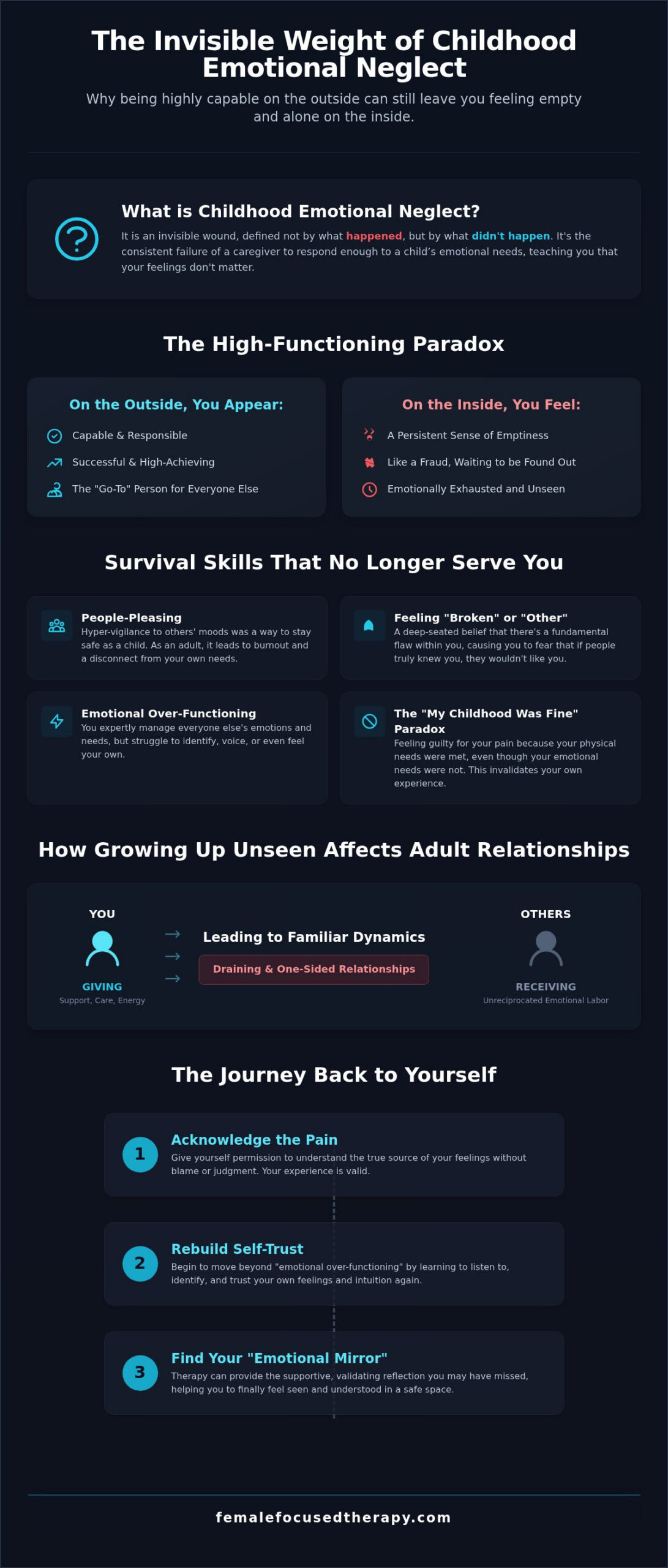
You may be looking at a life that, from the outside, seems perfectly fine. You’re capable, responsible, and perhaps even successful. Yet, inside, there’s a persistent feeling of emptiness or a quiet sense that you’re somehow a fraud, just waiting to be found out. If this sounds familiar, you’re not alone, and your feelings are very real. This profound sense of disconnection often has its roots in an experience that’s difficult to name because it’s about what didn’t happen: childhood emotional neglect.
It’s an invisible wound, one that can leave you doubting your own feelings and struggling to identify your personal needs. You might find yourself emotionally exhausted from constantly over-functioning for everyone else, yet unable to ask for what you need in return. In this article, I want to help you understand this experience without blame or judgment.
Together, we will gently explore why you feel this way and create a framework for understanding that emotional numbness. My hope is to offer you a starting point for the journey back to yourself-a path toward rebuilding the self-trust you so deeply deserve.
Key Takeaways
- Discover why being highly capable on the outside can still leave you feeling empty and alone on the inside.
- Learn how the patterns of childhood emotional neglect can lead you to unconsciously repeat familiar, yet unfulfilling, dynamics in your adult relationships.
- Find small, actionable steps to move beyond “emotional over-functioning” and begin rebuilding trust in your own feelings.
- Understand how therapy can provide the supportive “emotional mirror” you may have missed, helping you to finally feel seen and validated.
The invisible weight of childhood emotional neglect
You might be here because you carry a sense of emptiness you can’t quite name. On paper, your childhood looks fine. You had a home, food on the table, and parents who provided for you. Yet, there’s a quiet ache, a feeling of being unseen that has followed you into adulthood. This is often the mark of childhood emotional neglect.
Unlike other forms of trauma, emotional neglect isn’t about what happened to you; it’s about what didn’t happen. It’s the silence when you needed comfort, the blank stare when you sought understanding, the emotional support that was never there. It’s an invisible wound because you can’t point to a specific event. How can you remember something that was absent?
What emotional attunement actually looks like
A parent is meant to be a child’s first emotional mirror. When you were sad, they were supposed to reflect that sadness back with comfort. When you were joyful, they were meant to share in that joy. This mirroring is what helps you learn that your feelings are real and valid. When that mirror is missing, you can grow up feeling a deep and persistent emotional loneliness, even when surrounded by people.
Put simply, emotional neglect is the failure of a caregiver to respond enough to a child’s emotional needs. This consistent lack of response teaches you that your feelings don’t matter. If you’d like to explore a more formal overview of What is Emotional Neglect?, this resource can be helpful, but what truly matters is how it has felt for you.
The “my childhood was fine” paradox
So many women I work with feel a profound sense of guilt. You might tell yourself, “My parents worked hard, I went to a good school, I shouldn’t be complaining.” This is especially true in a high-achieving environment like Singapore, where the focus is often on success and resilience. But providing physical care and emotional nourishment are two very different things.
It’s possible to have parents who were good people, who loved you in their own way, but were simply unable to connect with you emotionally. Acknowledging this isn’t about blame; it’s about giving yourself permission to understand the true source of your pain. At Female Focused Therapy, we can explore this together in a safe and supportive space.
Why high-functioning women often miss the signs of neglect
From the outside, you look like you have it all together. You’re competent, reliable, and successful in your career and home life. Yet inside, you may feel a quiet sense of emptiness or fraud, as if you’re wearing a mask that hides a fundamental flaw. This is a pattern I see so often in the women I work with.
This disconnect is a common hallmark of childhood emotional neglect. You learned to cope by becoming highly capable-a form of “emotional over-functioning”-but without a strong internal anchor, you may feel adrift. No matter what you achieve, there’s a persistent feeling that something is missing, because the emotional validation you needed as a child was never there.
The habit of “people-pleasing” as a survival skill
As a child, you may have become hyper-vigilant to the moods of your caregivers. Learning to read the room and anticipate others’ needs was a way to stay safe, earn praise, or simply feel connected. This survival skill often follows us into adulthood.
You might find yourself constantly scanning your environment, trying to ensure everyone else is okay, often at your own expense. This is utterly exhausting. Over time, this intense focus on others creates a deep disconnect from your own feelings, desires, and boundaries. You simply don’t know what you want anymore.
The chronic feeling of being “other” or “broken”
Many women who experienced emotional neglect carry a deep-seated belief that there is something fundamentally wrong with them-a “fatal flaw.” You might worry that if people really knew you, they wouldn’t like you. This feeling isn’t something that achievements or external validation can fix.
This deep sense of emptiness is often a direct result of the lasting impact of neglect, which can shape your core beliefs about yourself. It erodes your ability to trust your own intuition, leaving you second-guessing your decisions and feelings. Rebuilding that self-trust is a central part of the healing journey we can navigate at Female Focused Therapy.
How growing up unseen affects your adult relationships
If you find yourself repeatedly in relationships that feel draining or one-sided, you are not alone. In my work, I often see a pattern where women who experienced childhood emotional neglect find themselves in unbalanced or toxic relationships. It’s not a coincidence; it’s a quiet echo of the past, playing out in the present.
When emotional connection was missing in your formative years, the feeling of being unseen can become a familiar, almost comfortable, baseline. This can lead you to subconsciously seek out partners who are emotionally unavailable, creating a cycle that is both painful and difficult to break.
Choosing partners who mirror the neglect
There’s a part of us that hopes to heal the past by re-creating it with a different ending. You might be drawn to a partner who is distant or self-absorbed, unconsciously hoping that this time, you can finally win the love and attention you always craved. This is why the charm of narcissistic personalities can feel so magnetic; they present a challenge that your inner child is desperate to solve.
Unravelling these deep-seated patterns is challenging to do on your own, but it is possible. For many, couples therapy can provide a safe space to understand these dynamics and build healthier ways of connecting.
The struggle to ask for what you need
Growing up, you likely learned that your needs were an inconvenience. This often fosters a fierce “I can do it myself” independence that, while a powerful survival skill, can block true intimacy. You may believe, deep down, that asking for support makes you a burden, or that your needs are simply “too much” for anyone to handle.
This feeling of being a burden is a heavy weight to carry and a common thread connecting childhood emotional neglect and depression in adulthood. But your needs are not a burden-they are a fundamental part of being human.
This dynamic often fuels the painful “demand-withdraw” cycle. You might suppress your needs for so long that when you finally voice them, it comes out with an intensity (a demand) that causes your partner to pull away (withdraw). This reinforces your deepest fear: that being truly seen, with all your needs and vulnerabilities, is dangerous and will only lead to rejection.
Moving from emotional over-functioning to genuine self-trust
I want to be very clear: this part of the journey isn’t about assigning blame or dwelling on the past. Healing from childhood emotional neglect is about finally, gently, turning your attention inwards and showing up for the one person who needs you most: yourself. It’s a quiet revolution of self-care.
For so long, you’ve likely managed everyone else’s needs and feelings. Now, it’s time to start reconnecting with your own internal world. This begins by simply naming the feelings you were taught to wall off. Acknowledging “I feel sad” or “I feel angry” without needing to fix it is a radical act of self-validation. It’s how you begin to offer compassion to the little girl inside who had to grow up far too fast.
Learning to listen to your body
Emotions often speak to us through physical sensations long before our minds catch up. A tight chest, a knot in your stomach, a clenched jaw-this is your body’s language. I often suggest a simple practice: a few times a day, just pause and check in with your breath and your “gut feeling.” Ask yourself, “What am I noticing right now?” Your body often remembers the neglect that your mind has tried to minimize.
The slow rebuilding of self-trust
The slow rebuilding of self-trust is the absolute cornerstone of healing. When your feelings weren’t validated as a child, you learned not to trust them. Reclaiming that trust happens in tiny, consistent moments. It can be as small as choosing what you want for lunch without asking for anyone else’s opinion, or admitting to yourself that you need a quiet evening alone. This is where mindfulness and somatic practices can be so supportive, helping you return to your body as a safe and reliable home. The work we do at Female Focused Therapy is deeply rooted in this gentle process of reconnection.
Reconnecting with yourself through female-focused therapy
I understand just how daunting it can feel to begin talking about things you’ve kept hidden for years, perhaps even decades. The thought of revisiting painful memories is overwhelming, especially when you’ve spent so long just trying to keep everything together. Please know that this is a common and completely valid fear.
Therapy can provide the “emotional mirror” that you may have missed out on. In a safe, confidential space, your feelings are seen, heard, and validated without judgment. This consistent, compassionate reflection helps you to finally see yourself clearly and begin rebuilding the self-trust that childhood emotional neglect so often erodes.
My approach is integrative, combining practical tools from Cognitive Behavioural Therapy (CBT) with a deep, trauma-informed understanding of the female experience. We explore not just what happened, but how it impacts you today as a woman. Together, we will always move at a pace that feels safe and sustainable for you.
A safe space to be “un-fine”
Here, you don’t have to be the capable, high-functioning woman who has it all under control. This is a space where you can finally take off the mask and just be. There is immense relief in allowing yourself to be “un-fine” with someone who can hold that space for you.
I often support women as they navigate life transitions and midlife changes, as these periods can unexpectedly trigger old feelings of emptiness or confusion. My work is grounded in professional expertise and, as my clients often say, a dose of Scottish warmth.
Taking the first small step
If you’re not ready for a session, that’s perfectly okay. A gentle starting point could be exploring my collection of free therapy resources. They are there to offer support whenever you need it.
The most important thing to remember is that you don’t have to carry this invisible weight alone anymore. Healing is possible, and it begins with one small, courageous step. When you feel ready, you can learn more about how we can work together at Female Focused Therapy.
Reconnecting With the You Who Was Always There
Feeling unseen as a child creates an echo of loneliness that can follow you into adulthood, often hidden behind a mask of high achievement. It can make you the one who always takes care of everyone else, leaving little room for your own needs. But I want you to know that this pattern doesn’t have to define your future.
Understanding that these feelings are a valid response to childhood emotional neglect is the first, powerful step towards healing. It’s the moment you stop blaming yourself for feeling disconnected and start seeing a path back to yourself.
This journey of reconnection is deeply personal, and you don’t have to walk it alone. As a Registered Psychotherapist with years of experience here in Singapore and online, I specialise in trauma-informed, female-focused therapy. My warm, integrative approach combines proven methods like CBT with somatic practices to help you gently rebuild self-trust. If you feel ready to explore what support could look like, you can learn more about my work at Female Focused Therapy.
Please remember, healing is possible. Being truly seen, perhaps for the very first time, is possible.
Frequently Asked Questions About Childhood Emotional Neglect
How do I know if I experienced childhood emotional neglect?
Recognising this can be subtle, as it’s often about what was absent rather than what happened. You might carry a persistent feeling of emptiness, or a sense that something is missing inside. Perhaps you struggle to identify or trust your own feelings, or you’ve been told you’re ‘too sensitive’. Many women I work with describe being fiercely independent from a young age, simply because they learned they had to be. It’s a quiet, invisible wound.
Is childhood emotional neglect the same as emotional abuse?
This is a really important question. Emotional abuse often involves direct actions, like yelling, criticising, or shaming. In contrast, emotional neglect is a failure to act-it’s the absence of emotional support, validation, and attunement from your caregivers. While both are deeply painful and can co-exist, neglect is about your emotional needs not being seen or met. Your parents may have provided for you physically but were unavailable for your inner world.
Can I heal from childhood emotional neglect as an adult?
Yes, absolutely. Healing is not about changing the past but about changing its impact on your present. The journey involves learning to tune into your own emotions, perhaps for the first time, and validating them. It’s about building self-compassion and learning to give yourself the emotional care you didn’t receive. Through this process, you can rebuild self-trust and form deeper, more secure connections with others. It is a path towards wholeness.
What are the long-term effects of being emotionally neglected?
The long-term effects often show up as persistent feelings of emptiness, chronic self-doubt, or a sense that you are somehow flawed. You might struggle with people-pleasing, find it hard to set boundaries, or feel disconnected in your relationships. Many women also experience a harsh inner critic or deep-seated perfectionism. It’s as if you learned early on that your needs weren’t important, and you’ve carried that belief into your adult life, impacting your self-worth.
Why do I feel guilty for thinking my parents neglected me?
Feeling guilty is an incredibly common and understandable response. Your parents may have loved you and provided a good home, so acknowledging this emotional gap can feel like a betrayal. You might be telling yourself, ‘I had everything I needed,’ because the neglect was invisible. This guilt is often a protective mechanism, but allowing yourself to see the truth of your experience isn’t about blaming them; it’s about understanding yourself and your own pain.
How does childhood emotional neglect affect my parenting?
This is a deep concern for many mothers I support. You might fear you’ll repeat the same patterns, or you might swing the other way and become emotionally over-responsible for your children, leading to burnout. Because your own feelings weren’t validated, it can be challenging to sit with your child’s big emotions without feeling overwhelmed. The wonderful thing is that your awareness is the first step. Healing your own wounds is one of the greatest gifts you can give your children.
Can therapy really help with something that happened so long ago?
It’s a valid question. The goal of therapy isn’t to dwell on the past but to understand its echoes in your life today. The patterns of childhood emotional neglect-like self-doubt or difficulty with intimacy-are very much alive in the present. In a safe therapeutic space, we can gently explore these connections, help you process long-held emotions, and support you in building the skills for self-trust and emotional connection that you didn’t get to learn back then.
What is the difference between CEN and ADHD in women?
This is a nuanced area, as symptoms like emotional dysregulation, rejection sensitivity, and a feeling of being ‘different’ can overlap significantly. The key difference is the origin: CEN stems from your developmental environment and a lack of emotional attunement from caregivers. In contrast, ADHD is neurobiological-a difference in brain wiring you were born with. It is entirely possible to experience both, which can complicate things. A thorough assessment with a trained professional can help bring clarity.

Article by
Cheryl Kennedy MacDonald MA BA (Hons) Pg. Dip. SAC BACP
Cheryl Kennedy MacDonald is a psychotherapist specialising in women’s mental health, relationships, and life transitions. She works with women navigating trauma, relationship breakdown, identity shifts, and midlife change, helping them rebuild self-trust, emotional stability, and a clear sense of who they are and what they want.
With over 20 years’ experience working with women internationally, Cheryl is the founder of YogaBellies, a global women’s yoga school, and the creator of the Birth ROCKS method. Her work sits at the intersection of psychotherapy and embodiment, integrating evidence-based therapeutic approaches with somatic, body-based practices that support deep, lasting change.
Known for her grounded and direct approach, Cheryl moves beyond surface-level insight to address the patterns held in the body and nervous system. Her work supports women to regulate, reconnect, and respond to their lives from a place of clarity, strength, and self-respect.
She is a published author in academic journals and has written multiple books on women’s health, pregnancy, and midlife wellbeing, available on Amazon and leading book retailers worldwide.