
If you’ve found your way here, you’re likely holding a heavy and confusing question in your heart: “Am I being gaslighted, or am I just too sensitive?”
As a therapist who works primarily with women navigating the complexities of difficult relationships and narcissistic abuse, this is a question I hear almost every day. It’s a question born from a place of deep confusion, exhaustion, and chronic self-doubt. Before we go any further, I want you to take a breath and hear this: That feeling is not your fault. You are not "crazy," and you are not alone.
This guide is written for you. Together, we will help you understand the true meaning of gaslighting, learn to recognize its insidious patterns in your relationship, and take the first brave steps toward reclaiming your reality and your right to trust yourself again.
Let’s Untangle That Question: The Real Meaning of Gaslighting
So, what is the actual gaslighting meaning? At its core, gaslighting is a destructive form of psychological manipulation and emotional abuse. Its goal is not simply to win an argument, but to systematically erode your perception of reality, making you question your own sanity, memory, and instincts. It’s a strategy designed to make you feel so unstable that you become dependent on your abuser for your sense of what is real.
The term itself comes from the 1938 play Gas Light (and later, two film adaptations), in which a husband manipulates his wife by subtly dimming their home’s gas-powered lights and then denying it’s happening, convincing her she is losing her mind. It’s a perfect metaphor for the experience: a slow, insidious dimming of your own inner light.
The Goal Isn’t to Disagree; It’s to Destabilize
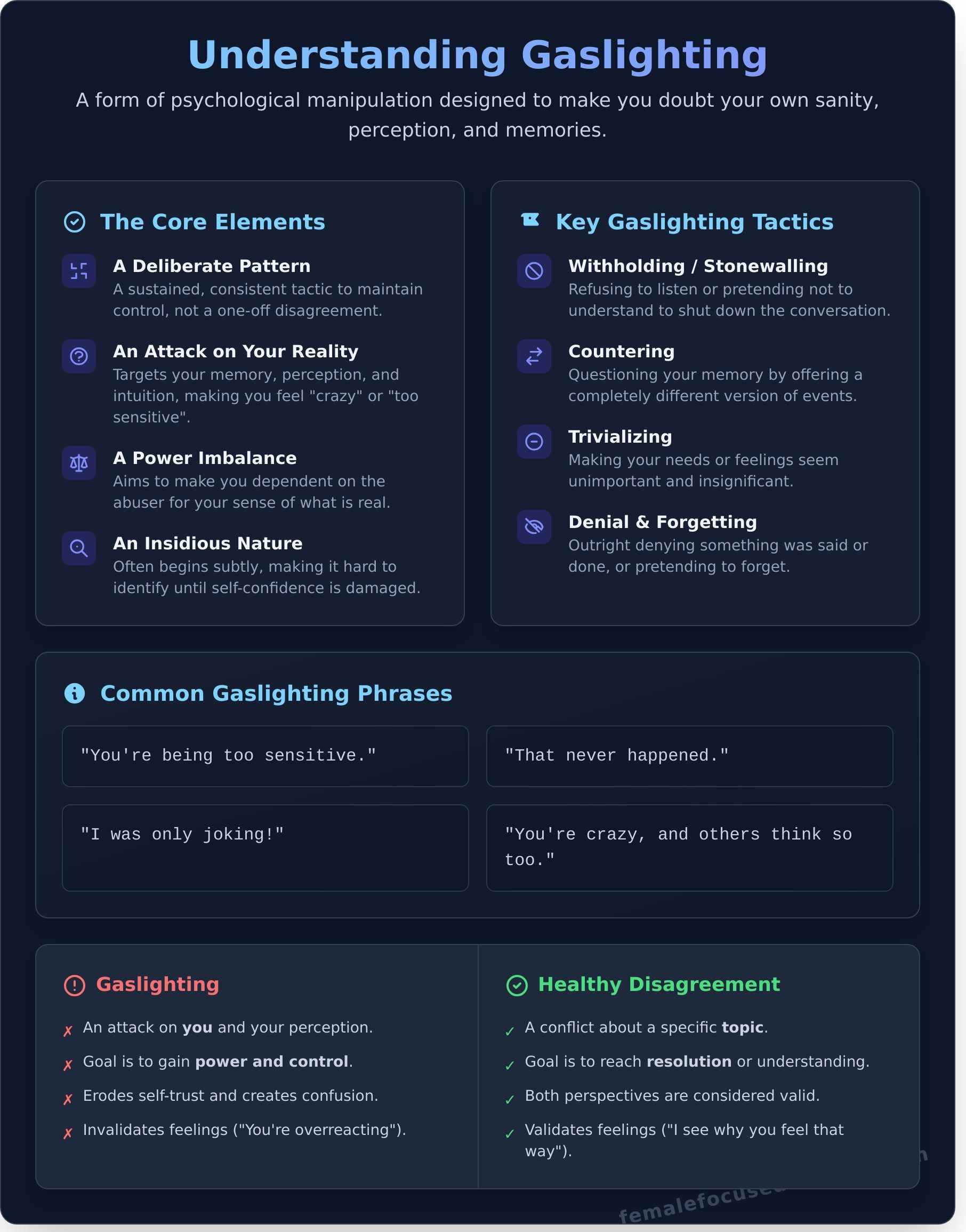
It is crucial to understand that gaslighting is a deliberate and repetitive pattern. It’s not a one-off disagreement or a simple misunderstanding. It is a targeted attack on your intuition and your ability to trust yourself. In a relationship with a narcissist, this serves a specific purpose: it creates a significant power imbalance. By making you doubt your reality, they gain more control and position themselves as the sole arbiter of truth, making you easier to manipulate and control. This process often starts so subtly that you don’t notice it until you’re deep in a fog of confusion.
Healthy Conflict vs. Narcissistic Control
In a healthy relationship, disagreements happen. Partners can have different perspectives or memories of an event. The goal of a healthy disagreement is mutual understanding and resolution. You feel heard, even if you don’t agree.
Gaslighting is the opposite. It is not an attack on the topic at hand; it is an attack on you-your mind, your emotions, your sanity. Healthy conflict seeks connection; gaslighting seeks control. If you consistently leave conversations feeling confused, anxious, and questioning your own intelligence or stability, you are not just disagreeing. You are likely being gaslighted.
The Narcissist’s Playbook: Common Gaslighting Phrases and Tactics
Recognizing gaslighting can be difficult when you’re in the thick of it. The tactics are designed to be confusing. Think of this section as a practical checklist, a way to put a name to the behaviors you’ve been experiencing. In my practice, I see these patterns emerge time and time again.
Phrases Designed to Make You Doubt Yourself
These phrases are often delivered with feigned concern or outright aggression, but the goal is always the same: to dismiss your reality.
- "You’re being too sensitive" or "You’re overreacting." This is a classic tactic to invalidate your feelings. It reframes your legitimate emotional response as a personal flaw.
- "That never happened. You’re imagining things." This is a direct assault on your memory, making you question what you know to be true. Over time, it can make you feel completely untethered from reality.
- "I was only joking! You have no sense of humor." This allows the gaslighter to say cruel and hurtful things without accountability. When you react, they turn it around and blame you for not being able to "take a joke."
- "You’re crazy, and other people think so too." By invoking imaginary allies, the abuser amplifies your self-doubt and fosters a sense of isolation, making you believe that you are the only one who sees the situation this way.
Key Gaslighting Tactics Explained
Beyond specific phrases, gaslighting involves a set of manipulative behaviors:
- Withholding: They refuse to listen or pretend they don’t understand what you’re saying. They might say, "I’m not having this conversation again," shutting down any attempt at communication.
- Countering: They vehemently question your memory of events. They will insist that you are remembering things wrong, even when you have clear recollections.
- Trivializing: They make your needs, feelings, or accomplishments seem unimportant. If you’re proud of something, they might dismiss it. If you’re upset, they’ll tell you it’s "not a big deal."
- Denial & Forgetting: They will deny things they said or did, even if you have proof. They may also feign memory loss, saying "I don’t remember that," to avoid taking responsibility for their actions.
How Gaslighting Shows Up in Your Relationship
In a romantic partnership with a narcissist, these tactics become a daily reality.
- He denies his infidelity, telling you, "You’re just insecure and paranoid. Your jealousy is pushing me away."
- He "forgets" promises he made for a special occasion, then claims, "I never said that. You always make things up to start a fight."
- After a rage-filled outburst, he tells you the next day, "I wasn’t even yelling. You’re so dramatic. You’re the one who is always escalating things."
The Invisible Scars: How Gaslighting Chips Away at Your Sanity
The constant questioning of your reality is a profound form of psychological injury. It’s not just about feeling bad after an argument; it’s a slow erosion of your very sense of self. Please know that the feelings you are experiencing are a normal and valid reaction to an incredibly abusive situation.
Losing the Signal: When You Can No Longer Trust Your Intuition
Your intuition is your internal guidance system. Gaslighting is designed to break it. Over time, you stop trusting your gut feelings. You constantly second-guess every decision, every feeling, every memory. This creates a persistent state of confusion and brain fog, leaving you feeling lost and unsure of yourself.
The Slow Creep of Anxiety, Depression, and Isolation
Living in a state of constant high alert is emotionally and physically exhausting. You may feel perpetually on edge, waiting for the next attack, which can lead to chronic anxiety. The emotional toll, the feeling of hopelessness, and the loss of self can trigger deep depression. Often, the narcissist will actively isolate you from friends and family who might validate your experience, making you even more dependent on them.
When Their Voice Becomes Your Inner Critic (Internalized Gaslighting)
Perhaps the most dangerous outcome of long-term gaslighting is when you start to do the abuser’s work for them. You internalize their voice. You start telling yourself that you are "too sensitive," "too much," or "hard to love." You find yourself automatically apologizing for things that aren’t your fault. You begin to believe you are fundamentally flawed, which is exactly what the gaslighter wants.
Why Does He Do It? Understanding the Narcissist’s Need to Gaslight
Let me be very clear: understanding the motivation behind gaslighting is for your clarity, not his excuse. There is no justification for this abuse. However, seeing the pattern for what it is-a reflection of his own deep-seated issues-can help you depersonalize the attacks and begin to break free.
It’s All About Control and a Fragile Ego
Gaslighting is a hallmark trait of Narcissistic Personality Disorder (NPD). For a narcissist, their fragile sense of superiority is paramount. They cannot tolerate being wrong, criticized, or seen as flawed. Gaslighting is their primary defense mechanism. By creating a reality where they are always right and you are always wrong, confused, or "crazy," they protect their ego and maintain absolute control over the relationship.
A Masterclass in Avoiding Accountability
Narcissists have an almost allergic reaction to accountability and blame. Gaslighting is a powerful tool to deflect from their own mistakes, betrayals, and shortcomings. By making you the problem, they never have to confront their own behavior. They expertly shift blame to avoid any feelings of shame or inadequacy, leaving you holding all the emotional weight.
Reclaiming Your Reality: A Therapist’s Guide to Healing
Healing from gaslighting is a journey of reclaiming your mind and rebuilding your self-trust. It begins the moment you start to trust yourself again, even just a little. Let’s walk through the first steps together.
Step 1: See It, Name It, Write It Down
The first and most powerful step is simply to acknowledge what is happening. Naming the behavior-"This is gaslighting"-takes it out of the realm of confusion and into the realm of clarity.
- Keep a private journal. Write down conversations and incidents exactly as you remember them. Note the date, what was said, and how it made you feel. This isn’t for him; it’s for you. It will become your anchor to reality when you start to doubt yourself.
- Confide in a trusted friend. Share your experiences with one or two people you know will believe and support you without judgment. Hearing someone else say, "That’s not okay," can be incredibly validating.
Step 2: Disengage and Create Boundaries
You cannot win an argument with a gaslighter, because they are not playing by the rules of logic or respect. The only way to win is not to play.
- Learn to disengage. When a conversation turns into a reality-bending argument, stop. You can say calmly, "I’m not going to argue with you about this," and walk away.
- State your reality without needing their agreement. You don’t need them to validate your experience. Practice simple, firm statements like, "I know what I saw," "My feelings are valid," or "We remember that differently."
Step 3: Rebuild Your Self-Trust in a Safe Space (Therapy)
This is where our work together can truly begin. Healing from the deep wounds of narcissistic abuse and gaslighting often requires professional support. Therapy provides a confidential, non-judgmental space where your reality is never questioned.
- A therapist can validate your experiences and help you see the patterns of abuse clearly.
- We can work together to rebuild your self-esteem and reconnect you with your intuition.
- You can learn powerful coping strategies to manage the emotional trauma and set healthier boundaries for your future.
If this article resonates with you, please know you are not overreacting, and you are not alone. Taking the step to seek support is an act of profound courage and self-love.
Frequently Asked Questions
What is the difference between gaslighting and just disagreeing?
Disagreement is about a difference of opinion on a topic, where both parties can state their case. Gaslighting is a manipulative attack on a person’s perception of reality, designed to make them doubt their own sanity and memory. The intent behind gaslighting is control, not resolution.
Does my partner know he’s gaslighting me?
While some gaslighters may act out of deep-seated insecurity without full conscious awareness of the term, in the context of narcissistic abuse, it is often a deliberate and practiced tactic to maintain control and avoid accountability. Regardless of intent, the impact is abusive and damaging.
How is gaslighting different from simple lying?
A lie is a false statement. Gaslighting is a more complex and insidious process that uses lies, denial, and misdirection to fundamentally warp your sense of reality. The goal isn’t just to hide the truth, but to make you believe you can no longer identify the truth at all.
What are the long-term effects of being in a gaslighting relationship?
Long-term effects can be severe, including chronic anxiety, depression, post-traumatic stress disorder (PTSD), a complete loss of self-esteem and intuition, and difficulty forming healthy relationships in the future.
Is it possible for someone who gaslights to change their behavior?
Genuine, lasting change requires a profound level of self-awareness, accountability, and a willingness to engage in intensive therapy. For individuals with narcissistic personality traits, this is extremely rare, as it would require them to confront the very ego they are built to protect. The focus should be on your safety and healing, not on changing them.
How can I support a friend or family member who is being gaslighted?
Listen without judgment. Validate their feelings by saying things like, "That sounds incredibly confusing and painful," or "I believe you." Gently encourage them to seek professional support and remind them that they are not crazy and their feelings are real. Avoid criticizing their partner directly, as this can sometimes cause them to become defensive.