
You may be here because you feel a profound sense of loneliness, even when you’re with your partner. Perhaps you find yourself trying to explain your feelings or observations, only to be met with dismissal, doubt, or the suggestion that you’re being ‘too sensitive.’ This constant cycle of being disbelieved can leave you questioning your own reality and feeling utterly exhausted. If this resonates deeply, please know that what you are experiencing is valid, and it has a name: Cassandra syndrome.
It describes the deep emotional and psychological distress that arises when your valid perceptions are chronically ignored by those closest to you. The weight of this experience can be immense, leading to feelings of isolation and a slow erosion of your confidence in what you know to be true. You are not “crazy” or “dramatic”-you are a person whose perspective is not being seen or heard.
This guide is here to offer a safe, compassionate space to explore this dynamic. Together, we will navigate the root causes of being unheard, especially its common link to neurodiversity in relationships. We will also provide gentle, practical strategies to help you validate your own perceptions, cope with the emotional pain, and begin the vital journey of rebuilding your self-trust.
Understanding Cassandra Syndrome: More Than Just a Myth
You may be here because you feel a profound sense of loneliness within your most important relationships. You try to explain your reality, your feelings, or your observations, only to be met with dismissal, doubt, or denial. This experience has a name, drawn from ancient stories but describing a very real, modern pain: Cassandra Syndrome.
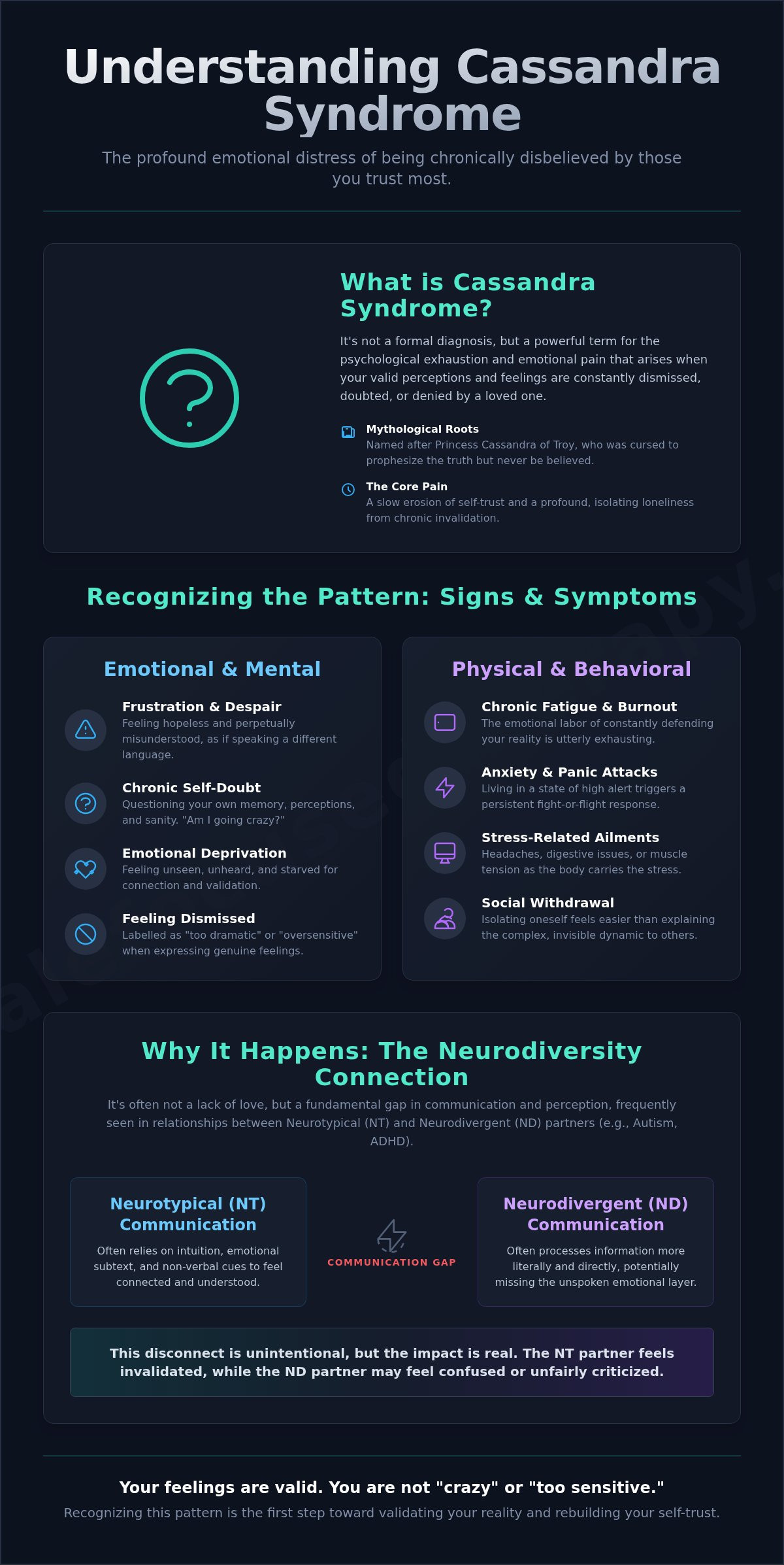
The term originates from the Greek myth of Princess Cassandra of Troy. She was given the gift of prophecy but was cursed by the god Apollo so that no one would ever believe her true predictions. This story has evolved into the powerful Cassandra metaphor, which describes the anguish of knowing the truth but being utterly disbelieved. While it is not a formal clinical diagnosis, Cassandra Syndrome powerfully articulates the emotional distress and psychological exhaustion that arises from being chronically invalidated, especially by those you trust the most. It’s far deeper than a simple disagreement; it’s a pattern where your core reality is constantly questioned, leading to a slow erosion of self-trust.
The Agony of Being Disbelieved
The core pain of this experience is a profound and isolating loneliness. When your partner, the person you should be able to turn to for support, consistently invalidates your perceptions, it can feel like a form of emotional neglect. This dynamic is often invisible to the outside world. Friends and family may see a perfectly fine relationship on the surface, making it even harder for you to feel understood and reinforcing the feeling that you are the one who is overreacting or “seeing things.”
Who Experiences Cassandra Syndrome?
This relational dynamic is most frequently described by neurotypical women in relationships with neurodivergent partners, particularly those with undiagnosed or unsupported Autism Spectrum Disorder (ASD) or ADHD. The disconnect in communication styles and emotional processing can lead to unintentional, yet deeply painful, invalidation. However, it can also emerge in relationships with partners who display significant emotional immaturity or traits of personality disorders. It’s crucial to remember: this is a description of a relational dynamic, not a personal failing on your part.
Key Signs & Symptoms: Recognizing the Pattern in Your Life
The effects of being chronically disbelieved don’t appear overnight. They are a slow, quiet erosion of your wellbeing, often developing so gradually that you may mistake them for personal failings, like anxiety or depression. Recognizing the pattern of Cassandra syndrome in your life is not about placing blame; it is a powerful first step toward validation, clarity, and reclaiming your sense of self.
This experience takes a significant toll on your entire being. Let’s gently explore the specific emotional, mental, and physical signs that may feel painfully familiar.
Emotional and Mental Symptoms
The internal toll is often the most profound. You may be here because you are navigating:
- Persistent frustration, confusion, and despair. You may feel like you are speaking a different language from your partner or family, leaving you feeling hopeless and perpetually misunderstood. This can be especially pronounced in dynamics where a partner’s neurodivergence is unacknowledged, leading to intense frustration in autism relationships as your reality is consistently invalidated.
- Chronic self-doubt and low self-esteem. You begin to question your own perceptions, memories, and even your sanity. The phrase, “Am I going crazy?” becomes a familiar and distressing internal monologue.
- A deep sense of emotional deprivation. You feel unseen, unheard, and emotionally starved, as your core needs for connection and validation are consistently unmet.
- Feeling dismissed as ‘too dramatic’ or ‘oversensitive’. Your genuine emotional responses are frequently minimized or challenged, forcing you to suppress and internalize your pain.
Physical and Behavioral Symptoms
This sustained emotional and mental stress inevitably manifests in your body and actions. The constant effort to be understood can lead to:
- Chronic fatigue and burnout. The emotional labour of constantly explaining, defending, and managing your reality is utterly exhausting, leaving you with little energy for anything else.
- Anxiety, panic attacks, or symptoms resembling C-PTSD. Living in a state of high alert and emotional invalidation can trigger a persistent fight-or-flight response in your nervous system.
- Stress-related physical ailments. You might experience frequent headaches, digestive problems, muscle tension, or a weakened immune system as your body carries the burden of the stress.
- Social withdrawal. It can begin to feel easier to isolate yourself than to ‘perform’ normalcy or try to explain the complexities of your situation to friends or family who may not understand.
Why It Happens: The Connection to Neurodiversity and Communication Gaps
If you feel like you’re screaming into a void, it’s rarely because your partner doesn’t care. More often, the experience of cassandra syndrome arises from a fundamental gap in communication and perception, frequently seen in relationships between neurotypical (NT) and neurodivergent (ND) individuals (such as those with Autism or ADHD). This isn’t about blame or a lack of love; it’s about navigating the profound differences in how your brains are wired to process the world, emotions, and connection.
Understanding this can be a powerful turning point. It allows you to shift from a painful cycle of feeling dismissed and invalidated to a more compassionate space of curiosity and problem-solving. Your partner can be loving and well-intentioned, yet still struggle to meet your emotional needs in a way you recognise.
Neurodivergent Communication Styles
The disconnect often stems from differing communication styles. What feels intuitive to you may be completely foreign to your partner. Key differences can include:
- Processing Emotions: A partner with Alexithymia, common in Autism, may struggle to identify or describe their own feelings, making it difficult to offer the emotional validation you need.
- Non-Verbal Cues: They may not naturally pick up on tone of voice, facial expressions, or body language, leading them to miss your distress or misunderstand the emotional weight of a situation.
- Emotional Regulation: For a partner with ADHD, challenges with emotional regulation can mean they react with overwhelming intensity or, conversely, appear disengaged when their executive functions are overloaded.
- Masking: Many neurodivergent individuals learn to “mask” their traits to fit in, meaning they may appear perfectly capable and empathetic to the outside world. This can intensify your isolation, as others don’t see the private reality you experience.
The ‘Double Empathy Problem’
This theory reframes the issue beautifully. Instead of viewing the problem as a deficit in your neurodivergent partner, the ‘Double Empathy Problem’ suggests the misunderstanding is mutual. Just as your ND partner struggles to grasp the NT social-emotional world, you may struggle to understand their internal experience. The constant misinterpretations can be deeply painful, leading to complex relationship traumas over time. Acknowledging this two-way gap is the first step toward building a bridge of mutual understanding, moving away from blame and toward genuine reconnection.
The Long-Term Impact: How Cassandra Syndrome Erodes Your Self-Trust
While the immediate pain of not being believed is immense, the most damaging long-term consequence of the cassandra syndrome is the slow, quiet erosion of your self-trust. When your reality, feelings, and perceptions are consistently dismissed or questioned by someone you love, you eventually learn to question them yourself. Your intuition, once a clear and steady guide, becomes a voice you start to silence.
This chronic invalidation teaches you that your internal compass is faulty. Over time, you stop relying on your own judgment and begin looking outside of yourself for validation that may never come. This is the deepest wound of this experience, and it can take time and gentle support to heal.
Losing Your Sense of Self
You may start to internalize the external narrative, believing that you truly are ‘too sensitive,’ ‘too needy,’ or ‘making things up.’ This can lead to emotional over-functioning, where you take on all the responsibility for the relationship’s health, constantly trying to fix things or manage your partner’s reactions. It’s crucial to recognise that this experience is more than just a difficult dynamic; it is a form of relationship trauma that requires deep compassion and a safe space to navigate.
The Ripple Effect on Your Life
The loss of self-trust rarely stays confined to one relationship. It can seep into every corner of your life, creating a ripple effect that impacts your wellbeing and confidence.
- In your career: You might second-guess your professional judgment, shy away from leadership opportunities, or feel like an imposter.
- In friendships: You may find it difficult to be vulnerable or to trust that others will believe and support you.
- In parenting: You could constantly doubt your instincts, worrying that you aren’t making the right decisions for your children.
This chronic stress and self-doubt place you at a much higher risk of developing burnout, depression, or severe anxiety. It’s this very erosion of self-worth that can make it so challenging to leave the relationship, trapping you in a cycle where you feel the problem must be you.
Healing from cassandra syndrome is a process of gently turning back toward yourself. It is about rebuilding that sacred connection to your inner wisdom and learning to honour your feelings as valid, important, and true.
A Path to Healing: Strategies for Coping and Reclaiming Your Voice
Living with the emotional weight of not being believed is profoundly isolating. The path to healing from cassandra syndrome begins not with the goal of changing your partner, but with gently turning your focus back towards yourself. It’s about reclaiming your own wellbeing and rebuilding your sense of self-trust, one step at a time. These strategies are designed to empower you, whether your partner engages in the process or not. Remember, small, consistent actions can create significant and lasting change in your life.
Start with Self-Validation
The first and most crucial step is to become your own anchor. When external validation is absent, learning to validate your own reality is a radical act of self-care. This practice helps you reconnect with your intuition and honour your experiences, creating a foundation of inner strength.
- Keep a private journal to document your experiences and feelings without filter or fear of judgment.
- Practice naming your emotions. Simply saying to yourself, “I am feeling hurt” or “I am feeling confused” acknowledges your inner state as real.
- Find validating resources, such as books, podcasts, or articles that describe experiences similar to yours.
- Use a daily affirmation. Gently remind yourself: “My feelings are valid, even if someone else doesn’t understand them.”
Build External Support Systems
While your partner may be central to your life, they cannot be the sole source of your emotional support. Intentionally building connections outside of your relationship is essential for your wellbeing. This reduces your emotional dependency and provides you with the empathy and perspective you need.
- Connect with trusted friends or family members who listen with compassion and without trying to “fix” the situation.
- Seek out support groups, either online or in your community in Singapore, for partners of neurodivergent individuals or those in difficult relationships.
- Invest in your own hobbies and interests to build confidence and a life that is rich and fulfilling on your own terms.
Shift Your Communication
Changing your communication style is not about finding the magic words that will make your partner understand. Instead, it’s about speaking your truth with clarity and setting boundaries to protect your emotional energy. This shift moves you from seeking a reaction to expressing your reality.
- Use clear “I” statements. For example, “I feel sad when our plans are cancelled at the last minute.”
- Set boundaries around circular arguments. You can say, “I’m not willing to have this conversation while we are both upset. Let’s take a break.”
- Focus on expressing your needs without attachment to their emotional response.
Navigating the complexities of cassandra syndrome is a challenging journey. Rebuilding your confidence and reclaiming your voice takes time and patience. If you need a safe, professional space to explore these dynamics and find your footing, you can learn more about how we can support you.
How Therapy Provides a Safe Space to Heal
After months or even years of being dismissed, the emotional exhaustion can feel overwhelming. The constant self-doubt and isolation that define Cassandra syndrome can make you question your own sanity. Therapy offers a quiet, confidential space where your experience is not only heard but validated, often for the very first time. It is a sanctuary where you can begin to untangle your feelings from your partner’s reality and start the essential work of healing.
Individual Therapy: Rebuilding Your Self-Trust
Individual therapy provides a dedicated space to focus entirely on your own wellbeing. Working one-on-one with a therapist who understands the complexities of neurodiversity and difficult relationship dynamics is crucial. Here, you can safely explore the deep-seated pain of being invalidated and begin rebuilding the most important relationship of all-the one you have with yourself. The goals are to:
- Process the grief and trauma that comes from chronic emotional dismissal and feeling unheard.
- Strengthen your sense of self by learning to identify your needs and trust your own perceptions again.
- Develop practical tools for setting healthy boundaries and improving your personal agency in and out of the relationship.
Couples Therapy: Building a Bridge of Understanding
If both partners are willing, couples therapy can be transformative. A skilled therapist acts as a neutral translator, helping to bridge the communication gap that often fuels the painful dynamic of Cassandra syndrome. The focus isn’t on blame, but on building a new foundation of mutual understanding and respect.
Together, you can learn practical strategies for navigating neurodiverse challenges and create a new relationship dynamic where both partners feel seen and valued. Exploring options for couples therapy designed for your unique needs in Singapore can be a powerful step towards reconnection. You deserve to be heard and believed, and professional support can help you reclaim your voice and confidence.
Reclaiming Your Voice and Rebuilding Self-Trust
Feeling unheard and unseen in a relationship is a deeply isolating experience. Recognizing that this pattern is not just in your head-but a core feature of cassandra syndrome-is the first powerful step toward healing. Over time, this dynamic can severely erode your self-trust, leaving you questioning your own perceptions. But it is crucial to remember that your reality is valid, and a path to reclaiming your voice truly exists.
You do not have to navigate this journey alone. As a specialist in relationship trauma for women, I provide a safe, trauma-informed space to help you process these painful experiences. Through an integrative therapy approach, we can work together to rebuild your confidence and reclaim your sense of self. With online therapy available worldwide from my base in Singapore, compassionate support is within reach. Ready to feel seen and heard? Book a confidential session to begin your healing journey. Your story matters, and a future filled with clarity and confidence awaits.
Frequently Asked Questions About Cassandra Syndrome
Is Cassandra Syndrome a real diagnosis?
While Cassandra Syndrome is not a formal clinical diagnosis in manuals like the DSM-5, it is a widely recognised term describing a profoundly distressing relational experience. It gives a name to the emotional and psychological toll of feeling consistently disbelieved or dismissed by those closest to you. Recognising this pattern is a vital first step toward seeking support and validation for your reality, which is essential for healing and rebuilding your sense of self.
Can a relationship with Cassandra Syndrome be saved or improved?
Yes, it is possible to navigate and improve a relationship affected by this dynamic, but it requires commitment from both individuals. The key is fostering open communication and a genuine willingness from your partner to understand your perspective. Couples counselling can provide a safe, structured space to rebuild trust and develop healthier communication patterns. The journey involves both partners learning to listen and validate each other’s experiences, paving the way for reconnection.
Is Cassandra Syndrome only related to autism and ADHD?
Although the term is frequently discussed within the context of neurodiverse relationships, such as those involving autism or ADHD, this painful dynamic is not exclusive to them. It can emerge in any partnership where there is a significant communication gap or where one person’s reality is consistently invalidated. This could be due to narcissistic abuse, differing communication styles, or other complex interpersonal challenges. The core experience is one of being unheard, regardless of the underlying cause.
How do I know if I have Cassandra Syndrome or am just in an unhappy relationship?
While general unhappiness can stem from many sources, this experience has a distinct pattern. It involves persistently trying to explain your reality or emotional needs, only to be met with dismissal, confusion, or disbelief from your partner. This often leads to profound self-doubt, loneliness, and a feeling that you are the one who is ‘crazy’ or ‘too sensitive.’ If your distress is specifically tied to this cycle of invalidation, it points more toward this dynamic.
What is the difference between Cassandra Syndrome and gaslighting?
This is a subtle but important distinction. Gaslighting is typically a deliberate, manipulative tactic used to make someone question their sanity for control. In contrast, the dynamic of Cassandra Syndrome can be unintentional. It may arise because a partner genuinely cannot perceive or understand your emotional reality, perhaps due to neurodivergence or different life experiences. While the impact of feeling invalidated is painfully similar, the underlying cause is not always malicious.
How can I explain Cassandra Syndrome to my partner without blaming them?
Focus on explaining your own feelings and experience using ‘I’ statements. For example, you could say, “I feel lonely and misunderstood when I try to share my perspective, and it seems like we can’t connect on it.” Frame it as a pattern affecting ‘us’ as a couple, rather than a fault in them. Describing it as a communication gap you want to bridge together invites collaboration rather than defensiveness, opening a path to mutual support.

Article by
Cheryl Kennedy MacDonald MA BA (Hons) Pg. Dip. SAC BACP
Cheryl Kennedy MacDonald is a psychotherapist specialising in women’s mental health, relationships, and life transitions. She works with women navigating trauma, relationship breakdown, identity shifts, and midlife change, helping them rebuild self-trust, emotional stability, and a clear sense of who they are and what they want.
With over 20 years’ experience working with women internationally, Cheryl is the founder of YogaBellies, a global women’s yoga school, and the creator of the Birth ROCKS method. Her work sits at the intersection of psychotherapy and embodiment, integrating evidence-based therapeutic approaches with somatic, body-based practices that support deep, lasting change.
Known for her grounded and direct approach, Cheryl moves beyond surface-level insight to address the patterns held in the body and nervous system. Her work supports women to regulate, reconnect, and respond to their lives from a place of clarity, strength, and self-respect.
She is a published author in academic journals and has written multiple books on women’s health, pregnancy, and midlife wellbeing, available on Amazon and leading book retailers worldwide.