
Recognising signs of emotional neglect in a relationship and reclaiming your reality
You’re sitting next to your partner and the distance between you feels like an ocean. It’s a heavy, hollow silence that leaves you wondering if you’re being too sensitive. I want you to know that this feeling is real, and it’s often one of the first signs of emotional neglect in a relationship.
I understand how exhausting it is to feel invisible in your own home, doubting whether your needs are valid or if you’re asking for too much. I’m here to help you recognise these subtle, invisible patterns and show you how to begin reclaiming your emotional reality.
We’ll look at why this gap exists and how it affects both your mind and your body. I’ll guide you through the steps to restore your sense of self-trust and find a way back to feeling seen, held, and valued again.
Key Takeaways
- You will learn to distinguish between a partner who is simply busy and the hollow, invisible silence of true emotional absence.
- I will show you how your nervous system and body track a lack of attunement through physical tension and a closed heart centre.
- We’ll identify seven clear signs of emotional neglect in a relationship, such as when your partner habitually dismisses or tries to fix your feelings.
- You’ll gain insight into how ADHD and Rejection Sensitivity Dysphoria can make the experience of emotional distance feel much more overwhelming.
- I’ll guide you on how to prioritise your own internal restoration and self-trust as you begin to reclaim your emotional reality.
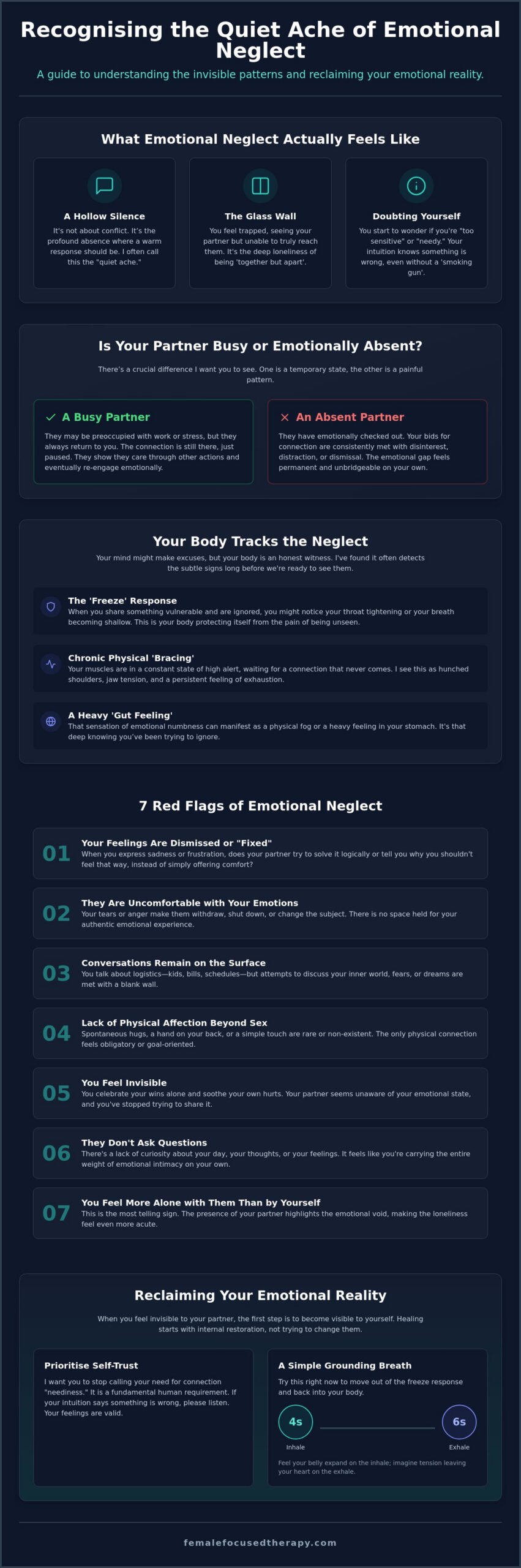
What does emotional neglect actually feel like in a marriage?
Emotional neglect is uniquely painful because it’s defined by an absence. It isn’t about shouting or obvious conflict. Instead, it’s about the silence where a response should be.
I often describe this experience as a “quiet ache” or a hollow space. It’s the void left when your bids for connection are met with a blank stare or a distracted nod.
I find that many women struggle to name this because there is no “smoking gun.” Even without overt psychological abuse, the lack of warmth is damaging. The signs of emotional neglect in a relationship are found in what is missing.
There is a real difference between a partner who is busy and one who is absent. A busy partner eventually returns to you. An emotionally absent partner has checked out, often requiring couples therapy to bridge the gap.
The loneliness of being ‘together but apart’
Living with neglect feels like being trapped behind a glass wall. You can see your partner, but you cannot reach them. I see many women performing a version of happiness to keep the peace.
It’s exhausting to carry the weight of a relationship entirely on your own. Social conditioning often tells us to prioritise our partner’s comfort. We learn to ignore our own needs just to stay “polite.”
Validating your need for emotional attunement
I want you to stop calling your desire for connection “neediness.” Emotional attunement is a fundamental human requirement, not a luxury. Even without conflict, a lack of warmth can leave deep scars.
If your intuition tells you something is wrong, please listen to it. Your feelings are valid, even if there isn’t a “big” reason for them. You deserve to be heard, not just handled or managed.
The quiet body: Somatic signs your nervous system is tracking neglect
Your mind might tell you everything is fine, but your body is a far more honest witness. While you’re busy making excuses for your partner’s distance, your nervous system is silently recording the lack of connection. I’ve found that the body often detects these subtle signs of emotional neglect in a relationship long before the conscious mind is ready to accept them.
When you try to share something vulnerable and are met with indifference, you might notice a sudden “freeze” response. Your throat tightens, your breath becomes shallow, and you might feel a literal closing of your heart centre. This isn’t just “shyness”; it’s your body protecting itself from the pain of being unseen. Over time, this chronic lack of attunement can lead to measurable physical health problems, including higher blood pressure and a weakened immune system.
I see this manifest as a persistent “bracing” in the body. You’re waiting for a connection that doesn’t come, and that state of high alert is physically taxing. My perspective is that rest and intentional breath are not just “self-care” luxuries. They are essential tools to help you drop back into your body and reconnect with your own truth when your external reality feels hollow.
Listening to the ‘gut feeling’ you’ve been ignoring
Have you noticed how you physically shrink when your partner enters the room? Perhaps your shoulders hunch or you find yourself taking up less space. This chronic state of bracing is why you might feel completely drained after an evening “together,” even if no one said a cross word. You can use mindfulness to scan for areas of emotional numbness, often felt as a physical fog or a heavy sensation in the pit of your stomach.
Somatic movement as a tool for internal restoration
Healing from neglect requires more than just talking; we have to move that “trauma of absence” out of our tissues. I often use somatic movement to help women create a safe internal home. When you feel invisible to your partner, you must first become visible to yourself through gentle, grounding movement that releases stored tension.
Try a simple grounding breath right now. Inhale for four counts, feeling your belly expand. Exhale for six counts, imagining the tension leaving your heart. This gentle shift helps move you out of the freeze response and back into your own skin. If you feel ready to explore how this internal restoration can support your healing, you might consider reaching out for a private session.
7 Substantial red flags of emotional neglect in your relationship
Identifying the signs of emotional neglect in a relationship can be difficult because they are often defined by what doesn’t happen. It’s the hug that isn’t returned, the news that isn’t celebrated, and the tears that are met with an awkward shrug. I’ve found that these red flags usually appear as a slow drift rather than a sudden break. You might not even realise how much you’ve shrunk until you’re already feeling completely invisible.
I see many women who have become “detectives” in their own homes. You find yourself constantly scanning your partner’s micro-expressions, trying to gauge their mood or predict if they’ll be available to you. This hypervigilance isn’t a sign of a “deep connection”; it’s a survival strategy. Here are the red flags that suggest the emotional well has run dry:
- Your partner consistently dismisses or “fixes” your feelings instead of simply hearing them.
- You have stopped sharing your inner world because it feels safer to stay silent than to be ignored.
- Bids for connection, like a look, a touch, or a small comment, are frequently met with apathy.
- Physical intimacy feels clinical or entirely disconnected from emotional warmth.
- You feel more alone when you are sitting in the same room as them than when you are by yourself.
- Logic is used as a weapon to shut down your emotional requests.
- You feel like a burden for having basic human needs for attunement.
The ‘Wall of Silence’ and the ‘Fix-it’ trap
Logic is a common shield. Your partner might use “practicality” to avoid the discomfort of emotional vulnerability. If you say you’re feeling overwhelmed, they might suggest a better calendar app instead of asking how you’re really doing. This is the difference between solving a problem and witnessing an emotion. Because you are likely very high-functioning, your partner might assume you don’t actually need support. They see your external success and use it as an excuse to remain emotionally distant.
When your presence and their absence feel the same
There is a specific pain in realising you don’t feel “seen” even when your partner is right in front of you. This persistent lack of attunement often mirrors the patterns I see in relationship trauma and narcissistic abuse, where your needs are treated as an inconvenience. When your “independence” means you no longer expect anything from your partner, you’ve moved into emotional isolation. You deserve a partnership where your presence is cherished, not just tolerated.
The intersection of ADHD and emotional neglect for women
As an adult woman with ADHD, I know that our brains often process the world with the volume turned up. When we talk about the signs of emotional neglect in a relationship, we have to acknowledge that neurodivergence adds a complex layer to the pain. For us, a partner’s emotional distance isn’t just a “sad” experience; it can feel like a physical blow to the nervous system.
I often see high-achieving women in my practice who are master “maskers.” You’ve spent your life learning how to appear organised and composed, even when the internal chaos is loud. The tragedy is that because you look like you have it all together, your partner might neglect your emotional needs by default. They don’t see the struggle, so they stop offering the attunement you actually need to feel safe.
Rejection Sensitivity Dysphoria (RSD) is a common part of the ADHD experience that makes neglect feel even more intense. When a partner is distracted or unresponsive, it doesn’t just feel like a minor oversight. It can trigger an overwhelming sense of shame or a fear that you are fundamentally “too much” or “not enough.” This isn’t your fault; it’s how your brain is wired to track safety.
ADHD, overwhelm, and the need for co-regulation
Our brains often require more explicit emotional “anchoring” than neurotypical brains. When you are managing the “life admin,” the domestic labour, and the mental load of a household alone, the lack of a supportive partner can lead to total burnout. ADHD-focused therapy can be a vital space to understand why you need this co-regulation and how to stop blaming yourself for needing it.
Breaking the cycle of ‘not being enough’
There is often a deep-seated shame that comes with both ADHD and emotional neglect. You might tell yourself that if you were “better” at life, your partner would be more present. I want to tell you clearly: your neurodivergence is never an excuse for a partner’s neglect. You deserve to be met with curiosity and warmth, not just a list of things you’ve forgotten to do.
Learning to ask for specific types of support that work for your brain is a key part of your restoration. This might mean asking for eye contact during a conversation or requesting a “soft start” to difficult discussions. If you’re ready to stop masking and start healing, you can book a private session with me to explore how we can rebuild your self-trust together.
Reclaiming your emotional reality and finding a path forward
When you finally recognise the signs of emotional neglect in a relationship, the first instinct is often to try and fix the other person. You might think that if you just explain your needs one more time, or find the perfect way to phrase your hurt, they will finally “get it.” I want to gently suggest a different starting point. Instead of focusing all your energy on fixing the partnership, I invite you to prioritise your own internal restoration.
A realistic first step is simply acknowledging the ache without immediate pressure to solve it. You don’t need to have a grand plan today. Just admitting to yourself that the loneliness you feel is real and valid is a profound act of self-kindness. It moves you out of the “detective” role and back into your own life.
For those who feel that the emotional distance in their relationship has manifested as chronic anxiety or stress, practitioners such as Amandine Baptista offer specialized support to help adults navigate these difficult emotional states and reclaim their well-being.
I often talk about “warm but boundaried” communication. This means being clear about your needs while protecting your own emotional energy. If a partner is willing to meet you in that space, couples therapy in Singapore can be a helpful container for change. However, if you feel you are the only one trying to bridge the gap, focusing on your own healing is usually the most empowering path.
Building a foundation of self-trust
Reclaiming your reality starts with being emotionally honest with yourself. For a long time, you may have been gaslighting your own experiences, telling yourself you’re “too sensitive” or that it “isn’t that bad.” This internal conflict is exhausting for your mind and your body. I use individual psychotherapy to help women stop the self-doubt and start trusting their own intuition again.
We work on creating a safe internal home where your needs aren’t treated as inconveniences. This process often involves somatic practices like noticing where you hold “bracing” tension and using breath to create space for your feelings. When you trust yourself, the external silence of a partner becomes less of a reflection of your worth and more of a fact about the relationship that you can then address from a place of strength.
Your next step toward healing
I want you to know that you don’t have to carry this heavy, quiet ache alone. Whether you are navigating a life transition, ADHD, or relationship trauma, your feelings deserve a witness. You deserve to be in a partnership where you are seen, heard, and deeply known, rather than just managed or ignored.
If you feel ready to explore your situation in a safe and grounded space, you can book a consultation with me. We can look at the signs of emotional neglect in a relationship you’ve been noticing and find a manageable way forward that respects your pace and your nervous system. You have already taken the hardest step by being here and reading this; let’s take the next one together.
Moving toward emotional restoration
You’ve likely spent a long time wondering if your feelings were real or if you were simply being too sensitive. Recognising the signs of emotional neglect in a relationship is the first step in stopping that internal gaslighting. Whether it’s the quiet ache in your chest or the exhaustion of carrying the relationship’s intimacy alone, your body and mind have been trying to tell you that something fundamental is missing.
As a registered integrative psychotherapist with my own lived experience of ADHD, I offer a warm, boundaried, and trauma-informed space to help you navigate these complex dynamics. You don’t have to keep performing happiness while feeling invisible in your own home. We can work together to rebuild your self-trust and find a path that honours your unique needs and your nervous system.
I’m here to support you in reclaiming your voice and your emotional reality. If you’re ready to start this journey of internal restoration, please book your consultation with Cheryl Kennedy MacDonald. You deserve to be seen, heard, and deeply valued in every part of your life.
Frequently Asked Questions
Can a relationship survive emotional neglect?
A relationship can survive when both people are willing to look at the patterns of distance. It isn’t just about ending the silence; it’s about rebuilding a sense of active curiosity. This requires a shared commitment to restoring the emotional bridge.
Is emotional neglect a form of emotional abuse?
Neglect is defined by acts of omission, while abuse is often defined by acts of commission. One is the absence of care, and the other is the presence of harm. Both can deeply affect your sense of safety and self-worth.
How do I talk to my partner about feeling neglected without them getting defensive?
Try starting the conversation when you both feel calm and connected. Use “I” statements, like “I feel lonely when we don’t talk about our day.” This invites your partner to understand your feelings rather than feeling attacked.
What is the difference between emotional neglect and a temporary ‘rough patch’?
A rough patch is usually temporary and tied to a specific life stressor. Emotional distance becomes neglect when it is a chronic, unchanging state. If the silence has become your relationship’s baseline, it’s more than just a phase.
Why do I feel so lonely even though my partner is a ‘good person’?
You feel lonely because being a “good person” isn’t the same as being emotionally available. Your partner might be reliable and kind, but still lack the skills for deep attunement. Your need for more than just practical stability is valid.
Can childhood emotional neglect affect my current relationship?
Our childhood experiences often create the blueprint for our adult relationships. If your needs were ignored as a child, you might unconsciously accept a lack of warmth now. Healing involves recognising these old patterns and choosing a new way.
How do I know if I am the one being emotionally neglectful?
Emotional distance can sometimes be a byproduct of your own burnout or ADHD overwhelm. If you feel too drained to engage, you might be pulling away as a survival mechanism. Recognising this is the first step toward restoration.
What are the first steps to healing from emotional neglect?
The first step is to stop doubting your own experience and trust your intuition. Begin by noticing how you feel in your body when you are with your partner. From there, you can explore safe, professional support to help you move forward.

Article by
Cheryl Kennedy MacDonald MA BA (Hons) Pg. Dip. SAC BACP
Cheryl Kennedy MacDonald is a psychotherapist specialising in women’s mental health, relationships, and life transitions. She works with women navigating trauma, relationship breakdown, identity shifts, and midlife change, helping them rebuild self-trust, emotional stability, and a clear sense of who they are and what they want.
With over 20 years’ experience working with women internationally, Cheryl is the founder of YogaBellies, a global women’s yoga school, and the creator of the Birth ROCKS method. Her work sits at the intersection of psychotherapy and embodiment, integrating evidence-based therapeutic approaches with somatic, body-based practices that support deep, lasting change.
Known for her grounded and direct approach, Cheryl moves beyond surface-level insight to address the patterns held in the body and nervous system. Her work supports women to regulate, reconnect, and respond to their lives from a place of clarity, strength, and self-respect.
She is a published author in academic journals and has written multiple books on women’s health, pregnancy, and midlife wellbeing, available on Amazon and leading book retailers worldwide.