
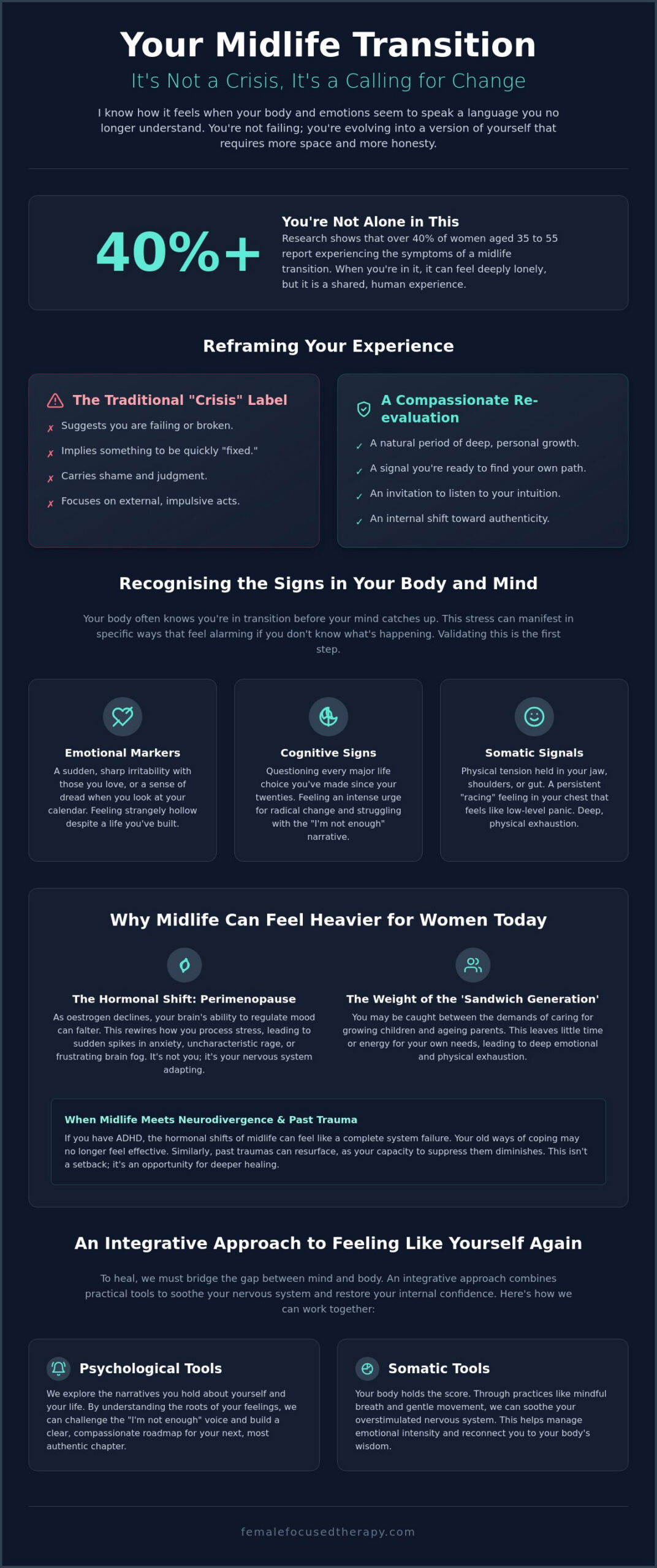
Research shows that over 40% of women aged 35 to 55 report symptoms of a midlife crisis, yet when you’re in the thick of it, it feels like a deeply lonely experience. If you’re searching for midlife crisis women therapy, you’re likely looking for more than just a label; you want to know why you feel invisible at the dinner table or undervalued in your career. It’s that heavy, physical exhaustion that lives alongside a racing, anxious mind, making you wonder if you’ve lost the real you somewhere along the way.
I know how unsettling it is when your emotions feel out of character and your body feels like it’s speaking a language you no longer understand. I’ve seen how this transition isn’t just about getting through it, but about deep restoration of your internal confidence and self-reliance. You aren’t going crazy; you’re simply at a crossroads that requires a different, more compassionate kind of support.
I’ll help you understand why this stage feels so overwhelming and how an integrative approach, combining the mind and the body, can help you reclaim your sense of self. We’ll explore practical tools to manage emotional intensity and build a clear roadmap for your next, most authentic chapter.
Key Takeaways
- Reframe the traditional “crisis” label to see this transition as a natural and necessary period of deep personal re-evaluation.
- Understand how the physical reality of perimenopause and the weight of “Sandwich Generation” roles contribute to your emotional exhaustion.
- Explore why midlife can feel like a system failure if you have ADHD and why your old ways of coping may no longer feel effective.
- Learn how an integrative approach to midlife crisis women therapy bridges the gap between your mind and body to help you feel like yourself again.
- Discover practical somatic and psychological tools designed to soothe your nervous system and restore your internal confidence.
Understanding the Midlife Transition Beyond the ‘Crisis’ Label
I see so many women who arrive in my practice feeling deeply ashamed of their own unhappiness. You’ve spent decades building a life, perhaps raising a family or climbing a career ladder, only to find yourself feeling strangely hollow. The term “midlife crisis” often carries a punchline about red sports cars or impulsive flings, but for women, the experience is usually far more internal and complex. Searching for midlife crisis women therapy is often the first step in admitting that the old way of living just doesn’t fit anymore.
When we talk about Understanding the Midlife Transition, I prefer to view this period as a profound re-evaluation. It’s a natural shift where the structures you’ve built to please others start to feel too tight. This isn’t a sign that you’re failing; it’s a sign that your soul is ready for a different kind of growth. I believe this malaise is a signal that you’re ready to move from meeting everyone else’s expectations to finally discovering your own.
Is it a crisis or a call for change?
I want you to consider that your unrest is actually your intuition speaking. We live in a society that pressures women to stay “forever young” or to remain the selfless glue holding everyone else together. When you start to feel a dip in your happiness, it’s easy to worry that you’re slipping into clinical depression. While that can happen, often what I see in midlife crisis women therapy is a “call for change” rather than a medical pathology.
It’s about noticing that the “I’m not enough” narrative is actually a byproduct of societal expectations. You aren’t behind, and you aren’t failing. You’re simply evolving into a version of yourself that requires more space and more honesty.
Recognising the signs in your body and mind
Your body often knows you’re in transition before your mind catches up. I’ve found that the stress of this period manifests in very specific ways that can feel quite alarming if you don’t know what’s happening. These include:
- Emotional markers: You might feel a sudden, sharp irritability with those you love or a sense of dread when you look at your calendar.
- Cognitive signs: You find yourself questioning every major life choice you’ve made since your twenties and feel an intense urge for radical change.
- Somatic signals: Your body might hold tension in your jaw, or you might experience a persistent “racing” feeling in your chest that feels like low-level panic.
Validating this malaise is the first step toward healing. It isn’t “just a phase” to be ignored until it passes. It’s a significant life event that deserves space, breath, and professional support to help you find your way back to yourself.
Why Midlife Feels Heavier for Women Today
I often see women struggling under the weight of roles they never asked for but feel obliged to perform. It’s a heavy load. You’re trying to meet societal expectations of “ageing gracefully” while dealing with an internal reality of upheaval. It feels like you’re expected to be more polished and put-together just as your world starts to feel most fragile.
This stage of life often brings a double-edged sword of identity shifts. Perhaps your career has reached a plateau, or your children are leaving the nest, leaving you wondering who you are when you aren’t being “productive” or “needed.” These shifts aren’t small. They’re seismic, and they require more than just “powering through.”
Finding the right space for midlife crisis women therapy means acknowledging these external pressures as valid. You aren’t imagining the weight; it’s real. When we work together, we look at how these life changes impact your sense of self and your ability to find joy in the everyday.
The hormonal shift: Perimenopause and emotional regulation
We cannot talk about midlife without talking about the body. The physiological reality is that perimenopause rewires how we process stress. As oestrogen levels decline, your brain’s ability to regulate mood can falter, leading to sudden spikes in anxiety or a thick, frustrating brain fog that makes you feel unlike yourself.
I believe we must address the body to heal the mind. If you’re feeling an uncharacteristic rage or a deep, lingering grief, it’s often your nervous system reacting to these hormonal shifts. It’s vital to normalise these feelings. Your body is going through a significant transition, and your mind is simply trying to keep up.
Hormonal shifts can also impact your physical appearance in ways that feel distressing, including hair thinning. To explore therapeutic restoration options, you can learn more about The Hair Clinic.
The weight of the ‘Sandwich Generation’
Many of the women I work with are part of the “Sandwich Generation.” You’re likely managing the dual pressure of caring for ageing parents while still supporting maturing children. This invisible labour is exhausting. It’s the constant mental load of being the “fixer” for everyone else’s problems while your own cup remains empty.
This role leads to a profound emotional burnout. When your energy is entirely directed outward, your own sense of self begins to erode. You might feel like a ghost in your own life; invisible and undervalued despite doing the most work. It’s a lonely place to be, but you don’t have to navigate it alone.
If you feel like you’re carrying the world on your shoulders, it might be time to explore these feelings in a safe, confidential space where your needs finally come first.
When Midlife Meets Neurodivergence and Past Trauma
I’ve often seen that for women with ADHD, midlife can feel like a complete system failure. It’s as if the delicate scaffolding you’ve used to hold your life together for decades suddenly buckles. You might have spent years masking your struggles with high-functioning perfectionism, but as your hormones shift, those old coping mechanisms simply stop working. It’s a disorienting experience that leaves many feeling like they’re losing their grip.
This period of life isn’t just about the present; it’s often when the ghosts of the past decide to speak up. If you’ve carried trauma or survived difficult relationships, the quietness that sometimes comes with midlife can feel loud with old echoes. Searching for midlife crisis women therapy is frequently a response to this internal noise, as you realise you can no longer outrun the things you’ve been carrying.
How ADHD symptoms can intensify during midlife
It really is a “perfect storm.” When oestrogen drops during perimenopause, executive dysfunction often spikes. You might find that the brain fog and forgetfulness you once managed with sheer willpower now feel insurmountable. I help my neurodivergent clients understand that this sudden overwhelm isn’t a moral failing. It’s a physiological shift that requires a different approach to your daily life.
In our work together, we don’t try to “fix” your brain. Instead, we look at tailoring therapy to work with your neurodivergence rather than against it. We explore how somatic themes like breath and rest can create a sense of safety when your mind feels like it’s spinning out of control. It’s about finding a rhythm that respects your brain’s unique wiring.
Re-evaluating relationships and healing from trauma
Midlife is frequently a catalyst for leaving toxic or unfulfilling relationships. When you start to re-evaluate your life, you might look at your partner and wonder how you ended up in a dynamic that feels so draining. This is especially true if you’ve experienced narcissistic abuse in the past. Those old wounds can resurface now as a profound crisis of self-trust, making you doubt your own intuition just when you need it most.
Reclaiming your narrative is a huge part of the restoration process. After years of being told who you should be by parents, partners, or society, you finally have the chance to decide for yourself. The journey of healing from narcissistic abuse during this transition is about rebuilding that internal compass and learning to trust your own “yes” and “no” again.
I’ve found that when we combine clinical expertise with a deep understanding of your history, the “crisis” starts to feel more like a clearing. You aren’t just getting older; you’re getting free from the narratives that never belonged to you in the first place. My goal is to hold a warm, boundaried space where you can safely explore these layers without judgment.
Somatic and Psychological Tools for Internal Restoration
I believe that healing midlife malaise requires a bridge between the mind and body. For years, you’ve likely relied on your intellect to solve every problem. But when the “midlife dip” hits, your brain can’t always think its way out of the exhaustion. This is why I integrate a mind-body perspective into midlife crisis women therapy. We aren’t just talking about your feelings; we’re listening to what your nervous system is trying to tell you.
The “pushing through” mentality that served you in your thirties often becomes your greatest obstacle now. Your nervous system is likely stuck in a state of high alert, and more “doing” only adds to the fire. In our sessions, we use Cognitive Behavioural Therapy (CBT) to gently dismantle that “I’m not enough” narrative. We look at the actual evidence of your life and reframe the guilt you feel for needing rest.
Restoring the nervous system is the foundation of this work. When you’re high-functioning, you’re used to ignoring your body’s signals to keep the peace or meet a deadline. I help you reconnect with those signals so they don’t have to turn into a crisis to get your attention. It’s about moving from a state of constant “doing” into a more sustainable way of “being.”
Breath and movement as a path to calm
When life feels chaotic, simple somatic practices can ground you faster than any logical argument. I often teach my clients how to use their breath to signal safety to their brain. It’s about moving from “fight or flight” into a state of “rest and restore.” This is why I’m so passionate about the power of somatic movement and yoga for emotional release.
These tools aren’t about fitness; they’re about feeling. By moving your body with intention, you can process the stress and “stuck” emotions that talk therapy alone might not reach. Integrating these body-first tools into my psychotherapy practice allows for a deeper, more lasting internal restoration. It’s about giving your body the same attention and kindness you give your thoughts.
Rebuilding self-trust through integrative therapy
Our work together is a shift from “fixing” yourself to “finding” yourself. You aren’t broken; you’re in a stage of significant growth. I help you identify your core values for this next chapter. Often, the things that mattered to you at twenty-five aren’t the same things that matter now. We look at what brings you genuine peace and purpose today.
Cultivating a physical environment that reflects your evolving values is another way to support this transition. For those interested in how aesthetic choices can symbolise peace and clarity, learn more about Nicholas Wells Antiques.
A key part of this journey is learning to set boundaries that protect your emotional energy. This might mean saying no to “invisible labour” or stepping back from draining dynamics. By reclaiming your time and space, you rebuild the self-trust that midlife often shakes. If you’re ready to stop pushing through and start healing, you can book a session to begin your restoration.
Finding Your Path Forward with Female Focused Therapy
I offer a safe, confidential space specifically designed for women’s unique journeys. This stage of life often feels like a “midlife awakening” rather than a crisis, but that doesn’t make the transition any less daunting. You don’t have to navigate this alone. Whether you’re in Singapore or looking for online therapy, I’m here to hold space for your growth and restoration.
My approach isn’t about “fixing” you. It’s about a collaborative journey. I combine clinical expertise with soulful, somatic wisdom to help you rebuild your internal confidence. Searching for midlife crisis women therapy often leads to sterile, clinical options, but I believe in a more human, integrated path that respects your mind and your body.
The psychological and life challenges women face are unique. My practice is built on that understanding, ensuring you feel seen and heard. I’ve worked with women from diverse backgrounds, both in my Singapore practice and through online therapy sessions globally, helping them find their way back to themselves.
How I support you through this transition
In our sessions, we look at the whole picture. This includes my life transitions and menopause therapy services, where we address both the emotional and physiological shifts you’re facing. We explore how these changes impact your identity and your relationships.
As someone who understands the ADHD female experience personally and professionally, I know how midlife can amplify executive dysfunction. We work together in a non-judgmental way to find strategies that actually fit your brain. You can expect our collaborative sessions to be a place of calm insight and practical support.
Taking the first step toward your new chapter
I invite you to book a consultation to see if we’re a good fit for your journey. It’s a chance to breathe and speak your truth without fear of judgment. Taking that first step can feel heavy, but it’s the start of reclaiming your own narrative.
Here is one realistic next step you can take right now. Sit quietly for a moment and write down three things your body is trying to tell you today. Is it asking for rest, movement, or perhaps just to be heard? Listening to these somatic signals is the beginning of internal restoration.
This period of “unbecoming” the person you were told to be is simply the start of becoming who you truly are. It’s a brave process, and I’m here to support you every step of the way. You have the strength within you; sometimes you just need a guide to help you find the way back.
Moving Toward Your Authentic Next Chapter
I know that the feeling of being “lost” is often just the beginning of finding a more honest version of yourself. We’ve explored how the intersection of hormonal shifts, the pressures of the Sandwich Generation, and neurodivergence can create a perfect storm of overwhelm. This period of “unbecoming” is exactly where your internal restoration begins. You aren’t losing your mind; you’re simply outgrowing the roles that no longer fit who you are.
As a registered integrative psychotherapist, yoga master, and specialist in women’s life transitions, I’ve seen how transformative it is to finally put your own needs on the agenda. By combining clinical insight with somatic tools, we can soothe your nervous system and help you reclaim your voice. You’ve spent years being the “fixer” for everyone else. Now, it’s time to hold that same compassionate space for yourself.
If you’re looking for a warm, boundaried space to explore midlife crisis women therapy, I’m here to support you in Singapore or online. This transition can be the start of the most authentic chapter of your life, grounded in self-trust and peace. Book your consultation with Cheryl Kennedy MacDonald to take that first step toward finding your way back to you.
Frequently Asked Questions
Is a midlife crisis in women the same as depression?
No, a midlife transition is a developmental stage of re-evaluation, whereas depression is a clinical health condition. I often see women whose unrest is a natural response to a life that no longer fits their needs. While the low mood and lack of interest can look similar, therapy helps distinguish whether you’re navigating a life shift or require clinical depression support.
At what age does a midlife crisis typically start for women?
This transition usually begins between the ages of 40 and 60, though perimenopause can trigger these feelings as early as your late thirties. I’ve found that the “midlife dip” in happiness often occurs during this window. It’s a time when the convergence of hormonal shifts and changing family dynamics forces a deep internal review of your life’s direction.
How can therapy help me through a midlife transition?
Therapy provides a safe space to untangle your identity from your roles as a mother, partner, or professional. When you engage in midlife crisis women therapy, I help you bridge the gap between your mind and body. We use somatic tools to calm your nervous system while exploring your core values for this next chapter of your life.
Can perimenopause cause a midlife crisis?
Yes, the hormonal fluctuations of perimenopause can act as a powerful catalyst for emotional upheaval. Declining oestrogen levels directly impact your brain’s ability to regulate mood and manage stress. I help my clients understand that their sudden feelings of rage or grief are often tied to these physiological changes rather than a personal failing.
What are the most common signs of a midlife crisis in high-functioning women?
Common signs include a persistent sense of dread, uncharacteristic irritability, and a deep urge to escape your current responsibilities. You might find yourself questioning every major choice you’ve made while feeling physically exhausted but mentally “wired.” High-functioning women often notice that their usual coping mechanisms for stress simply stop working during this stage.
How long does a midlife transition usually last?
The duration varies for everyone, but many women find this period of re-evaluation lasts between two and five years. It isn’t a single event but a gradual process of “unbecoming” old patterns that no longer serve you. I support you in moving through this transition at a manageable pace that respects your individual needs and history.
Do I need a specialist therapist for midlife issues?
Working with a specialist ensures your therapist understands the unique intersection of hormones, gender roles, and life stages. I focus on midlife crisis women therapy because these challenges require an integrative approach. This means addressing both the psychological weight of caregiving and the physiological reality of the female body during hormonal transitions.
Can ADHD make a midlife crisis feel worse?
Absolutely, because the drop in oestrogen during midlife can significantly worsen ADHD symptoms like executive dysfunction and emotional dysregulation. I help neurodivergent women understand that their sudden inability to “keep it all together” is often a biological shift. We work together to find new strategies that respect your unique brain wiring during this intense transition.

Article by
Cheryl Kennedy MacDonald MA BA (Hons) Pg. Dip. SAC BACP
Cheryl Kennedy MacDonald is a psychotherapist specialising in women’s mental health, relationships, and life transitions. She works with women navigating trauma, relationship breakdown, identity shifts, and midlife change, helping them rebuild self-trust, emotional stability, and a clear sense of who they are and what they want.
With over 20 years’ experience working with women internationally, Cheryl is the founder of YogaBellies, a global women’s yoga school, and the creator of the Birth ROCKS method. Her work sits at the intersection of psychotherapy and embodiment, integrating evidence-based therapeutic approaches with somatic, body-based practices that support deep, lasting change.
Known for her grounded and direct approach, Cheryl moves beyond surface-level insight to address the patterns held in the body and nervous system. Her work supports women to regulate, reconnect, and respond to their lives from a place of clarity, strength, and self-respect.
She is a published author in academic journals and has written multiple books on women’s health, pregnancy, and midlife wellbeing, available on Amazon and leading book retailers worldwide.