
Last Tuesday, Sarah sat in my office in Singapore and described the quiet ache of returning to her high-pressure job just days after her world stopped. She felt like a ghost in her own life, struggling with the invisible weight of pregnancy loss grief while her body felt like a complete stranger. It’s a deeply isolating experience to feel your body has failed you while the rest of the world expects you to keep moving.
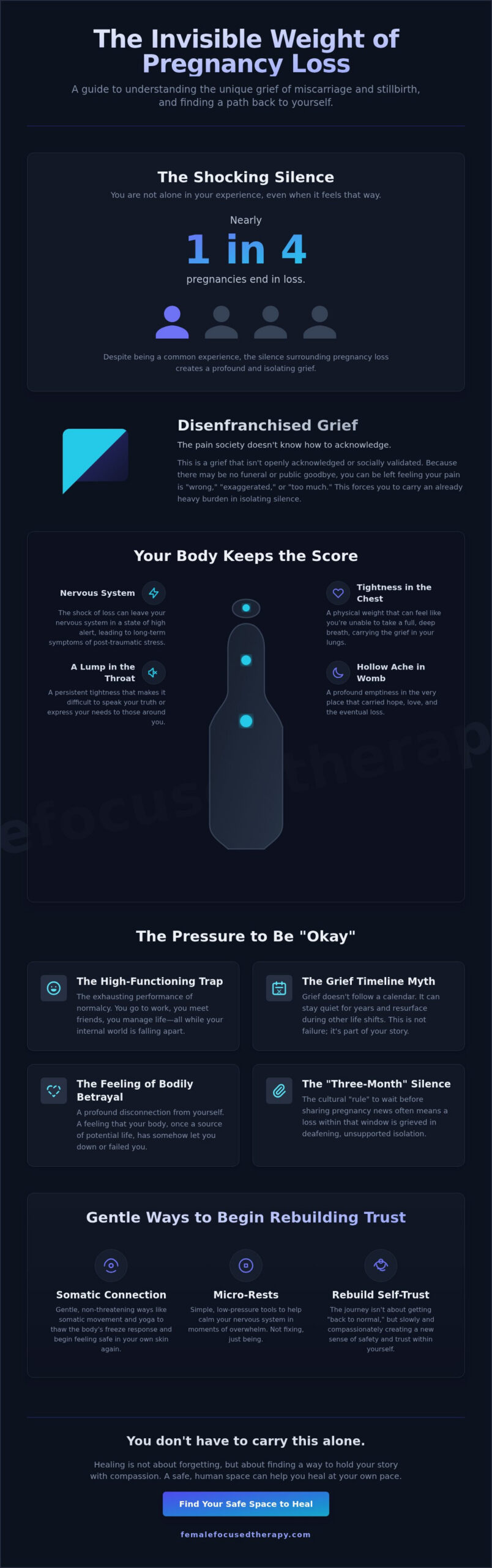
I know how exhausting it is to perform normality when your internal world has been upended. You might feel a deep sense of betrayal by your own physical form, especially since nearly 1 in 4 pregnancies end in loss yet we rarely speak about it openly. It’s a trauma that deserves more than just a passing acknowledgement; it requires a safe, grounded space to be seen and felt.
In this guide, I’ll help you navigate this journey with compassion and gentle insight. We’ll look at practical ways to manage the waves of emotional overwhelm that hit at the most unexpected times. Together, we can find a path back to your body through somatic connection, helping you slowly rebuild the self-trust that this experience may have taken away.
Key Takeaways
- Understand why your pain is a valid life trauma and why society’s struggle to acknowledge this “invisible” loss often leaves you feeling isolated.
- Explore how your body stores the memory of pregnancy loss grief and learn gentle ways to navigate feelings of bodily betrayal.
- Discover how being a “fixer” or having ADHD can intensify your experience and how to step out of the exhausting “high-functioning” trap.
- Learn simple, low-pressure somatic tools like micro-rests to help you begin rebuilding self-trust and calming your nervous system.
- Find out how I use an integrative approach in Singapore to provide a safe, human space for you to heal at your own pace.
Understanding the unique and invisible weight of pregnancy loss grief
I know the weight you’re carrying right now feels different from any other kind of sadness. It’s a heavy, invisible ache that often goes unnoticed by the world around you. Whether your loss happened at six weeks or twenty, the trauma is real. Your heart doesn’t measure love or the depth of your bond by the length of a gestation period.
We often talk about what is miscarriage from a clinical perspective, but that rarely touches on the emotional earthquake it triggers. In my practice, I see how this experience shifts your very foundation. I define pregnancy loss grief as a holistic shattering of future expectations and bodily safety.
There is a specific term for this called “disenfranchised grief.” It happens when society doesn’t quite know how to label or validate your pain because there may have been no funeral or public goodbye. This lack of recognition can make you feel like your pregnancy loss grief is “wrong” or “too much,” which only adds to the burden you’re carrying.
This loss often ripples through your sense of identity. You might feel like a mother without a baby to hold, or a woman whose body has somehow let her down. It’s a profound disconnection from yourself. Rebuilding that self-trust takes time, patience, and a lot of gentle self-compassion.
The silence surrounding miscarriage and stillbirth
The silence often starts with the “three-month rule,” where we’re told to wait before sharing news. When loss happens in that window, the isolation is deafening. You find yourself performing normalcy at work or with friends while your internal world is falling apart. This emotional exhaustion is draining because you aren’t just grieving a pregnancy; you’re grieving the entire life you had already imagined for that child.
Why your grief doesn’t have a timeline
Please don’t listen to anyone who tells you that you should be “back to normal” after a few weeks. Grief doesn’t follow a calendar, and there is no finish line. It’s common for pregnancy loss grief to stay quiet for years and then resurface during other major life shifts, such as moving house or entering menopause.
If you find that these old wounds are opening up during a new chapter of life, you aren’t failing. You are simply processing a deep layer of your story. You might find it helpful to look at who I work with to see how I support women navigating these complex life transitions in Singapore.
Why your body remembers the loss even when your mind tries to move on
You might find yourself logically understanding that time has passed, yet your heart still races when you walk past a baby shop in Orchard or see a scan photo on social media. This happens because your nervous system doesn’t just process information; it stores experiences. Your mind might try to “move on,” but your body keeps the score of what you’ve endured.
Clinical research into the psychological impact of perinatal loss shows that the weight of this experience can lead to long-term symptoms of post-traumatic stress. The shock of the news and the physical trauma of the loss can leave your body in a state of high alert. This is why pregnancy loss grief often feels so physical, manifested as a literal ache that your mind can’t simply think its way out of.
Healing isn’t just about talking through the “why”; it’s about helping your nervous system feel safe again. I believe that true recovery must involve both the mind and the body. We can’t ignore the physical vessel that carried the hope, the love, and the eventual loss.
The physical landscape of grief
Grief isn’t just a thought; it’s a physical weight. I often see women in my practice who carry a tightness in their chest that feels like they can’t take a full breath, or a heavy, hollow ache in their womb. Sometimes, it’s a persistent lump in the throat that makes it difficult to speak your truth or express your needs to those around you.
When the pain becomes too much, your system might switch to a “freeze” response. You might feel numb, disconnected, or like you’re watching your life from behind a glass wall. In my integrative approach, I find that somatic movement and yoga can be a gentle, non-threatening way to begin thawing this numbness and reconnecting with yourself.
Moving from betrayal to reconnection
It’s incredibly common to feel a deep sense of “bodily betrayal” after a loss. You might feel like your body failed you, your baby, or your partner. This creates a rift where you no longer trust your own physical cues, leading to constant hyper-vigilance and anxiety. You’re always waiting for the next “bad” thing to happen.
We can start the process of rebuilding that trust through small, gentle steps. Reframing your body as a survivor rather than a failure is a powerful shift. Your body did something incredibly difficult, and it’s still here, carrying you through each day. Simple breathwork can help calm a traumatised nervous system, signaling to your brain that you’re safe in this moment.
If you’re struggling to feel at home in your skin again, we can explore these somatic feelings together in a confidential, professional space designed just for women.
Navigating the “High-Functioning” trap and the pressure to be okay
I’ve spent much of my life being the woman who fixes things. If you’re like me, you pride yourself on being in control and getting things done. When pregnancy loss grief hits, that need to “fix” becomes a heavy burden. You might feel like your grief is a project you’re failing at because you can’t simply work your way through it. This is a common trap for women who are used to being the pillars of their families or workplaces.
For those of us with ADHD or other neurodivergent traits, this intensity is often magnified. Our brains don’t always have a “low” setting for emotions. I’ve seen how this can lead to sensory overload, where the world feels too loud and the pain feels too sharp. It’s not just sadness; it’s a complete nervous system overwhelm that makes “business as usual” feel impossible.
Many women I work with in Singapore use busyness as a shield. We fill our diaries with meetings and social obligations to avoid the silence where the pain lives. A 2019 study from Imperial College London found that 29 percent of women showed symptoms of post-traumatic stress one month after pregnancy loss. Being high-functioning often means being a high-masking griever, where you spend your energy making sure everyone else feels comfortable with your loss while you struggle internally.
The myth of “getting over it”
The goal isn’t to return to the woman you were before the loss. That version of you has evolved. Healing is about integrating this experience into your story. I often hear women express guilt for being “unproductive” or “weak” because they need a nap or can’t focus on a report. You aren’t weak. You’re carrying a heavy weight. It’s vital to set boundaries with people who offer well-meaning but hurtful advice. You don’t have to accept every comment just because it was intended to be kind.
When grief triggers deeper traumas
Loss has a way of reopening old wounds. It might bring back memories of childhood neglect or relationship trauma that you thought you’d settled. When you’re grieving, your emotional skin is thinner. You might find yourself more vulnerable to narcissistic dynamics or people who drain your energy. Your reaction isn’t “too much,” even if others don’t understand the layers of what you’re feeling. Every layer of your response is a valid part of your unique healing journey.
Gentle ways to begin rebuilding trust with yourself and your body
I know how it feels when your body suddenly feels like a stranger. When you are moving through pregnancy loss grief, the sense of betrayal can be physical. You might feel like your body failed you, or that you can no longer trust your own instincts. Healing begins when we stop demanding performance from ourselves and start offering grace instead.
I believe rebuilding self-trust is the most important part of your recovery. It is about learning to listen to your needs again, even when they feel quiet or confusing. This doesn’t require big, sweeping gestures; it happens in the small, kind choices you make every day. You aren’t broken, you are simply carrying a very heavy weight.
In our busy Singapore lives, we often feel immense pressure to “get back to normal” quickly. I want you to give yourself permission to be entirely non-productive. Try taking “micro-rests” throughout your day. This might mean sitting in your car for three minutes before going into the house, or simply closing your eyes between meetings. Your nervous system needs these pauses to process the physical toll of your experience.
Somatic tools for emotional overwhelm
If you feel a wave of overwhelm, try a simple grounding exercise. While sitting at your desk or in traffic, press your feet firmly into the floor. Notice the texture of your seat. Identify three things you can see and two things you can hear. This pulls you out of the “grief loop” and back into the safety of the present moment.
Movement helps too, but keep it gentle. You don’t need a high-intensity workout; a 10 minute slow walk in the fresh air can help move the “stuck” energy of grief through your system. If you need immediate support during these moments of acute distress, I have compiled several free therapy resources to help you find your footing.
Mindful self-compassion
The way you speak to yourself matters deeply. I often hear women say “I failed,” but I invite you to try a different narrative: “I am carrying something incredibly heavy right now.” This shift in language creates space for healing rather than shame. You might find it helpful to journal with a simple prompt like, “What does my body need from me today?”
Remember, it is okay to feel joy again. Experiencing a moment of laughter doesn’t mean you have forgotten your baby or that your grief was any less real. It means you are human. Allowing yourself to feel light, even for a second, is a vital part of the rebuilding process. Creating a small ritual, like lighting a candle or keeping a special memento, can help you honour the baby while still giving yourself permission to move forward.
Rebuilding trust is a slow process, but you don’t have to do it alone. If you feel ready to explore these feelings in a safe, professional space, you can book a session with me to begin your journey toward peace at a pace that feels sustainable for you.
How we can hold space for your healing together
I offer a gentle, integrative approach to psychotherapy that acknowledges the unique weight of pregnancy loss grief. My work with women in Singapore and across the globe isn’t about clinical checklists or trying to fix you. Instead, it’s about creating a deeply human, boundaried space where you can finally let the mask slip. When we sit together, whether through a screen or in person, my goal is to make you feel seen and held without judgment.
In our sessions, we don’t just focus on the words you use to describe your loss. We also pay attention to the story your body is telling. Processing pregnancy loss grief requires a space that is as gentle as it is professional. Grief often settles in the chest, the belly, or the shoulders as a physical ache that words can’t quite reach. By blending traditional talk therapy with somatic awareness and breathwork, I help you process these heavy emotions at a pace that feels sustainable for your nervous system. You don’t have to carry this quiet ache by yourself anymore.
The therapeutic relationship we build is grounded in safety. It’s a place where your anger, your numbness, and your deepest sadness are all welcome. I bring my own humanity and my Scottish warmth into the room, ensuring that you aren’t just talking to a detached expert, but to a person who truly cares about your journey toward reconnection and self-trust.
Finding the right support for your journey
Sometimes, the traditional once a week model doesn’t feel like enough when you’re in the thick of deep trauma. For those who feel ready to dive deeper into their healing, I offer focused intensive therapy. These sessions allow us to move through the layers of your experience without the interruption of weekly gaps, providing a dedicated, concentrated container for processing your grief.
If getting to an office in Singapore feels overwhelming right now, please know that online therapy is a valid and nurturing option. It allows you to stay within the safety of your own home, perhaps with a cup of tea or a familiar blanket, as we navigate this path together. This flexibility ensures that support is available whenever you feel a flicker of readiness to share your burden. I am here to listen whenever you are ready to take that step.
Your next realistic step
Today, your only job is to breathe. I want you to take a moment to simply acknowledge that what you’re feeling is real and valid. Healing doesn’t require a giant leap; it starts with one small, honest breath and the decision to be kind to yourself. If you feel that you need a professional hand to hold as you move forward, you can book a consultation with me. There is no pressure to have everything figured out before we talk; we will simply begin where you are.
Cheryl Kennedy MacDonald
Registered Integrative Psychotherapist & Yoga Master
Founder of Female Focused Therapy & YogaBellies
Contact: cheryl@femalefocusedtherapy.com
Website: www.femalefocusedtherapy.com
Book a session: Schedule here
Moving Toward a Gentler Way of Being
Healing from the invisible weight of loss isn’t about rushing back to your old self or pretending you’re okay. It’s about acknowledging that your body carries this memory even when you feel pressured to stay high-functioning for those around you. We’ve explored how you can begin to listen to your body’s needs and slowly rebuild a sense of self-trust at a pace that feels safe and sustainable for you.
Navigating pregnancy loss grief is a deeply personal journey, but it isn’t one you have to walk in isolation. As a Registered Integrative Psychotherapist, I provide a trauma-informed, female-focused approach for women in Singapore and globally. I’m here to offer a grounded, compassionate space where we can hold your experience together and help you find a path toward clarity and peace.
You don’t have to carry this ache alone; you deserve to be heard and supported with genuine kindness.
Frequently Asked Questions
Is it normal to still feel sad about a miscarriage that happened years ago?
It is completely normal to feel a wave of sadness even 10 or 20 years after a loss. Grief doesn’t follow a straight line or a set schedule; it’s a lifelong process of integration rather than something you simply “get over”. In my experience supporting women in Singapore, I’ve seen how anniversaries or seeing a child the age yours would have been can trigger these feelings.
You aren’t stuck in your healing; you’re simply honouring a love that still exists within you. I often tell my clients that the depth of the sadness reflects the depth of the connection you felt. It is okay to let those feelings breathe whenever they surface.
How do I tell my partner what I need when I don’t even know myself?
You can start by being honest about your confusion and saying, “I’m struggling right now and I don’t know what I need yet, but I need you to stay close.” It’s okay not to have a roadmap for your emotions. Research shows that 60 percent of couples experience significant strain after a loss, so being open about your uncertainty helps prevent misunderstandings while you’re both hurting.
Sometimes, the best support isn’t a long conversation but a small, physical gesture. I suggest asking for simple comforts, like a cup of tea or a quiet walk together in the evening. This allows you to feel supported without the pressure of having to explain a grief that feels wordless.
Can pregnancy loss grief cause physical symptoms like exhaustion or pain?
Yes, pregnancy loss grief often manifests as physical exhaustion, chest tightness, or even digestive issues. Your body has gone through a massive hormonal shift and a trauma at the same time, and it’s common to feel like you’re moving through lead. I’ve worked with many women who find that their physical pain is just as intense as their emotional ache.
Taking time for gentle movement or restorative rest isn’t a luxury; it’s a necessary part of letting your nervous system process the shock you’ve endured. I encourage you to listen to these physical cues. Your body is telling you that it needs extra tenderness and space to heal from the inside out.
What is the difference between “normal” grief and complicated grief after a loss?
“Normal” grief involves intense waves of pain that gradually allow for moments of peace, while complicated grief feels like being stuck in a permanent state of acute loss. About 10 percent of bereaved people experience this persistent, life-disrupting form of grief. If you find that after 6 months you still cannot function at work or feel completely detached from life, it’s a sign you might need extra support.
There’s no shame in seeking professional help if the weight feels too heavy to carry alone. In my practice, I help women distinguish between the natural ebb and flow of sadness and the points where the grief has become an obstacle to their wellbeing. We work at a pace that feels safe for you.
How can I support myself if I have to go back to work immediately after a loss?
If you’re returning to an office in the CBD or working from home right away, try to schedule 5 minute “breathing pockets” throughout your day. Under the Singapore Employment Act, you may be entitled to sick leave or hospitalisation leave depending on your medical certificate, so please check your options first. Your health must come before your productivity.
I suggest telling one trusted colleague what has happened so you have a safe person to turn to if you feel overwhelmed during a meeting. Having that one person who knows you’re struggling can make the professional environment feel much less isolating. Remember to lower your expectations of yourself during this time.
Why do I feel angry at other pregnant women, and is that “bad”?
Feeling a flash of anger or resentment when you see another pregnant woman is a common, natural response to your own pain. It isn’t “bad” and it doesn’t make you a bitter person; it’s simply your heart protecting itself from a reminder of what you’ve lost. I want you to give yourself permission to feel this without the added weight of guilt.
It’s perfectly okay to unfollow social media accounts or skip baby showers for as long as you need to protect your peace. You are allowed to set boundaries that keep you feeling safe. Over time, this sharp edge of anger usually softens as you find more space for your own healing.
How does therapy help with a loss that feels so personal and private?
Therapy offers a confidential, professional space where you don’t have to “hold it together” for anyone else’s sake. In my practice, I use an integrative approach to help you process the trauma of pregnancy loss grief without feeling judged or rushed. We work together to rebuild your sense of self in a way that feels sustainable.
Because this type of loss is often “disenfranchised” or not fully acknowledged by society, having a dedicated hour to talk about your experience is vital. I provide the grounded, trauma-informed support you need to navigate these dark periods. You don’t have to carry the silence of your loss by yourself.
What if I feel like my body is a “failure” after my pregnancy loss?
It’s heartbreakingly common to feel like your body has let you down, but I want to gently remind you that your body was doing its best in a difficult situation. This sense of “failure” is often a way our minds try to find logic in something that feels senseless. It’s a heavy burden to carry, but it is not the truth of who you are.
Through somatic work and self-compassion, we can start to reconnect with your body as a place of healing rather than a site of betrayal. I help you move toward rebuilding self-trust, learning to treat your physical self with the same kindness you would offer a dear friend. Your body deserves your grace right now.

Article by
Cheryl Kennedy MacDonald MA BA (Hons) Pg. Dip. SAC BACP
Cheryl Kennedy MacDonald is a psychotherapist specialising in women’s mental health, relationships, and life transitions. She works with women navigating trauma, relationship breakdown, identity shifts, and midlife change, helping them rebuild self-trust, emotional stability, and a clear sense of who they are and what they want.
With over 20 years’ experience working with women internationally, Cheryl is the founder of YogaBellies, a global women’s yoga school, and the creator of the Birth ROCKS method. Her work sits at the intersection of psychotherapy and embodiment, integrating evidence-based therapeutic approaches with somatic, body-based practices that support deep, lasting change.
Known for her grounded and direct approach, Cheryl moves beyond surface-level insight to address the patterns held in the body and nervous system. Her work supports women to regulate, reconnect, and respond to their lives from a place of clarity, strength, and self-respect.
She is a published author in academic journals and has written multiple books on women’s health, pregnancy, and midlife wellbeing, available on Amazon and leading book retailers worldwide.