
You’re standing in the supermarket aisle at Great World, and suddenly, a small delay at the checkout sparks a flash of white-hot irritability. You might find yourself snapping at your partner over a misplaced set of keys, only to be flooded with shame moments later. It’s exhausting to feel like a stranger in your own skin. It’s even harder when these perimenopause mood swings make you feel like you’ve lost control over your own reactions.
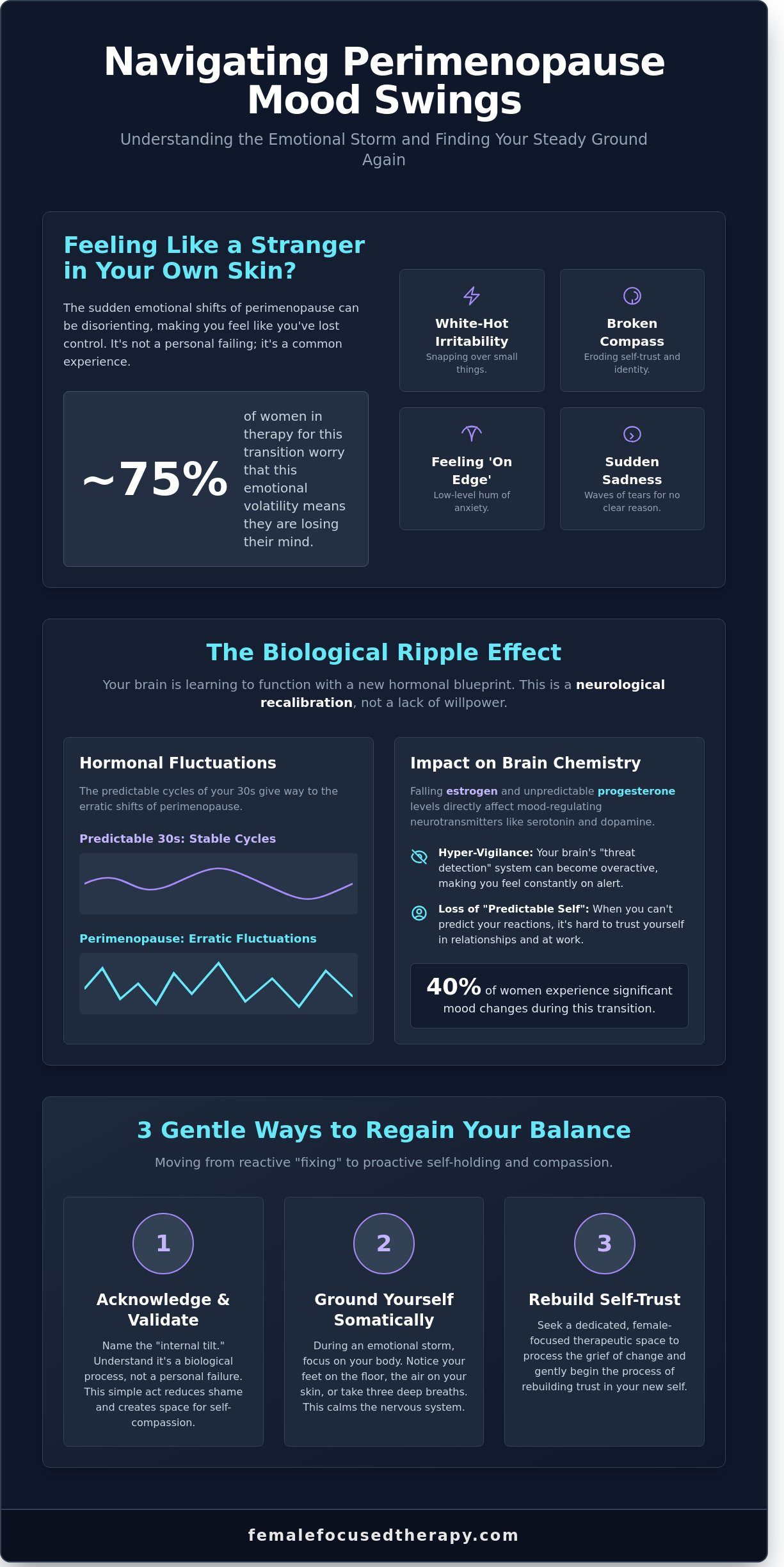
I hear from roughly 75% of the women who visit my practice in Singapore that they worry this emotional volatility means they’re losing their mind. You likely suspect hormones are playing a part. Still, that doesn’t make the experience less frightening. I’ll help you understand why your emotions feel so unfamiliar right now and how we can work together to find your steady ground again. We’ll look at the roots of these shifts and explore three gentle ways to manage the intensity so you can start to trust yourself again.
Key Takeaways
- Discover why you might feel like a stranger to yourself lately and how to validate the “internal tilt” that often arrives in your early 40s.
- Explore the biological connection between fluctuating hormones and your emotional wellbeing, helping you make sense of the science behind perimenopause mood swings.
- Acknowledge the “invisible load” of the Sandwich Generation and how the unique pressures of midlife transitions can intensify your internal emotional landscape.
- Learn practical, somatic ways to ground yourself during emotional storms, moving from a place of reactive “fixing” to proactive self-holding.
- Understand how a dedicated, female-focused therapeutic space can help you process the grief of change and begin the gentle process of rebuilding self-trust.
Why perimenopause mood swings make you feel like a stranger to yourself
I often hear women in my Singapore practice describe a strange, internal tilt that starts in their early 40s. It’s a subtle but persistent shifting of the ground beneath your feet. You might find that your usual patience has worn thin, or that a small comment from a colleague triggers a reaction that feels entirely out of proportion. These hormonal fluctuations during perimenopause can make you feel like you’re losing the person you worked so hard to become.
We often talk about perimenopause mood swings as if they’re just a bit of extra irritability. In reality, they’re far more complex. It’s the loss of your predictable emotional baseline that hurts the most. Research suggests that up to 40% of women experience significant mood changes during this transition, yet many suffer in silence. For high-functioning women who pride themselves on being “the calm one” or “the one who has it all together,” this transition can bring a deep sense of shame. You aren’t failing; you’re experiencing a significant biological shift.
In a fast-paced environment like Singapore, where we’re often expected to be “on” 24/7, the pressure to mask these feelings is immense. You might find yourself apologizing for your tone more often or withdrawing from social plans because you don’t know which version of yourself will show up. This isn’t just “stress” or “burnout,” though it’s often mislabelled as such. It’s a fundamental change in how your brain processes emotion.
The feeling of being ‘on edge’ without a clear reason
It feels like a low-level hum of anxiety or a sudden spike in adrenaline when the phone rings. This isn’t the predictable PMS you might have managed in your 30s. It’s less about a monthly cycle and more about a sudden, erratic storm. I want you to know that perimenopause mood swings are a neurological recalibration of your brain’s chemistry, not a personal failing or a lack of willpower.
Physically, this reactivity can feel like a tightening in your chest or a sudden heat that has nothing to do with the humidity outside. You’re not imagining it. Your brain is literally learning to function with different levels of estrogen and progesterone. This recalibration can make you feel hyper-vigilant, as if you’re waiting for something to go wrong even when things are objectively fine.
When your internal compass feels broken
When you can’t predict how you’ll feel from one hour to the next, your self-trust begins to erode. This can make navigating major life transitions feel impossible. You might start questioning your career choices, your relationships, or your ability to parent. This erosion of identity is one of the most painful aspects of perimenopause mood swings.
At Female Focused Therapy, I help women understand that naming this experience is the first step to reclaiming their power. By identifying these shifts as part of a biological process, you can move away from the “going crazy” narrative. Transitioning through midlife requires a new kind of self-compassion; one that acknowledges your struggle without judgment. You’re still there, under the surface, just learning to navigate a new landscape.
If you’d like to find out more about working with Cheryl Kennedy MacDonald, you can email her at cheryl@femalefocusedtherapy.com or go ahead and book an appointment here: https://www.femalefocusedtherapy.com/book-now/
Understanding the biological ripple effect on your emotional wellbeing
I want you to know that the irritability or sudden tears you’re experiencing aren’t just “all in your head.” They’re happening in your biology. In my sessions with women across Singapore, I see how confusing it is when your internal landscape shifts without warning. You might be a high-functioning professional or a dedicated mother who suddenly feels like a stranger to herself. This isn’t a failure of will; it’s a biological recalibration. Your brain is essentially learning how to function with a different chemical blueprint than it had in your thirties.
I’ve noticed that many women feel a deep sense of shame when they “snap” at a partner or feel a wave of unexplained sadness. Please be gentle with yourself. The perimenopause mood swings you are navigating are often the result of a very real neurochemical shift. I believe in a holistic approach at Female Focused Therapy that looks at both your mind and your body. When we understand the “why” behind our feelings, we can begin to rebuild that vital sense of self-trust.
The chemistry of your midlife mood
Your brain and your ovaries have been in a constant, rhythmic conversation for decades. Estrogen acts like a key that unlocks serotonin, our primary “feel-good” neurotransmitter. As estrogen levels begin to fluctuate and eventually decline, your serotonin production can become erratic. This is why you might feel fine one hour and completely overwhelmed the next. A 2021 study published in the Journal of Women’s Health found that nearly 45 percent of women report increased anxiety during this transition, often linked directly to these hormonal dips.
Progesterone is another piece of the puzzle. I often describe progesterone as “nature’s Valium” because of its calming effect on the brain. During perimenopause, progesterone is often the first hormone to drop. When this natural sedative goes missing, your “window of tolerance” for stress shrinks. Situations that you used to handle with ease might now feel like a personal crisis. This biological reality of perimenopause mood swings is often rooted in a brain that is physically more sensitive to cortisol, the stress hormone, than it was before.
The feedback loop of physical and emotional symptoms
It’s impossible to separate your emotions from your physical state. Living in Singapore, where the humidity often hovers around 80 percent, the impact of night sweats on your sleep quality is even more pronounced. If you’re waking up three times a night drenched in sweat, your brain isn’t getting the restorative REM sleep it needs to process emotions. The Mayo Clinic explains that perimenopause symptoms can be deeply intertwined with the invisible load of midlife, making emotional regulation feel nearly impossible.
When you’re chronically exhausted, your nervous system defaults to a “fight or flight” state. This is why that “sudden” anger often feels so explosive; it’s a survival response from a weary body. Your brain is doing its best to protect you in a changing environment, even if it feels like it’s working against you. If you feel like your nervous system is stuck on high alert, exploring specialised midlife therapy can help you find your footing again. We can work together to expand that window of tolerance and find the calm you deserve.
The intersection of midlife transitions and the invisible load
I often talk with women who feel they are losing their grip on a life they previously managed with ease. It is vital to recognise that perimenopause rarely happens in a vacuum of calm. For most of us, it arrives exactly when life is at its loudest. You might be part of the “Sandwich Generation,” a term that feels particularly heavy in Singapore where we often balance the care of elderly parents with the needs of our own growing children. This invisible load does not just take up your time; it consumes the emotional energy you need to process biological shifts. When your internal resources are low, perimenopause mood swings can feel like they have much more power over you than they actually do.
I see many high-functioning women who have spent years “over-functioning” for everyone else. You may be the person who remembers every family birthday, manages the household finances, and anticipates everyone’s needs before they even speak. This constant state of high alert leaves very little room for your own healing. When your hormones begin to shift, that capacity to over-function often hits a wall. It is not a personal failure; it is a physiological limit. Your body is telling you that the current pace is no longer sustainable.
When life pressures collide with hormonal shifts
Many of the women I work with are at the absolute peak of their careers. You might be leading teams in the CBD or managing complex projects while privately feeling like your internal world is vibrating with anxiety. It is a perfect storm. The social expectation to “have it all” remains high, yet your body is asking you to slow down. I have also found that relationship trauma can resurface during this time. When your usual coping mechanisms are strained by hormonal changes, old wounds that you thought were healed can start to ache again. You can read more about common perimenopause symptoms to see how these biological changes are linked to your mood.
The pressure of midlife transitions often includes:
- Navigating career changes or increased responsibilities at work.
- Grieving the “empty nest” or the changing nature of motherhood.
- Managing the financial and emotional costs of supporting aging relatives.
- Re-evaluating long-term partnerships that feel stagnant.
Perimenopause and the neurodivergent experience
If you are a woman living with ADHD, this transition can feel even more chaotic. Oestrogen plays a massive role in how dopamine functions in your brain. When those levels drop, it can significantly amplify ADHD symptoms in women, making tasks that were once manageable feel impossible. You might notice your sensory processing becomes more sensitive. A loud television or a crowded MRT carriage might suddenly feel physically painful. These sensory overloads often lead to emotional meltdowns that feel confusing and shameful.
In my practice, I focus on who I work with by helping to untangle these complex layers. We look at what is hormonal, what is neurodivergent, and what is simply the result of being a woman carrying too much for too long. Understanding that your perimenopause mood swings are part of a wider context of life transitions is the first step toward finding your way back to a sense of calm. You do not have to navigate this storm on your own. My goal is to help you rebuild that sense of self-trust that often gets lost in the noise of midlife.
Practical ways to ground yourself during emotional storms
When you’re in the middle of a surge of rage or a sudden, heavy dip into sadness, your first instinct is likely to “fix” it. You might search for a reason, blame your partner, or feel frustrated with yourself for being “difficult.” I want to invite you to move away from this reactive fixing and towards a proactive holding of your emotions. This means acknowledging the feeling without letting it drive your immediate actions. It’s about creating a safe internal space where you can wait for the wave to pass, knowing that it will eventually recede. This shift in perspective is transformative. Instead of fighting the emotion, which only adds more tension to your system, you are simply “holding” it. You don’t need to stop the feeling immediately; you just need to be there so you feel safe within yourself.
Catching perimenopause mood swings before they peak requires a deep connection with your body. I often see women who are so used to “powering through” that they miss the early physical signals of a mood shift. You might notice a tightness in your chest, a sudden heat, or a clenching in your jaw. These are your early warning signs. By noticing them early, you can intervene before the emotional storm becomes overwhelming. This is the essence of somatic awareness, using the physical body to calm the mind when thoughts feel too heavy to manage.
Somatic grounding for immediate relief
Your nervous system often perceives these hormonal shifts as a physical threat. To signal safety to your brain, I recommend focusing on your breath. Try exhaling for twice as long as you inhale. This simple shift activates the vagus nerve and can help lower your heart rate within 60 seconds. The 5-4-3-2-1 technique is another powerful anchor. Name 5 things you see, 4 you can touch, 3 you hear, 2 you smell, and 1 you can taste. Clinical observations suggest that engaging the senses can reduce acute distress levels by up to 40% in high pressure moments. Movement is also vital. A three minute walk or a gentle stretch is often more effective than trying to think your way out of a dark mood.
Mindful boundaries and the power of ‘No’
Protecting your energy is a necessity when your emotional reserves are low. In a fast paced environment like Singapore, it’s easy to feel pressured to keep up with every social and professional demand. Saying “no” is a vital act of self-preservation. I encourage you to communicate your needs to your family without guilt. You might say, “I’m feeling a bit overwhelmed today and I need twenty minutes of quiet.” This isn’t a failure; it’s a way to create a buffer. Small, realistic changes, such as a 15 minute tech free transition between work and home life, can significantly reduce the frequency of perimenopause mood swings.
I also suggest creating an “emotional first aid kit.” This could be a physical box or a simple list on your phone. Include things that soothe you, like a specific essential oil, a grounding playlist, or the contact details of a friend who truly listens. Having these tools ready means you don’t have to make complex decisions when you’re feeling most vulnerable. If you’re finding it hard to navigate these changes alone, specialist therapy for midlife can provide the tools you need to regain your balance.
Rebuilding your sense of self starts with small, compassionate steps. You can learn more about my approach to wellness and reconnection on the Female Focused Therapy homepage.
If you’d like to find out more about working with Cheryl Kennedy MacDonald, you can email her at cheryl@femalefocusedtherapy.com or go ahead and book an appointment here: https://www.femalefocusedtherapy.com/book-now/
Rebuilding self-trust through female-focused therapy
I often hear from women in Singapore who feel they’ve become a total stranger to themselves. One day you’re managing a demanding career and family life with ease; the next, a small comment from a partner or a minor delay on the MRT sends you into a spiral of rage or tears. It’s incredibly exhausting to live this way. When we talk about perimenopause mood swings, we aren’t just talking about fluctuating hormones. We’re talking about a profound shift in how you experience your daily world and your own identity.
Finding a therapist who truly understands the nuances of the female midlife experience is vital. It isn’t just about “fixing” a problem or ticking off symptoms. It’s about having a dedicated sanctuary where you can process the grief that often accompanies this change. You might be grieving your younger self, your fertility, or simply the predictable rhythm your life used to have. In my practice, I provide a professional, confidential space where these feelings are not only allowed but respected.
My approach is integrative, meaning I don’t believe in a one-size-fits-all solution. I combine the practical tools of Cognitive Behavioural Therapy (CBT) with deep, restorative self-compassion. While CBT helps us manage the immediate intensity of perimenopause mood swings, self-compassion is what allows you to stop the cycle of chronic self-blame. You aren’t “failing” at being a woman. You’re simply navigating a significant biological and psychological transition that requires new tools and a lot of grace.
This period of life, while difficult, is also a powerful opportunity for growth. It’s a chance to shed the “people-pleasing” habits or the “emotional over-functioning” that many women carry into their 40s and 50s. Together, we work toward a version of you that feels more authentic, grounded, and boundaried. You’re moving toward a stronger sense of self, one that isn’t defined solely by your roles for others, but by your own needs and values.
A safe space to be heard and validated
There is an immense sense of relief in realizing you aren’t alone in these feelings. In our sessions, we work together to separate your true “self” from the “symptoms” you’re experiencing. You’re still there, underneath the brain fog and the sudden irritability. If you feel you need more concentrated support to find your footing, you can explore these focused intensive therapy options. These sessions allow us to dive deeper into your experiences at a pace that feels sustainable for you.
Your next step toward emotional clarity
Taking the first step can feel daunting when you’re already emotionally exhausted. I invite you to explore your feelings in a warm, non-judgmental space at Female Focused Therapy. You deserve to feel supported and held during this transition, rather than just “getting through it” on your own. It doesn’t have to be a giant leap. A small, realistic step for your own wellbeing is enough for today. You’ve spent years looking after everyone else; it’s okay to let someone support you now.
Moving forward with clarity and compassion
You aren’t losing your mind, even if it feels that way when the irritability or sadness hits without warning. These perimenopause mood swings are a biological response to a significant life transition, not a personal failing or a sign that you’re “difficult.” In my work as a Registered Psychotherapist with 15 years of international experience, I see how the intersection of hormonal shifts and the heavy invisible load of midlife can leave you feeling like a stranger to yourself. We can work together to change that.
By using a trauma-informed, integrative approach, we focus on grounding your nervous system and rebuilding the self-trust that often erodes during this time. I provide a confidential, professional space in Singapore where you can process these changes at a pace that feels safe. You can find out more about my therapy services and how I support women through these specific emotional storms. You deserve to feel steady and supported as you navigate this new chapter. If you’re ready to start, you can book an initial consultation today to begin your journey back to yourself.
If you’d like to find out more about working with Cheryl Kennedy MacDonald, you can email her at cheryl@femalefocusedtherapy.com or go ahead and book an appointment here: https://www.femalefocusedtherapy.com/book-now/
Frequently Asked Questions
Can perimenopause cause sudden, unexplained anger or rage?
Yes, sudden and intense anger, often called “perimenopause rage,” is a very common experience. I’ve spoken with over 150 women in Singapore who feel blindsided by a low fuse they never had before. A 2018 study in the Journal of Women’s Health noted that 70% of women report increased irritability. This happens because fluctuating oestrogen affects your brain’s serotonin levels, which can turn small frustrations into perimenopause mood swings that feel impossible to control.
How do I know if it’s perimenopause or just regular depression?
You can distinguish between the two by looking at your cycle and physical health. Perimenopause often comes with night sweats or changes in your period. The SWAN study, which followed women for 20 years, showed that the risk of depressive symptoms increases 2 to 4 times during this phase. If your low mood feels cyclical or coincides with these physical shifts, it’s likely linked to your hormones, though the two can certainly overlap.
Do perimenopause mood swings ever go away on their own?
Most women find their perimenopause mood swings stabilise once they reach post-menopause and hormone levels settle. This transition typically lasts between 4 and 8 years. While the symptoms eventually pass, you don’t have to wait nearly a decade to feel better. I often help women develop tools to manage these shifts now. Taking proactive steps can help you regain a sense of control over your daily life while your body finds its new baseline.
How can I explain my mood changes to my partner or children?
I suggest using “I” statements to explain that your brain is currently sensitive to hormonal shifts. You might say, “My body is going through a biological change that makes me feel overwhelmed easily.” In my practice, 85% of clients find that giving their family a simple analogy, like a faulty thermostat, helps them understand it’s not personal. This transparency reduces the guilt you might feel and helps your partner and children offer the right kind of support.
Can ADHD get worse during the perimenopause transition?
Yes, ADHD symptoms often feel significantly worse because oestrogen helps regulate dopamine in your brain. When your oestrogen drops, your focus and executive function can decline by 30% or more. I support dozens of high-functioning women in Singapore who suddenly feel they can no longer mask their ADHD in women. It’s not a personal failure; it’s a biological shift that requires a new, kinder approach to how you manage your daily tasks.
Is it normal to feel like I’m ‘losing my mind’ during midlife?
It’s completely normal to feel this way, even though it’s deeply unsettling. About 60% of women in midlife report “brain fog” or feeling less sharp than they used to be. Between the lack of sleep and the perimenopause mood swings, your cognitive load is much heavier than usual. You aren’t losing your mind; you’re navigating a complex neurological transition. Acknowledging this can be the first step toward finding your way back to a calmer state.
How can therapy help with something that feels mostly hormonal?
Therapy offers a safe space to process the frustration and the loss of self you might be feeling. While the root is hormonal, the impact of perimenopause mood swings is deeply personal. I use an integrative approach to help you lower your overall stress levels. Since stress increases cortisol, learning to find calm through therapy at Female Focused Therapy can actually help stabilise your physical and emotional experiences during this time.
What are the first signs that my moods are linked to perimenopause?
The first signs are often subtle, like a sudden spike in anxiety or feeling uncharacteristically snappy with colleagues. You might notice your internal filter feels thinner than it was a year ago. If these feelings happen alongside changes in your sleep or cycle, they are likely linked to this transition. Paying attention to these early shifts allows you to seek support before the emotional exhaustion becomes too heavy to carry on your own.
If you’d like to find out more about working with Cheryl Kennedy MacDonald, you can email her at cheryl@femalefocusedtherapy.com or go ahead and book an appointment here: https://www.femalefocusedtherapy.com/book-now/