
The ground has shifted beneath your feet. Perhaps a career has ended, a relationship has changed, or you’ve relocated to a new city like Singapore, and the person you see in the mirror feels like a stranger. You might feel overwhelmed, adrift, and constantly wonder, ‘Who am I now?’ This sense of being unmoored is a common, yet deeply personal, experience during major life transitions. There’s often a quiet, persistent voice telling you that you should be handling it all with more grace-that you should somehow ‘know’ how to navigate this new terrain on your own. If you’re feeling lost or stuck, please know you are not alone, and your feelings are entirely valid.
This guide is here to offer a compassionate hand. Together, we will explore why change feels so disorienting and share gentle, practical strategies to help you move through this period with greater clarity and resilience. Our goal is to support you as you navigate the uncertainty, not just to cope, but to reconnect with your core self. By the end, you will have the tools to find your footing, rediscover your strength, and feel hopeful about the path ahead.
Key Takeaways
- Learn why change is an internal psychological journey, not just a shift in your external circumstances.
- Discover a compassionate framework for understanding the emotional stages of transition and the unique pressures women often face.
- Move beyond generic advice with practical strategies to build resilience and self-trust during major life transitions.
- Find out how to cultivate your inner resources to navigate change with greater clarity and a renewed sense of self.
What Are Life Transitions and Why Do They Feel So Overwhelming?
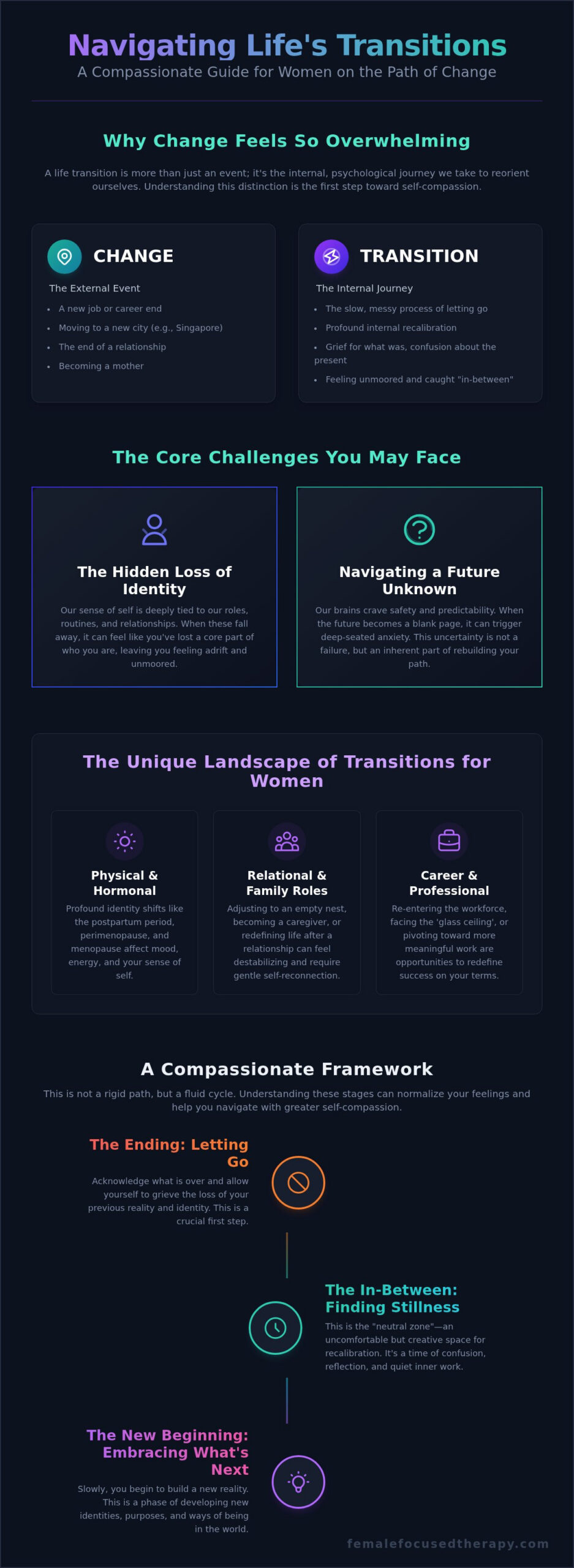
A new job, a move to Singapore, the end of a relationship, or becoming a mother-these are all significant life changes. But the reason these major life transitions can feel so deeply unsettling goes beyond the external shift in circumstances. A transition is the internal, psychological journey we undertake to reorient ourselves to that change. While the change is the event, the transition is the slow, often messy process of letting go of one reality and embracing a new one. It’s a period of profound internal recalibration.
This process often leaves us feeling caught in an uncomfortable in-between space. You may feel like you’re straddling two worlds-the one you’ve left behind and the one you haven’t yet fully entered. Historically, cultures have acknowledged these significant shifts with ceremonies known as rites of passage to guide individuals through this liminal state. Without such clear markers today, it’s common to feel lost. This emotional journey is valid and real, often bringing with it a mix of anxiety, grief for what was, confusion about the present, and deep exhaustion.
The Hidden Loss of Identity
So much of our sense of self is tied to our roles, routines, and relationships. During a major life transition, these familiar structures can fall away, leaving us feeling unmoored. You may be grieving the loss of who you were in that previous chapter-the career woman, the partner in a relationship, the expat with a settled community. This isn’t just about missing the past; it’s about navigating the temporary loss of a core part of your identity.
For English-speaking expats, this transition also involves navigating new practical and legal systems. For those facing this journey in Israel, for example, getting guidance from a firm like SALIOR Law Office can be an essential step in finding stable ground.
Navigating the Uncertainty of the Future
Our brains are wired for safety and predictability. When the future becomes a blank page, it can trigger a deep-seated anxiety and a feeling of being fundamentally unsafe. It is completely normal to feel directionless when the map you’ve been following no longer reflects the territory you’re in. This uncertainty isn’t a sign of failure; it’s an inherent part of the courageous work of rebuilding and finding a new path forward.
The Unique Landscape of Life Transitions for Women
While change is a universal human experience, many life transitions are uniquely shaped by a woman’s journey. Societal expectations often place an immense pressure on women to navigate these shifts with quiet grace, managing personal, professional, and family needs simultaneously. This unique convergence of biological, social, and professional pressures can profoundly impact a woman’s mental wellbeing, often leaving her feeling isolated and overwhelmed as she tries to find her footing on constantly shifting ground.
Physical and Hormonal Transitions
Changes like the postpartum period, perimenopause, and menopause are far more than just physical events; they are profound identity shifts. Fluctuating hormones can affect everything from your mood and energy to your sense of self. Acknowledging and understanding these changes is the first step toward navigating them with clarity and self-compassion. We offer specialised support for women navigating menopause and midlife transitions in a safe, understanding space.
Relational and Family Role Shifts
Your roles and relationships are central to your identity, and when they change, it can feel destabilising. You may be adjusting to an empty nest, becoming a primary caregiver for ageing parents, or redefining your life after the end of a significant relationship. Even friendships can shift during midlife, prompting a re-evaluation of who you are and what you need from your support system. These moments require a gentle reconnection with yourself outside of those familiar roles.
Career and Professional Changes
A woman’s professional path is often non-linear, marked by its own distinct transitions. You might be re-entering the workforce after a career break to raise a family, confronting the ‘glass ceiling’ or ageism, or feeling a deep pull to pivot towards work that offers more meaning and purpose. Each of these professional crossroads is an opportunity to redefine success on your own terms and align your career with your authentic self.
A Compassionate Framework: The Three Stages of Transition
When you feel lost, having a map-even a simple one-can provide immense comfort. We can look to a gentle framework to help us understand the psychological process of change. It’s not a rigid, linear path you must follow, but a fluid cycle. Understanding these stages can normalize your feelings, reduce self-judgment, and help you navigate major life transitions with greater self-compassion. It’s a process of letting go, finding stillness, and gently embracing what’s next.
Stage 1: The Ending – Acknowledging What’s Been Lost
Every new chapter begins with the closing of a previous one. This first stage is about honouring what you are leaving behind. It’s a crucial time to create space for grief, sadness, anger, or even nostalgia for what’s been lost-a job, a relationship, or a version of yourself. Rushing this process or dismissing your feelings can lead to them resurfacing later. True growth begins with acknowledging the reality of the ending and allowing yourself to feel it fully.
Stage 2: The Neutral Zone – The Sacred ‘In-Between’
This is often the part where you feel most lost. The old is gone, but the new hasn’t arrived yet. It can feel confusing, empty, and unproductive. It’s vital to see this not as a void, but as a sacred pause. This is a fertile time for reflection and integration, not for forced action or demanding clarity. Think of it as a creative emptiness, where the soil of your life is being prepared for new seeds to sprout when the time is right.
Stage 3: The New Beginning – Stepping into What’s Next
A new beginning isn’t a grand, sudden event; it emerges quietly and naturally from the stillness of the neutral zone. This stage is about curiosity and experimentation. It’s a time to try on new identities, explore different possibilities, and test new ways of being. The focus here is not on having a perfect plan, but on taking small, tentative steps that help you build a renewed sense of purpose and reconnect with yourself in a new way.
Remember, you may find yourself moving between these stages. Some days you might revisit the grief of the Ending, while on others you feel the spark of a New Beginning. This is completely normal. By treating this framework as a compassionate guide, you can offer yourself the patience and support needed to navigate the complex journey of these life transitions.
Practical Tools to Navigate Change with Resilience and Self-Trust
When you feel adrift, it’s natural to search for a quick fix. But true stability comes not from changing your external world, but from cultivating your internal one. The strategies below are not about ‘fixing’ your situation; they are psychologically-grounded tools to support yourself with kindness. The goal is to gently rebuild your sense of self-trust, creating a foundation of resilience that will serve you through all of life’s chapters.
Practice Radical Self-Compassion
During difficult life transitions, our inner critic often becomes louder. Radical self-compassion is the practice of meeting your own struggle with kindness rather than judgment. It means acknowledging your pain-the confusion, the grief, the fear-and treating yourself with the same warmth you would offer a dear friend. Instead of thinking, “I should be stronger,” try whispering, “This is incredibly hard, and I am doing my best to navigate it.”
Reconnect with Your Core Values
When the path ahead is unclear, your values become your compass. A major life change is a powerful opportunity to pause and ask yourself: What truly matters to me now? Is it connection, creativity, security, or growth? Identifying your core values gives you an internal anchor. When you feel lost, you can make small, intentional choices that align with these values, helping you find your way back to yourself, one step at a time.
Create Anchoring Rituals
In the midst of external chaos, small, consistent routines can create a profound sense of stability and control. These anchoring rituals don’t need to be grand; their power lies in their consistency. They are a promise you keep to yourself each day. Consider what might ground you:
- A quiet morning cup of tea or kopi before the day begins.
- A short, mindful walk in your neighbourhood or a nearby park.
- Five minutes of journaling to untangle your thoughts before sleep.
These simple acts provide moments of calm and predictability, reminding you that you are still in charge of your inner world, even when the outer world feels turbulent.
Building these internal resources is a gentle, ongoing practice. If you feel you need dedicated support to navigate your own life transitions with greater clarity and confidence, please know you don’t have to do it alone.
How Therapy Provides a Safe Harbour During Life’s Storms
Navigating major life transitions can feel like weathering a storm on your own. But you don’t have to. Therapy offers a confidential, non-judgmental space dedicated entirely to you-your feelings, your fears, and your healing. It’s a protected time where you can pause, breathe, and process the complex emotions that come with profound change, without the pressure of outside expectations. A therapist acts as a skilled and compassionate guide, helping you find your own way forward, not by giving you the answers, but by empowering you to discover them within yourself.
This kind of professional guidance is invaluable. For readers based in the UK, for instance, you can visit Jonathan Cullen Therapy to see how a dedicated practitioner supports clients through these exact challenges.
A Space to Grieve and Make Sense of Change
Change, even when positive, often involves a sense of loss. Therapy provides a safe container to explore feelings of grief, anger, and confusion that you might not feel comfortable sharing elsewhere. Together, we can begin to co-create a new narrative for your life-one that honours your past while building a hopeful vision for your future. You can learn more about who we work with and how our female-focused approach can support you through this specific chapter.
Rebuilding Your Identity and Self-Trust
When the ground shifts beneath your feet, it’s common to question who you are. Working with a professional helps you reconnect with your core strengths and values, which can become obscured during difficult life transitions. We focus on rebuilding your self-trust, developing your confidence to handle uncertainty, and equipping you with practical coping skills tailored to your unique journey, whether you are in Singapore or living abroad.
Taking the First Step
Reaching out for support is not a sign of weakness; it is a profound act of strength and self-care. Our integrative approach is warm, trauma-informed, and specifically designed to address the needs of women navigating change. If you are ready to feel more grounded and find your footing again, we invite you to book a confidential consultation today. Your safe harbour is waiting.
Embrace Your Next Chapter with Confidence and Support
Change, while a natural part of every woman’s story, can feel disorienting and deeply personal. As we’ve explored, understanding that these periods are not endings but powerful invitations to grow is the first step. By embracing a compassionate framework and practical tools, you can learn to reconnect with your inner strength and rebuild your self-trust, transforming uncertainty into an opportunity for profound self-discovery.
Navigating these significant life transitions doesn’t have to be a solitary journey. Sometimes, the most courageous step is asking for support. If you’re seeking a safe harbour to process your experience, Female Focused Therapy offers specialized support tailored to the unique challenges women face. With a warm, confidential, and trauma-informed therapeutic approach, we provide a space for you to heal and grow, with sessions available both online and in-person here in Singapore.
You deserve to move forward with clarity and confidence. Take the first step towards clarity. Book a consultation with Female Focused Therapy.
Frequently Asked Questions About Life Transitions
What is the difference between a life change and a life transition?
A life change is the external event itself-like moving to a new city, starting a new job, or ending a relationship. A life transition, however, is the internal psychological process you go through to adapt to that change. It’s the journey of letting go of the old reality and navigating the emotional and mental shifts required to embrace the new one. Understanding this difference can bring a great deal of clarity and self-compassion.
Is it normal to feel depressed or anxious during a major life transition?
Yes, it is completely normal. Major transitions disrupt our routines, identity, and sense of security, which can naturally trigger feelings of anxiety, sadness, or even grief. These emotions are a valid part of the process as you adjust. It’s important to be gentle with yourself and acknowledge that your feelings are a sign that you are processing a significant shift in your life. Acknowledging them is the first step toward navigating them with kindness.
How long does a typical life transition last?
There is no set timeline for a transition, as each journey is deeply personal. The duration depends on the nature of the change, your individual coping mechanisms, and the support system you have in place. The goal isn’t to rush through it but to move at a pace that feels safe and sustainable for you. Rebuilding your sense of self takes time, and honouring your own rhythm is a crucial part of the healing process.
How can I support a friend or family member who is going through a difficult transition?
The most powerful support you can offer is to listen with empathy and without judgment. Hold space for their feelings, validating whatever comes up. Instead of offering unsolicited advice, ask what they need. Practical help, like preparing a meal or running an errand, can also be incredibly meaningful. Simply being a consistent, kind, and patient presence in their life can make a world of difference during a challenging time.
I’m going through a career change. How can therapy help with that?
A career change is also an identity change. Therapy provides a confidential, supportive space to explore the fears, anxieties, and excitement that come with this shift. Together, we can work on managing stress, clarifying your new professional goals, and rebuilding your confidence. It’s an opportunity to ensure your new path aligns with your core values, helping you move forward with a stronger sense of purpose and self-trust in your abilities.
What if my life transition was a positive one, but I still feel sad?
This is a very common and valid experience. Even wonderful life transitions, like getting married, having a baby, or getting a promotion, involve a form of loss. You might be grieving a past identity, a familiar routine, or a certain kind of freedom. It is perfectly okay to hold conflicting emotions-joy for the new and sadness for what has been left behind. Therapy can help you honour and process this complexity without guilt.

Article by
Cheryl Kennedy MacDonald MA BA (Hons) Pg. Dip. SAC BACP
Cheryl Kennedy MacDonald is a psychotherapist specialising in women’s mental health, relationships, and life transitions. She works with women navigating trauma, relationship breakdown, identity shifts, and midlife change, helping them rebuild self-trust, emotional stability, and a clear sense of who they are and what they want.
With over 20 years’ experience working with women internationally, Cheryl is the founder of YogaBellies, a global women’s yoga school, and the creator of the Birth ROCKS method. Her work sits at the intersection of psychotherapy and embodiment, integrating evidence-based therapeutic approaches with somatic, body-based practices that support deep, lasting change.
Known for her grounded and direct approach, Cheryl moves beyond surface-level insight to address the patterns held in the body and nervous system. Her work supports women to regulate, reconnect, and respond to their lives from a place of clarity, strength, and self-respect.
She is a published author in academic journals and has written multiple books on women’s health, pregnancy, and midlife wellbeing, available on Amazon and leading book retailers worldwide.