
You are lying in bed, inches away from the person you love, yet the distance feels like a vast, cold ocean. You reach out for comfort, only to find a polite wall that leaves your heart racing. Learning how to deal with an emotionally unavailable partner starts with this hollow ache, making you wonder if you’re “too much.” I want to help you understand this loneliness and show you how to rebuild your own sense of peace and self-trust.
Key Takeaways
- Learn why the heavy ache of loneliness you feel is a physical response to a lack of connection, not a sign that you are being too needy.
- Understand the “pursuer-distancer” cycle and how this constant chase keeps your body in a draining state of chronic stress.
- Discover how to deal with an emotionally unavailable partner by shifting your energy away from their walls and toward your own somatic restoration.
- Find the clarity to look at your relationship honestly and decide if it truly offers the safe space you need to thrive.
Why it feels so lonely to love someone who pulls away
I want to start by acknowledging that deep, heavy ache in your chest. It is that physical sensation you feel when you reach out for connection and find nothing there. You might be sitting on the same sofa, yet it feels like they are miles away. This is the reality of loving someone who is emotionally unavailable.
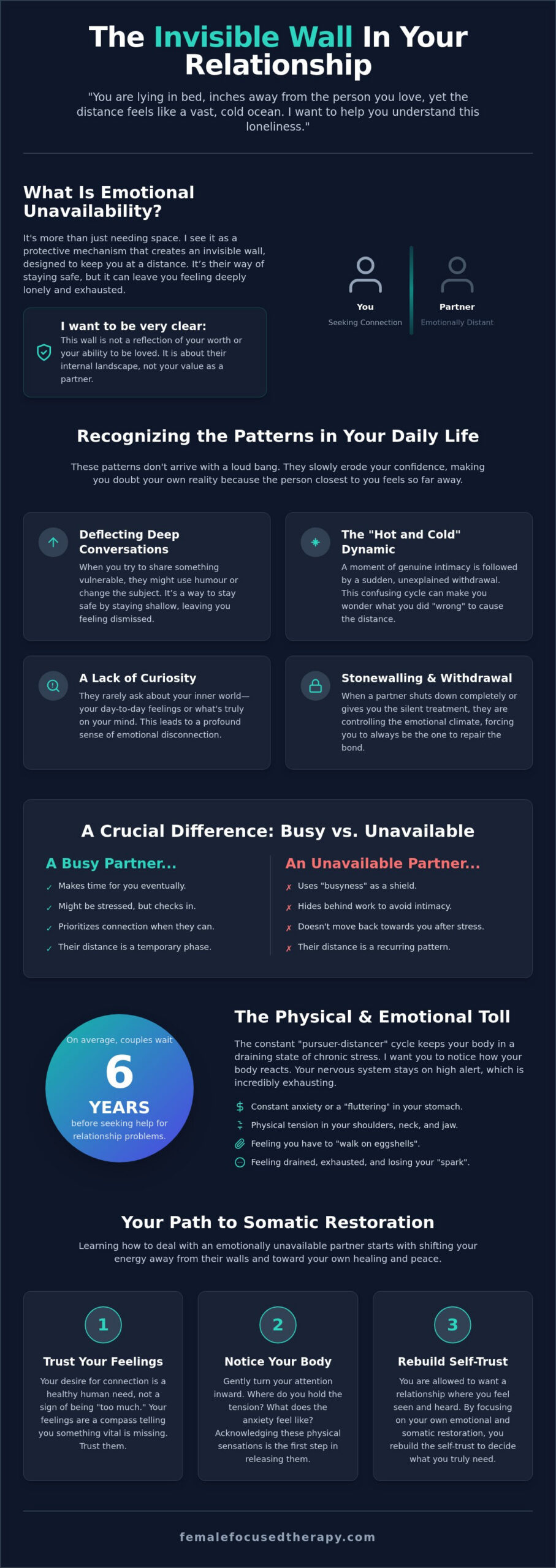
Emotional unavailability is more than just being a quiet person or needing some space. It is a consistent inability to engage with your emotional needs or share their own inner world. I define it as a protective mechanism that creates an invisible wall between two people, designed to keep the other person at a safe distance.
If you are struggling with relationship trauma, you might wonder if this distance is your fault. I want to be very clear: this wall is not a reflection of your worth or your ability to be loved. It is about their internal landscape, not your value as a partner.
The “Invisible Wall” in your relationship
Living with someone who is physically present but emotionally distant is exhausting. You might find yourself constantly “mind-reading” to figure out what they are thinking or feeling. This mental gymnastics leaves you drained and anxious, often manifesting as tension in your shoulders or a fluttering in your stomach.
Your desire for connection is a healthy human need, not a sign of being needy. We are wired for bond and safety. When we look at Attachment theory in adults, we see that our early experiences often shape how we show up in our current relationships. Understanding this can help you see why you feel so unsettled when that bond is missing.
Why you are not “too much”
Many women I work with in my individual psychotherapy sessions worry they are a burden. They have been told they are “too much” or “too sensitive” simply for wanting intimacy. This is especially common for high-functioning women who already carry the emotional labour of their entire household.
Research suggests that couples often wait six years before seeking help for relationship problems. During that time, you might have internalised the idea that your emotions are the problem. They aren’t. Your feelings are a compass, telling you that something vital is missing. Learning how to deal with an emotionally unavailable partner starts with trusting those feelings again.
I often see women in my practice who feel guilty for wanting more than their partner can give. You are allowed to want a relationship where you feel seen and heard. Validation is not a luxury; it is a fundamental part of a healthy partnership.
Recognizing the patterns of emotional unavailability in your daily life
In my work, I often see how these patterns manifest in subtle, everyday ways. They don’t usually arrive with a loud bang; instead, they slowly erode your confidence over time. You might start to doubt your own reality or feel like you are losing your spark because the person closest to you feels so far away.
One clear sign is the “deflection” of deep conversations. When you try to share something vulnerable or talk about the relationship, they might use humour to brush it off or suddenly change the subject. It is a way of staying safe by staying shallow, but it leaves you feeling dismissed and unheard.
You may also experience a “hot and cold” dynamic. This is where a moment of beautiful, genuine intimacy is followed by a sudden, unexplained withdrawal. It is a confusing cycle that leaves you wondering what you did “wrong” to cause the distance. Usually, it is simply their way of retreating after feeling too exposed.
A consistent lack of curiosity about your inner world is another red flag. They might not ask about your day-to-day feelings or what is truly on your mind. This lead to a profound sense of emotional disconnection in relationships that can feel more lonely than being alone.
The difference between “busy” and “unavailable”
A busy partner makes time eventually. They might be swamped with work, but they check in and prioritize your connection when they can. An unavailable partner uses busyness as a shield. They hide behind their laptop or a packed schedule to avoid the vulnerability of being present with you.
I want you to look at whether “I’m just stressed” has become a recurring pattern rather than a temporary phase. While life transitions can cause anyone to shut down for a while, a healthy partner will eventually move back toward you. If the door remains closed, you are likely learning how to deal with an emotionally unavailable partner rather than just a stressed one.
When withdrawal becomes a form of control
Stonewalling is a defensive tactic that often leaves you feeling abandoned. When a partner shuts down completely or gives you the silent treatment, they are controlling the emotional climate of your home. It forces you to be the one who always makes the first move to repair the bond.
I want you to notice how your body reacts when this happens. Do you feel like you have to walk on eggshells to avoid a shutdown? Your nervous system stays on high alert, which is incredibly draining. If you feel ready to explore these feelings in a safe space, I am here to help you find your ground again.
Moving beyond the pursuer-distancer cycle in your relationship
This cycle is a dance where the more you lean in, the further they lean back. It’s a painful rhythm that many couples get stuck in for years. You reach out for reassurance, and they feel a sudden need for air. When you try to bridge the gap, they move further away, leaving you feeling stranded and alone.
This dynamic creates a state of chronic stress for your body. When you can’t find that vital connection, your nervous system often stays in a “fight or flight” mode. You aren’t just “worried” or “anxious”; your body is physically reacting to a perceived loss of safety. Over time, this constant state of high alert leads to physical exhaustion and a deep sense of emotional depletion.
Attachment theory helps us understand why this happens. Often, those with an anxious attachment style find themselves drawn to those with an avoidant style. It’s a magnetic but difficult pull. One person seeks closeness to feel secure, while the other sees closeness as a threat to their autonomy. Understanding this doesn’t fix the problem, but it helps you see that it’s a systemic pattern rather than a personal failure.
Understanding the “Waltz of Pain”
I want you to see that your “pursuit” isn’t about being needy. It’s a desperate attempt to feel safe and connected. Conversely, their “withdrawal” usually isn’t a rejection of you as a person. It’s often an attempt to manage their own internal overwhelm. This cycle reinforces the belief that you are “too much” and they are “suffocating,” even though both of you are just trying to feel okay in your own way.
The intersection of ADHD and emotional unavailability
I have found that for women with ADHD, this cycle can be even more painful. Our emotional intensity can make the “pursuit” feel much more urgent. When a partner shuts down, it can trigger Rejection Sensitive Dysphoria (RSD). This is an intense emotional pain that feels almost physical, making the distance feel like an unbearable wound.
Navigating these dynamics requires a specific approach that respects how your brain works. If you’re finding that your neurodivergence is making it harder to manage these relationship waves, exploring ADHD therapy can provide you with the tools to soothe your own system. Learning how to deal with an emotionally unavailable partner involves recognizing these triggers so you can move from a place of panic to a place of grounded self-trust.
Practical steps for your own emotional and somatic restoration
I want to share a truth that took me years to learn: healing begins by turning your focus away from “fixing” your partner and toward soothing yourself. When you spend all your energy trying to figure out how to deal with an emotionally unavailable partner, you leave nothing for your own restoration. It is time to bring that beautiful, nurturing energy back home to your own heart.
I want to share some somatic tools to help you ground yourself when the loneliness feels overwhelming. When you feel that urge to chase or explain yourself for the tenth time, your body is likely in a state of high arousal. Your nervous system can learn to find safety outside of your partner’s approval, but it takes practice and patience.
Setting boundaries isn’t about changing them or issuing ultimatums. It is about protecting your own energy and time so you don’t end up hollowed out by the constant effort of trying to connect. You are allowed to have a life that feels full and rich, even if they choose to remain behind their wall.
Somatic tools to calm your nervous system
Simple breathwork practices can help move you out of that “pursuit” panic. When you feel the urge to lean in too hard, try extending your exhale to be longer than your inhale. This sends a direct signal to your brain that you are safe in this moment, even if you feel emotionally distant from your partner.
Reconnecting with your physical self through somatic movement and yoga allows you to process the tension that words cannot reach. Rest is also a radical act of self-care here. If you are emotionally drained, your body needs permission to simply be, without the pressure of “working” on the relationship or managing someone else’s moods.
Reclaiming your “Self” outside the relationship
Investing in your own friendships, hobbies, and joy is essential. Don’t wait for their participation to live your life. I often talk about “detaching with love,” which means staying in the relationship while letting go of the desperate need for them to change. It is a way of saying, “I love you, but I am not going to wait for you to make me happy.”
You can stop being the “emotional manager” for the entire family. You are not responsible for carrying everyone’s feelings while your own are ignored. This shift allows you to reclaim your “Self” as an individual, not just a frustrated partner. If you feel ready to start this journey of internal restoration, you can book a session with me to explore these steps in a supportive, private space.
Deciding on your next steps and finding a safe space to heal
There is a point where we must ask: Is this relationship a place where I can truly grow? It is a heavy question to carry. You might feel like you have tried every possible way to bridge the gap, yet the silence remains. I want you to know that it is okay to feel tired of being the only one holding the emotional weight of your partnership.
I offer a safe, judgemental-free space to explore these feelings. Whether you want to work on the relationship or focus purely on your own restoration, I am here to hold that space for you. You don’t have to navigate this loneliness on your own. My goal is to help you move forward with a renewed sense of self-assurance and internal stability.
Rebuilding self-trust is the most important work you will ever do. When you have spent years wondering how to deal with an emotionally unavailable partner, you may have forgotten how to listen to your own gut. I want to help you find that voice again, so you can make decisions from a place of peace rather than panic.
When couples therapy can help
Identifying if your partner is willing to look at their own patterns is a vital first step. On average, couples wait six years from the onset of relationship problems before seeking help. However, research shows that 70-75% of couples who undergo Emotionally Focused Therapy move from distress to recovery. If both people are willing to be vulnerable, change is possible.
There is a significant difference between “trying” and “performing” change. True growth requires a genuine willingness to look at the invisible walls they have built. If you are both ready to try, couples therapy in Singapore can provide the framework needed to rebuild that bond and move away from scorekeeping.
Rebuilding your internal foundation
Sometimes the path forward is a solo journey. Individual therapy is a powerful way to heal from relationship trauma. It allows you to process the years of being told you are “too much” or feeling like your needs are a burden. You deserve to be in a space where your emotions are seen as a gift, not a problem.
Developing this internal restoration is what helps you make clear, grounded decisions about your future. You deserve to feel stable and secure in your own skin. This is true regardless of what anyone else chooses to do or say. My role is to act as a guide as you learn to trust your own intuition again.
I want to leave you with a calm reassurance. You are already enough, exactly as you are. Your value is not defined by how much someone else is capable of giving you. If you feel ready to take a small step toward your own peace, you can book an initial session with me to begin your journey of healing.
Taking the first step toward your own restoration
You’ve spent so much time looking for answers in someone else’s silence. It is a heavy burden to carry, but you don’t have to carry it alone anymore. By understanding the cycles of pursuit and withdrawal, and by using somatic tools to ground your own body, you can begin to breathe again.
Learning how to deal with an emotionally unavailable partner isn’t about finding a magic key to unlock them. It is about restoring the connection you have with your own intuition and needs. As a Registered Integrative Psychotherapist specializing in relationship trauma and narcissistic abuse, I’ve seen how this internal work can transform a woman’s life.
My trauma informed, gender centric approach is designed to help you rebuild your sense of self assurance. You are already enough, and you deserve a life that feels safe and emotionally rich. If you are ready to find a safe space to explore these feelings, you can book a discovery call with me to begin your journey of restoration.
You have the strength to find your peace, and I am here to support you every step of the way.
Frequently Asked Questions
Can an emotionally unavailable partner ever change?
Change is only possible if your partner recognises their own defensive patterns and feels a genuine internal desire to dismantle them. It requires deep work and a willingness to sit with the discomfort of vulnerability rather than running from it. You cannot “love” or “fix” someone into changing; the drive to be present must come from within their own heart.
How do I know if I am being too needy or if they are really unavailable?
You are likely not being too needy; your desire for connection is a fundamental human requirement for a secure bond. If your partner consistently meets your requests for intimacy with silence or withdrawal, the issue is their inability to engage. When you are navigating these difficult waters, it’s common to doubt your reality, but trust the signal your body is sending.
Is emotional unavailability a sign of narcissistic abuse?
While emotional unavailability is a core component of narcissistic patterns, the two are not always the same thing. A partner can be unavailable due to their own past trauma or protective attachment style without having manipulative intent. However, if the distance is used as a weapon to control you, it may be part of a more harmful dynamic that we can explore together.
What is avoidant attachment and how does it affect my relationship?
Avoidant attachment is a style where a person views closeness as a threat to their autonomy and safety. In your relationship, this often looks like pulling away whenever things get “too real” or intimate. It creates a painful gap where you feel kept at arm’s length, as they use distance as a survival strategy to manage their own internal overwhelm.
How can I stay in the relationship without losing my mind?
Staying requires you to shift your focus from their behaviour back to your own internal restoration and somatic health. You must build a life that feels rich and full outside of their participation, investing in your own joy. By “detaching with love,” you stop making your peace dependent on their ability to connect, protecting your nervous system from the cycle of pursuit.
What happens if I stop pursuing my partner for connection?
When you stop pursuing, the “Waltz of Pain” often comes to a standstill, which can be both revealing and frightening. Sometimes, the partner feels the new space and moves toward you; other times, the distance simply grows. This pause is essential for your own clarity, allowing you to see the relationship for what it truly is without your constant effort to bridge the gap.
Should I suggest therapy to my partner, or go alone?
I always recommend starting individual therapy for yourself first to rebuild your self-trust and find your ground. Healing your own relationship trauma gives you the perspective needed to make clear decisions about your future. If your partner is willing to look at their own walls, couples work can be a helpful bridge, but your own restoration shouldn’t wait for them to be ready.
How long does it take to heal from relationship trauma?
Healing is a personal journey with no fixed timeline, as it happens in layers rather than a straight line. Many women start feeling a shift within a few months of consistent support as they move out of chronic “fight or flight.” It’s about slowly reclaiming your sense of self and learning to feel safe in your own skin again, one breath at a time.

Article by
Cheryl Kennedy MacDonald MA BA (Hons) Pg. Dip. SAC BACP
Cheryl Kennedy MacDonald is a psychotherapist specialising in women’s mental health, relationships, and life transitions. She works with women navigating trauma, relationship breakdown, identity shifts, and midlife change, helping them rebuild self-trust, emotional stability, and a clear sense of who they are and what they want.
With over 20 years’ experience working with women internationally, Cheryl is the founder of YogaBellies, a global women’s yoga school, and the creator of the Birth ROCKS method. Her work sits at the intersection of psychotherapy and embodiment, integrating evidence-based therapeutic approaches with somatic, body-based practices that support deep, lasting change.
Known for her grounded and direct approach, Cheryl moves beyond surface-level insight to address the patterns held in the body and nervous system. Her work supports women to regulate, reconnect, and respond to their lives from a place of clarity, strength, and self-respect.
She is a published author in academic journals and has written multiple books on women’s health, pregnancy, and midlife wellbeing, available on Amazon and leading book retailers worldwide.