
Do you find yourself constantly walking on eggshells, exhausted from trying to decipher your husband’s reactions? The emotional whiplash-from moments of connection to a sudden, devastating lack of empathy-can leave you feeling isolated, confused, and questioning your own sanity. This painful cycle of uncertainty often leads to one of the most difficult questions a woman can ask herself: is my husband autistic or narcissistic? On the surface, the behaviours can look strikingly similar, making it feel impossible to tell if his actions stem from intentional cruelty or a genuine lack of awareness.
This guide is here to offer you a safe space for clarity and validation. We will gently navigate the key differences between autism spectrum condition (ASC) and narcissistic personality disorder (NPD), providing clear, practical examples to help you understand your relationship dynamics. Our goal is not to label your partner, but to empower you with the insight needed to protect your own mental health, rebuild your self-trust, and find a sustainable path forward toward your own wellbeing. You deserve to feel seen and understood.
Key Takeaways
- Discover the crucial difference between intent and inability. Understanding the ‘why’ behind his behavior is the first step toward gaining clarity in your relationship.
- Get clear answers to the question, “is my husband autistic or narcissistic?” by learning to identify the subtle differences in common overlapping behaviors.
- Validate your own emotional experience and understand why the impact on you can feel profoundly similar, regardless of its source.
- Learn how to shift your focus from changing him to empowering yourself with practical steps to reclaim your peace and wellbeing.
The Crucial Difference: Intent vs. Inability
Before we explore the details, it is essential to hold this gentle reminder: this guide is designed to offer clarity and support your understanding, not to provide a diagnosis. Navigating these complexities is challenging, and seeking professional guidance is a powerful step toward wellbeing.
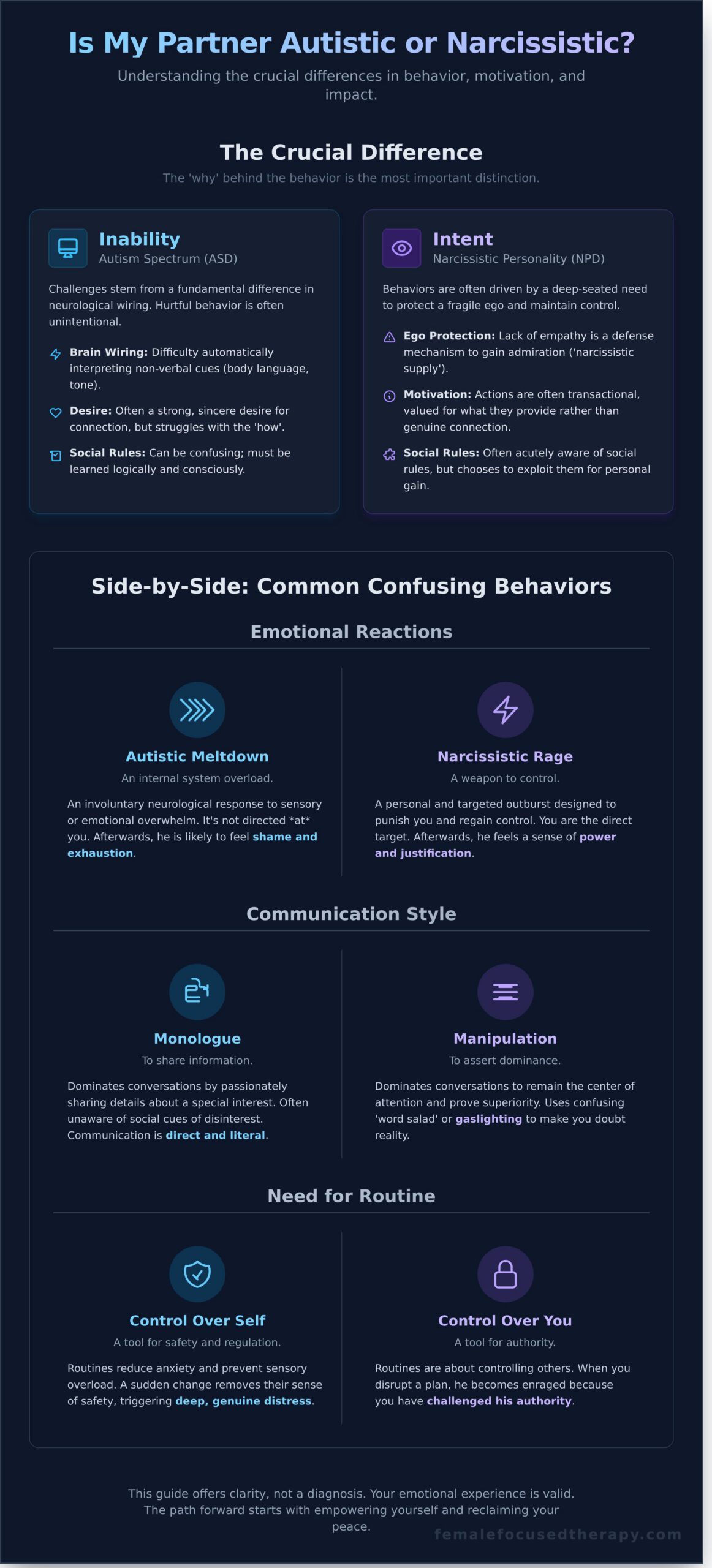
When you find yourself wrestling with the question, is my husband autistic or narcissistic?, it’s often because the outward behaviours can look confusingly similar. A blunt comment, a missed social cue, or an intense focus on a personal interest can leave you feeling unseen or dismissed. The most profound difference, however, lies not in what he does, but why he does it. The core distinction is one of intent versus inability. Narcissism is often rooted in a need to control the narrative and gain admiration, while autism is a neurodevelopmental difference that affects how the brain processes the social world.
Narcissistic Personality (NPD): A Focus on Self-Preservation
For an individual with narcissistic traits, behaviours that appear uncaring are often driven by a deep-seated need to protect a fragile ego. This lack of empathy is a defence mechanism. Actions are frequently aimed at gaining ‘narcissistic supply’-a constant stream of admiration, attention, and validation to feel worthy. An individual with traits of Narcissistic Personality Disorder may be acutely aware of social rules but chooses to exploit them for personal gain. In this worldview, relationships are often seen as transactional, valued for what they provide rather than for genuine, mutual connection.
Autism Spectrum (ASD): A Difference in Brain Wiring
In contrast, for an autistic individual, challenges with empathy stem from a fundamental difference in neurological wiring. It’s typically not a lack of caring but a genuine difficulty in automatically interpreting non-verbal cues like body language or tone of voice-a concept sometimes called ‘mind-blindness’. Hurtful behaviour is often unintentional, a direct result of a miscommunication or sensory overload. Social rules can be confusing and must be learned logically, almost like studying a manual. Beneath this, there is often a strong, sincere desire for connection, but the person may struggle with knowing how to build and maintain it.
Side-by-Side: Comparing Common Confusing Behaviors
You may be feeling emotionally exhausted, trying to navigate behaviors that leave you feeling hurt and bewildered. When you’re asking yourself, “is my husband autistic or narcissistic?”, it’s often because the outward actions can look deceptively similar. The confusion is understandable, as some traits can present in overlapping ways. In fact, recent research has even explored the complexities of narcissistic vulnerability in adults with autism, highlighting just how nuanced this distinction can be. The key to gaining clarity lies not in the behavior itself, but in the underlying motivation behind it. Let’s explore these differences side-by-side.
Emotional Reactions: Meltdown vs. Narcissistic Rage
When your husband has an explosive outburst, it can feel terrifying regardless of the cause. However, the experience and purpose are fundamentally different. Narcissistic rage is a weapon. It feels personal and targeted, designed to punish you, regain control, and put you in your place. You are the direct target of the anger. In contrast, an autistic meltdown is an involuntary neurological response to sensory or emotional overwhelm. It’s an internal system overload that ‘short-circuits’. While it can be frightening to witness, it is not directed at you; you are simply in the vicinity of the explosion. Afterwards, he is more likely to feel shame and exhaustion than a sense of power.
Communication Style: Monologue vs. Manipulation
Does he dominate every conversation? An autistic man may monologue about a special interest, sharing every detail with passion but remaining unaware of social cues that you’re no longer engaged. His communication is often direct and literal, aimed at sharing information, not asserting dominance. A narcissistic man, however, dominates conversations to prove his superiority and remain the center of attention. His communication can be manipulative, using confusing ‘word salad’ or gaslighting to make you doubt your own perception and memory.
Need for Routine: Control Over You vs. Control Over Self
A rigid need for routine can be another point of confusion. For an autistic individual, routine and predictability are essential tools for self-regulation. They reduce anxiety and prevent sensory overload in a world that can feel chaotic. A sudden change in plans can trigger deep, genuine distress because it removes their sense of safety. For a narcissist, routines and plans are about controlling others. When you disrupt a plan, he may become enraged not because of internal distress, but because you have challenged his authority and undermined his control over you and the situation.
The Impact on You: Recognizing the Emotional Toll
While you search for answers, it’s easy to get lost in analysing your husband’s behaviour. But for a moment, let’s gently shift the focus back to you. Regardless of the underlying cause, the day-to-day experience of living in such a relationship can be profoundly difficult and isolating. The confusion, the self-doubt, and the emotional exhaustion you feel are not just real-they are valid and deserve to be acknowledged.
Your emotional wellbeing is the most important compass you have. Understanding your own experience is the first step toward clarity and healing, whether you are asking, “is my husband autistic or narcissistic?” or simply trying to make sense of your reality.
Feeling Chronically Lonely and Misunderstood
One of the most painful experiences is a profound sense of loneliness within your own partnership. An emotionally unavailable partner, whether due to an inability to empathise or a difficulty in processing social-emotional cues, leaves you feeling unseen and unheard. Over time, having your reality ignored or denied can erode your self-esteem, causing you to question your own perceptions and worth. This is a heavy burden to carry alone.
Navigating the Aftermath of Emotional Harm
It’s important to recognise that emotional harm can occur regardless of intent. While the calculated manipulation of narcissistic behaviour is a clear form of emotional abuse, the unintentional hurt caused by an autistic partner’s blunt communication or emotional dysregulation can also be traumatic. Your nervous system doesn’t distinguish between intent and impact. This is why healing from relationship trauma is so crucial for rebuilding your sense of safety and self-trust.
The Exhaustion of ‘Walking on Eggshells’
Do you feel like you are constantly managing your partner’s moods? This state of hyper-vigilance, where you try to anticipate and prevent an outburst or a shutdown, is emotionally draining. You may find yourself shrinking-keeping your opinions to yourself, hiding your feelings, and putting your own needs last to keep the peace. This chronic anxiety is unsustainable and often leads to burnout, digestive issues, and other stress-related health problems.
If these experiences resonate with you, please know that support is available. Taking the space to process your feelings with a professional can help you find clarity and begin to reconnect with yourself. You don’t have to navigate this journey alone.
Finding Your Path Forward: Steps to Reclaim Your Peace
The endless cycle of asking, “is my husband autistic or narcissistic?” can leave you feeling emotionally exhausted and confused. While understanding the source of his behaviours is a natural desire, the most empowering shift you can make is to turn the focus back to yourself. You cannot change him, but you have complete control over how you respond and care for your own wellbeing. The goal is to move from a place of confusion to one of clarity and intentional action, regardless of any label.
Step 1: Stop Detective Work and Start Self-Observation
Give yourself permission to stop the exhausting detective work. Instead of analysing his every move, begin to gently observe your own inner world. Start a journal, not to document his faults, but to track your own feelings and reactions. Notice the moments you feel anxious, unheard, small, or confused. This practice isn’t about blame; it’s about gathering information on what is truly impacting you.
Step 2: Establish and Uphold Healthy Boundaries
Boundaries are not about controlling him; they are a profound act of self-respect. They are clear statements about what you will and will not accept in your life, and what you will do to protect your peace. Healthy boundaries are consistent and compassionate. For example:
- “I will not participate in circular arguments. If this conversation isn’t productive, I am going to take a break.”
- “I need to be spoken to respectfully. If you raise your voice, I will leave the room until we can both speak calmly.”
Step 3: Seek Support That Is Just for You
Navigating this complex dynamic alone can feel incredibly isolating. You deserve a safe, confidential space to process your experiences without judgment. Professional support can provide validation, perspective, and practical tools to rebuild your sense of self. Explore therapy designed for women to find a space where your experiences are understood and honoured. While in some cases specialized couples therapy in Singapore may be an option down the line, your individual support is the essential first step to regaining your footing.
Additionally, understanding the practical support systems available if autism is a factor can provide another layer of relief and empowerment. For those in Australia, for example, you can explore Support work to see how specialized disability services can assist in navigating daily challenges.
Your journey toward peace begins with small, consistent steps focused on what you can control. Rebuilding self-trust is possible, and you don’t have to do it alone.
Finding Your Clarity and Path Forward
Navigating the complexities of your marriage can feel confusing and isolating. The most crucial takeaway from this guide is understanding the difference between intent and inability-whether hurtful behaviors stem from a deliberate lack of empathy or a genuine neurological difference. Recognizing the emotional toll this has taken on you is a vital first step. Untangling the answer to the question, is my husband autistic or narcissistic, is less about applying a label to him and more about validating your own experience and reclaiming your peace.
You do not have to walk this path alone. As specialists in narcissistic abuse and relationship trauma, we provide a safe, non-judgmental space for women to heal. With confidential online therapy available worldwide, professional support is accessible from the comfort of your home. If you are ready to move forward with clarity and confidence, we invite you to take the next step. Book a confidential consultation to find clarity and support.
Remember, seeking understanding is an act of strength. You deserve a relationship where you feel seen, heard, and emotionally safe.
Frequently Asked Questions
Can a person be both autistic and have narcissistic personality disorder (NPD)?
Yes, it is possible for an individual to be autistic and also meet the criteria for a co-occurring diagnosis of NPD. Autism is a neurodevelopmental condition affecting social communication and sensory processing, while NPD is a personality disorder. This combination can be complex, as autistic traits might mask or be misinterpreted as narcissistic ones, and vice versa. A comprehensive professional evaluation is crucial to accurately diagnose and navigate the nuances of co-occurring conditions.
Does an autistic person realize they are being hurtful?
Often, an autistic individual may not immediately realize their words or actions have been hurtful. This is typically due to differences in social processing and difficulty interpreting non-verbal cues, not a lack of empathy or malicious intent. Once the impact is explained to them clearly and directly, they often feel genuine remorse and will want to understand and repair the situation. This contrasts with narcissistic behaviour, where hurt is often intentional or dismissed.
What is the difference between an autistic special interest and narcissistic self-obsession?
An autistic special interest is a deep, passionate focus on a specific topic for the joy of learning and engagement. An autistic person loves to share information about their interest, driven by genuine enthusiasm for the subject itself. Narcissistic self-obsession, however, is a relentless focus on the self-achievements, status, and appearance-with the primary goal of gaining admiration and reinforcing a sense of superiority. The conversation is always steered back to them.
How can I bring up my concerns with my husband without him shutting down or exploding?
When you’re trying to understand, “is my husband autistic or narcissistic,” your approach to communication is vital. Choose a calm, neutral time when you are both relaxed. Use “I” statements to express your feelings without placing blame, such as, “I feel disconnected when…” instead of “You always…”. Being specific, factual, and gentle can help prevent a defensive reaction. For an autistic partner, clear and direct language is often most effective, avoiding hints or sarcasm.
Will couples therapy work if one partner is a narcissist?
Couples therapy can be very challenging if one partner has true NPD. A person with narcissistic traits may use the sessions to manipulate the therapist, blame their partner, and portray themselves as the victim, which can be counterproductive. For therapy to succeed, both individuals must be willing to self-reflect and change. In cases of narcissistic abuse, individual therapy for you may be a safer and more effective path to gain clarity and rebuild self-trust.
Why do I feel so drawn to and protective of him, even when he hurts me?
These powerful, conflicting feelings can be a sign of a trauma bond. This is a strong emotional attachment that forms in a cycle of mistreatment followed by positive reinforcement, like apologies or moments of kindness. You may feel protective of his perceived vulnerability or hope for the “good” side of him to return. Recognizing this pattern is a courageous first step toward understanding the dynamic and beginning to prioritize your own emotional wellbeing and safety.

Article by
Cheryl Kennedy MacDonald MA BA (Hons) Pg. Dip. SAC BACP
Cheryl Kennedy MacDonald is a psychotherapist specialising in women’s mental health, relationships, and life transitions. She works with women navigating trauma, relationship breakdown, identity shifts, and midlife change, helping them rebuild self-trust, emotional stability, and a clear sense of who they are and what they want.
With over 20 years’ experience working with women internationally, Cheryl is the founder of YogaBellies, a global women’s yoga school, and the creator of the Birth ROCKS method. Her work sits at the intersection of psychotherapy and embodiment, integrating evidence-based therapeutic approaches with somatic, body-based practices that support deep, lasting change.
Known for her grounded and direct approach, Cheryl moves beyond surface-level insight to address the patterns held in the body and nervous system. Her work supports women to regulate, reconnect, and respond to their lives from a place of clarity, strength, and self-respect.
She is a published author in academic journals and has written multiple books on women’s health, pregnancy, and midlife wellbeing, available on Amazon and leading book retailers worldwide.