
What if the feeling of being completely lost after your marriage ends isn’t a sign that you’re broken, but a signal that you’re finally ready to meet the real you? I know that learning how to start again after divorce feels like trying to navigate a thick fog without a compass. You might feel like you’ve lost the woman you used to be, buried under years of being a wife and managing everyone else’s needs.
It’s common to feel a deep sense of nervous system overwhelm, where even small decisions leave you feeling shaky or fatigued. I understand that bone-deep tiredness and the way your intuition feels like a faded memory after years of relationship trauma. You’ve spent so long looking outward for stability that looking inward feels unfamiliar and even a bit frightening.
In this article, I will guide you through the emotional and somatic steps of rebuilding your life and self-trust after the end of your marriage. We’ll look at practical ways to find internal calm and the gentle movements that help your body feel safe again. By the end, you’ll have a clear path to reclaiming your confidence and living as your most authentic self.
Key Takeaways
- Learn why high-functioning women often ‘perform’ wellness and how to honour the profound stillness that follows the end of a marriage.
- Discover how to start again after divorce by listening to your body’s wisdom and releasing stored stress through gentle somatic practices.
- Understand how relationship trauma impacts your intuition and the first steps to reclaiming your reality after gaslighting.
- Find out how to audit your social circle and set ‘gentle intentions’ that protect your energy during this transition.
- Identify the ‘glimmers’ of your new life that signal you are finally returning to yourself and finding genuine joy.
Honouring the silence and the rubble of your old life
I want to start by acknowledging the profound stillness that often follows the legal paperwork. For months, or perhaps years, your life has likely been a whirlwind of negotiations, logistics, and high-alert tension. When the final decree arrives, the sudden silence can feel deafening rather than peaceful.
I see so many high-functioning women who immediately jump into “performing” wellness. You might be hitting the gym, posting curated photos, and excelling at work, all while feeling completely hollow inside. You’re holding everything together for your children or your career, but your internal world feels like a void. It’s okay to admit that you aren’t “fine” yet.
There is often a frantic urge to clear away the “rubble” of your old life immediately. We want to scrub the house, delete the photos, and reinvent ourselves by Tuesday. But I believe there is deep value in letting that rubble exist for a while. I’ve spent years helping women understand how to start again after divorce, and the first step is always the hardest: simply being where you are.
You don’t have to have all the answers about the psychological effects of divorce on your identity right away. Healing isn’t about a quick tidy-up; it’s about a slow, intentional restoration. Sitting in the quiet allows the dust to settle so you can eventually see what’s worth keeping and what’s ready to be let go.
The myth of the ‘clean break’
Emotional untethering takes far longer than any legal process. A judge can sign a paper in minutes, but your heart and nervous system take their own time to catch up. I’ll help you sit with the discomfort of an unfinished story. You don’t need immediate answers to know you’re safe right now.
It’s vital to recognise that your worth was never tied to your marital status. Even if the world made you feel that your value was as a “wife,” that was only one role you played. I focus on helping you separate your core self from the external labels that have recently fallen away.
Navigating the ‘Who am I now?’ fog
It’s common to feel like you’ve lost your internal compass. This is a core part of learning how to start again after divorce. You might look at your old hobbies or interests and feel like they belong to a stranger. I often work with women in individual psychotherapy sessions to help them navigate this specific identity fog.
We start small, reconnecting with simple preferences. What do you actually want for dinner when no one else is watching? What music do you like when you aren’t sharing a car? These tiny choices are the building blocks of your new life. They help you slowly find your footing in a world that finally belongs entirely to you.
Reclaiming your body through somatic healing and rest
I believe that divorce isn’t just a mental transition; it’s a physical release of stored stress. You might have noticed that your body feels heavy, or perhaps you’re experiencing unexplained aches and tension in your jaw and shoulders. This is because your body often holds onto the emotional weight of a relationship long after the final papers are signed. Understanding how to start again after divorce requires us to address this physical imprint.
Somatic healing is the process of listening to the wisdom of your body to restore a sense of safety. When you’ve been through a period of high conflict or emotional neglect, your nervous system can become stuck in a “fight or flight” response. You might feel constantly on edge, even when you’re technically safe in your own home. This research-based guide to rebuilding your life highlights how chronic stress impacts our overall wellbeing during this time.
Calming the divorce-induced ‘anxiety hum’
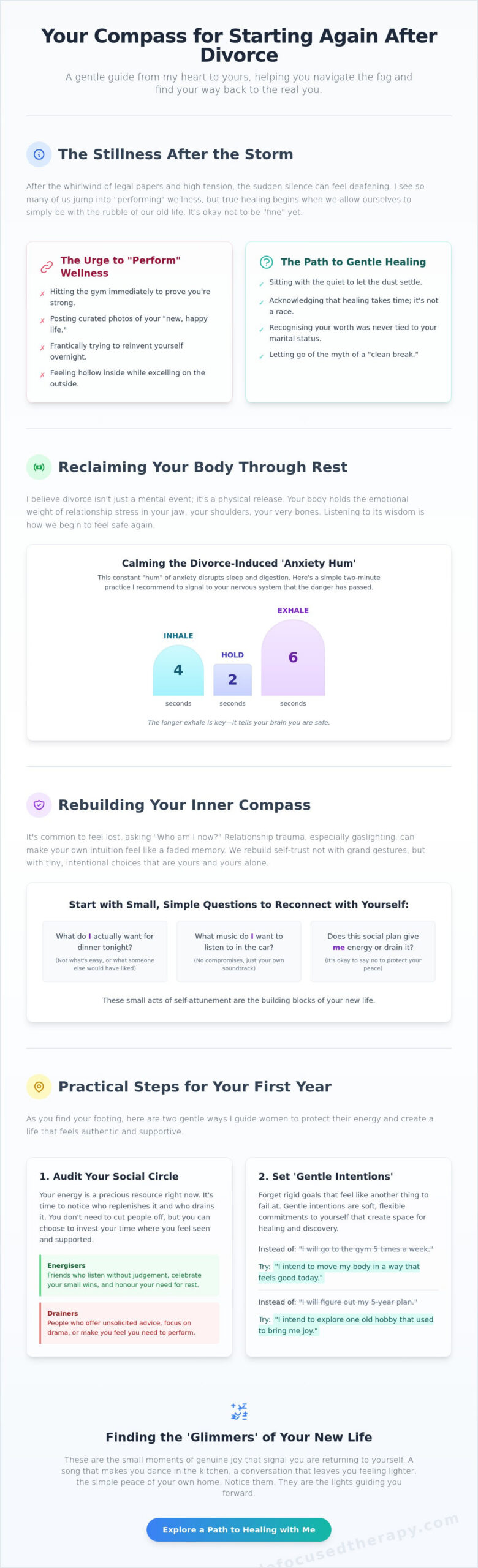
I’ll often hear my clients describe a constant “hum” of anxiety. This chronic stress doesn’t just feel unpleasant; it actively disrupts your sleep and digestion. To help quiet this hum, I recommend a simple two-minute breath practice. Inhale slowly for a count of four, hold for two, and exhale for a count of six. This longer exhale signals to your brain that the “danger” has passed.
Incorporating somatic movement and yoga into your week can also provide a structured way to release this tension. It isn’t about fitness or flexibility. It’s about finding a way to feel at home in your skin again after years of feeling disconnected. If you feel ready to explore this physical path to healing, you might wish to book a session to discuss your needs.
The radical act of choosing rest
You might feel a powerful urge to “stay busy” to avoid the pain. For high-functioning women, productivity is often a shield we use to protect ourselves from difficult emotions. I suggest the opposite. Choosing rest is a radical act of self-care when you’re learning how to start again after divorce. Your brain needs downtime to process the massive life transition you are navigating.
I’ll help you reframe “doing nothing” as an essential part of your recovery programme. When you rest, you aren’t being lazy; you’re allowing your nervous system to recalibrate. This stillness is where your intuition starts to speak again, guiding you toward the version of yourself that is waiting to emerge from the rubble.
Rebuilding self-trust after relationship trauma
If your marriage involved narcissistic abuse, your ability to trust yourself may be severely damaged. You’ve likely spent years being told that your perceptions were wrong or that your feelings were “too much.” When you’re constantly looking outside yourself for the truth, your internal compass eventually stops spinning. It’s quiet. It’s disorienting. You’ve been trained to doubt your own reality, which is the most exhausting way to live.
Gaslighting is particularly cruel because its effects linger long after you’ve left the relationship. You might find yourself second-guessing simple memories or wondering if you actually “caused” the conflict. This persistent doubt is a hallmark of relationship trauma. Reclaiming your inner voice from the echoes of an ex-partner’s criticism is a slow, delicate process. I believe that self-trust is a muscle we rebuild through tiny, daily acts of self-honouring. It isn’t about one big epiphany; it’s about making a small promise to yourself and actually keeping it.
Integrating practical Golden Rules for Starting Your New Life can help provide a framework, but the internal work of trusting your gut is what makes those steps sustainable. When you finally stop asking everyone else for their opinion, you begin to hear your own.
Forgiving yourself for what you didn’t know
I want to help you move away from the “How did I let this happen?” cycle of shame. High-functioning women are often the hardest on themselves, feeling they should have “seen the signs” earlier. I want you to understand that your survival strategies weren’t a sign of weakness. They were necessary at the time. You were doing the best you could with the information and the emotional capacity you had. I see your past self as brave, not foolish, and I’ll help you view her with that same kindness.
Learning to listen to your ‘gut’ again
Distinguishing between anxiety and intuition is a vital part of how to start again after divorce. Anxiety is usually loud, frantic, and rooted in the “what ifs.” Intuition is different. It’s a quiet, steady, and grounded knowing. We start by making very small decisions based on what feels right, not what feels safe or expected. I often find that individual psychotherapy can accelerate this process of internal restoration, helping you filter out the noise of fear so you can finally hear your intuition again. You’ve had the answers all along; we’re just clearing the path to reach them.
Practical steps for your first year of starting again
I often see high-functioning women trying to “optimise” their lives the moment the moving boxes are unpacked. You might feel a frantic urge to prove you’re thriving by setting rigid, corporate-style goals. However, I recommend focusing on “gentle intentions” instead. Learning how to start again after divorce is less about a massive overhaul and more about finding a baseline of safety. This first year is about stabilising, not winning a productivity race.
Your energy is a finite resource right now, and you must protect it fiercely. I suggest performing a “social audit” to see who in your life leaves you feeling grounded and who leaves you feeling drained. It’s also a beautiful time to create a “sanctuary” in your living space. This doesn’t require a full renovation; it could be as simple as a corner with a comfortable chair, a soft blanket, and lighting that makes you feel calm. This space should reflect your new chapter, free from the echoes of the past.
Your first year is a unique window of time where the goal of how to start again after divorce should simply be to exist without the weight of external expectations. When you stop trying to “fix” everything at once, you allow your internal restoration to happen at its own pace. If you’re struggling to find your footing in this first year, you can book a session with me to create a personalised stabilisation plan.
Navigating divorce overwhelm with ADHD
I know from personal and professional experience that ADHD symptoms like executive dysfunction can spike during major life transitions. When your brain is already processing grief, a simple to-do list can feel like a mountain. I encourage you to use “low-demand” routines on difficult days. Focus on the bare essentials, like hydration and rest. Practices like “body doubling,” where you have someone else present while you tackle paperwork, can be life-changing for neurodivergent women during this time.
Curating a supportive ‘inner circle’
You may encounter well-meaning friends who offer unsolicited advice that feels like a heavy weight. I’ll help you distinguish between “venting,” which often keeps you stuck in the trauma, and “healing,” which moves you forward. It’s about finding people who can hold space for your pain without trying to fix it for you. If you feel you need more specialized support, I’ve written a guide on finding a therapist in Singapore who truly understands the unique psychological needs of women in transition.
Finding your footing and moving toward joy
I want to reassure you that joy isn’t something you have to hunt for; it will naturally emerge. When you’ve spent so long in a state of hyper-vigilance, the idea of happiness can feel like a distant, exhausting goal. But joy isn’t a mountain to climb. It’s more like a garden that begins to bloom once you’ve stopped the storm and cleared the ground.
As you learn how to start again after divorce, you’ll start to notice what I call “glimmers.” These are small, quiet moments where you suddenly feel like yourself again. It might be the way the light hits your kitchen in the morning, the taste of a meal you truly enjoy, or a laugh that comes from your belly rather than your throat. These glimmers are the first signs that your internal restoration is taking root.
The transition from surviving the divorce to thriving in your own life is often a subtle shift. One day, you realise you haven’t thought about the legal paperwork or the old arguments for several hours. You’re no longer just getting through the day; you’re starting to wonder what you might do with your tomorrow. I’m here to support you in this final phase of integration, helping you weave these new threads of joy into a stable, confident identity.
Redefining what a ‘successful’ life looks like
Forget the societal timelines that tell you where you “should” be by now. True success is embracing your own pace of healing. I’ll help you see that how to start again after divorce is actually a rare opportunity to build a life entirely on your own terms. For many of the women I work with, this is the first time in decades they’ve had the space to choose themselves. That choice is incredibly powerful.
Your next step toward restoration
You don’t have to navigate this final stretch of the journey alone. If you feel ready to dive deeper into your healing, I offer a gentle invitation to explore focused intensive therapy to help you clear the remaining emotional blocks. These sessions are designed to provide a safe, concentrated space for your transformation at a pace that feels right for you.
I want to leave you with a final word of calm reassurance. You are far stronger and more resilient than you feel right now. The fog will lift, the identity confusion will clear, and you will find that the woman waiting on the other side is someone you truly like. I am here to hold that space for you whenever you’re ready to take that next step.
Your journey of restoration begins today
We’ve explored how healing is a multidisciplinary process that involves both your mind and your body. From honouring the initial silence to reclaiming your physical sense of safety through somatic rest, every small step counts. I’ve also shared why rebuilding self-trust is essential, especially if you’ve experienced the confusion of narcissistic abuse. These aren’t just psychological concepts; they are the practical building blocks of your new identity.
Learning how to start again after divorce isn’t about rushing toward a finish line or meeting societal expectations. It’s about giving yourself the grace to move at your own pace while protecting your energy and your peace. As a Registered Integrative Psychotherapist specialising in relationship trauma, I use a trauma-informed, mind-body approach to help you find your footing again. I see your resilience, even on the days when you feel most hollow.
You don’t have to carry the weight of this transition alone. If you’re ready to move from surviving to thriving, I invite you to book a compassionate consultation with me to begin your journey of restoration. You’ve already shown immense strength by being here today. Trust that the clarity and joy you’re seeking are already beginning to take root within you.
Frequently Asked Questions
How long does it typically take to feel ‘normal’ again after a divorce?
There is no fixed timeline for feeling ‘normal’ again; however, many women find it takes eighteen months to two years for the initial fog to lift. This isn’t a race, and your nervous system needs time to process the significant life changes you’ve endured. I often tell my clients that the first year is primarily about stabilisation while the second year focuses more on your internal restoration.
Is it normal to feel like I’m failing at starting over because I’m still sad?
Feeling sadness doesn’t mean you’re failing at starting over; it’s actually a sign that you’re processing your grief rather than suppressing it. High-functioning women often feel they should be “over it” quickly, but true restoration requires sitting with these difficult emotions. Your sadness is a natural response to the end of a significant chapter, not a reflection of your progress or your future potential.
How can I explain my need for space to friends and family without offending them?
You can explain your need for space by using gentle, “I” focused statements that highlight your current capacity. I suggest saying something like, “I value our relationship deeply, but I’m currently in a phase where I need more quiet time to process things.” Most people who love you will understand that protecting your energy is a vital part of your recovery and isn’t a rejection of them.
I’m struggling with brain fog and focus; could this be related to my divorce?
Brain fog and difficulty focusing are very common responses to the chronic stress of divorce. When your nervous system is in a state of high alert, your prefrontal cortex, which handles executive function, often takes a back seat. I see this frequently in my ADHD-focused therapy sessions, where major transitions cause a significant spike in executive dysfunction and cognitive fatigue. It’s a physical response to emotional trauma.
Can somatic therapy help me if I feel completely disconnected from my body?
Somatic therapy is specifically designed to help you reconnect when you feel completely untethered from your body. If you’ve spent years in a high-conflict marriage, your brain may have “muted” your bodily sensations to protect you from pain. I use gentle movement and breathwork to help you slowly turn the volume back up, allowing you to feel safe and grounded in your skin again.
What is the first thing I should do if I feel overwhelmed by my new responsibilities?
The first thing you should do when overwhelmed is to pause and strip your to-do list down to the absolute bare essentials. Learning how to start again after divorce involves accepting that you cannot do everything at once. I recommend focusing only on what is necessary for safety and basic needs today, then reaching out for support or ‘body doubling’ to help with the rest.
How do I know if I’m ready to start thinking about a new relationship?
You’ll know you’re ready when a new relationship feels like a choice rather than a necessity for emotional stability. I believe that once you’ve rebuilt your self-trust and feel comfortable in your own company, you’ll be able to see a potential partner clearly. If you’re still looking for someone to ‘fix’ the pain of the past, it’s usually a sign that you need more time.

Article by
Cheryl Kennedy MacDonald MA BA (Hons) Pg. Dip. SAC BACP
Cheryl Kennedy MacDonald is a psychotherapist specialising in women’s mental health, relationships, and life transitions. She works with women navigating trauma, relationship breakdown, identity shifts, and midlife change, helping them rebuild self-trust, emotional stability, and a clear sense of who they are and what they want.
With over 20 years’ experience working with women internationally, Cheryl is the founder of YogaBellies, a global women’s yoga school, and the creator of the Birth ROCKS method. Her work sits at the intersection of psychotherapy and embodiment, integrating evidence-based therapeutic approaches with somatic, body-based practices that support deep, lasting change.
Known for her grounded and direct approach, Cheryl moves beyond surface-level insight to address the patterns held in the body and nervous system. Her work supports women to regulate, reconnect, and respond to their lives from a place of clarity, strength, and self-respect.
She is a published author in academic journals and has written multiple books on women’s health, pregnancy, and midlife wellbeing, available on Amazon and leading book retailers worldwide.