
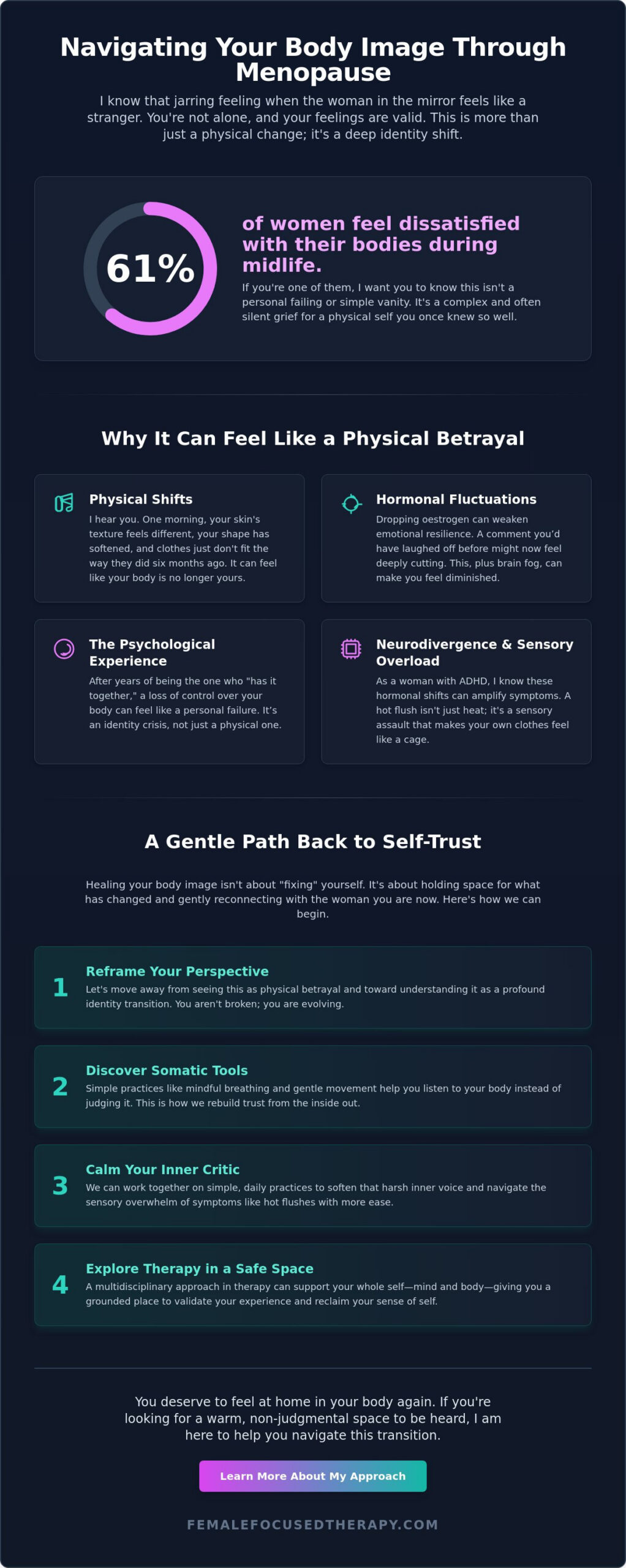
Did you know that 61% of women are currently dissatisfied with their bodies as they move through midlife? I know how it feels to catch a glimpse of yourself in the mirror and not quite recognise the woman looking back. Many of us struggle with our body image in menopauase, feeling a deep sense of grief for a physical identity that feels like it’s slipping away.
You might feel invisible in a youth-centric society, or perhaps you’re just exhausted by the constant hormonal fluctuations. It is completely normal to feel overwhelmed by these changes. I see you, and I understand the quiet anxiety that comes when your own skin feels like an unfamiliar place, especially when navigating body image in menopauase.
I want to help you navigate this emotional complexity and find a gentle path back to self-trust. In this article, I will share how we can move toward internal peace and use somatic tools to feel grounded again. We’ll explore ways to validate your experience and reclaim your sense of self while addressing body image in menopauase.
Key Takeaways
- Reframe your perspective to see that shifts in body image in menopause are a deeper identity transition, allowing you to move past feelings of physical betrayal.
- Discover how somatic tools like breath and movement can help you rebuild self-trust by listening to your body instead of judging it.
- Learn simple, daily practices to calm your inner critic and navigate the sensory overwhelm of symptoms like hot flushes.
- Explore how a multidisciplinary approach to therapy can support your mental and physical wellbeing during this significant life stage.
Why Menopause Can Feel Like a Physical Betrayal
I often hear from women who feel as though their bodies have staged a quiet coup. One morning you wake up and the reflection in the mirror feels like a stranger; the texture of your skin has changed and your shape has shifted. It’s a jarring experience that leaves you feeling deeply disconnected from your own history.
When we explore the concept of body image in menopauase, it’s vital to recognise that this isn’t just about vanity. It is a fundamental identity shift. For decades, you’ve known how your body responds to life. Now, those old rules don’t seem to apply, making your own skin feel like an unreliable place to live.
Society doesn’t make this transition any easier with its constant demand that we “age gracefully.” Trying to maintain that polished mask while navigating the physical changes in menopause can feel exhausting. It’s hard to feel graceful when you’re dealing with sudden hot flushes or clothes that no longer fit the way they did six months ago.
The Silent Grief of Physical Change
I often see women in my practice carrying a heavy, silent grief for their younger selves. You might feel guilty for missing your younger body, as if you’re being shallow, but that grief is real and valid. You aren’t just missing a specific look; you’re missing the ease and familiarity that came with it.
In our work together, I encourage moving away from a “fix-it” mentality. We aren’t trying to repair a broken version of you. Instead, we focus on a “holding space” approach. Healing your body image in menopauase starts with giving yourself permission to mourn what has changed without immediately trying to diet it away.
The Impact of Hormonal Fluctuations on Self-Worth
The drop in oestrogen does more than change our skin elasticity; it directly impacts our emotional resilience. Oestrogen is closely linked to our “feel-good” neurotransmitters. When levels dip, your ability to bounce back from stress can feel compromised. A comment you might have laughed off at thirty can now feel like a devastating blow.
Brain fog and fatigue also play a significant role in how you perceive your value. When you struggle to remember a name, it’s easy to feel “lost” or diminished. If you feel like you’re struggling to keep up, specialised menopause therapy can offer a grounded space to process these shifts and rebuild your internal confidence.
Understanding the Psychological Shift in Midlife
Midlife isn’t just a physical hurdle. It’s a deep psychological inventory. For many high-functioning women I work with, the sudden lack of control over their bodies feels like a personal failure. You’ve spent years being the one who “has it all together.” Now, your body is doing things you didn’t give it permission to do.
We also carry the weight of internalised ageism. We’ve been taught by a youth-centric society to fear getting older, leading to “old talk”; those reflexive self-criticisms about wrinkles or weight. Breaking this cycle requires us to look at how body image and sexuality during menopause are influenced by the stories we’ve told ourselves for decades.
When Old Traumas Resurface
Midlife has a way of peeling back the layers of our history. The changes you’re seeing now can mirror the vulnerability you felt during puberty or after pregnancy. If you’ve experienced relationship trauma, these shifts can feel even more threatening to your sense of self. We aren’t just dealing with today’s mirror; we’re often dealing with decades of re-opened wounds.
The Role of Neurodivergence in Midlife
As someone who lives with ADHD, I know that hormonal shifts aren’t just about moods. When oestrogen drops, ADHD symptoms can suddenly feel significantly more overwhelming. Executive function slips and sensory issues become heightened. A hot flush isn’t just heat; it’s a sensory assault that makes your clothes feel “too much” to handle.
This emotional intensity makes navigating body image in menopauase feel like an uphill battle. If you’re feeling overwhelmed by the sensory and emotional load, you might find it helpful to explore these feelings in a safe space. You deserve to be heard and understood without judgment.
Moving From Body Dissatisfaction to Somatic Self-Trust
I believe that real healing happens when we stop treating our bodies as projects to be fixed. For years, you might have looked at yourself through a lens of critique, but somatic healing asks you to do something different: to listen. It is about moving away from the external “shoulds” and returning to the internal “feels.”
Developing a healthy body image in menopause isn’t about forcing yourself to love every single change you see in the mirror. It is about finding a path back to self-trust. When the external world feels confusing, your intuition is the only compass that matters. Reclaiming that intuition starts with acknowledging that your body is still on your side, even when it feels unfamiliar.
Mindfulness and breath aren’t just buzzwords; they are essential anchors when your physical world feels chaotic. A simple, conscious breath can be the difference between spiralling into midlife anxiety and remaining grounded in the present moment. These tools help you move from a place of judgment to a place of observation, which is where the shift begins.
Restoring the Mind-Body Connection
I often suggest gentle ways to re-engage with movement through somatic yoga. This isn’t about achieving a perfect pose or burning calories. It’s about feeling the floor beneath you and noticing the sensations within your muscles without any pressure to change them. It is a way of saying “I am here” to yourself.
In midlife, rest is a radical act of self-care. We are so used to pushing through and “doing” that we forget our bodies need quiet spaces to recalibrate during these hormonal shifts. Taking time to simply be, without an agenda, allows your nervous system to settle. This stillness is where you can begin to respect your body again, regardless of how you feel about its appearance.
Practising Body Neutrality
You might find that body neutrality is much more attainable than body positivity. While positivity asks you to love your looks, neutrality simply asks you to accept your body as the vessel that carries you. It focuses on what your body *does*—how it keeps you breathing, walking, and experiencing life—rather than just how it looks to others.
Practising body neutrality reduces the cognitive load of menopause by quieting the constant mental chatter about physical flaws. When you stop obsessing over every shift in skin tone or muscle mass, you free up immense mental energy. This shift allows you to focus on your internal restoration and the things that truly bring you peace in this new stage of life.
Practical Ways to Reconnect With Your Changing Self
I know that the theory of self-acceptance is one thing, but the reality of standing in front of a mirror at 7 am is quite another. When you’re navigating body image in menopause, the shift from critique to compassion doesn’t happen by accident. It requires small, intentional steps that help you feel safe in your own skin again.
It’s also about setting boundaries with the world around you. We’re constantly sold the idea that we need to “fight” ageing, which only reinforces the feeling that our bodies are the enemy. I encourage you to curate your environment by unfollowing social media accounts that trigger your inner critic and seeking out communities of women who are navigating these same transitions with honesty and grace.
A Daily Ritual for Grounding
I often suggest starting your day with a five-minute morning check-in before you even get out of bed. Place one hand on your heart and the other on your belly. Notice the rise and fall of your breath without trying to change it. This simple act of gentle touch helps you reclaim your physical space and signals to your nervous system that you are safe.
When you eventually stand before the mirror, try to use soft, supportive language. If you catch yourself thinking something harsh, pause and replace it with a neutral observation. Instead of “I hate my skin,” try “My skin is protecting me today.” This isn’t about being “perfectly positive”; it’s about being kind.
Mindfulness can also be a powerful anchor during the sensory overwhelm of a hot flush. Instead of resisting the heat, try to breathe into it. Notice the sensation as it peaks and eventually fades, treating it as a passing weather system rather than a personal failing. This approach helps reduce the anxiety that often accompanies physical symptoms.
Nurturing Your Emotional Wellbeing
I believe that movement should be a source of joy, not a punishment for what you’ve eaten. Focus on activities that make you feel strong or fluid, whether that’s a slow walk in nature or a gentle stretching routine. When we move for pleasure, we reinforce the idea that our bodies are worth caring for, regardless of their size or shape.
Identifying the triggers that lead to body-shaming spirals is another crucial step. Is it a certain clothing store? A specific friend? Once you know the triggers, you can build a toolkit to protect your peace. You can find free therapy resources on my website to help you start this reflection and identify your personal patterns.
Healing your relationship with your body is a journey that doesn’t have to be walked alone. If you feel ready to move beyond the overwhelm and reclaim your self-trust, you can book an individual psychotherapy session with me to begin your restorative work.
How Therapy Can Support Your Midlife Transition
While practical tools and daily rituals are wonderful anchors, there are times when the weight of these changes feels too heavy to carry alone. I believe that traditional talk therapy is most effective when we also bring a deep sense of somatic awareness to the room. If your body image in menopause is suffering, we can’t just think our way into feeling better; we need to feel our way back to a place of internal safety.
In a session with me, you’ll find a space of warmth and validation where your experiences are truly heard and understood. We use a specialised menopause therapy approach that respects the complex intersection of your biology and your personal history. This isn’t about simply “managing symptoms” or “getting through it.” It’s about helping you move from a state of survival to one where you can thrive with a renewed sense of self-assurance.
My integrative approach combines evidence-based psychotherapy with a grounded understanding of how hormonal shifts impact the nervous system. We look at the whole picture, acknowledging that your mind and body are not separate entities. By bringing these elements together, we can address the root of your anxiety and help you reclaim a sense of agency over your life and your wellbeing.
The Power of Being Truly Seen
Therapy provides a quiet sanctuary where we can discuss the parts of aging that society often treats as taboo or invisible. From the grief of lost physical identity to the frustration of feeling “unreliable” in your own skin, I am here to help you navigate this transition with kindness. We work together to rebuild the self-trust that might have been eroded by years of trauma, people-pleasing, or the pressure to be everything to everyone.
Being truly seen in your vulnerability allows for a profound kind of healing. It’s in this safe, boundaried space that you can stop performing and start listening to what you actually need. Whether you are dealing with the resurfacing of old wounds or the fresh overwhelm of midlife, having a compassionate guide can make all the difference in how you perceive your body image in menopause.
Taking the First Step Toward Restoration
You don’t have to navigate these hormonal and emotional waters without support. If you feel you need more concentrated time to process these shifts, I offer intensive therapy options that allow for deeper, focused work. These sessions are designed to move at a pace that feels manageable for your nervous system, providing the space for significant internal restoration.
Always remember that your worth is not tied to your hormone levels, your productivity, or the reflection you see in the mirror. You are a whole person with an incredible history and a future that still belongs to you. If you’re ready to start this journey back to yourself, a realistic next step is simply to sit with your breath for a moment and acknowledge how much you’ve already navigated with strength.
Reclaiming Your Sense of Self in Midlife
We’ve explored how the shift in your physical identity is a profound transition that requires more than just a new lifestyle plan. It’s about moving from a sense of physical betrayal to a place of somatic self-trust. By embracing body neutrality and using gentle grounding tools, you can begin to quiet the inner critic that so often dominates this stage of life.
Improving your body image in menopause is a journey of internal restoration. It’s about recognising that while your body is changing, your worth remains constant and deep. You don’t have to navigate these psychological and hormonal shifts alone; there is immense power in being seen and validated in a safe, professional space.
As a Registered Integrative Psychotherapist, I offer trauma-informed and compassionate care specialised in women’s midlife transitions. I would be honoured to help you find your way back to yourself. You can book a consultation with me to begin your journey of midlife restoration today. You deserve to feel grounded, steady, and at peace in your own skin once again.
Frequently Asked Questions
How does menopause specifically change a woman’s body image?
Menopause changes body image by introducing a sense of physical unpredictability that can feel like a betrayal. Recent surveys show that 61% of women are not satisfied with their bodies during this stage. This dissatisfaction often stems from weight gain and skin changes that happen rapidly. It creates a disconnect where your external appearance no longer reflects your internal identity.
Can therapy really help with how I feel about my aging body?
Therapy helps by offering a sanctuary to explore the emotional complexity of midlife. It isn’t just about changing your thoughts; it’s about processing the grief of physical change. I work with women to help them move past the “fix-it” mentality. We focus on rebuilding self-trust and finding internal stability amidst the hormonal and life transitions you’re facing.
What is the difference between body positivity and body neutrality in midlife?
Body positivity asks you to love your looks, whereas body neutrality asks you to accept your body’s function. For many women in midlife, neutrality feels more honest and attainable. You don’t have to love every wrinkle to respect your body as the vessel that carries you. It reduces the mental energy spent on self-critique and allows you to focus on wellbeing.
Why do I feel more anxious about my looks now than I did in my 30s?
This increased anxiety is often a result of oestrogen drops affecting your emotional resilience. In your 30s, you may have felt more “visible” in a society that prizes youth. Now, the combination of physical shifts and a youth-obsessed culture can make you feel more vulnerable. It’s a natural reaction to a significant life transition that reshapes your sense of self.
How can I stop comparing my menopausal body to my younger self?
You can start by practising radical presence and moving away from “old talk.” Comparison is often a way of avoiding the reality of the present moment. I encourage you to focus on what your body can do now, like its strength or its capacity for rest. Reclaiming your intuition helps you value your current self over a past memory.
Is it normal to feel a sense of grief during perimenopause?
Yes, feeling a sense of grief is a very real part of the perimenopausal experience. You are mourning a version of yourself that is changing, and that deserves to be acknowledged. Healing your body image in menopause requires you to give yourself permission to feel this loss. Only then can you begin to build a new, kinder relationship with yourself.
What somatic practices can help with body image during menopause?
Somatic yoga and mindful breathing are excellent tools for reconnecting with your physical self. These practices help you move from judging your body to actually inhabiting it. By focusing on internal sensations, you can manage the sensory overwhelm of hot flushes. It’s about finding a “felt sense” of safety that isn’t dependent on how you look in a mirror.
How do I know if I need professional support for midlife body dissatisfaction?
If your body dissatisfaction is causing you to withdraw from life or feel persistent hopelessness, professional support is a wise choice. High-functioning women often try to “power through,” but you don’t have to carry this alone. Therapy provides the warmth and specialised insight needed to navigate these transitions. It is a vital step toward reclaiming your internal peace.

Article by
Cheryl Kennedy MacDonald MA BA (Hons) Pg. Dip. SAC BACP
Cheryl Kennedy MacDonald is a psychotherapist specialising in women’s mental health, relationships, and life transitions. She works with women navigating trauma, relationship breakdown, identity shifts, and midlife change, helping them rebuild self-trust, emotional stability, and a clear sense of who they are and what they want.
With over 20 years’ experience working with women internationally, Cheryl is the founder of YogaBellies, a global women’s yoga school, and the creator of the Birth ROCKS method. Her work sits at the intersection of psychotherapy and embodiment, integrating evidence-based therapeutic approaches with somatic, body-based practices that support deep, lasting change.
Known for her grounded and direct approach, Cheryl moves beyond surface-level insight to address the patterns held in the body and nervous system. Her work supports women to regulate, reconnect, and respond to their lives from a place of clarity, strength, and self-respect.
She is a published author in academic journals and has written multiple books on women’s health, pregnancy, and midlife wellbeing, available on Amazon and leading book retailers worldwide.