
Have you ever felt like you’re slowly disappearing while standing right in front of someone? It’s that heavy, silent exhaustion that comes from years of walking on eggshells and second-guessing your own reality. If you’re searching for narcissistic abuse recovery singapore, I want you to know that the brain fog and the constant tension in your shoulders aren’t just in your head. They are your body’s way of telling you that you’ve been surviving for far too long.
I understand how painful it is to realise that a relationship has systematically dismantled your confidence. It’s incredibly draining to maintain a “perfect” mask in your professional circles while feeling completely hollow inside. You deserve to feel grounded again. I promise to guide you through a compassionate process of reclaiming your self-trust through an integrative, female-focused approach that honours both your mind and your body.
In the following sections, we’ll explore how narcissistic trauma affects your nervous system and why your intuition feels so out of reach. I’ll share how we can use gentle somatic tools and psychotherapy to help you stop surviving and start living with a renewed sense of internal stability and peace.
Key Takeaways
- Recognise that the systematic erosion of your sense of self is a real experience with a name, helping you move away from self-blame and toward validation.
- Understand the physical reality of cortisol flooding and how your body often holds the truth of your trauma before your mind is fully ready to process it.
- Learn why the trauma bond creates a biological addiction to the cycle of abuse, making narcissistic abuse recovery singapore a journey that requires deep patience.
- Discover the power of micro-boundaries as a gentle way to start reclaiming your internal space and signalling safety to your nervous system.
- Explore how an integrative approach to therapy can bridge the gap between your mind and body to restore your lost intuition and internal peace.
Understanding the Shadow of Narcissistic Abuse in Singapore
I want to start by validating that what you are feeling is real. It has a name. If you have been searching for narcissistic abuse recovery singapore, you likely already suspect that the confusion and exhaustion you feel aren’t just “stress.”
Narcissistic abuse is the systematic erosion of your sense of self and your reality. It isn’t just a series of arguments; it’s a pattern where your identity is slowly chipped away until you no longer recognise the woman in the mirror.
In our high-pressure Singapore lifestyle, the initial ‘love-bombing’ phase often feels like a much-needed sanctuary. It might look like intense validation or grand gestures that feel like an antidote to a demanding career. However, this intensity is often a mask for a deep-seated fragility.
When the mask slips, the abuser may experience a “narcissistic wound” when they feel criticized or ignored. Understanding Narcissistic Injury helps us see that their subsequent lashing out is about their own internal instability, not your perceived failures.
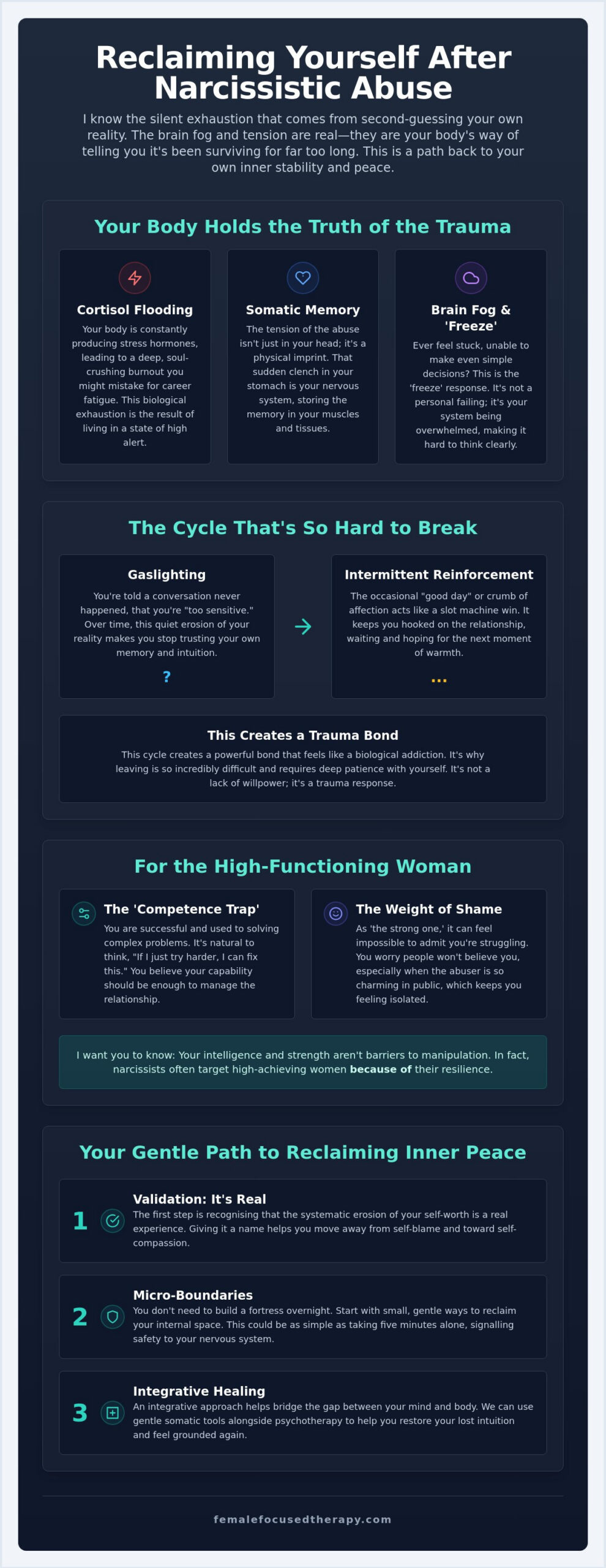
It’s vital to understand that narcissistic abuse is a psychological trauma that impacts your nervous system, not just your mood. It leaves your body in a state of constant high alert, making it nearly impossible to feel truly relaxed or safe.
Identifying the subtle signs of emotional manipulation
Gaslighting is that slow, quiet process where you begin to doubt your own memory. You might remember a conversation clearly, only to be told it never happened. Over time, you stop trusting your own eyes and ears.
Then there is intermittent reinforcement, which keeps you hooked on the relationship. It’s the occasional “good day” or moment of warmth that acts like a slot machine win. It keeps you waiting and hoping for the next crumb of affection.
This cycle creates a powerful bond that is incredibly difficult to break on your own. You can find more about these patterns in my guide on relationship trauma and narcissistic abuse.
Why high-functioning women often stay longer
Many of the women I work with in my narcissistic abuse recovery singapore practice fall into the ‘competence trap.’ You are successful, capable, and used to solving complex problems at work. You think if you just try harder, you can ‘fix’ this.
There is also the heavy weight of shame that comes with being ‘the strong one.’ It feels impossible to admit to your social circle that you are struggling behind closed doors. You worry that people won’t believe you because the abuser is so charming in public.
I want you to know that your intelligence and strength aren’t barriers to being manipulated; in fact, narcissists often target high-achieving women for their resilience. If you feel isolated, looking at who I work with might help you see you aren’t alone.
The Impact of Trauma on Your Body and Mind
I believe that your body often knows the truth before your mind is ready to accept it. You might feel a sudden clench in your stomach or a racing heart when you hear their key in the lock, even if you’re telling yourself everything is fine. This visceral reaction is your nervous system trying to protect you from a perceived threat.
Living in a toxic relationship means your body is constantly producing stress hormones. This “cortisol flooding” eventually leads to deep, soul-crushing burnout. In a fast-paced environment like Singapore, it is so easy to mistake this biological exhaustion for simple career fatigue or the demands of a busy life.
I see many high-functioning women who have mastered the art of “masking.” You show up to meetings, lead teams, and stay “on” for your career, but the moment you’re alone, you collapse. Your health suffers because your energy is spent maintaining a facade of being “okay” while your internal world is in turmoil.
Your body stores the tension of the abuse in what we call somatic memory. It isn’t just a memory in your head; it’s a physical imprint in your tissues and muscles. Resources like the Narcissistic Abuse Recovery Center highlight how these physical patterns are a core part of the trauma experience and require specialized attention.
Understanding the ‘freeze’ response and brain fog
Do you ever feel completely stuck, unable to make even simple decisions like what to eat for dinner? This is the “freeze” response in action. When your emotional brain senses danger, it hijacks your logical brain. You aren’t losing your mind; your brain is simply prioritising survival over logic, which often results in that heavy, disorienting brain fog.
Try this simple grounding exercise right now: take a slow breath in, noticing the air fill your chest. As you exhale slowly through your mouth, imagine the tension leaving your shoulders and melting into the floor.
Somatic symptoms: When your body holds the story
Trauma often shows up in physical ways that we don’t immediately connect to our emotional state. You might experience some of these common signs:
- Persistent tightness in the jaw or grinding your teeth at night.
- Digestive issues or a constant “nervous” stomach.
- Deep exhaustion that a night of sleep doesn’t seem to fix.
- Chronic tension in your neck and shoulders that never truly releases.
“Just talking” about the abuse isn’t always enough because talk therapy mainly engages the logical mind. To truly find narcissistic abuse recovery singapore, we have to work with the body to release that stored tension. If you feel ready to explore this mind-body connection, I’m here to help you reclaim your sense of safety.
Breaking the Cycle: Why Recovery Feels So Difficult
Recovery isn’t a linear path. I want you to know that “relapsing” into contact or checking their social media is a common part of the process. It doesn’t mean you have failed; it simply means you’re human and navigating a deeply complex emotional landscape.
This happens because of the trauma bond. It is a biological addiction to the intense highs and lows of the relationship cycle. Your brain becomes wired to seek the dopamine hit of the “good” moments, even when the “bad” moments are devastating. The trauma bond is a physiological connection that requires patience and professional support to untangle.
You might also find yourself trapped in cognitive dissonance. This is the painful state of loving the charming person they were at the start while fearing the person they have become. Holding these two conflicting versions of one person is exhausting. Breaking this cycle is the core of narcissistic abuse recovery singapore.
Navigating the unique social pressures of Singapore
Singapore can feel like a very small world, especially within professional and expat communities. You might share the same social circles, attend the same industry events, or even work in the same building. This proximity creates a unique layer of anxiety that women in larger cities might not face.
There is often a genuine fear of social “discard” or reputation damage. If your partner holds a high-status position, you may worry that others won’t believe your experience. This pressure feels even more intense if you are also navigating major life transitions like menopause or midlife while trying to untangle your life.
The myth of “closure” from a narcissist
We often stay in toxic loops because we are waiting for an apology or an acknowledgment of the pain they caused. I want to be honest with you: you will likely never get the closure you deserve from them. Their version of reality is built to protect their own ego, not to provide you with peace.
Waiting for them to change or understand your perspective only keeps you tied to the cycle. True healing begins when you shift the focus from their explanation to your own internal acceptance. Seeking narcissistic abuse recovery singapore means learning to stop searching for “why” they did it and instead asking yourself, “how do I feel in my body right now?”
Your restoration doesn’t depend on their honesty. It depends on your willingness to trust your own intuition again. By letting go of the need for them to understand, you reclaim the power to define your own story and move forward on your own terms.
Practical Steps Toward Restoring Your Internal Peace
I want to offer you a few gentle ways to begin reclaiming your space today. Healing doesn’t always require a massive life overhaul right this second; sometimes it starts with “micro-boundaries.” These are the tiny, quiet choices you make that signal to your brain and your nervous system that you are finally safe.
Choosing low contact or no contact is a vital protective measure, not a punishment for the other person. It is about creating a sanctuary where your mind can finally stop scanning for threats. When you reduce the noise of their influence, you create the necessary quiet for somatic movement and rest to begin its work.
Finding the right path for narcissistic abuse recovery singapore involves more than just understanding what happened. It requires active steps to settle your body and quiet the internal alarm bells that have been ringing for so long.
Setting boundaries that actually work
It is helpful to remember that boundaries are for you. They aren’t about controlling the other person’s behaviour, which we know is often impossible. Instead, they are about what you will tolerate and how you will protect your own energy.
Digital boundaries are a great place to start. This might mean blocking their number, muting their social media, or only checking your emails at a scheduled time once a day. If they try to “hoover” you back in with drama or false promises, I often suggest the Grey Rock approach. This means becoming as uninteresting and unreactive as a plain grey rock, giving them no emotional fuel to use against you.
The role of mindfulness and rest in healing
Your nervous system needs active rest to recover from months or years of chronic hyper-vigilance. This isn’t just about sleeping; it’s about giving your body permission to be still without feeling like it has to be productive. When you are in the middle of narcissistic abuse recovery singapore, your brain is often too tired for complex meditation.
I often recommend simple mindfulness practices that don’t require perfect focus. You might try a simple grounding exercise, where you simply name five things you can see and four things you can touch. Healing is a mind-body process, not just an intellectual one. You can’t think your way out of a physiological trauma response; you have to feel your way into safety.
If you’re ready to start this journey of restoration, I’m here to support you. You can book a session with me to begin finding your way back to yourself.
How We Work Together Toward Your Restoration
In my practice, I offer a warm, integrative space designed specifically for women like you. I know how heavy it feels to carry the weight of a toxic relationship while trying to maintain your career and social life in Singapore. You deserve a place where you can finally set that burden down.
Our sessions are a sanctuary. They are safe, confidential, and entirely focused on your restoration. You don’t have to worry about being judged or “fixing” yourself for anyone else; this time is dedicated to helping you find your way back to your own intuition.
I use an integrative approach that combines CBT and mindfulness with deep, trauma-informed care. This means we address both the logical “why” of your experience and the emotional “how” of your healing. For those who feel they need more concentrated support, I offer focused intensive therapy options to help you move through the process with more depth.
An integrative approach to relationship trauma
My background as a yoga master informs our somatic work together. We’ll use breath and gentle movement to release the tension that talk therapy alone can’t always reach. You can read more about me and my mind-body perspective to see if my approach feels like the right fit for your journey.
Taking the first step: What to expect
Taking that first step doesn’t have to be overwhelming. You can begin the process by booking a consultation through my simple online system. It’s a quiet, private way to start reclaiming your life without any external pressure.
I want to reassure you that you don’t need to have a perfect narrative of your experience before we start. We’ll work at your pace, ensuring you feel grounded and supported as you begin your narcissistic abuse recovery singapore. You’ve been strong for a long time; now, it’s okay to let someone else hold the space for you.
Reclaiming Your Voice and Your Future
Healing from this kind of trauma isn’t just about understanding what happened; it’s about coming home to yourself. We’ve explored how your body stores these experiences and why the biological pull of a trauma bond makes leaving so difficult. You now know that restoration begins with micro-boundaries and a gentle return to your own intuition. I want you to remember that your strength and intelligence aren’t what kept you stuck. They are the very tools that will help you rebuild.
As a Registered Integrative Psychotherapist with over 20 years of experience supporting women, I specialise in trauma and narcissistic abuse. I understand the unique pressures of life in this city. Finding a dedicated space for narcissistic abuse recovery singapore is about more than just therapy; it’s about finally feeling seen and safe. You don’t have to carry this burden alone any longer.
If you are ready to begin your journey back to yourself, you can book a session with me here. There is a calm, stable version of you waiting to be rediscovered, and I’d be honoured to help you find her. You deserve a life defined by your own peace rather than someone else’s chaos.
Frequently Asked Questions
What exactly is narcissistic abuse, and how is it different from a ‘bad’ relationship?
Narcissistic abuse is a systematic pattern of emotional manipulation designed to erode your sense of self, whereas a “bad” relationship usually involves mutual conflicts or incompatibility. In a healthy but struggling relationship, both partners can generally admit faults and work toward change. In an abusive one, the power dynamic is skewed, and you are often punished for having your own needs, opinions, or boundaries.
I’m a high-functioning professional in Singapore; why did I ‘allow’ this to happen to me?
You didn’t “allow” this to happen; your empathy and resilience were simply weaponised against you by someone who targeted your best qualities. High-functioning women are often targeted because they are reliable, forgiving, and used to working hard to solve difficult situations. It is your capacity for deep connection and hard work that was exploited, not a lack of intelligence or strength on your part.
How long does it typically take to recover from a narcissistic relationship?
Recovery is a deeply personal journey that doesn’t follow a fixed timeline, but many women find significant shifts after six to twelve months of consistent support. Healing involves untangling the trauma bond and settling your nervous system, which takes time and patience. I encourage you to focus on the small, steady wins in your daily life rather than reaching for a distant or perfect finish line.
Do I have to go ‘No Contact’ to heal, or is there another way?
While “No Contact” is often the safest path for narcissistic abuse recovery singapore, I understand that co-parenting or shared professional interests can sometimes make this impossible. In these cases, we work on “Low Contact” or the “Grey Rock” method to protect your energy. The goal is to create enough emotional distance so that their actions no longer have the power to destabilise your internal peace.
What are the physical signs of narcissistic abuse that I should look out for?
Chronic tension in your jaw, unexplained digestive issues, and a persistent feeling of “brain fog” are common physical markers of this trauma. Your body often stays in a state of high alert, leading to cortisol flooding and deep exhaustion. If you find yourself constantly scanning for danger even when you are alone, your nervous system is likely still holding onto the stress of the relationship.
Is therapy for narcissistic abuse recovery in Singapore confidential?
Yes, your privacy is my absolute priority and our sessions are strictly confidential within professional ethical boundaries. I provide a safe, boundaried space where you can speak openly without fear of your story leaking into your professional or social circles. Maintaining your trust is the foundation of the work we do together toward your restoration and long term stability.
How do I explain this to my friends or colleagues in our small social circle?
You aren’t obligated to share the details of your trauma with anyone who doesn’t feel safe or supportive. In small circles, a simple statement like “we are no longer together, and I’m focusing on my health right now” is often enough. You get to choose who earns the right to hear your story, and it is perfectly okay to keep your healing journey private.
Can I do narcissistic abuse recovery therapy online, or must it be in person?
I offer both online and in-person sessions to ensure that narcissistic abuse recovery singapore is accessible and fits into your busy life. Online therapy can be incredibly effective, allowing you to engage in deep healing work from the safety and comfort of your own home. We can still incorporate somatic tools and mindfulness practices effectively through a digital space to support your restoration.

Article by
Cheryl Kennedy MacDonald MA BA (Hons) Pg. Dip. SAC BACP
Cheryl Kennedy MacDonald is a psychotherapist specialising in women’s mental health, relationships, and life transitions. She works with women navigating trauma, relationship breakdown, identity shifts, and midlife change, helping them rebuild self-trust, emotional stability, and a clear sense of who they are and what they want.
With over 20 years’ experience working with women internationally, Cheryl is the founder of YogaBellies, a global women’s yoga school, and the creator of the Birth ROCKS method. Her work sits at the intersection of psychotherapy and embodiment, integrating evidence-based therapeutic approaches with somatic, body-based practices that support deep, lasting change.
Known for her grounded and direct approach, Cheryl moves beyond surface-level insight to address the patterns held in the body and nervous system. Her work supports women to regulate, reconnect, and respond to their lives from a place of clarity, strength, and self-respect.
She is a published author in academic journals and has written multiple books on women’s health, pregnancy, and midlife wellbeing, available on Amazon and leading book retailers worldwide.