
You’ve just finished another productive day, your to-do list is ticked off, and everyone around you thinks you have it all figured out. But as you lie in bed, your mind is racing with a relentless chatter of everything you didn’t do perfectly or the fear that tomorrow is the day you’ll finally be ‘found out’ as a failure. These hidden signals are often the clearest signs of high functioning anxiety, masking themselves as your greatest professional strengths.
I know how heavy it feels to carry the weight of the world while looking like you’re effortlessly gliding through it. It’s a lonely place to be when your outward success is fuelled by a quiet, internal storm that never seems to settle. You deserve to know that this struggle is real, even if the rest of the world only sees your achievements and your drive.
I want to help you recognise these patterns so you can finally feel seen and validated. In the following sections, we’ll explore the deep link between your high-achieving nature and your internal unease. I’ll also offer a gentle, non-clinical path toward restoring your sense of self and finding peace in both your mind and your body.
Key Takeaways
- Understand why your outward success might actually be fuelled by a deep-seated fear of failure and crumbling inside.
- Learn to identify the subtle signs of high functioning anxiety, from a relentless inner critic to an inability to enjoy quiet moments.
- Discover how being a woman, navigating menopause, or living with ADHD can uniquely shape and amplify your experience of overwhelm.
- Explore how to shift your body and mind out of survival mode and toward a state of gentle, internal restoration.
- See how an integrative approach, blending psychotherapy with somatic wisdom, can help you feel safe enough to finally be yourself.
The heavy weight of the successful facade
I often meet women in my therapy practice who seem to have it all together. You’re the one everyone relies on at home and at work; you’re the person who gets things done. But inside, you feel like you’re crumbling under the weight of it all. This disconnect between your outer success and your inner turmoil is a heavy burden to carry.
We call this high-functioning anxiety because your drive is actually fuelled by a deep fear of failure. It’s an exhausting way to live. Your productivity is a shield that protects you from criticism, but it doesn’t mean you aren’t struggling. High achievement can be a very effective way of masking the pain.
You might find yourself saying ‘yes’ to every single request, even when you’re already stretched thin. While your calendar fills up, your internal world becomes increasingly loud and chaotic. It’s one of the most common signs of high functioning anxiety that I see in my work with high-achieving women.
A foundational step in understanding anxiety is recognising that it doesn’t always look like panic or avoidance. Sometimes, it looks like over-achievement and a refusal to rest. It’s the silent motor that keeps you running long after your body has asked you to stop.
Why we hide our internal struggle
There’s so much pressure on us to be the perfect woman, mother, or professional. We feel we have to do it all without breaking a sweat or asking for help. This expectation creates a silent cage where we feel we can’t show any weakness without losing our status or our sense of self.
Your very competence can become a barrier to getting help. People assume you’re fine because you’re getting things done and meeting your targets. I know the fear that if you stop for even a moment, the whole house of cards might fall down around you.
In my work with women from all walks of life, I’ve seen how this silence breeds a deep, lonely exhaustion. You don’t have to wait for a total collapse to ask for support. Admitting you’re tired is a brave first step toward real restoration.
The cost of being the ‘reliable one’
Being the ‘reliable one’ often comes at a high emotional price. You might find yourself trapped in a cycle of people-pleasing to avoid the discomfort of conflict or the guilt of saying no. You sacrifice your own peace to keep the waters calm for everyone else.
Maintaining this image of total self-reliance is incredibly draining. It leaves very little room for your own needs or for genuine rest. Your body carries the tension that your mind tries to ignore, often leading to that bone-deep fatigue that sleep can’t seem to fix.
Rebuilding self-trust starts with acknowledging this invisible burden you carry. It’s about being honest with yourself that the facade is heavy and that you’re allowed to set it down. When we name the struggle, we can finally begin the process of letting it go.
Recognising the internal signs of high-functioning anxiety
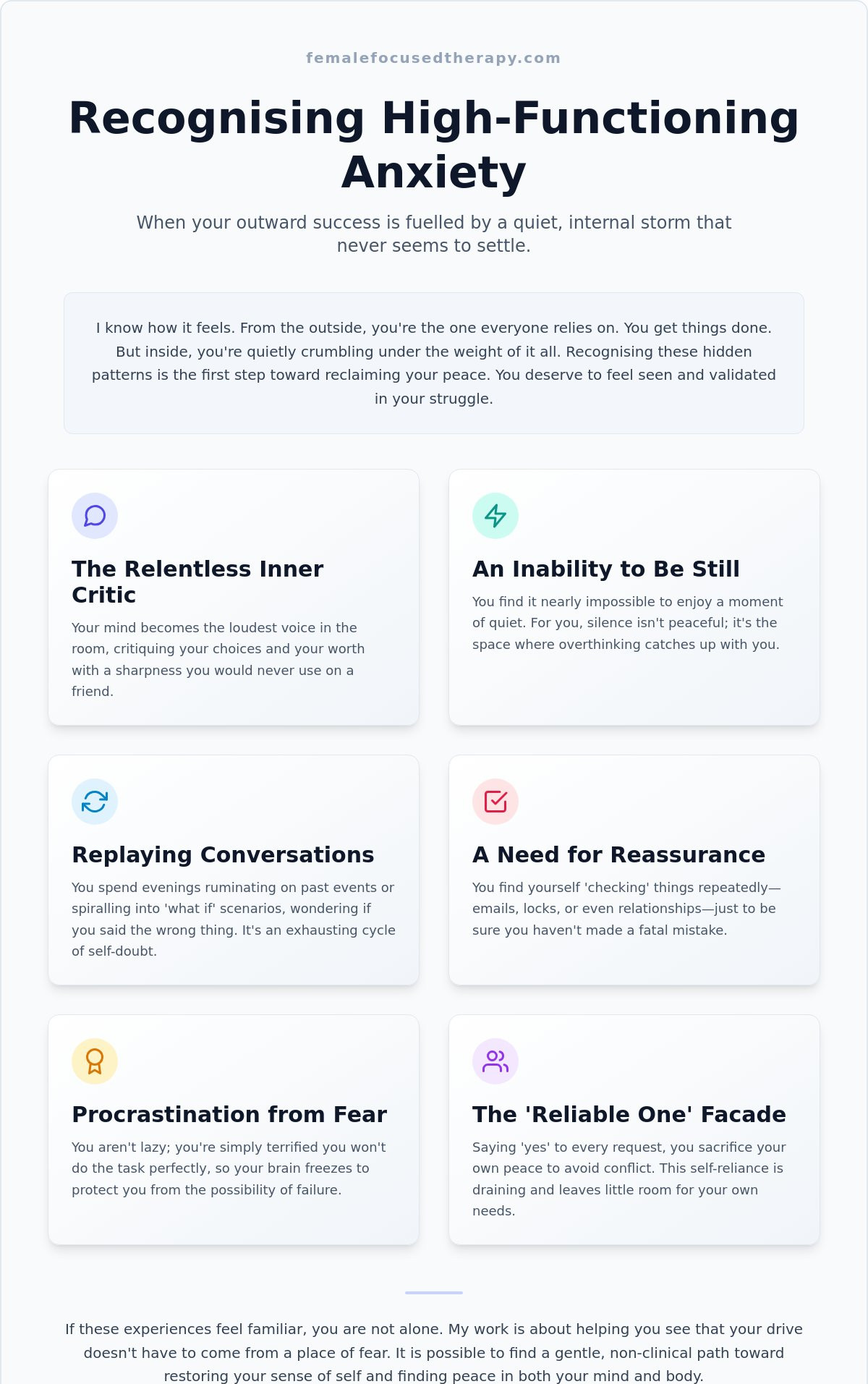
While everyone around you sees a woman who is capable and collected, your internal experience is often one of constant, exhausting noise. Your inner critic is likely the loudest voice in the room, even when you’re completely alone. It critiques your choices and your worth with a sharpness you would never use on a friend.
You might find it nearly impossible to sit still or enjoy a moment of quiet. For you, silence isn’t peaceful; it’s the space where the overthinking catches up with you. You spend your evenings replaying conversations from three days ago, wondering if that one sentence you said was taken the wrong way. It’s a relentless cycle of self-doubt that leaves you drained.
There is often a constant need for reassurance. You might find yourself ‘checking’ things repeatedly, such as emails, locks, or even your relationships, just to be sure you haven’t made a fatal mistake. This can lead to a strange kind of procrastination. You aren’t lazy; you’re simply terrified that you won’t do the task perfectly, so your brain freezes to protect you from potential failure.
Recognising these signs of high functioning anxiety is the first step toward reclaiming your peace. It’s about understanding that your drive doesn’t have to come from a place of fear. If these experiences feel familiar, we can begin to unpick them together in a safe, supportive way.
The mental chatter that never stops
This mental load is incredibly heavy. You might find yourself ruminating on past events or spiralling into ‘what if’ scenarios for the future. This chatter steals your ability to be present with your loved ones, making you feel distant even when you’re in the same room. Ruminative thought is a cycle of mental ‘checking’ where the brain repeats a thought to try and resolve a feeling of unease.
According to the Mayo Clinic, identifying these signs of high-functioning anxiety is crucial because they often go unnoticed by others. When your mind is constantly scanning for threats, you lose the capacity to simply ‘be’. You’re always preparing for the next crisis, even when life is calm.
The physical toll on your body
Anxiety isn’t just in your head; it lives in your tissues. You might notice your jaw is constantly clenched or your shoulders are pulled up toward your ears like a shield. Perhaps there’s a persistent flutter in your chest that won’t go away, even after a good night’s rest. I believe our bodies often hold the anxiety that our minds try to ignore.
This physical burden can show up as digestive issues or sleep disturbances that seem to have no clear medical cause. Your nervous system is stuck in a state of high alert, unable to find the ‘off’ switch. Learning to listen to these somatic signals is a vital part of your journey toward internal restoration and healing.
Why high-functioning anxiety feels different for women
High-functioning anxiety doesn’t happen in a vacuum. For many of us, it’s inextricably linked to our unique biology and the roles we are expected to play. As a woman living with ADHD, I know first-hand how neurodivergence can hide behind a mask of hyper-competence while the internal motor is redlining.
We also have to look at the shadows cast by our past. Your need to be perfect or “on” at all times might actually be a protective response to relationship trauma. When you’ve lived through narcissistic abuse, hyper-vigilance becomes a survival strategy you can’t easily switch off.
This constant scanning for potential threats is one of the more hidden signs of high-functioning anxiety. You aren’t just “driven” by ambition; you’re often trying to stay safe by anticipating everyone else’s needs before they even speak. It’s a lonely and exhausting way to exist.
The intersection of ADHD and anxiety
For neurodivergent women, “masking” ADHD symptoms can lead to a state of constant, high-functioning worry. You might work twice as hard as everyone else just to appear organised and focused. This creates a massive internal load that eventually leads to burnout. I offer specialised ADHD therapy for women to help you navigate this specific overlap.
Managing this overwhelm is particularly difficult when your brain naturally processes information with such high intensity. It’s not just about being “busy” or having a full calendar. It’s about the deep exhaustion that comes from filtering a world that often feels too loud, too fast, and too demanding for your nervous system.
Hormonal shifts and the ‘anxious’ mind
Life transitions like perimenopause and menopause can suddenly amplify these feelings. You might find that the coping mechanisms that served you well for decades suddenly feel like they’re failing. It can make you feel suddenly out of control in your own skin, even if nothing else in your life has changed.
I provide a safe, warm space to discuss menopause and midlife transitions without any judgment. We look at how these hormonal shifts change your relationship with stress. It’s about finding a new sense of balance and safety within yourself during a time of significant change.
Recognising these signs of high functioning anxiety through the lens of your specific life stage is vital for healing. It’s not a personal failing or a lack of willpower. It’s your system reacting to real biological changes and past experiences, and you deserve a path toward gentle restoration.
Moving from a state of survival to internal restoration
I want to be very clear: healing isn’t about ‘fixing’ a broken version of yourself. You aren’t a project to be managed or a machine that needs a tune-up. True restoration is about returning to a state of safety within your own skin, allowing your nervous system to finally step down from high alert.
When you live with the signs of high functioning anxiety, your body is often stuck in a cycle of survival. We begin the journey back by noticing the breath and the quiet physical sensations in your limbs. It’s about learning to listen to what your system is telling you before it has to scream for your attention.
I encourage you to move away from the relentless ‘doing’ that has defined your success for so long. Together, we look for a more compassionate way of ‘being’ instead. Small, sustainable changes are always more effective than trying to overhaul your entire life in a single weekend. True change happens in the quiet, consistent moments of self-care.
The power of somatic movement and rest
High-functioning anxiety often leaves us feeling ‘stuck’ in our heads, disconnected from the neck down. Gentle movement can help release the stored tension that words alone sometimes can’t reach. It’s about teaching your body that it is safe to let go of the internal armour you’ve been wearing for years.
We need to challenge the deeply ingrained idea that rest must be ‘earned’ through productivity. Rest is a fundamental human need, not a reward for completing a long to-do list. I often use somatic movement and yoga as a way to ground the nervous system and invite a sense of genuine ease into your day.
Cultivating self-compassion
You likely speak to yourself with a harshness you would never dream of using with a friend or a loved one. Cultivating self-compassion means learning to offer yourself that same kindness and patience. It’s about identifying your core needs versus the heavy ‘shoulds’ that the outside world imposes on you.
Rebuilding self-trust happens one small, intentional step at a time. It starts with honouring your boundaries and learning to trust your own intuition again. If you feel ready to move from a state of survival into a space of genuine restoration, you can book a session with me to begin that journey in a safe, held space.
How I can help you find your way back to yourself
I provide a warm, boundaried space where you can finally feel safe enough to take off the mask. We spend so much of our lives performing for others that we forget who we are underneath all those expectations. In our sessions, you don’t have to be the high-achiever or the one who has it all figured out; you can just be you.
My integrative approach is designed to meet you exactly where you are in your life. I combine evidence-based psychological modalities with mindfulness and somatic wisdom to address both the mind and the body. We don’t just talk about the signs of high functioning anxiety; we work to soothe the underlying nervous system that keeps you in a state of high alert.
I understand that your life is busy and your responsibilities are many. Whether you are living in Singapore or joining me from elsewhere in the world, I offer online therapy to support your journey. You don’t have to navigate this heavy feeling of constant overwhelm on your own anymore. There is a gentle path toward restoration that doesn’t involve pushing yourself even harder.
A personalised approach for your unique journey
Every woman’s experience is different, so our work together is always tailored to your specific life story and current challenges. We’ll work together to understand the roots of your anxiety while also acknowledging the incredible strengths that have brought you this far. My goal is to help you feel grounded, empowered, and truly at home in your own skin.
You can learn more about my background and my philosophy of care to see how my own experiences as a woman with ADHD shape my practice. I believe that healing is a deeply collaborative process. It’s built on trust, kindness, and a shared understanding of the invisible burdens you’ve been carrying for far too long.
Your next realistic step toward calm
I invite you to take a small, quiet moment right now, exactly where you are. Simply notice the natural rhythm of your breath without trying to change it or judge it. Feel the air moving in and out of your body, and notice any areas where you might be holding onto tension or holding your breath.
If you feel ready to look more closely at these signs of high functioning anxiety, you can book a consultation with me to start your journey. I am here to hold a safe space for you whenever you feel ready to begin. Restoration is possible, and it often starts with this one small, kind choice for your own wellbeing.
Embracing a life of genuine ease
You’ve spent so long maintaining a perfect image that the idea of letting go might feel frightening. But as we’ve explored, recognising the signs of high functioning anxiety is the first step toward a much deeper kind of success. It’s a success that doesn’t leave you feeling hollow or exhausted at the end of every day.
True restoration happens when we bridge the gap between the mind and the body. By combining my experience as a Registered Integrative Psychotherapist with somatic wisdom and mindfulness, I help you move beyond the loud “shoulds” of the world. Whether you’re navigating neurodivergence, relationship trauma, or the shifts of midlife, you deserve a space where your internal world is finally safe and heard.
You don’t have to carry this invisible weight alone. I’m here to offer specialised, trauma-informed support that honours your unique journey and your incredible strengths. When you’re ready to set the mask aside, I’ll be here to hold the space for you.
Book a consultation with me to begin your journey toward calm. You’ve looked after everyone else for long enough; it’s finally time to look after you.
Frequently Asked Questions
Is high-functioning anxiety a formal medical diagnosis?
High-functioning anxiety isn’t a formal clinical diagnosis found in the DSM-5. It’s a descriptive term we use to understand women who appear successful and composed on the outside while struggling with significant internal worry. Even without a formal medical label, the emotional and physical impact on your life is very real and deserves professional support.
How can I tell the difference between being a high achiever and having high-functioning anxiety?
The main difference lies in what motivates your actions. A high achiever is often pulled forward by passion, goals, and a genuine sense of purpose. If you’re living with high-functioning anxiety, you’re likely pushed by a relentless fear of failure or a need to avoid making mistakes. One feels like growth; the other feels like a desperate race to stay safe.
Can high-functioning anxiety lead to physical health problems if left unaddressed?
Yes, chronic stress takes a significant toll on your physical wellbeing over time. When your system is constantly flooded with stress hormones, it can lead to digestive issues, heart palpitations, and a weakened immune system. I often see women who have ignored the mental signs of high functioning anxiety until their bodies finally force them to stop through illness or total burnout.
Is it possible to have both ADHD and high-functioning anxiety at the same time?
It’s very common for these two experiences to overlap. Many women with ADHD use anxiety as a tool to “mask” their symptoms and stay organised in a world that wasn’t built for them. This creates a state of constant hyper-vigilance that is incredibly draining. In my ADHD-focused therapy, I help you understand how these patterns work together and how to find a gentler way of functioning.
What is the first step I should take if I recognise these signs in myself?
The first step is simply acknowledging that your internal struggle is valid and real. You don’t have to wait for a total collapse before you’re allowed to ask for help. Take a small moment today to be kind to yourself and recognise that you’ve been carrying an invisible load. Reaching out for a consultation can help you begin unpicking these patterns in a safe, boundaried space.
How does therapy for high-functioning anxiety differ from standard anxiety treatment?
My approach goes beyond just reducing your symptoms. We work together to understand the “mask” you wear and the somatic patterns your body has developed to keep you safe. While standard treatment might focus purely on logic, I integrate mindfulness and somatic wisdom to help you feel safe in your body again. It’s a journey of internal restoration rather than just “fixing” a problem.
Can menopause make my existing anxiety feel much worse?
Hormonal shifts during perimenopause and menopause can absolutely amplify your anxiety. As your oestrogen levels fluctuate, your nervous system can become far more sensitive to stress. This often makes your usual coping strategies feel suddenly ineffective. I specialise in menopause and midlife therapy to help you navigate these biological changes with compassion and specialised support.
Do I need to stop being successful to recover from high-functioning anxiety?
You don’t have to give up your success or your ambitions to heal. Recovery is about changing the engine that powers your drive. We work to move you away from a fear-based motivation toward a version of success that is sustainable and grounded. You can still achieve great things, but you’ll do so from a place of internal safety and peace rather than a state of survival. Recognising the signs of high functioning anxiety is simply the start of doing things differently.

Article by
Cheryl Kennedy MacDonald MA BA (Hons) Pg. Dip. SAC BACP
Cheryl Kennedy MacDonald is a psychotherapist specialising in women’s mental health, relationships, and life transitions. She works with women navigating trauma, relationship breakdown, identity shifts, and midlife change, helping them rebuild self-trust, emotional stability, and a clear sense of who they are and what they want.
With over 20 years’ experience working with women internationally, Cheryl is the founder of YogaBellies, a global women’s yoga school, and the creator of the Birth ROCKS method. Her work sits at the intersection of psychotherapy and embodiment, integrating evidence-based therapeutic approaches with somatic, body-based practices that support deep, lasting change.
Known for her grounded and direct approach, Cheryl moves beyond surface-level insight to address the patterns held in the body and nervous system. Her work supports women to regulate, reconnect, and respond to their lives from a place of clarity, strength, and self-respect.
She is a published author in academic journals and has written multiple books on women’s health, pregnancy, and midlife wellbeing, available on Amazon and leading book retailers worldwide.