
You may be here because you feel a deep, persistent sense of emotional exhaustion. Perhaps you live with a harsh inner critic that tells you you’re never quite good enough, a relentless voice that sounds suspiciously like a parent from your past. You might find yourself repeating unhealthy patterns in your relationships, always striving for a perfection that feels necessary for love, yet remains just out of reach. These feelings are often the complex, lingering echoes of growing up with a narcissistic parent.
If this resonates with you, please know you are not alone, and your experiences are valid. This guide is designed to be a compassionate space for you. Here, we will gently unpack the long-term effects of your upbringing and offer a clear, supportive roadmap to help you navigate the path to healing. Our goal is to help you quiet that inner critic, reclaim your self-worth, and begin the vital work of rebuilding trust in your own feelings, allowing you to build the healthier, more authentic relationships you deserve.
Key Takeaways
- Understand the confusing ‘charming in public, critical in private’ dynamic and validate that the emotional harm you experienced was real and not your fault.
- Discover how growing up with a narcissistic parent can impact your adult relationships and learn why rebuilding self-trust is the foundation of your healing.
- Explore a compassionate, 5-step path to begin disentangling from past dynamics and start reconnecting with your authentic needs and desires.
- Learn why specialized, trauma-informed therapy provides a safe, supportive space to process complex emotions and build a foundation for healthier relationships.
Recognizing the ‘Invisible Wounds’: 7 Signs You Grew Up With a Narcissistic Parent
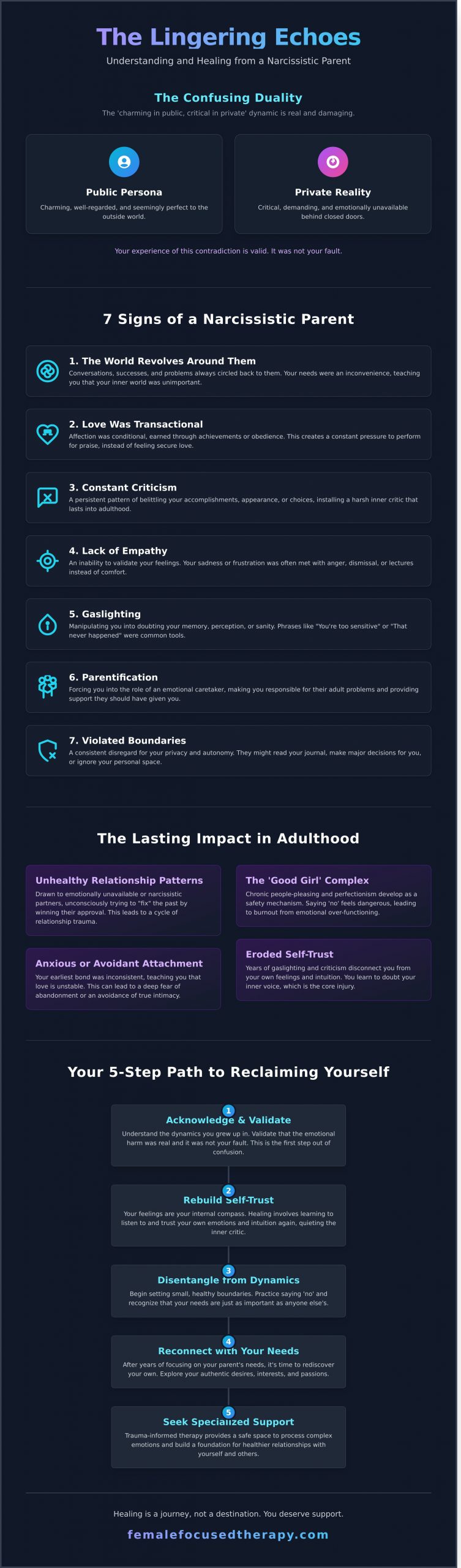
You may be here because your childhood memories feel confusing-a mix of moments that looked perfect on the outside but felt deeply painful on the inside. Many adult children of narcissists recall a parent who was charming and well-regarded in public, yet critical, demanding, and emotionally unavailable behind closed doors. If this sounds familiar, please hear this first: their behavior was never your fault. Taking this first step in understanding is crucial for healing the invisible wounds left behind.
The experience of growing up with a narcissistic parent is often marked by a distinct and damaging set of patterns. These behaviours stem from traits associated with Narcissistic Personality Disorder (NPD), where an individual has an inflated sense of their own importance and a deep need for excessive attention and admiration. For a child, this creates an environment where their own emotional needs are consistently overlooked. Recognizing these signs is the first step toward clarity and rebuilding your sense of self.
The World Revolves Around Them
In your childhood home, did conversations always circle back to your parent’s achievements, problems, or feelings? A narcissistic parent struggles to see you as a separate individual. Your successes were often seen as a reflection on them, and your needs were frequently dismissed as an inconvenience or an interruption to their own agenda. This constant focus on them teaches you that your own inner world is not important.
Love Was a Transaction, Not a Gift
Instead of unconditional support, love was often conditional. It had to be earned through achievements, obedience, or by making your parent look good. This creates a constant pressure to perform, to be the ‘good’ or ‘successful’ child, just to receive a moment of praise or affection. This transactional dynamic is the opposite of the secure, unconditional love that is essential for fostering healthy self-worth and confidence.
Other common signs of growing up with a narcissistic parent include:
- Constant Criticism: A persistent pattern of belittling your accomplishments, appearance, or choices, leaving you with a harsh inner critic.
- Lack of Empathy: An inability to understand or validate your feelings. When you were upset, they may have become angry or dismissive.
- Gaslighting: Manipulating you into doubting your own memory, perception, or sanity. Phrases like “You’re too sensitive” or “That never happened” are common.
- Parentification: Being forced into the role of an emotional caretaker for your parent, listening to their adult problems and providing the support they should have been giving you.
- Violating Boundaries: A consistent disregard for your personal space, privacy, and autonomy-reading your journal, making decisions for you, or ignoring your requests.
The Lasting Impact on Adult Daughters: Common Patterns in Relationships and Life
For women, growing up with a narcissistic parent often leaves a unique and complex imprint on adulthood, particularly within relationships and the development of self-worth. Your earliest attachment bond, which should have been a source of safety and security, was likely inconsistent and conditional. This can shape your attachment style, often leading to an anxious preoccupation with relationships or a deep-seated avoidance of true intimacy, as you were taught that love is something to be earned, not freely given.
This early relational template can create a painful pattern of being drawn to emotionally unavailable or narcissistic partners. The dynamic feels familiar, and you may unconsciously try to “fix” the past by finally winning the approval of someone who mirrors your parent’s behaviour. This cycle is often driven by a profound fear of abandonment, creating constant anxiety and a sense that you must perform perfectly to keep love. Navigating this can be exhausting, but understanding the roots of relationship trauma and narcissistic abuse is the first, powerful step toward creating healthier connections.
The ‘Good Girl’ Complex: Perfectionism and People-Pleasing
The relentless need for parental validation often evolves into a chronic pattern of people-pleasing and perfectionism. You may find it incredibly difficult to say ‘no,’ fearing that setting boundaries will lead to conflict or disapproval. This drive to be the perfect daughter, partner, friend, and employee is not about ambition but about safety. Over time, this emotional over-functioning can lead to profound burnout, resentment, and a feeling of being disconnected from your own needs and desires.
A Complicated Relationship with Success and Self-Worth
When you’ve been raised to believe your value is conditional, it becomes nearly impossible to internalize your own achievements. You may struggle with intense Imposter Syndrome, feeling like a fraud no matter how much you accomplish. The internalised voice of the critical parent can lead to self-sabotaging behaviours because success feels unfamiliar or undeserved. Research on the broader Impacts on Adult Children confirms that this struggle to feel genuine pride is a common consequence of growing up with a narcissistic parent, making it difficult to build the stable self-trust you deserve.
The Core Injury: How Narcissistic Parenting Erodes Your Self-Trust
If you find yourself constantly questioning your own memories or asking, “Am I just overreacting?” you are not alone. This deep-seated self-doubt is one of the most common and painful legacies of growing up with a narcissistic parent. It is a direct attack on your self-trust-the innate ability to rely on your own feelings, instincts, and perceptions as valid and true.
This erosion doesn’t happen by accident. It is the result of systematic gaslighting, a form of manipulation where your reality is constantly denied and distorted. You were taught, often from a very young age, that your perceptions were wrong and your parent’s version of events was the only one that mattered. Over time, this conditioning creates a harsh inner critic-an internalized version of your parent’s voice that continues to judge, question, and belittle you long into adulthood.
Learning to Silence Your Own Voice
As a child, you likely learned that expressing your genuine feelings was unsafe. Your sadness might have been labelled as “being too dramatic,” your anger as “disrespectful,” and your joy as “annoying.” This dynamic, where a child’s internal world is consistently invalidated, is a core theme in extensive research on parent-child relationships, which underscores its profound, long-term effects. This conditioning teaches you to silence your own voice, leading to a profound difficulty in making decisions as an adult without seeking constant external validation.
The Physical Toll of Emotional Trauma
The consequences of growing up with a narcissistic parent are not just emotional; they are physical. Living in a state of chronic stress and emotional suppression means your nervous system is often on high alert. This can manifest in very real physical symptoms and is frequently linked to anxiety, depression, and Complex PTSD (C-PTSD). Healing, therefore, is not just about talking; it’s about a gentle and supportive process of reconnection between your mind and body, learning to feel safe in your own skin once again.
Your Path to Healing: 5 Steps to Reclaim Your Authentic Self
Beginning the journey of healing can feel overwhelming, but it is a courageous and deeply rewarding act of self-love. Remember, this is not about fixing something that is broken within you; it is about gently reconnecting with the authentic self that has always been there. Healing is a process, not a destination, and every small step you take is a significant victory.
Here are five foundational steps to help you navigate your path toward clarity, confidence, and emotional freedom.
- 1. Acknowledge and Grieve. The first, most powerful step is to name your experience for what it was. Acknowledging that growing up with a narcissistic parent was damaging-and that it was not your fault-is profoundly validating. Allow yourself to grieve the secure, nurturing childhood you deserved but did not receive. Your pain is real, and it deserves to be honoured.
- 2. Practice Self-Compassion. The harsh inner critic you live with is often an echo of your parent’s voice. Self-compassion is the antidote. When you notice self-critical thoughts, pause and ask: “How would I speak to a dear friend in this situation?” Offer yourself that same kindness and understanding. This isn’t about making excuses; it’s about offering yourself the warmth you were denied.
- 3. Re-Parent Your Inner Child. Your ‘inner child’ is the part of you that holds the emotions, unmet needs, and wounds from your past. Re-parenting means consciously giving yourself the safety, validation, and unconditional love you needed back then. You can do this by celebrating small achievements, creating a peaceful home environment, and allowing yourself to be playful. For more support, explore our free therapy resources for guided meditations.
- 4. Set Healthy Boundaries. For many who experienced growing up with a narcissistic parent, boundaries feel terrifying or selfish. In truth, they are essential for your wellbeing. A boundary is simply a line you draw to protect your energy. Start small. You can say “no” to a request, limit the length of a phone call, or state, “I am not willing to discuss that.” Each boundary you set rebuilds your sense of self-respect.
- 5. Reconnect with Your Feelings and Needs. You likely learned to suppress your own feelings to manage your parent’s. Reconnecting with them is key to rebuilding self-trust. Begin by asking yourself simple questions throughout the day: “What do I need right now?” or “How am I truly feeling in this moment?” There is no right or wrong answer. The goal is simply to listen to your own inner voice again.
Navigating this journey is a brave act, and you don’t have to do it alone. Professional therapy can provide a safe, supportive space to heal and grow. If you’re ready, you can learn more about how we can work together at femalefocusedtherapy.com.
How Specialized Therapy Provides a Safe Space to Heal
Making the decision to seek support is a profound act of courage and self-compassion. After a lifetime of being taught that your needs don’t matter, prioritising your own healing is a powerful first step. The complex emotional landscape created by growing up with a narcissistic parent often requires a professional guide-someone who can help you navigate the fog of confusion, self-doubt, and pain without judgment.
A therapist who is trauma-informed and understands the nuances of narcissistic abuse can provide a unique relationship, one that is safe, consistent, and focused entirely on you. This therapeutic space becomes a safe laboratory where you can unpack your experiences, challenge old beliefs, and practice new ways of relating to yourself and others. It is a place to find your voice, perhaps for the very first time.
What to Expect in Therapy for Narcissistic Abuse
Your healing journey is unique, but it often follows a path of rediscovery and empowerment. We will work together at a pace that feels safe and sustainable for you. The process typically involves:
- Validating Your Story: The first step is having your reality acknowledged. We will create a space where your experiences are heard, believed, and understood, counteracting the gaslighting you endured.
- Processing Grief and Anger: Grieving the parent you deserved but never had is a crucial part of healing. We’ll gently work through the complex layers of sadness, anger, and loss.
- Building New Skills: We will focus on rebuilding your self-trust, setting firm boundaries, and developing a stronger sense of self. We may draw on modalities like Cognitive Behavioural Therapy (CBT), somatic work to release trapped trauma from the body, and attachment-focused therapy to build healthier relationship patterns.
The ultimate goal is to help you move from surviving to thriving. To learn more about my integrative, female-focused approach, you can read about my professional journey on my About Me page.
Taking the Next Step with Female Focused Therapy
At Female Focused Therapy, I specialise in supporting women as they navigate the aftermath of growing up with a narcissistic parent. This is a path I understand deeply, and I am committed to providing the compassionate, expert support you deserve. I offer confidential sessions both online and in-person in Singapore, providing a flexible and accessible space for your healing.
When you feel ready, I invite you to take the next gentle step. Book a confidential consultation to explore how we can work together on your path to clarity, confidence, and reconnection with your true self.
Your Path to Healing Begins Today
Recognising the patterns and invisible wounds from your childhood is a profound and courageous step. The experience of growing up with a narcissistic parent often leaves a legacy of eroded self-trust and complex relational dynamics that can follow you into adulthood. Remember, this understanding is not about dwelling in the past; it is about empowering yourself with the clarity needed to reclaim your authentic voice and build a future defined by your own values.
You do not have to navigate this healing journey alone. At Female Focused Therapy, we provide a compassionate, safe space specifically for women recovering from narcissistic abuse. Our trauma-informed, integrative therapeutic approach is designed to support you holistically. We offer confidential sessions both online and in-person in Singapore, providing expert guidance as you reconnect with your inner strength and rebuild your sense of self.
Ready to move from surviving to thriving? Book a confidential consultation today.
Your story is not over; a new, empowered chapter is waiting to be written.
Frequently Asked Questions
Can you ever have a healthy relationship with a narcissistic parent?
While challenging, it is possible to have a more manageable relationship, though it may not fit the traditional definition of “healthy.” This requires you to set firm boundaries and manage your expectations. A “healthy-enough” dynamic might involve limited contact and keeping conversations superficial to protect your emotional wellbeing. The focus must shift from changing your parent to empowering yourself to control the terms of your engagement, ensuring your own safety and peace of mind.
What is the difference between a narcissistic parent and a selfish parent?
Selfishness is a behaviour, whereas narcissism is a pervasive personality pattern rooted in a lack of empathy. A selfish parent might occasionally prioritise their own needs but can often feel remorse and is capable of change. A narcissistic parent consistently views their child as an extension of themselves, requires constant admiration, and struggles to recognise their child’s feelings or needs. Their actions are part of a consistent dynamic of control and manipulation.
What are the ‘golden child’ and ‘scapegoat’ roles in a narcissistic family?
These are roles the narcissistic parent assigns to maintain control. The ‘golden child’ is idealised, embodying the parent’s unfulfilled ambitions and receiving praise as long as they comply. The ‘scapegoat’ is blamed for all family problems, enduring constant criticism and absorbing the family’s dysfunction. Both roles are incredibly damaging, creating deep-seated issues with self-worth, identity, and relationships that often require dedicated therapeutic support to heal from.
How do I stop attracting narcissistic partners after growing up with a narcissistic parent?
Growing up with a narcissistic parent can make manipulative dynamics feel familiar and even comfortable. To break this cycle, the first step is building self-awareness and self-worth. Therapy provides a safe space to understand what healthy attachment feels like, establish strong boundaries, and learn to trust your intuition when something feels wrong. By healing your original wounds, you can stop recreating harmful relationship patterns and begin to attract secure, reciprocal partnerships.
Is it possible to heal from the trauma of a narcissistic parent?
Yes, healing is absolutely possible. It is a journey of reclaiming your identity, rebuilding self-trust, and learning to re-parent yourself with the compassion you may not have received. The process often involves grieving the childhood you deserved and processing complex emotions in a safe, supportive therapeutic environment. With time and professional guidance, you can navigate your trauma and build a fulfilling life based on your own values and needs.
How do I explain my decision to limit contact with my parent to other family members?
You do not owe anyone a detailed justification for protecting your mental health. A simple, clear, and firm statement is most effective. You can say something like, “For my own wellbeing, I’ve decided to take some space in my relationship with my parent. This was a necessary decision for me, and I would appreciate your support.” Avoid getting drawn into debates or defending your choice. The goal is to communicate your boundary, not to win an argument.