
I’m Finding My Way Back Through Difficult Contact
The grey rock method means keeping contact brief, factual and emotionally neutral. When dealing with someone you describe as a narcissist, it can be a short-term way to manage an interaction, not a promise that the other person will change.
You may be tired of replaying conversations, choosing your words carefully or wondering whether a calmer response could help. It’s understandable to look for ways to protect your energy when contact feels difficult to avoid.
Here’s what the method involves, what it may and may not do, and why behaviour can sometimes escalate. Strain can be a sign to seek support, too. Understanding these points can help you consider your next step with more clarity and care.
Key Takeaways
- Learn how intentional, limited responses differ from stonewalling, and why the purpose behind them matters.
- Consider what grey rocking may change in an interaction, and what it cannot control about someone else’s behaviour.
- Notice when contact is becoming more distressing or unsafe, and when it may be time to seek support.
- Explore how individual psychotherapy can help you make sense of the relationship and rebuild trust in your own judgement.
What Is the Grey Rock Method and Is It Effective?
Grey rocking means choosing limited, emotionally neutral contact for a specific interaction. To assess whether it’s useful, consider whether it helps you maintain necessary boundaries without adding to your distress.
Grey Rocking and Stonewalling
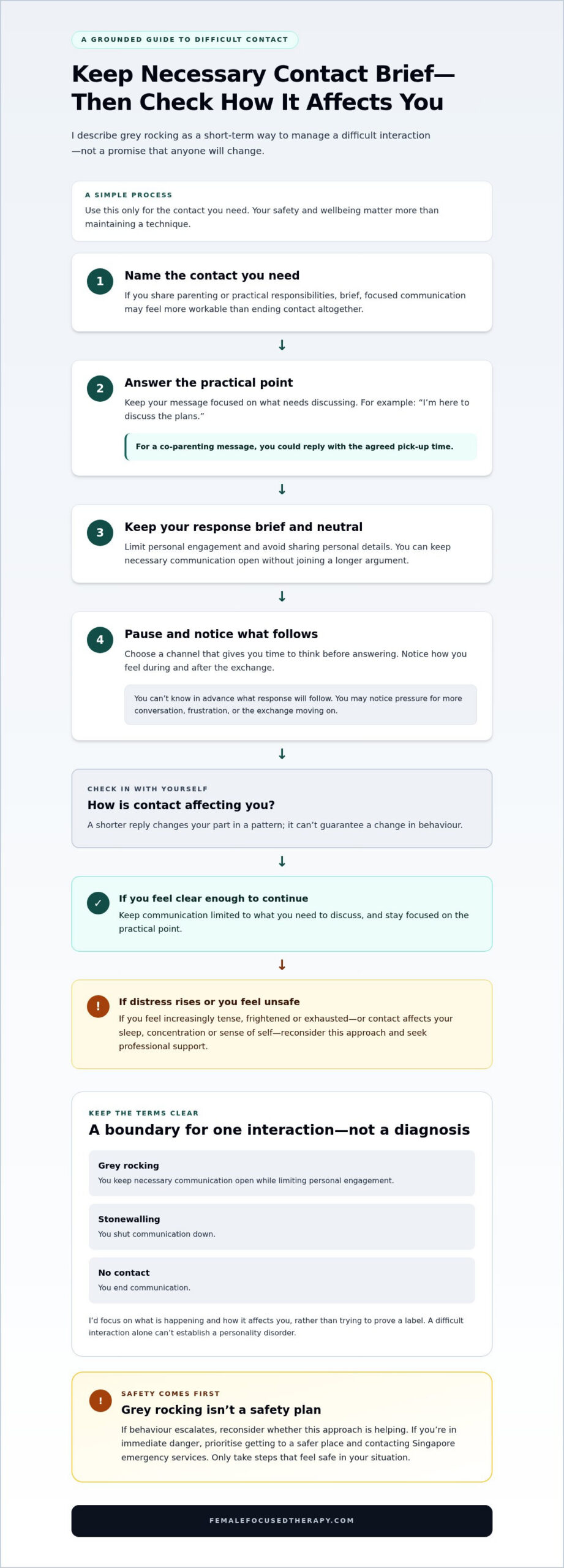
Grey rocking and stonewalling differ in purpose. Grey rocking keeps necessary communication open while limiting personal engagement; stonewalling shuts communication down. If a conversation turns critical, you might answer the practical question, then return to your task. Notice whether this boundary helps you stay clear about what needs discussing, rather than leaving you unable to speak about important matters.
Grey Rocking and Social Withdrawal
Grey rocking is a response to a specific interaction, not a reason to withdraw from every connection. You might keep a difficult exchange brief, then still call a trusted friend or attend a family meal. Notice whether you’re choosing distance from one conversation or losing interest in people and activities that usually matter to you. That difference can help you decide what support to keep close.
Grey Rocking and No Contact
No contact means ending communication, while grey rocking leaves room for limited exchanges. If you share parenting or practical responsibilities, no contact may not fit your circumstances, and brief, focused communication may feel more workable. Consider what contact is necessary for you, rather than treating complete silence as the only possible boundary.
Challenges, Risks, and Possible Reactions
Pay attention to how you feel during and after each interaction. The person may press for more conversation, show frustration or move on; there’s no way to know in advance which reaction will follow. If you feel increasingly tense or unsafe, reconsider this approach. You could reduce contact where possible, keep essential messages focused or seek professional support. Your safety matters more than maintaining a technique.
Is Gray Rocking Narcissistic Behavior?
Grey rocking is a response to behaviour that feels manipulative or harmful, not a diagnosis. If you’re dealing with blame, pressure or repeated attempts to draw you into an argument, a restrained response may help you choose how much of yourself to bring into that exchange. A difficult interaction alone can’t establish narcissistic personality disorder, and a list of traits isn’t a reliable way to label someone.
Responding Without Diagnosing
Focus on the action and its effect on you, rather than trying to prove a label. If a conversation shifts into personal criticism, you might say, “I’m here to discuss the plans,” and return to the practical matter. This can help you focus on what you need to communicate, especially when shared responsibilities mean you can’t simply avoid every exchange.
What Extinction Can Explain
The term “extinction” describes a behavioural idea: a response may fade when it no longer brings the result it previously brought. If an argument has led you to defend yourself at length, a shorter reply changes your part in that pattern. It won’t necessarily change the other person’s behaviour. Notice any escalation and take your safety and wellbeing seriously.
Changing Your Own Responses
If you recognise behaviour in yourself that has hurt someone, focus on a specific repair. Name what you did, apologise sincerely where appropriate, and say what you’ll try to do differently. For example: “I interrupted you. I’m sorry. I’ll listen before responding.” This gives you a clear action to practise, rather than relying on someone else to manage the situation for you.
Building Skills Beyond Grey Rocking
I may draw on dialectical behaviour therapy (DBT) skills to help you practise emotional regulation, distress tolerance and interpersonal effectiveness. In a tense exchange, you could pause, notice your feelings, then choose a clear response instead of reacting automatically. If you’d like support making sense of these patterns, you can book an individual therapy appointment and explore what feels manageable for you.
When to seek professional help
Seek professional support when an abusive interaction leaves you frightened, exhausted or unable to manage daily life. If grey rocking feels difficult to sustain, treat that as useful information, not a failure. A personality disorder label isn’t needed to take harmful behaviour seriously; focus on what is happening and how it affects your safety.
When you must stay in contact, limit the technique to necessary communication. For example, reply to a co-parenting message with the agreed pick-up time, avoid sharing personal details, and save important messages if it feels safe. Choose a channel that gives you time to think before answering. Grey rocking isn’t a safety plan. If behaviour escalates, reconsider whether this approach is helping.
In Singapore, you can seek help from a local domestic violence support service or a mental health professional. If you’re looking for a hotline, choose a Singapore-based service that supports people experiencing domestic violence or relationship abuse. You can also speak with a trusted person and ask them to help you make contact, especially if fear or isolation makes that first step harder.
If you’re in immediate danger, prioritise getting to a safer place and contacting Singapore emergency services. Avoid confronting the person about the technique if that could increase risk. A safety plan can include identifying somewhere you could go, keeping essential items accessible and deciding whom you can contact. Only take steps that feel safe in your situation.
Seek professional support if contact is affecting your sleep, concentration or sense of self, or if behaviour becomes threatening. You don’t need to prove narcissistic personality disorder or use the word “abuse” before asking for help. A therapist can help you understand the pattern, consider boundaries and explore options at a manageable pace.
Definition and purpose of the grey rock method
Grey rocking means deliberately making your part in a difficult interaction less emotionally engaging. Its purpose is to protect your attention and limit what you share, not to diagnose someone or make them behave differently. If you’re asking what the grey rock method means in a relationship with a narcissist, keep that distinction in view: it’s a response strategy, not a treatment for narcissistic personality disorder.
The “grey rock” image suggests being as uninteresting as an ordinary stone. In practice, think of it as a boundary for a specific exchange, not a personality you must adopt. For example, if a relative asks a pointed question about your private life, you could give a brief, ordinary answer and turn back to the shared task. The aim is to share fewer personal details and less emotional energy.
Notice the cost, too. If you leave every conversation feeling tense, disconnected or mentally worn down, the technique may not be supporting your wellbeing in that situation. Check in with yourself after an interaction: are you able to settle, or are you replaying the exchange for hours? That information matters. You deserve boundaries that protect your mental health without requiring you to suppress every feeling.
If you need ongoing contact, write down the practical topics you must discuss, such as a shared appointment or household task. Keep those interactions focused on the subject, then reconnect with a trusted member of your support circle. If physical safety is a concern, prioritise safety planning and contact a therapist or domestic violence hotline for support, rather than relying on grey rocking alone.
If you’re trying to understand how this pattern affects you, you can book a therapy appointment and explore what support and boundaries feel right for you.
Female Focused Therapy: Individual Psychotherapy Sessions
At Female Focused Therapy, I offer Individual Psychotherapy Sessions for women navigating narcissistic abuse and its impact on their relationships, boundaries and self-trust. Therapy can help you make sense of what’s happening, consider what feels safe and explore choices at a pace that suits you. Online Therapy is available if meeting remotely feels more comfortable or practical.
You don’t need to arrive with a diagnosis or a perfect explanation. We can begin with what’s troubling you now, whether that’s confusion after a difficult interaction or uncertainty about how to move forward. If you’d like to explore this support, contact Female Focused Therapy.
Choose a Next Step That Centres You
If you’ve been asking what the grey rock method means when dealing with a narcissist, consider a gentler question, too: what do you need to feel more like yourself? Your next step doesn’t have to be a major decision. You might write down one boundary you want to honour, or notice how your body feels before and after contact.
I know it can take time to hear your own needs clearly when you’ve been focused on managing someone else’s reactions. You deserve space to explore your choices without judgement or pressure. Support can help you reconnect with your own sense of direction, one thoughtful step at a time.
If you’d like a confidential space to begin that conversation, you can book an appointment with Female Focused Therapy. You can move forward at your own pace, with care for what feels right for you.
Frequently Asked Questions
What Are Examples of the Grey Rock Technique?
Keep an unavoidable exchange focused on its practical purpose. If a relative asks for personal news during a tense family gathering, you could say, “Work’s busy, thanks,” then ask where the plates go. For a message about a shared bill, answer with the amount and due date only. These examples show how to limit personal details without ignoring necessary communication.
What happens when you grey rock a person with NPD?
An NPD label can’t predict someone’s response, and one interaction isn’t enough to diagnose a person. They might accept your brief reply, ask more questions or react with frustration. For example, if a colleague presses you for a personal explanation, a neutral answer may not end the exchange. Pay attention to what happens next, especially if you feel less safe.
What is the grey rock method in dealing with a narcissist?
Grey rocking means choosing a restrained response to a difficult interaction, rather than trying to win an argument or prove a point. The word “narcissist” doesn’t tell you exactly how someone will respond, so focus on the specific exchange. For instance, if a conversation shifts from planning to personal criticism, you can return to the practical topic or pause the discussion.
How does the grey rock method work in practice?
Prepare a simple phrase before a predictable conversation, such as, “I’ll reply about the schedule by email.” When a message arrives, read it once, identify the practical question and answer only that part. For example, “Tuesday at three works” is clearer than explaining your whole day. After replying, take a moment away from the conversation before deciding whether anything else needs attention.
What are examples of grey rock responses to a narcissist?
Choose answers that are brief and accurate, not deliberately confusing. If someone asks, “Why are you being so difficult?”, you could say, “I’m not discussing that now.” If they demand a decision, try, “I’ll respond tomorrow.” If they send a string of messages about a shared task, answer the task itself. You don’t need to add a personal defence to each reply.
When is the grey rock method useful in relationships or at work?
Consider grey rocking only for contact you need to manage, such as arranging a handover with an ex-partner or keeping a workplace exchange focused on a task. At work, you might reply to a pointed message with the requested project update and keep a record of relevant communication. If this approach increases distress or risk, pause and seek support rather than forcing yourself to continue.

Article by
Cheryl Kennedy MacDonald MA BA (Hons) Pg. Dip. SAC BACP
Cheryl Kennedy MacDonald is a psychotherapist specialising in women’s mental health, relationships, and life transitions. She works with women navigating trauma, relationship breakdown, identity shifts, and midlife change, helping them rebuild self-trust, emotional stability, and a clear sense of who they are and what they want.
With over 20 years’ experience working with women internationally, Cheryl is the founder of YogaBellies, a global women’s yoga school, and the creator of the Birth ROCKS method. Her work sits at the intersection of psychotherapy and embodiment, integrating evidence-based therapeutic approaches with somatic, body-based practices that support deep, lasting change.
Known for her grounded and direct approach, Cheryl moves beyond surface-level insight to address the patterns held in the body and nervous system. Her work supports women to regulate, reconnect, and respond to their lives from a place of clarity, strength, and self-respect.
She is a published author in academic journals and has written multiple books on women’s health, pregnancy, and midlife wellbeing, available on Amazon and leading book retailers worldwide.