
A grey-rock response can help keep interactions neutral, brief and focused on work, but it does not make harmful behaviour acceptable or guarantee it will stop. If you’re wondering how to deal with a narcissistic boss, treat grey rock as one boundary-setting tool alongside clear written communication, careful record-keeping and support when you need it.
You may already be questioning your judgement after being criticised, closely monitored or given unclear instructions. Preparing for every conversation and replaying it afterwards can be draining. Feeling unsettled doesn’t mean you’re overreacting, and you don’t need to diagnose your boss to take repeated behaviour seriously.
This article looks at when grey rock may be useful, how to set practical limits and what to consider before seeking support at work. It also explores how to begin recovering when the experience has left you doubting yourself or feeling worn down. Move at a manageable pace and notice what helps you feel steadier and safer.
Key Takeaways
- I suggest looking at repeated patterns of behaviour and their effect on you, rather than trying to diagnose your boss.
- You can keep a clear record of difficult interactions and think carefully about who may be safe to approach for support.
- A neutral, brief response may help keep a tense exchange focused on work; it isn’t a promise that your boss will change.
- I’ll explore how setting practical limits and seeking individual therapy can help you regain perspective and rebuild trust in yourself.
1. Q: What does recovery from a narcissistic workplace actually look like?
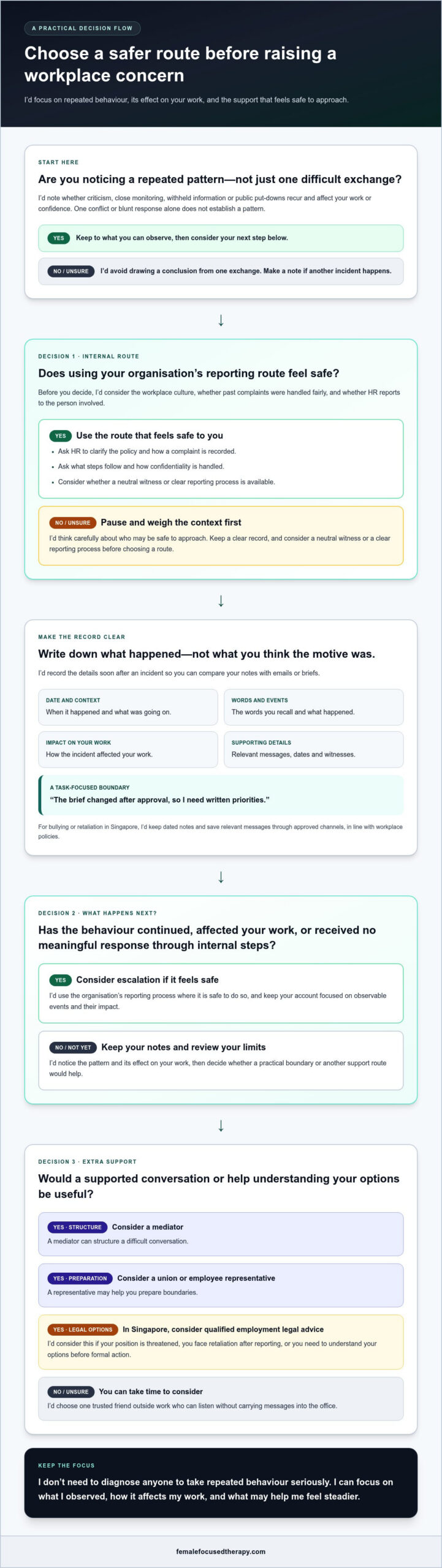
Start by noticing repeated behaviour rather than trying to diagnose your boss. You may be constantly monitored or criticised, or blamed when unclear instructions cause problems. One conflict or blunt response does not establish a pattern. Notice whether criticism, withheld information or public put-downs recur and affect your work or confidence. Narcissistic traits alone do not mean someone meets the criteria for narcissistic personality disorder.
Workplace gaslighting can leave you questioning what you heard, remembered or did. For example, your boss may deny giving an instruction, then criticise you for following it. Soon afterwards, note the date, the words you recall, the context and any impact on your work. Compare your notes with emails or briefs. This is not about proving a diagnosis. It can help you separate observable events from self-doubt and consider your options more clearly.
Recovery may involve deciding whether to accept what you can’t change, try to change the situation, or leave. I’d weigh the pattern’s effect on your health, your ability to do your job, and whether support inside the organisation feels safe. If you’re wondering how to deal with a narcissistic boss, start with one practical step: review your responsibilities and identify a boundary you can communicate clearly. You can explore the women I work with page to see whether this support feels relevant to your experience.
Leaving can be a considered choice, not a failure. If you stay, a written record and clearer work boundaries may help you regain perspective, though your boss may not change. Healing from workplace trauma can include sleeping more steadily, feeling less on edge before meetings, and trusting your own judgement again. I’d also notice what happens in your body after difficult interactions, then make space to pause, breathe, or talk with someone you trust. Progress can mean feeling more like yourself, whether you remain in the role or move on.
2. Seeking support from HR, a mediator or a representative
Before approaching HR, consider the workplace culture and your manager’s relationships across the team. Notice whether colleagues can raise concerns safely, whether past complaints were handled fairly and whether HR reports to the person involved. This context can help you choose a considered route. Record incidents, messages, dates and witnesses so your account is clear. Consider whether there is a neutral witness or a clear reporting process.
In Singapore, if you’re dealing with bullying or retaliation, keep dated notes, save relevant messages through approved channels, and describe the conduct and its impact. Use your organisation’s reporting process where it is safe to do so. Ask what steps follow and how confidentiality is handled.
Escalate if the behaviour continues, affects your work or receives no meaningful response through internal steps. In Singapore, consider qualified employment legal advice if your position is threatened, you face retaliation after reporting, or you need to understand your options before taking formal action. Keep records in line with workplace policies.
Ask HR to clarify the policy and explain how a complaint is recorded. A mediator can structure a difficult conversation, while a union or employee representative may help you prepare boundaries. Focus on observable events: “The brief changed after approval, so I need written priorities.” You don’t need to explain your manager’s motives. Ask for a response that supports your work.
Outside work, choose one trusted friend who can listen without carrying messages into the office. I find therapy can help you notice the mental toll, steady your response to conflict, and rebuild confidence in relationships beyond work. If ADHD or stress makes workplace tension harder to manage, I can help you explore strategies at your pace. If you’d like support, you can book an appointment.
3. Who Is The Toxic Boss or Co-Worker?
Focus on repeated behaviour, not a label. You might be micromanaged, criticised over minor details or left without information needed to finish a task. Your boss might take work away, give you an unclear brief, then blame you for the result. A co-worker may undermine you in a meeting or privately share a damaging account. One difficult conversation alone tells you little. Notice the pattern and its effect on your work.
Some behaviour is overt: a boss publicly attacks your work or humiliates you in a team meeting. Other behaviour is quieter, such as withholding key details, giving poor performance reviews without clear examples or spreading insinuations about you. When instructions change, you may be set up to fail without an obvious confrontation. Compare what was agreed with what happened instead of trying to read intent.
Narcissistic traits do not automatically mean someone meets the criteria for narcissistic personality disorder. You cannot know the roots of your boss’s behaviour from the outside, and guessing may draw you into explaining or excusing it. Understanding a possible reason does not make repeated mistreatment acceptable. Focus on what you can observe, how it affects you and what would protect your ability to work.
Set a limit around one specific action. For example: “I can revise the report once I have the final priorities in writing.” Keep the conversation calm and focused on the task. If your boss or a co-worker attacks you, pause before replying and return to the issue that needs resolving. Your boundary can guide your response even if the other person does not agree with it.
If you’re dealing with this pattern, describe the behaviour plainly in private notes: “My work was reassigned after I requested clear priorities.” This records an event without diagnosing anyone. If the pattern continues, use the workplace support options discussed earlier and consider what limit would help you feel safer at work.
4. Handling a narcissistic boss
Begin with what you can control: your communication, boundaries and next response. If your boss gives changing instructions, ask for priorities in writing and refer back to them calmly. Keep messages neutral and work-focused. For example: “I’ll complete the revised report once you confirm which deadline takes priority.” This gives the conversation a clear focus without inviting an argument about motives.
If an email includes inaccurate details, reply with the correction and relevant facts without debating the distortion. If a meeting becomes tense, pause before responding or step away if possible. A grey-rock response keeps your words brief, neutral and unemotional. It may help you avoid being drawn into conflict, but it cannot make your boss behave differently. The aim is to protect your position and wellbeing, not win their approval.
To manage the emotional strain, build small recovery breaks into your day. After a difficult exchange, take a short walk, slow your breathing or speak with someone you trust outside the organisation. Regular movement, nourishing food and adequate sleep can support resilience. If work stress is affecting your sleep or relationships, notice what changes on the hardest days and consider talking with a therapist.
Keep your role in view. Review your job description, identify what your department expects and ask specific questions when a task is unclear. Rather than relying on praise to confirm your work has value, keep track of completed tasks and feedback. A boundary can be simple: “I can discuss the work, but I’ll continue this conversation when we can speak respectfully.”
If you’re finding it hard to steady your response or trust your own judgement, I can help you explore what support feels right. You can book an appointment and make space to work through the impact at your own pace.
Female Focused Therapy: Individual Psychotherapy Sessions
At Female Focused Therapy, I offer individual psychotherapy for women navigating difficult workplace experiences. Sessions can give you space to explore the impact, strengthen boundaries and consider what you need next. If your boss’s behaviour has left you anxious, confused or questioning your judgement, you can work towards rebuilding trust in yourself.
I also offer Online Therapy, so you can access support remotely. My work includes support around narcissistic abuse and ADHD-focused Therapy. You don’t need to arrive with everything worked out; we can begin with what feels most present for you.
If you’d like to explore working with me, you’re welcome to visit Female Focused Therapy.
Take your next step towards feeling like yourself
Learning how to deal with a narcissistic boss can also mean making room for a life that isn’t defined by work. You might choose one small activity that reconnects you with yourself, such as returning to a hobby or setting aside quiet time after a demanding day. Let your next step reflect what matters to you, not what you feel you have to prove.
If you’d like to explore this with support, you can book an appointment with Female Focused Therapy. You deserve space to hear yourself clearly and move forward at a pace that feels right.
If you’d like to find out more about working with Cheryl Kennedy MacDonald, you can email her at cheryl@femalefocusedtherapy.com or book an appointment here: https://www.femalefocusedtherapy.com/book-now/ or find lifestyle and yoga programmes at YogaBellies on www.yogabellies.com
Frequently Asked Questions
Does being a “grey rock” work at work?
A brief, neutral response may limit how much personal information enters a tense exchange, but consider the workplace context. If it could be read as refusing a reasonable request, keep your tone courteous and address the work issue. Answer the practical question, then stop there. Afterwards, notice whether this approach leaves you feeling more settled or more on edge.
Should I go to HR about a narcissistic boss?
HR may help clarify workplace procedures, reporting routes or possible next steps. Before contacting them, decide what outcome you’re seeking, such as guidance on a work arrangement or a facilitated conversation. Ask how information will be handled and who may need to know. If the matter involves possible legal consequences, seek advice from a qualified employment lawyer in Singapore.
What does recovery from a narcissistic workplace actually look like?
Recovery can mean thinking about your future without organising every choice around your former boss’s reactions. You might find yourself contributing ideas again, accepting kind feedback or enjoying a weekend without mentally preparing for Monday. Changes can come gradually and unevenly. Notice what helps you feel present in your life outside work, not only how you feel during the working day.
Who Is The Toxic Boss or Co-Worker?
Use “toxic” to describe harmful conduct, not as a fixed identity for someone. A co-worker may fuel tension by passing private remarks between colleagues, while a manager’s authority can affect workloads and opportunities. These roles create different pressures. Consider how much power the person has over your work and what support or distance feels practical in that relationship.
What are common signs of a narcissistic boss?
Alongside behaviour that affects your day-to-day work, notice how your boss responds when you receive recognition or disagree respectfully. For example, they may redirect attention to themselves when a team member is praised, or treat a reasonable question as a personal challenge. These moments can help you understand the working dynamic, but they don’t establish a mental health diagnosis.
How can you set boundaries with a narcissistic boss?
Make a boundary more workable by deciding in advance what you’ll do if it isn’t respected. For instance, you might keep a work conversation to agreed topics, then ask to return to the agenda if it turns personal. Choose language you can use consistently, even when unsettled. A boundary is about your own response and limits, not controlling your boss’s choices.

Article by
Cheryl Kennedy MacDonald MA BA (Hons) Pg. Dip. SAC BACP
Cheryl Kennedy MacDonald is a psychotherapist specialising in women’s mental health, relationships, and life transitions. She works with women navigating trauma, relationship breakdown, identity shifts, and midlife change, helping them rebuild self-trust, emotional stability, and a clear sense of who they are and what they want.
With over 20 years’ experience working with women internationally, Cheryl is the founder of YogaBellies, a global women’s yoga school, and the creator of the Birth ROCKS method. Her work sits at the intersection of psychotherapy and embodiment, integrating evidence-based therapeutic approaches with somatic, body-based practices that support deep, lasting change.
Known for her grounded and direct approach, Cheryl moves beyond surface-level insight to address the patterns held in the body and nervous system. Her work supports women to regulate, reconnect, and respond to their lives from a place of clarity, strength, and self-respect.
She is a published author in academic journals and has written multiple books on women’s health, pregnancy, and midlife wellbeing, available on Amazon and leading book retailers worldwide.