
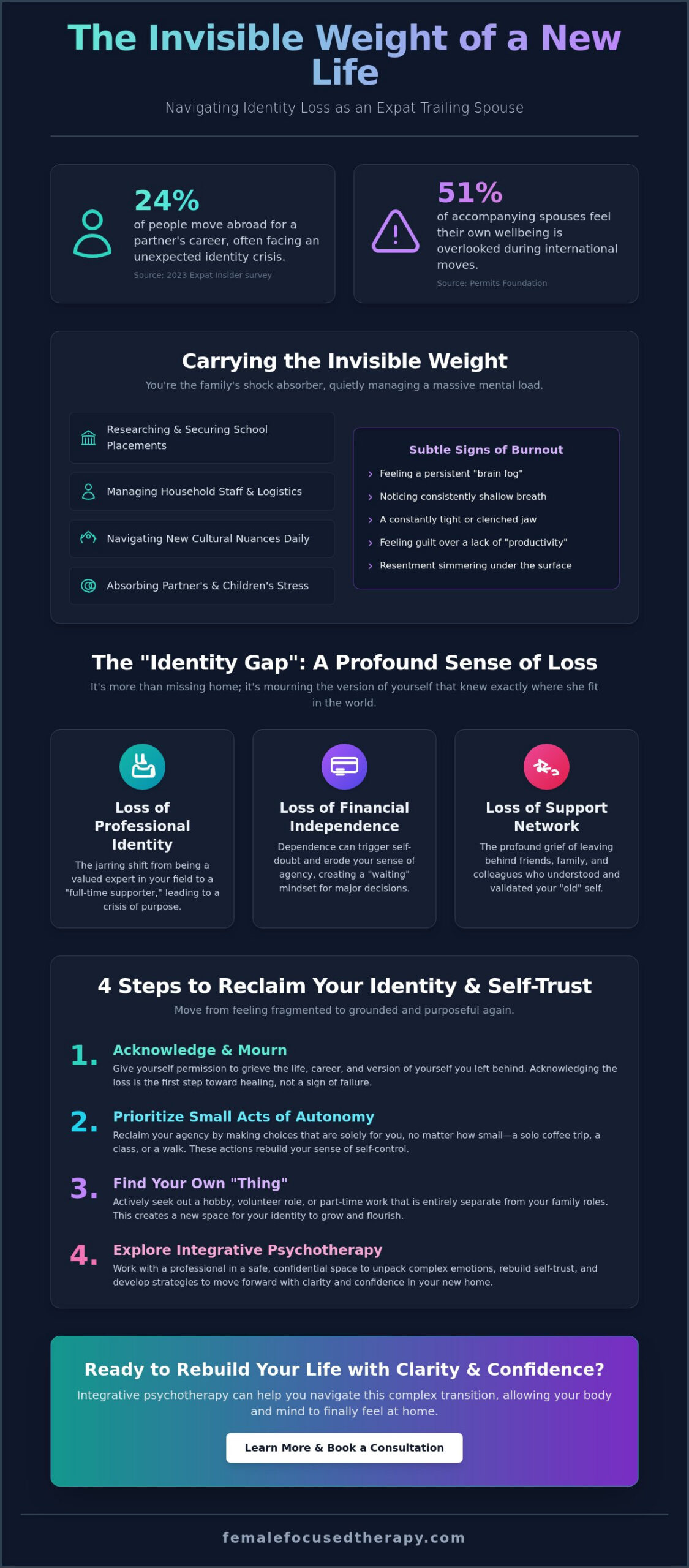
What if the most exhausting part of your move to Singapore wasn’t the humidity or the endless paperwork, but the quiet disappearance of who you used to be? According to the 2023 Expat Insider survey, about 24% of people move abroad for their partner’s career, and many find themselves struggling with a sudden loss of identity. I’ve sat with many women who feel like they’ve become a ghost in their own lives after arriving as an expat trailing spouse.
It’s a heavy, often invisible burden to carry when you’ve left your career and your support network behind to become the family’s emotional shock absorber. I understand that it’s difficult to celebrate your partner’s promotion when you’re grieving the loss of your own professional identity and financial independence. You might feel isolated in your new condo, wondering how to start over when your sense of self feels so fragmented.
I want to help you navigate this emotional complexity and move toward a life where you feel grounded and purposeful again. In this article, I’ll share how you can manage this supporting role without losing yourself, reclaim your self-trust, and find genuine emotional stability in a transient environment, allowing your body and mind to finally feel at home.
Key Takeaways
- Acknowledge the invisible emotional load you carry and why it is vital to give yourself permission to mourn the life and career you left behind.
- Understand why the lack of structure in a new country can unmask ADHD symptoms and how to navigate this transition with gentle compassion.
- Learn practical ways to reclaim your identity as an expat trailing spouse by prioritizing small acts of autonomy and finding your own “thing.”
- Explore how integrative psychotherapy can help you rebuild self-trust and move forward in your new home with clarity and confidence.
The Invisible Weight of Being an Expat Trailing Spouse
You might be sitting in a beautiful home in Orchard Road or Sentosa, yet feeling a strange, hollow ache in your chest. On paper, this move was a grand adventure, but in reality, you feel like you’ve lost the map to your own identity. I see this often in my practice; brilliant, capable women who find themselves adrift after a relocation, wondering where the “real” version of themselves went.
Understanding the ‘Trailing’ Label
The term itself often feels like a heavy anchor. When we talk about what is a trailing spouse?, the language suggests someone who simply follows, lacking their own direction or agency. This vocabulary matters because it shapes how you view your worth. I find that when you are constantly referred to as an “accompanying partner,” it’s easy to start feeling like a supporting character in your own life story, your career and social needs sidelined for a partner’s promotion.
I often describe Trailing Spouse Syndrome as a complex psychological transition involving the loss of professional identity and support networks, rather than a simple lifestyle choice. It isn’t just about moving house; it’s about the erosion of the roles that previously defined you. You aren’t just “trailing,” you are navigating a profound shift in your internal landscape while trying to keep your external world stable for everyone else.
The Reality of Relocation Stress
In Singapore, the mental load of settling a family is immense. You are likely the one researching UWC or Tanglin Trust school placements, finding a reliable helper, and navigating the nuances of the local markets. You become the emotional shock absorber, holding space for your partner’s work stress and your children’s tears while suppressing your own. This pressure to be the “happy expat” can lead to a quiet, simmering burnout that many women feel they have no right to complain about.
Research by the Permits Foundation shows that 51% of accompanying spouses feel their own wellbeing is overlooked during international moves. I work with many women navigating these life transitions in Singapore, helping them recognise that their exhaustion is valid. The initial “honeymoon phase” of exploring a new city can mask deeper feelings of loss or resentment. When the boxes are finally unpacked and the routine sets in, the silence of the house can feel deafening.
High-functioning women often miss the subtle signs of burnout. You might notice your breath is consistently shallow, your jaw is tight, or you feel a sense of “brain fog” that didn’t exist before. It’s vital to create a safe, confidential space to discuss these feelings without the weight of guilt. Acknowledging that you are struggling isn’t a sign of failure, it’s the first step toward rebuilding your sense of self in your new home.
Female Focused Therapy & YogaBellies
Cheryl Kennedy MacDonald
Registered Integrative Psychotherapist & Yoga Master
Singapore & Worldwide Online
www.femalefocusedtherapy.com
www.yogabellies.com
Losing Your Sense of Self in a New Country
Moving to Singapore often feels like a grand adventure, but once the boxes are unpacked, a quiet grief can settle in. I see this often in my practice. You aren’t just missing your favourite cafe; you are mourning the version of yourself that knew exactly where she fit in the world. As an expat trailing spouse, your identity can feel like it has been packed away in a shipping crate that hasn’t arrived yet.
The “Identity Gap” is that painful space between the person you were back home and the person you are still becoming here. Research from the Journal of Global Mobility indicates that the loss of a professional network is one of the top stressors for relocating partners. It is a legitimate loss. It is okay to grieve the life you left behind, even if you chose this move willingly.
Financial dependence can also trigger old patterns of self-doubt that you thought you had outgrown. When you no longer have your own salary landing in your bank account, it can change how you view your own agency. This shift often leads to a “waiting” mindset, where you feel you can’t make decisions until your partner is involved.
The Career Transition Trap
It’s a jarring shift to go from being a professional expert to a “full-time supporter.” When someone at a coffee morning in Orchard or Dempsey asks, “What do you do?”, it can feel like a punch to the gut. You might find yourself stumbling over an answer because your old title no longer applies, but your new reality feels unfinished.
Rebuilding self-trust is essential when your external validation, like a monthly paycheck or performance review, has disappeared. I encourage you to look at this time not as a void, but as a transition. Your skills haven’t vanished; they are simply in a state of hibernation while you navigate this new terrain.
Relationship Dynamics and the Power Shift
When one partner’s career takes centre stage, the domestic balance often tips. You might feel your needs for autonomy are being sidelined by the demands of your partner’s new regional role. It is important to communicate your need for recognition clearly, ensuring your contribution to the family’s move is seen as equal to the financial one.
If these shifts are causing tension or resentment, couples therapy in Singapore can help you both navigate these new power dynamics. It provides a safe space to talk about money, roles, and respect without the conversation devolving into an argument. You deserve to feel like a partner, not a passenger.
If you’re feeling lost in the transition, you can book a session with me to start finding your feet again.
Contact Female Focused Therapy
Cheryl Kennedy MacDonald | Registered Integrative Psychotherapist
Website: Female Focused Therapy
Book a Session: Online Booking
Navigating the Move with ADHD or Previous Trauma
I’ve noticed that for many women I support, the transition of being an expat trailing spouse is more than just a change of postcode. It’s a total dismantling of the internal systems you’ve spent years building. If you live with ADHD, you might find that the strategies that kept you afloat back home suddenly vanish. The “blank slate” of a new life in Singapore can feel less like a fresh start and more like a terrifying void.
Relocation has a way of “unmasking” ADHD symptoms that you previously managed through rigid routines. When your familiar supermarket, commute, and support network are gone, your brain has to work ten times harder to process basic tasks. According to a 2021 study in the Journal of Attention Disorders, women are often diagnosed much later than men, frequently when a major life stressor breaks their coping mechanisms. Being an expat trailing spouse in a high-energy city like Singapore is exactly that kind of stressor.
You might also feel a sense of hyper-vigilance or find yourself constantly “on edge” in your new surroundings. This isn’t just “new move jitters.” For those of us with a history of trauma, the loss of a known environment can trigger a deep sense of unsafety. Your nervous system is working overtime to scan for threats because the usual “safe signals” of your old life are missing.
ADHD and the Loss of Routine
In my experience, the lack of a 9-to-5 structure is the hardest part of the move for neurodivergent women. Without a workplace to report to or a familiar community, your day can feel like an endless stretch of overwhelming decisions. This lack of scaffolding often leads to executive function burnout, leaving you feeling paralyzed by simple choices like what to buy at the wet market or how to organise your new kitchen.
I suggest starting small by creating “anchor points” in your day. This might be a specific morning tea ritual or a set time for a walk at East Coast Park. These small, predictable habits help ground your brain. If you feel like you’re drowning in the details of your new life, my ADHD therapy page offers more insight into how we can work together to build a supportive environment for your neurodivergent brain.
When Old Shadows Follow You Abroad
I often hear from women who hoped that moving thousands of miles away would finally silence the echoes of past trauma. Unfortunately, physical distance doesn’t equal emotional healing. When you’re isolated in a new country without your “safe people” nearby, old wounds from narcissistic abuse or difficult relationships can resurface with surprising intensity. The silence of a new apartment can become a breeding ground for old self-doubts.
This isolation is particularly dangerous because you don’t have your usual mirrors to remind you of your worth. It’s vital to remember that narcissistic abuse recovery requires consistent, grounded support. Healing isn’t about the location; it’s about the steady process of rebuilding your self-trust. You deserve a space where you can process these old shadows at a pace that feels safe and sustainable for you.
Practical Steps to Reclaim Your Identity and Self-Trust
Reclaiming your identity starts with the smallest choices. When you are an expat trailing spouse, your schedule is often dictated by your partner’s career or the children’s needs. I’ve found that reclaiming autonomy begins with “micro-joys.” These are tiny, intentional acts that belong only to you and nobody else.
It might be choosing a specific blend of coffee at a shop in Tiong Bahru because you like the atmosphere. It could be taking a different route home just to see the rain trees. These moments signal to your brain that you are still the one in the driver’s seat of your own life.
I also encourage you to find “your thing.” This must be an activity or interest entirely separate from your family. Whether it’s a local ceramics class or a volunteer role, it helps you build a life that exists outside of your role as a supporter. This is how you begin the rebuilding of self-trust.
Comparison is a trap that many women fall into here. I see clients who feel they aren’t “doing” Singapore right because they aren’t as busy or “settled” as others. Setting boundaries with the wider community is vital. If a certain social group makes you feel inadequate, it’s okay to step back and protect your peace.
Grounding Yourself in the Body
When the transition feels too fast, your nervous system can go into overdrive. I often use somatic movement and yoga to help women reconnect with their physical selves. Simple breathwork or feeling your feet on the floor can signal safety to your brain when everything else feels uncertain.
I believe that rest is a radical act of self-care during a life transition. You don’t have to be “productive” every second to prove your worth in a new country. Sometimes, the most healing thing you can do is allow your body to be still and process the change at its own pace.
Building an Authentic Support Network
Moving beyond surface level expat friendships is essential for your long term wellbeing. It’s tempting to keep things light, but genuine connection happens when we share the messy parts of our transition. I’ve seen how vulnerability acts as a bridge; when you admit you’re struggling, it gives others permission to do the same.
Don’t be afraid to ask for what you need. Whether it’s a recommendation for a doctor or someone to walk with, people generally want to help. You aren’t a burden for needing support while you find your feet in a new environment. If you feel stuck in this process, you can book a session with me to explore these feelings in a safe space.
How We Can Work Together to Rebuild Your Life
I understand how heavy the label of expat trailing spouse can feel. It often feels like your identity was left behind at the airport, replaced by a list of administrative tasks and someone else’s career goals. My role is to help you gather those pieces and create a version of yourself that feels grounded and whole in your new environment.
When we sit together, whether in person in Singapore or through a screen, the focus is entirely on you. You don’t have to be the supportive partner, the resilient mother, or the “lucky” traveller here. This is a safe, confidential space where your feelings are finally the priority, without judgment or expectation.
I use integrative psychotherapy because life transitions aren’t just mental hurdles. Research suggests that the first 6 to 12 months of an international move are the most taxing on the nervous system. These shifts affect your sleep, your breath, and how you hold tension in your body. We look at the whole picture to help you move forward with clarity and a stronger sense of self.
I support women locally in Singapore and globally through online therapy. Whether you are navigating the humidity of Orchard Road or settling into a new life in a different time zone, I am here to provide a steady anchor. Together, we can work to move past the “stuck” feeling and rebuild a life that belongs to you.
A Tailored Approach for Women Abroad
My own background as an expat in Asia informs everything I do. I know the specific sting of relocation depression and the quiet loneliness that often hides behind a high-functioning facade. I’ve navigated the same complexities of rebuilding a professional and personal identity from scratch.
My practice combines evidence-based Cognitive Behavioural Therapy (CBT) with mindfulness and trauma-informed care. This holistic approach ensures we address both the mind and the body. By integrating somatic themes like breath and movement, we help your system feel safe enough to heal and grow.
This isn’t about a quick fix or “snapping out of it.” It’s about a sustainable reconnection to who you are. You can learn more about me and how my own experiences as a woman abroad shaped my therapeutic path.
Your Next Step Toward Healing
You’ve spent so much energy making sure your family is settled and your partner’s transition is seamless. Now, it’s time to settle into yourself. You don’t have to navigate this expat trailing spouse journey alone, and you don’t have to wait until you hit a breaking point to seek support.
Rebuilding your self-trust starts with a single, gentle step. I invite you to book an initial consultation where we can explore your needs at a pace that feels safe for you. We will talk about where you are now and where you want to be, creating a roadmap for your emotional wellbeing.
There is no pressure to have everything figured out before we speak. Our first session is simply a space for you to be heard. Book your session with me here.
Female Focused Therapy
Cheryl Kennedy MacDonald
Registered Integrative Psychotherapist
www.femalefocusedtherapy.com
Reclaiming Your Sense of Home Within Yourself
Moving across the world is more than just a change of address. It often feels like you’ve left pieces of yourself behind in the packing crates. We’ve explored how the role of an expat trailing spouse can carry a heavy invisible weight, especially when you’re managing ADHD or navigating the echoes of previous trauma in a brand new country.
You deserve to feel like more than just a supporting character in someone else’s story. Reclaiming your identity starts with acknowledging your own needs and finding a safe space where your voice is the one that matters most. Rebuilding self-trust is a steady process of reconnecting with your mind and your body at a pace that feels right for you.
I’m a Registered Integrative Psychotherapist based here in Singapore, and I specialise in trauma and ADHD in women. Whether we meet in person or through global online sessions, I’m here to help you navigate this transition with clarity and warmth. You don’t have to find your way through this new chapter alone.
Book a confidential consultation with me today to start the journey of coming home to yourself.
Frequently Asked Questions
What exactly is an expat trailing spouse?
An expat trailing spouse is a person who relocates to a new country specifically to support their partner’s career advancement. According to the 2023 Expat Insider survey, 24% of people living abroad moved primarily for their partner’s job rather than their own. While the term can feel a bit reductive, it describes the unique transition of leaving your own professional or social network to build a new life elsewhere.
Is it normal to feel depressed after moving abroad for my partner’s job?
It is completely normal and very common to feel low or depressed after such a big move. Research from the Truman Group indicates that expats are 2.5 times more likely to experience internalising problems like depression compared to those who remain in their home country. As an expat trailing spouse, you are navigating a massive loss of routine and support, which naturally impacts your mental wellbeing.
How can I find my identity again when I’m no longer working?
Finding your identity again involves looking inward at your values rather than your job title. A 2021 study in the Journal of Global Mobility found that identity transition is the primary challenge for 60% of accompanying partners. I often help women reconnect with themselves through somatic practices like breathwork and movement, helping them feel grounded in their bodies while their external world feels uncertain.
Can therapy help with the loneliness of being a trailing spouse in Singapore?
Therapy is a vital tool for navigating the specific isolation that can happen within the Singapore bubble. Living in a fast paced city like Singapore can feel lonely when your social circle consists of temporary contacts or people you only know through your partner. I provide a confidential, professional space where you can process these feelings, helping you build the self trust needed to create a meaningful life here.
What if my partner doesn’t understand why I’m struggling?
It is common for partners to have different experiences of the move, especially if one is busy with a demanding new role. The Gottman Institute reports that 67% of relationship conflict arises during major life transitions. I work with women to help them express their needs clearly, ensuring their partners understand that emotional struggles are a natural part of relocation rather than a failure to adapt.
How do I manage my ADHD symptoms in a new country without my usual support?
Managing ADHD in a new environment requires specific strategies and an understanding of local regulations. In Singapore, the Health Sciences Authority (HSA) has strict rules regarding the import of ADHD medications, so you must have your prescriptions verified by a local doctor. I use my own experience with ADHD to help you create new structures and rhythms that support your neurodivergent brain in a different culture.
Is online therapy as effective as in-person sessions for expats?
Online therapy is just as effective as sitting in a room together for most women. A 2020 meta-analysis published in the Journal of Anxiety Disorders confirmed that online CBT produces the same clinical outcomes as face to face sessions. I find that for busy women in Singapore, the flexibility of online sessions allows for a more consistent and sustainable healing journey that fits around your new life.
How long does it typically take to ‘settle in’ emotionally after a move?
Most people find it takes between 6 and 18 months to feel emotionally settled in a new country. The U-Curve model of cultural adjustment shows that the crisis or culture shock phase often peaks at the 4 month mark. I encourage you to be patient with yourself during this window, as your nervous system needs time to register that your new environment is safe and permanent.

Article by
Cheryl Kennedy MacDonald MA BA (Hons) Pg. Dip. SAC BACP
Cheryl Kennedy MacDonald is a psychotherapist specialising in women’s mental health, relationships, and life transitions. She works with women navigating trauma, relationship breakdown, identity shifts, and midlife change, helping them rebuild self-trust, emotional stability, and a clear sense of who they are and what they want.
With over 20 years’ experience working with women internationally, Cheryl is the founder of YogaBellies, a global women’s yoga school, and the creator of the Birth ROCKS method. Her work sits at the intersection of psychotherapy and embodiment, integrating evidence-based therapeutic approaches with somatic, body-based practices that support deep, lasting change.
Known for her grounded and direct approach, Cheryl moves beyond surface-level insight to address the patterns held in the body and nervous system. Her work supports women to regulate, reconnect, and respond to their lives from a place of clarity, strength, and self-respect.
She is a published author in academic journals and has written multiple books on women’s health, pregnancy, and midlife wellbeing, available on Amazon and leading book retailers worldwide.