
You’ve just finished another successful day at work, yet as you sit in your car, your heart is racing and your breath feels shallow. Despite your achievements, you might feel like a frayed wire, constantly waiting for the other shoe to drop or struggling with a heavy chest tightness that won’t go away. It is exhausting to live in a body that feels like it’s perpetually on high alert.
I understand how lonely it feels to be “broken” when the world sees you as someone who has it all together. You aren’t failing; your nervous system is simply trying to protect you from past experiences that haven’t quite found a place to rest yet. This state of hyper-vigilance is a natural response, but it doesn’t have to be your permanent reality.
I will help you understand your trauma and guide you through a gentle, somatic-informed journey to reclaim your internal stability. My approach to trauma therapy for women in Singapore focuses on more than just talking; it’s about helping your body feel safe again through a compassionate mind-body perspective.
We’ll look at how we can restore your self-trust and provide you with practical tools to manage emotional intensity. I’ll show you how a somatic-integrated approach can help you move forward with a nervous system that finally feels like a calm and grounded home.
Key Takeaways
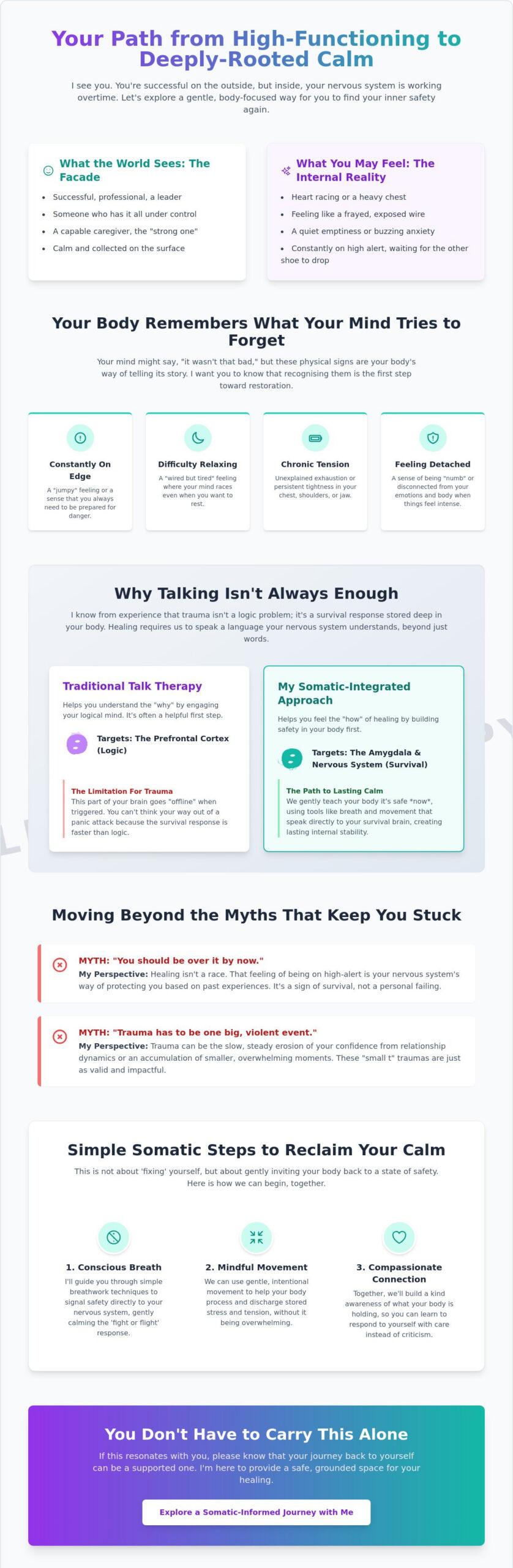
- Understand how trauma lives as an internal imprint in your body, explaining why you might feel overwhelmed despite being high-functioning in your career.
- Discover why moving beyond logic and talk therapy is necessary to reach the parts of your brain where stress responses are stored.
- Challenge the myths that suggest you should be over it by now or that your experience must be a single, violent event to be valid.
- Learn simple somatic techniques, such as breathwork and movement, to help you discharge stress and signal safety to your nervous system.
- Find out how specialized trauma therapy for women singapore can guide you through a gentle, somatic-informed journey to reclaim your internal stability.
Understanding the Weight You Carry: What Trauma Really Feels Like
If you’ve been searching for trauma therapy for women in Singapore, you might already realise that your external success doesn’t always match your internal peace. I often meet women who lead incredible, busy lives. They are leaders, caregivers, and professionals who seem to have everything under control. Yet, behind that high-functioning facade, there is often a quiet sense of emptiness or a buzzing anxiety that simply won’t switch off. I want you to know that trauma isn’t just about a single, catastrophic event. It’s an internal imprint that changes how you perceive safety within your own skin.
When we look at what is psychological trauma, we see it is less about the specific thing that happened and more about the disruption it causes to your natural self-trust. I see trauma as a break in the connection between your mind and your body. It is as if your internal compass has been recalibrated to scan for danger, even when you’re in a perfectly safe room. This persistent state of high alert is exhausting, and it’s a valid response to experiences that overwhelmed your ability to cope at the time.
The Subtle Imprint of Relational Trauma
Relational trauma isn’t always loud or obvious. It can be the slow, steady erosion of your confidence through relationship trauma and narcissistic abuse. These “small t” traumas accumulate over years, leaving you feeling like you’re constantly walking on eggshells even when you’re alone. You might find yourself rehearsing conversations in your head or doubting your own reality. It’s a heavy weight that erodes your sense of self, making it difficult to trust your intuition or feel secure in your connections with others.
Signs Your Body is Holding Onto the Past
Your mind might try to rationalise your past, telling you it wasn’t “that bad,” but your body has a different story to tell. I often notice physical markers in the women I work with, such as a perpetually tight jaw, shallow breathing, or a “wired but tired” feeling that sleep doesn’t fix. This is particularly common for women navigating life transitions, where hormonal shifts can make an already stressed nervous system feel even more fragile. Your mind might choose to forget, but your nervous system remembers every moment you didn’t feel safe. Recognising these signs is the first step toward restoration.
- A constant feeling of being on edge or “jumpy.”
- Difficulty relaxing, even during your downtime.
- Unexplained physical exhaustion or chronic tension in the chest and shoulders.
- Feeling detached or “numb” when things get emotionally intense.
Why Traditional Talk Therapy Isn’t Always Enough for Women
Many women tell me they’ve spent years in talk therapy. It is often helpful to understand the “why” behind our feelings, but you might find that the “how do I stop feeling this way” remains elusive. This happens because trauma isn’t a logic problem. It’s a survival problem. When you look for trauma therapy for women singapore, you need an approach that acknowledges how your brain actually processes stress.
Trauma is stored in the primitive parts of the brain, like the amygdala, where language and logic cannot easily reach. This is why you can “know” you are safe in your head, while your body is still reacting as if you are in danger. I combine traditional talk with somatic awareness because healing requires us to speak to the parts of you that don’t use words.
We work together to ensure you feel safe in your body before we ever attempt to process difficult memories. This gentle, paced approach prevents you from feeling overwhelmed and helps you build a foundation of internal stability. Without that physical sense of safety, talking can sometimes feel like you are just revisiting the pain without actually resolving it.
The Limitations of Logic in Healing
You cannot think your way out of a panic attack because your prefrontal cortex, the part of your brain responsible for reasoning, essentially goes offline during a trigger. While your amygdala is screaming “danger,” your logical brain is unable to override that signal. I use integrative therapy to bridge this gap, helping you learn to signal safety directly to your nervous system through the body.
Clinical vs. Integrative Approaches
The traditional clinical model is often diagnosis-led, focusing on what is “wrong” with you. I prefer an experience-led model that focuses on what has happened to you and how you are carrying it today. In the fast-paced, high-pressure environment of Singapore, you don’t need to be treated like a patient in a cold medical setting. You need a warm, boundaried space that respects your intelligence and your lived experience as a woman.
My goal is to provide trauma therapy for women singapore that feels human and supportive rather than clinical. It’s about restoring your self-trust and helping you feel grounded in your daily life. If you feel ready to begin this work, you can book a session with me to see if we are a good fit for your journey.
Moving Beyond the Label: Common Myths About Healing
I often hear women say, “I should be over this by now.” This phrase is usually followed by a deep sigh of frustration. In our culture of efficiency, we expect healing to follow a linear timeline, but your nervous system doesn’t work on a corporate schedule. Healing isn’t about hitting a deadline; it’s about gradually expanding your capacity to feel safe in the present moment.
Another common myth is that trauma must be a single, violent event to be “real.” Many women I work with in trauma therapy for women singapore feel they haven’t suffered enough to deserve professional support. They compare their stories to others and decide their pain isn’t valid. But trauma is defined by your internal response, not the external event. If it left you feeling helpless or disconnected, it is significant.
I also want to be clear about forgiveness. In my practice, I don’t push for immediate forgiveness of those who hurt you. Sometimes, the most healing thing you can do is acknowledge the anger and set firm boundaries. Your restoration is the priority, not pardoning someone else’s behaviour. We focus on your peace and your ability to move forward with self-assurance.
When Trauma and ADHD Intersect
Navigating ADHD in women adds another layer to this journey. If you are neurodivergent, your brain already processes sensory and emotional input with high intensity. This can make emotional regulation feel like an uphill battle, as the “overwhelm cycle” of ADHD often mimics or amplifies trauma responses. I help neurodivergent women find their calm by acknowledging how their unique brain wiring interacts with their past experiences, ensuring therapy feels accessible rather than another source of overwhelm.
The “Not Bad Enough” Trap
Your nervous system doesn’t compare stories; it only feels the threat. Whether it was a series of subtle dismissals in childhood or a difficult breakup, your body responds to the lack of safety. I encourage you to trust your own discomfort as a valid reason for seeking trauma therapy for women singapore. You don’t need a “big enough” story to justify wanting to feel better. If your life feels heavy, that is reason enough to seek a safe space for restoration.
By letting go of these labels and comparisons, we create room for genuine healing. We stop asking “is this bad enough?” and start asking “how can I feel safe again?”. This shift is where true internal restoration begins, allowing you to rebuild a relationship with yourself based on kindness rather than judgment.
Reconnecting with Your Body: Somatic Steps to Calm Your Nervous System
I believe that for healing to be sustainable, it has to happen in the body as much as the mind. If you are looking for trauma therapy for women singapore, you likely already know that your mind can’t always talk your body out of its stress. I use somatic movement as a way to “discharge” the stress that has been stored in your tissues for years. It isn’t about exercise; it’s about shifting the energy of the past that remains trapped in your muscles and fascia.
Your breath is your most immediate tool for signalling safety to your brain. When we are stuck in a trauma response, our breathing becomes shallow and tight, keeping us in a loop of anxiety. By gently changing the rhythm of your breath, you tell your nervous system that the emergency is over. I often weave somatic movement and yoga into our work together to help you find this internal rhythm again without it feeling like a chore.
Rest is often the hardest part of the process for high-functioning women. In a city like Singapore, we are conditioned to keep moving and producing, yet rest is a radical and necessary part of your restoration. It allows your nervous system to integrate the work we do and move out of a state of constant survival. True rest is not a reward for being “good”; it’s the foundation upon which your new sense of safety is built.
The Power of Somatic Awareness
We often try to “fix” our thoughts first, but I prefer a “bottom-up” approach where we listen to the body to calm the mind. If you feel triggered in the moment, try a simple grounding exercise: press your feet firmly into the floor and notice the texture of the ground beneath you. This brings you back to the “here and now” when your mind wants to pull you into the “then and there.” Somatic work is essentially a gentle, non-judgmental conversation with your body.
Creating a Sanctuary Within
Living in a busy urban environment means we have to be intentional about creating “pockets of peace” throughout the day. Movement can be especially powerful for releasing the “freeze” response often found in survivors of abuse, where the body feels stuck, heavy, or numb. I encourage you to view your physical sensations with self-compassion rather than fear. Your body isn’t trying to betray you; it’s trying to tell you a story that needs to be heard in a safe space.
If you’re ready to explore how this mind-body approach can support your healing and help you feel grounded again, you can book an individual psychotherapy session with me today.
How I Can Support Your Journey Back to Yourself
I don’t see myself as someone who “fixes” you. You aren’t a broken machine; you’re a human being who has survived a great deal and adapted in the best way you knew how. My role is to be your compassionate guide, walking alongside you as you navigate the complexities of your internal world. I believe that you already possess the wisdom needed for your own restoration; my job is simply to help you clear the path so you can hear it again.
I offer a space that is both safe and strictly confidential, whether we meet in person here in Singapore or through online therapy. In my practice, your stories are held with the utmost respect and professional care. I understand that for many women in this fast paced city, finding a moment of true privacy and stillness is a challenge. My practice is designed to be that sanctuary where the pressure to perform or “have it all together” finally stops at the door.
For those who feel they need to dive deeper into their healing process without the wait between weekly sessions, I provide focused intensive therapy options. These sessions are designed to create significant shifts in a shorter period, allowing for a more immersive somatic experience. It is a way to dedicate concentrated time to your nervous system, moving through blocks that might otherwise take months to address in a traditional format.
You don’t have to carry the weight of your past alone anymore. Finding the right trauma therapy for women in Singapore is about finding a practitioner who truly hears what your body and mind are trying to say. I am here to hold that space for you, ensuring that our work together happens at a speed that feels manageable, steady, and entirely within your control.
Your First Step Toward Restoration
In our first session, we won’t rush into the most painful parts of your history. Instead, we’ll focus on building a sense of safety and collaboration. I want to understand what you need right now and how we can work together to restore your self-trust. We will look at your current challenges and discuss how an integrative approach can help you manage emotional intensity in your daily life.
This initial meeting is also a chance for you to see how it feels to be in a therapeutic space with me. A realistic next step would be booking a consultation to see if our connection feels right for your journey. There is no pressure to commit to a long term plan immediately; we take everything one gentle step at a time.
A Message of Hope
I want to leave you with the reminder that internal stability and joy are entirely possible for you. Your past experiences have shaped you, but they do not have the power to define your future. You have the inherent strength to reclaim your sense of self and build a life where you feel grounded and at peace. The hyper-vigilance and exhaustion you feel now are not your permanent identity.
Healing is a quiet, steady process of coming home to yourself. I invite you to begin this journey whenever you feel ready, at a pace that feels kind. I am here to support you in rebuilding a life that feels safe, authentic, and full of possibility. You have already taken a brave step by being here and seeking understanding, and that is a beautiful place to start.
Taking the Next Step Toward Internal Peace
Healing from the past is a quiet, steady process of coming home to yourself. We’ve explored how trauma lives as an internal imprint in your nervous system and why traditional talk therapy often needs to be supported by somatic awareness. Reclaiming your self-trust isn’t about fixing something that’s broken; it’s about restoring the natural sense of safety that you deserve to feel every single day.
As a Registered Integrative Psychotherapist and Trauma-Informed Yoga Master, I’ve seen how powerful it is when women finally feel heard in both mind and body. My approach to trauma therapy for women singapore is designed to be a gentle, unhurried partnership where your comfort is always the priority. You don’t have to navigate the weight of hyper-vigilance or emotional exhaustion on your own.
I specialise in relationship trauma and narcissistic abuse, and I understand how these experiences can erode your sense of reality. You are worthy of a space where you can finally exhale and begin to rebuild. I invite you to book a gentle consultation to begin your journey back to yourself. I am here to hold that space for you whenever you feel ready to take that first step.
Frequently Asked Questions
What exactly is trauma therapy for women?
It is a specialised form of support that focuses on the unique ways women experience and process overwhelming life events. I use an integrative approach that looks at both the mind and the body to help you feel safe again. This isn’t just about managing symptoms; it’s about restoring your sense of self and your ability to trust your own intuition in your daily life.
How do I know if my experience counts as “trauma”?
If an experience left you feeling helpless, disconnected, or overwhelmed, it counts as trauma. Your nervous system doesn’t care if others think the event was “big” or “small”; it only cares about whether you felt safe at the time. If you find yourself struggling with hyper-vigilance or emotional exhaustion, your body is likely telling you that it’s still carrying the weight of the past.
Can therapy really help me if I’ve been in a relationship with a narcissist?
Yes, therapy is a vital tool for recovering your sense of reality after the gaslighting and manipulation of a narcissistic relationship. I specialise in relationship trauma to help you deconstruct the patterns of abuse and rebuild your boundaries. We work on restoring your self-trust so you can move forward without the constant fear of being misled or controlled by others in the future.
How is your approach different from a regular psychologist in Singapore?
My approach to trauma therapy for women singapore differs because I combine evidence-based psychotherapy with somatic practices like breathwork and movement. Many clinical models focus primarily on diagnosis and cognitive patterns, but I believe healing must involve the body. I provide a warm, boundaried space that feels human rather than clinical, ensuring you feel seen as an individual rather than a patient.
Do I have to talk about my past in every session?
No, we don’t have to revisit every painful detail of your past to find healing in the present. While understanding your history is helpful, our sessions often focus on how you are feeling right now and how to calm your nervous system. We move at your pace, and if a topic feels too intense, we use somatic tools to ground you before we continue our conversation.
How long does it typically take to start feeling “better”?
Healing is a personal journey, so there isn’t a fixed or guaranteed timeline for feeling “better.” Some women notice a shift in their internal stability after just a few sessions, while deeper restoration often takes more time. We focus on manageable, steady progress rather than a quick fix, ensuring that the changes you experience are sustainable and truly integrated into your daily life and relationships.
Do you offer online trauma therapy if I cannot come to the Singapore clinic?
I offer online trauma therapy for women who prefer the comfort of their own home or cannot easily travel to my clinic. These virtual sessions are just as confidential and supportive as in-person meetings. I’ve found that being in your own familiar environment can sometimes make it easier to engage with somatic work and deep emotional processing while feeling completely safe and secure.
Is trauma therapy confidential?
Yes, your privacy is a cornerstone of my practice, and everything we discuss remains strictly confidential. I provide a safe, professional space where you can speak openly without fear of judgment or your information being shared. This boundary is essential for building the trust needed to explore difficult emotions and begin the work of internal restoration in a way that feels protected and respectful.

Article by
Cheryl Kennedy MacDonald MA BA (Hons) Pg. Dip. SAC BACP
Cheryl Kennedy MacDonald is a psychotherapist specialising in women’s mental health, relationships, and life transitions. She works with women navigating trauma, relationship breakdown, identity shifts, and midlife change, helping them rebuild self-trust, emotional stability, and a clear sense of who they are and what they want.
With over 20 years’ experience working with women internationally, Cheryl is the founder of YogaBellies, a global women’s yoga school, and the creator of the Birth ROCKS method. Her work sits at the intersection of psychotherapy and embodiment, integrating evidence-based therapeutic approaches with somatic, body-based practices that support deep, lasting change.
Known for her grounded and direct approach, Cheryl moves beyond surface-level insight to address the patterns held in the body and nervous system. Her work supports women to regulate, reconnect, and respond to their lives from a place of clarity, strength, and self-respect.
She is a published author in academic journals and has written multiple books on women’s health, pregnancy, and midlife wellbeing, available on Amazon and leading book retailers worldwide.