
What if your “lack of focus” isn’t a personal failing, but a nervous system trying to survive a world that wasn’t built for you? You likely spend your day mastering the “Singapore juggle,” keeping your career and family on track, only to face an emotional meltdown the moment the front door shuts. I know this because I live it too.
I agree that it’s exhausting to feel like a fraud in the office or to watch your symptoms spiral during monthly hormonal shifts. You deserve to feel validated in your experience as a woman and to finally trust your own intuition again.
I’ll show you how a compassionate, somatic-integrated approach can help you find internal stability that doesn’t feel like more “work.” We’ll explore how your body holds onto this stress and how we can work together to build a nervous system that feels regulated, calm, and safe.
Key Takeaways
- Understand why the exhausting effort to “mask” your symptoms in Singapore leads to burnout and how I help you embrace your authentic self.
- Learn how your ADHD symptoms are intimately tied to hormonal transitions like your menstrual cycle or menopause.
- Explore how adhd therapy for adults singapore uses somatic, mind-body techniques to help you find a sense of internal safety and calm.
- Discover how to create life systems that actually breathe, allowing you to manage your mental load without the constant cycle of overwhelm.
Understanding the Exhaustion of Masking Your ADHD in Singapore
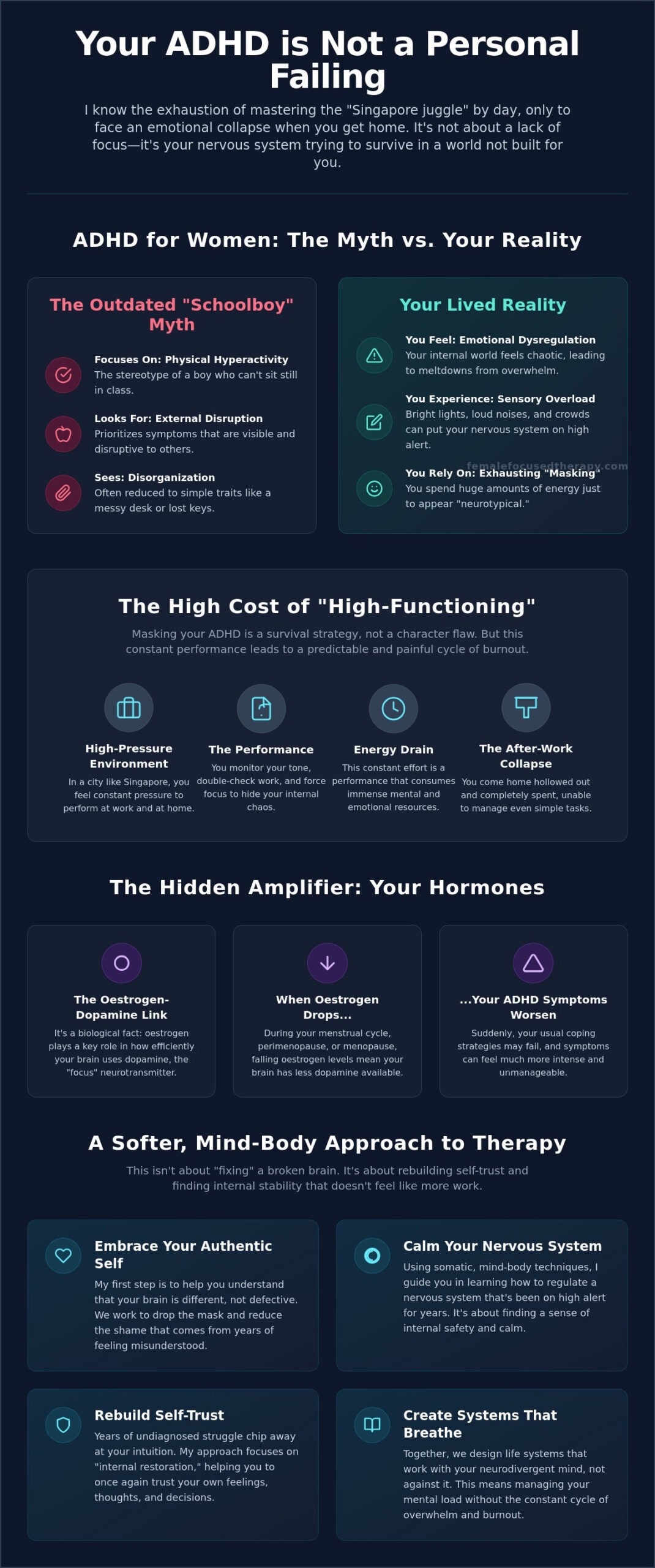
I often see women in my practice who are absolute masters at looking like they have it all together. In a high-pressure city like Singapore, where the “juggle” of career, family, and social standing feels like a competitive sport, many of us develop a sophisticated survival strategy called masking. Masking is the exhausting effort to appear “neurotypical” to avoid judgment or professional fallout.
It is not just about being polite; it’s about hiding the internal chaos. You might be the woman who never misses a deadline and always looks polished, yet you are secretly drowning. When we talk about adhd therapy for adults singapore, we have to start by acknowledging how much energy it takes just to exist in this “high-functioning” space.
Research into Adult attention deficit hyperactivity disorder shows that for women, symptoms often present internally rather than through physical hyperactivity. This internal struggle is why so many of us feel like frauds. We meet our KPIs and manage the household, but the internal cost is astronomical. It feels like you are running a marathon while everyone else is just going for a stroll.
The Invisible Cost of Being ‘High-Functioning’
Have you ever finished a productive day at the office only to come home and feel like you’ve completely run out of “people” energy? This is the “after-work collapse.” You have spent eight hours monitoring your tone, double-checking emails for typos, and forcing yourself to sit still in long meetings. It is a performance that leaves you hollowed out by 7 PM.
You might feel like a failure because you can’t manage a simple task like putting away the laundry after a “successful” day. I want you to know that masking is a survival strategy that leads to burnout. It isn’t a sign that you aren’t trying hard enough; it’s a sign that you have been trying too hard for too long.
Why You Feel Overwhelmed, Not Just ‘Disorganised’
Traditional views of ADHD focus on messy desks and lost keys. But for us, it’s often about emotional dysregulation. It is the “meltdown” that happens when the MRT is too loud, the office lights are too bright, and your to-do list feels like a mountain. This sensory overload is a key part of the female ADHD experience.
Living in a sensory-rich environment like Singapore can leave your nervous system in a constant state of high alert. The humidity, the crowds, and the constant hum of the city aren’t just minor annoyances. For a neurodivergent brain, they are genuine stressors that contribute to profound fatigue. I invite you to take a deep breath right now and acknowledge that your struggle isn’t a character flaw; it’s a physiological response.
Why ADHD Therapy for Women Needs a Softer, Gender-Centred Approach
I often wonder how many women spent their school years being called “daydreamers” or “chatterboxes” rather than receiving the support they needed. For decades, the medical world focused on the “schoolboy” model of ADHD. This model looked for physical hyperactivity and disruption. Because many of us presented with inattentive symptoms or worked twice as hard to stay quiet, we were simply missed.
Receiving a diagnosis in adulthood can feel like a relief, but it also brings up a lot of grief for the years spent wondering why everything felt so hard. This is why ADHD in Girls and Women requires a different lens. In my practice, I focus on “internal restoration.” This isn’t about fixing a broken brain. It’s about rebuilding the self-trust that years of undiagnosed struggle have chipped away.
I believe that effective adhd therapy for adults singapore must be led by someone who understands the unique societal and biological pressures women face here. As a woman with ADHD myself, I know that your experience isn’t just a list of symptoms. It’s a lived reality that involves navigating high-stakes environments while managing an internal world that often feels like it’s spinning.
Hormones and Your Neurodivergent Mind
It’s a biological fact that oestrogen and dopamine are closely linked. When your oestrogen levels drop during your menstrual cycle, pregnancy, or perimenopause, your brain’s ability to use dopamine decreases. This often makes your ADHD symptoms feel much worse. It’s why “standard” productivity advice feels like a slap in the face when your hormones are shifting.
I specialise in the intersection of midlife and menopause for women with ADHD. During these transitions, the strategies that used to work might suddenly fail. We need to work with your body, not against it, to find a rhythm that respects these natural shifts.
Moving Beyond Generic Diagnostic Checklists
Generic checklists often fail to capture the nuances of the female experience. While a boy might run around the room, you might experience deep, internalised restlessness. You might find yourself over-talking in meetings because you’re excited, or feeling a level of empathy that is almost physically painful. These are valid ADHD traits.
My goal is to provide a warm but boundaried space where you can explore these parts of yourself. We don’t need to fit you into a clinical box. Instead, we can look at how your neurodivergence makes you who you are. If you feel ready to explore this deeper, you can always book a chat with me to see how we can work together.
Integrating the Mind and Body in Your ADHD Journey
I have found that for many women, traditional talk therapy only goes so far. You might spend an hour discussing your week, but your leg is still bouncing and your heart is still racing. This is because ADHD isn’t just a “head” issue; it’s a whole-body experience. When we look at adhd therapy for adults singapore, we need to move beyond the idea that we can simply “think” our way out of overwhelm.
My approach is integrative because I believe that healing happens when we stop trying to “fix” our brains and start befriending our nervous systems. Your body has been holding onto the stress of masking and the pressure to perform for a very long time. We need to give it a way to release that tension so your mind can finally find some space to breathe.
While we focus on somatic integration, some individuals also find it helpful to explore specialized brain-based therapies; for example, you can check out Neurobics to learn how neurofeedback can help in improving brain functions and overall regulation.
I weave somatic themes like breath and movement into our sessions to help you ground yourself. This isn’t about achieving a “perfect” state of zen. It is about learning to listen to the subtle signals your body is sending you before you reach the point of a total meltdown.
Why Traditional CBT Isn’t Always the Whole Answer
Many women I work with have tried Cognitive Behavioural Therapy (CBT) and found it helpful for a while, but eventually, the “top-down” strategies start to feel like more homework. If your brain is already overstimulated, being told to track every thought can feel like one more task on an already impossible to-do list. It can actually add to your mental load rather than lightening it.
This is why we often need “bottom-up” somatic support first. We cannot always use our logic to talk ourselves out of a nervous system response. By addressing the physical sensations of stress, such as a tight chest or constant restlessness, we create a foundation of safety. Healing happens when we address both the story in your mind and the tension held in your muscles. For those seeking specialized musculoskeletal support, physical therapy flint mi offers an example of how advanced care can help release the physical stress held in the body.
Breath, Movement, and Regulating Your Nervous System
In our sessions, I often introduce simple somatic concepts like somatic movement and rest. These aren’t just “exercises”; they are gentle ways to communicate with your body. They help you shift from a state of high-alert into a state where your brain can actually process information without feeling attacked.
Gentle movement can be incredibly powerful for “quieting” the internalised restlessness that often defines the female ADHD experience. It allows you to process emotions that don’t have words yet. I always tell my clients: “Regulation is not about being still; it is about feeling safe in your own skin.” When you feel safe, you can finally stop running.
Creating Systems That Actually Breathe in a Fast-Paced City
I believe we need to stop trying to fit ourselves into systems that were never designed for neurodivergent minds. In Singapore, the cultural expectation of efficiency is incredibly high. We are taught that if we aren’t being productive, we are failing. But for you, “trying harder” often just leads to more shame and deeper burnout.
Instead, I encourage you to start trying differently. This means building systems that actually breathe. A system that “breathes” is one that has space for your “off” days. It is a framework that allows for flexibility rather than demanding rigid adherence to a schedule that feels like a cage.
Finding the right adhd therapy for adults singapore involves looking at how you protect your limited executive energy. In a city that never stops, stillness is a radical act. But true downtime isn’t just scrolling on your phone; that often leaves your brain more fractured than when you started.
Managing the Mental Load at Home and Work
Women in Singapore often carry a massive mental load. It is the invisible work of managing the household, coordinating with helpers, and keeping track of family schedules on top of a demanding career. These “invisible tasks” drain your executive function before you’ve even started your actual work day.
One strategy I use is “unbundling.” We take a project that feels like a mountain and break it down into tiny, manageable breaths. It’s about making the next step so small that your nervous system doesn’t see it as a threat. You can read more about the women who I work with and how they navigate these specific life transitions.
Finding Stillness in a City That Never Stops
I want you to look for “energy leaks” this week. Are there boundaries you can set to protect your peace? Maybe it’s turning off notifications after 7 PM or saying no to one social commitment. Protecting your energy isn’t selfish; it is necessary for your internal stability.
If you are tired of the constant cycle of guilt and overwhelm, I am here to help you find a different way forward. You don’t have to navigate this high-pressure environment alone. If you’re ready to build a life that feels more sustainable, please reach out for a session so we can begin this journey together.
Finding Your Way Forward with Female Focused Therapy
I know that choosing to start therapy is a big step. In a city like Singapore, where we are often taught to just “get on with it,” admitting that you need support can feel vulnerable. But I want you to know that seeking adhd therapy for adults singapore isn’t about fixing something that is broken. It is about finally giving yourself the understanding and grace you have been extending to everyone else for years.
Our work together is a partnership. Whether we meet in person or through ADHD-focused therapy online, you are the expert on your own life. I am here as a guide to help you make sense of your experiences through a gender-centred lens. We will acknowledge how your unique history, societal pressures, and biological shifts impact your daily reality.
What it’s Like to Work with Me
My philosophy is simple: I am a therapist who also “gets it” from the inside. I live with ADHD too. I understand the racing thoughts, the sensory overload, and the deep desire to just feel calm for a moment. When you choose adhd therapy for adults singapore with me, you are choosing a space that values your humanity over your productivity.
We move at a pace that feels safe and manageable for you. I make sure our sessions never feel like another “task” on your to-do list. We focus on restoration, not just strategies. We look at how to build a life that feels authentic to who you are, rather than who you think you “should” be.
For those who feel they are at a breaking point or simply want to make progress more quickly, I also offer focused intensive therapy. These sessions allow us to dive deeper into the patterns that are holding you back. They provide a concentrated, supportive space for healing and restoration without the wait.
Your First Step Toward Internal Restoration
I want to remove the pressure of “signing up” for something long-term right away. Instead, think of this as simply “reaching out.” You don’t need to have all the answers or even a clear goal yet. You just need to feel ready for something to change.
We can have a gentle conversation to see if we are a good fit. You can share what has been feeling heavy, and I can explain how my integrative approach might help you find that internal calm you’ve been searching for. It’s a low-pressure way to see if this path feels right for you.
You can easily start by booking a consultation through my online portal. It is a simple, private process designed to be as easy as possible for a neurodivergent brain. You have been carrying a lot; let’s see if we can lighten the load together.
Reclaiming Your Internal Calm and Self-Trust
I know how lonely it feels to be high-functioning but secretly drowning. We’ve explored how masking leads to that deep exhaustion and why your hormones play such a significant role in your symptoms. My work focuses on moving beyond productivity and helping you find a sense of internal restoration that lasts.
As a registered integrative psychotherapist and specialist in female neurodivergence with lived experience of adult ADHD, I want you to know that your neurodivergence isn’t a problem to be solved. It’s a part of who you are that deserves kindness and a nervous system that feels safe. Through adhd therapy for adults singapore, we can work together to build a life that actually breathes.
You don’t have to keep trying harder on your own. If you’re ready to explore a softer, more compassionate approach to your mental health, I’m here to hold that space for you. We can move at a pace that feels right for your mind and your body.
Book a gentle consultation with me today
You’ve been carrying so much for so long. It’s time to start trusting yourself again and finding the quiet you deserve.
Image Alt Text: A woman in her 30s breathes deeply in a grounded, sunlit space, feeling calm.
Frequently Asked Questions
How is ADHD therapy for women different from general ADHD coaching?
Coaching often focuses on the “how” of productivity, but therapy with me looks at the “why” of your emotional world. I help you heal the shame of being undiagnosed and find a sense of peace that coaching alone can’t reach. It’s about restoring your self-trust rather than just filling out another planner.
Do I need a formal diagnosis to start ADHD therapy in Singapore?
You don’t need a formal report or a piece of paper to start our work. I support you based on the lived reality of your experience and the challenges you face today. We focus on how your mind and body feel right now, rather than waiting for a clinical label to validate your struggle.
Can therapy help with the emotional ‘meltdowns’ I experience after work?
These meltdowns are often a sign that your nervous system is completely hollowed out from a day of masking. I help you identify your sensory triggers and “energy leaks” so you don’t hit that wall every evening. We find ways to regulate your body throughout the day so you have something left for yourself.
How does your integrative approach combine psychotherapy with somatic movement?
We don’t just sit and talk; we listen to what your body is telling us through tension or restlessness. I weave in gentle breathwork and movement to help you release the physical stress of ADHD. This “bottom-up” support helps your brain feel safe enough to process emotions without feeling attacked.
What if I feel like I’m ‘too successful’ to have ADHD?
Many of the women I see are incredibly high-achieving, but they are drowning internally. Being “successful” often means you’ve become an expert at hiding your struggles, which is exhausting. I help you bridge that gap so your life feels as good on the inside as it looks on the outside.
How many therapy sessions will I need to feel more regulated?
Every woman is different, but I usually recommend an initial commitment of 6 to 10 sessions to establish a foundation. This allows us enough time to understand your unique nervous system and integrate tools that actually stick. We move at a pace that feels safe and manageable for you.
Do you offer online ADHD therapy for women outside of Singapore?
I work with women globally through my online practice, providing the same warm, integrative support from wherever you are. This is a wonderful option for busy women who need therapy that fits into their lives without the extra stress of travel. You get the same personal connection and somatic focus.
Can you help me manage ADHD symptoms during menopause or midlife transitions?
Hormonal shifts are a massive part of the neurodivergent experience, and I specialise in supporting women through midlife. When oestrogen drops, your brain’s ability to use dopamine changes, often making symptoms feel much more intense. We work with your body’s natural cycles to find a rhythm that supports you.

Article by
Cheryl Kennedy MacDonald MA BA (Hons) Pg. Dip. SAC BACP
Cheryl Kennedy MacDonald is a psychotherapist specialising in women’s mental health, relationships, and life transitions. She works with women navigating trauma, relationship breakdown, identity shifts, and midlife change, helping them rebuild self-trust, emotional stability, and a clear sense of who they are and what they want.
With over 20 years’ experience working with women internationally, Cheryl is the founder of YogaBellies, a global women’s yoga school, and the creator of the Birth ROCKS method. Her work sits at the intersection of psychotherapy and embodiment, integrating evidence-based therapeutic approaches with somatic, body-based practices that support deep, lasting change.
Known for her grounded and direct approach, Cheryl moves beyond surface-level insight to address the patterns held in the body and nervous system. Her work supports women to regulate, reconnect, and respond to their lives from a place of clarity, strength, and self-respect.
She is a published author in academic journals and has written multiple books on women’s health, pregnancy, and midlife wellbeing, available on Amazon and leading book retailers worldwide.