
You sit down for your session and start “performing,” sharing a polished version of your week to be a “good client.” It’s a common trap many of my clients fall into, but finding your voice starts with letting go of that mask. You deserve a space where you don’t have to say the “right” thing to be heard.
Key Takeaways
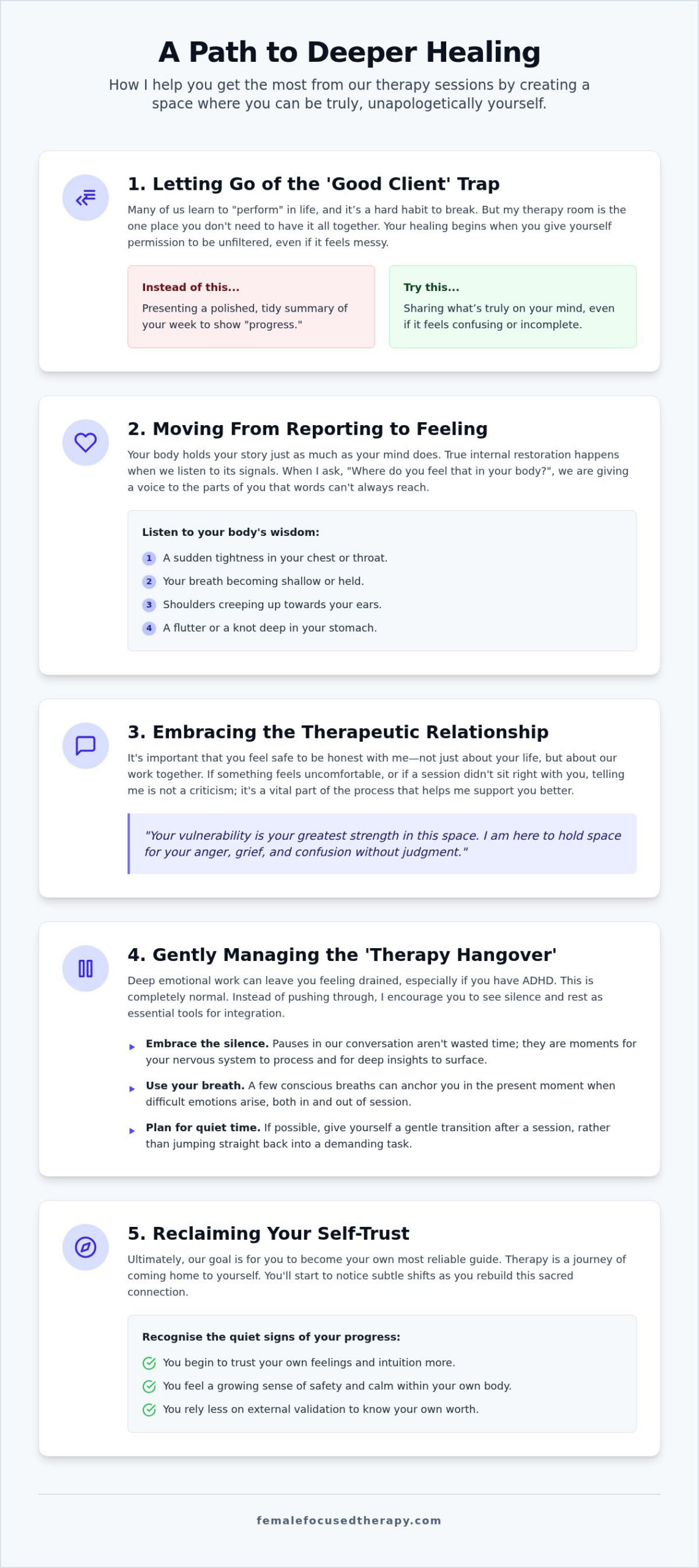
- Understand why letting go of the need to “perform” or be a perfect client is the first step toward true internal restoration.
- Learn how to listen to your body’s signals, like a tight chest or shallow breath, to move beyond simply reporting your week.
- Discover how to get the most out of psychotherapy by being honest about the therapeutic process, even when it feels uncomfortable.
- Find gentle ways to manage the “therapy hangover” and emotional overwhelm that often follow deep sessions, particularly for women with ADHD.
- Recognise the subtle signs that you are rebuilding self-trust and becoming your own most reliable guide.
The ‘Good Student’ Trap: Why You Don’t Have to Perform for Your Therapist
Performance in therapy is the unconscious need to please the therapist. It’s that quiet, nagging voice that tells you to be a “good client” by having a breakthrough every week or presenting a tidy summary of your progress. I often see women bringing their professional perfectionism into our sessions. While that drive serves you well in your career, it can actually stall your healing because it keeps you stuck in your head rather than your heart.
Being unfiltered is the most productive thing you can do for your progress. I want you to know that your session is the one place where you don’t have to have the answers. Learning how to get the most out of psychotherapy involves shedding the weight of expectation. You are here to explore, not to pass a test. It’s about creating a space where the “put-together” version of you can finally take a rest.
Letting go of the ‘correct’ way to heal
I encourage you to show up exactly as you are, even if that means feeling messy or incoherent. There is a profound difference between “reporting” your week like a status update and actually “living” your emotions in the room with me. When you stop trying to be the perfect client, we can finally look at what’s happening beneath the surface. This shift is essential for deep, internal restoration.
My role is to hold space for your anger, grief, and confusion without judgement. I work with women from many different backgrounds, and I’ve found that who I work with often feels the most relief when they realise they don’t have to stay composed. To truly grasp what is psychotherapy, we must view it as a collaborative journey where your vulnerability is your greatest strength rather than a weakness to be managed.
Embracing the silence in our sessions
You might feel the urge to fill every gap with small talk, but silence isn’t “wasted time.” It’s actually a vital moment for your nervous system to settle and process what we’ve just uncovered. In my practice, I use these pauses to help us listen to what your intuition is trying to say. It’s often in the quiet moments that the most significant realisations bubble up to the surface.
When you feel that familiar itch to fill the silence, try to notice it without acting on it. Instead of searching for something to say, take a breath and notice how your body feels in the chair. These pauses allow us to move away from the noise of the world and back into your own internal rhythm. It’s a key part of how to get the most out of psychotherapy because it trains you to trust the stillness within yourself.
Moving from Reporting to Feeling: The Power of Somatic Awareness
I believe that healing happens in both the body and the mind. This is especially true when you are navigating the aftermath of relationship trauma. While talking is a vital part of the process, true internal restoration requires us to look at how your physical self is holding onto your story. We can’t always think our way out of a deep nervous system response.
How to get the most out of psychotherapy often involves moving beyond the narrative and into the felt experience. You might notice your shoulders creeping up to your ears or a sudden flutter in your stomach as we speak. These aren’t just physical reactions. They are your body’s way of communicating what your words might not yet be able to capture.
I integrate mindfulness to help you ground yourself when the conversation feels heavy or overwhelming. It’s about rebuilding your sense of safety from the inside out. Part of Getting the most out of therapy is learning that your body is a resource, not an obstacle to be overcome. If you’re feeling ready to begin this journey, you can book a session with me to explore this integrated approach.
Noticing your body’s signals in the chair
I might ask you, “Where do you feel that in your body right now?” to help us bypass the logical mind. This question often reveals more than a twenty minute explanation of your week. It helps us connect physical sensations to the emotional impact of narcissistic abuse, where the body often stays on high alert long after the situation has ended.
Somatic awareness is a key part of my integrative approach. It allows us to process trauma where it lives. By acknowledging the tight jaw or the heavy chest, we give those parts of you a voice. This is a powerful way to reclaim your self-trust and stop feeling like a passenger in your own skin.
Using breath as a bridge to your emotions
I use simple, non-clinical breathwork in our psychotherapy sessions. It isn’t about deep meditation or complicated exercises. Instead, it’s about using a few conscious breaths to stay present when discussing difficult life transitions. It keeps you anchored in the room with me so you don’t drift away into a spiral of “what ifs.”
I view these somatic moments as essential rest for your busy, over-functioning brain. When you learn how to get the most out of psychotherapy, you realise that slowing down the breath can actually speed up the healing. It creates the space needed for your thoughts and feelings to finally align, making the work feel manageable rather than exhausting.
Navigating the Relationship: Why Honesty About the Process Matters
I view our therapeutic relationship as a ‘safe rehearsal’ for your life outside our sessions. It is a unique, protected space where you can experiment with being seen and heard without the usual social risks. If you’ve spent years accommodating others or walking on eggshells, being truly honest about how you feel in the room with me is how to get the most out of psychotherapy. This isn’t just about the stories you tell; it’s about the connection we build together in real time.
I genuinely welcome your feedback, even if you feel I’ve misunderstood you or if a session felt ‘off’ for some reason. In the outside world, expressing dissatisfaction can feel dangerous, but here, it is a tool for healing. When you tell me that something I said didn’t land right, we are working together to rebuild your self-trust. You are learning that your voice has power and that your perspective is valid, even when it differs from mine. This process is a vital part of your internal restoration.
Talking about the ‘elephant in the room’
If you feel anxious about our dynamic, I encourage you to bring it into our conversation. Perhaps you’re worried about being a ‘bad client’ or you feel a flash of frustration during a session. These feelings are often echoes of relationship trauma where your needs were secondary to someone else’s. By discussing our relationship openly, we can untangle those past patterns. I am here to model a warm but boundaried relationship that honours your needs, showing you that a disagreement doesn’t have to lead to a disconnection.
Rehearsing boundaries in a safe space
Practising saying ‘no’ or ‘I’m not ready to talk about that’ in our sessions is an incredible victory. For many women I work with, reclaiming the right to set a boundary is the foundation of their recovery. It is how you stop being overwhelmed and start feeling emotionally stable again. I see every boundary you set as a step toward reclaiming your power after experiencing narcissistic abuse. It is a way of telling yourself that your comfort matters more than ‘performing’ for the person sitting across from you.
This honesty also helps you determine if we are a ‘good fit’ for your specific needs. For instance, if you require ADHD support, you need to feel that I truly understand your unique brain wiring. You shouldn’t have to mask your neurodivergence here. When you are honest about what is and isn’t working, we can tailor our sessions to support your real life. This makes the process feel like a relief rather than another heavy chore on your to-do list.
ADHD and Overwhelm: Making Therapy Work for You
As a woman with ADHD myself, I know that “standard” therapy advice can sometimes feel like another chore on an already crowded to-do list. When your executive function is already stretched thin, the idea of “doing the work” can feel daunting. Understanding how to get the most out of psychotherapy means adapting the process to fit your unique brain, rather than forcing yourself into a rigid, clinical box.
I focus on making our sessions a place of relief rather than another source of pressure. I offer online therapy specifically to help reduce the “transition stress” of getting to an appointment. Being able to join a session from your own safe space means you don’t have to navigate traffic or worry about being late, allowing your nervous system to stay settled and ready for internal restoration.
I also provide practical tools to help you bridge the gap between our sessions so the insights we uncover don’t get lost in the noise of daily life. We work together to find methods that feel natural to you. If you are ready to explore a neuro-affirming approach to your healing, you can book an ADHD-focused session with me today.
Tools for between-session processing
I suggest simple ways to “track” your feelings without it becoming an overwhelming homework assignment. Many of my clients find that using voice notes or quick bullet points on their phone is a great way to capture thoughts for our next meeting. It takes the pressure off your memory and ensures we can dive straight into what matters most to you. I also help you manage the emotional intensity that often comes with neurodivergence, helping you feel less at the mercy of your moods.
Managing the ‘Therapy Hangover’
It is very common to experience a “therapy hangover,” which is that period of emotional exhaustion that can follow a deep session. Your brain is doing heavy lifting, and it’s natural to feel drained. I recommend scheduling a 15-minute “buffer” immediately after our session. Use this time to rest, sit with a cup of tea, or take a short walk before jumping back into work or family life. Your brain needs this low-stimulation time to integrate the psychological work we’ve done.
I view this rest as a vital part of your healing journey, not a sign of weakness or a lack of productivity. Giving yourself permission to pause is a powerful act of self-trust. It allows the shifts we’ve made in the session to settle into your body and mind properly. When you honour this need for quiet, you’re not just recovering; you’re actively supporting the process of long-term change.
Reclaiming Your Self-Trust: The Path to Internal Restoration
The ultimate goal of our work is for you to become your own most trusted guide. I view my role as a companion on your journey toward internal restoration. This isn’t about “fixing” a broken part of you; it’s about returning you to the person you were always meant to be. Often, relationship trauma or difficult life transitions can strip away your sense of self-reliance, leaving you feeling untethered.
Restoration is a gentle process of rebuilding that internal foundation. Learning how to get the most out of psychotherapy involves looking for growth in the quiet moments between our sessions. It is about noticing when you start to lean into your own wisdom rather than looking for external validation. You are not a project to be completed; you are a woman reclaiming her right to feel safe and certain in her own skin.
I focus on helping you rebuild the self-reliance that may have been compromised by past experiences. This path isn’t always linear, and that’s perfectly okay. We work together to ensure that every step you take is grounded in a deep, compassionate understanding of your own needs and boundaries.
Tracking your progress beyond the symptoms
It is easy to focus only on whether your anxiety has decreased, but the subtle signs of progress are just as important. You might notice when you start to trust your own intuition more than that harsh “inner critic” that used to run the show. I help you celebrate these small, significant shifts in your emotional stability and confidence. These are the building blocks of a life where you feel truly in control.
I am here to witness your journey as you move from a state of constant overwhelm to a place of groundedness. This transition happens as you learn to listen to your body’s signals and honour your emotional truths. When you can sit with a difficult feeling without being swept away by it, you are experiencing the real power of how to get the most out of psychotherapy.
Transitioning to a life of self-reliance
As we work together, I ensure you feel equipped with a comprehensive “toolbox” of somatic and psychological strategies. This includes everything from breathwork that settles your nervous system to cognitive tools that help you navigate complex relationship dynamics. I want you to leave our sessions with practical, real-world skills that you can use whenever life feels challenging. This is the heart of integrative healing.
Knowing when it’s time to reduce the frequency of our sessions is a beautiful part of the process. As your internal strength grows, you’ll find that you need the “safe rehearsal” of therapy less often. I believe that the best therapy eventually makes the therapist redundant. My greatest success is seeing you step into your life with a renewed sense of self-assurance, knowing you are fully capable of being your own guide.
Beginning Your Journey Toward Internal Restoration
Reclaiming your voice in our sessions isn’t about being a “good client” or having all the answers. It’s about showing up as your unpolished, authentic self and allowing the space for true healing to occur. We’ve explored how somatic awareness can bridge the gap between your thoughts and your body’s felt experience, and why neuro-affirming tools are essential for making the process sustainable for the ADHD brain.
As a Registered Integrative Psychotherapist and a specialist in ADHD and narcissistic abuse recovery, I use a trauma-informed mind-body approach to support your growth. Learning how to get the most out of psychotherapy is ultimately an act of self-trust. It’s the moment you decide that your internal peace is worth the honest, sometimes messy work of restoration.
You don’t have to carry the weight of overwhelm alone any longer. If you’re ready to move from simply surviving to feeling grounded and self-reliant, I am here to hold that space for you. You can book a consultation with me to begin your journey of internal restoration today. You deserve to feel safe, seen, and supported as you return to the person you were always meant to be.
Frequently Asked Questions
How long does it typically take to see results from psychotherapy?
It depends on your personal history and the specific challenges you are bringing to our sessions. While some women feel a sense of relief and clarity after just a few meetings, achieving deep internal restoration for long-standing trauma or narcissistic abuse often takes a more sustained commitment. Healing is a journey of returning to yourself, and the benefits often continue to grow for years after our work together has ended.
What should I do if I feel like I have nothing to talk about in a session?
I encourage you to show up anyway, as these “quiet” sessions often lead to the most profound somatic breakthroughs. When you don’t have a specific crisis to report, we can slow down and listen to what your body is holding in the present moment. I will guide you through grounding exercises or breathwork to help you stay present, allowing your intuition to surface without the noise of a busy weekly update.
Is it normal to feel worse after a therapy session before I feel better?
Yes, feeling emotionally drained or even “raw” after a session is a very common experience known as a therapy hangover. When we process difficult memories or untangle complex emotions, your nervous system needs time to settle and integrate that work. It isn’t a sign that you’re failing; it’s a sign that you are doing deep, meaningful work. I always suggest planning for some low-stimulation rest after our time together.
How can I tell if my therapist is the right fit for my ADHD or trauma?
You should feel a sense of safety and ease where you don’t feel the need to “mask” your symptoms or perform for approval. A therapist who is a good fit will understand the unique executive function challenges women with ADHD face and will respect your boundaries without judgement. If you feel you have to hide parts of yourself to be a “good client,” it’s time to discuss how to get the most out of psychotherapy in a way that truly supports you.
Can I really get the same benefits from online therapy as in-person sessions?
Absolutely, and for many women living in busy urban environments like Singapore, online sessions offer a level of convenience that makes healing more sustainable. Eliminating the stress of a commute allows you to stay in a settled state before and after our work. This accessibility ensures you can receive specialist support from your own safe space, making it easier to integrate our mind-body approach into your real life.
What happens if I disagree with something my therapist says?
I genuinely welcome your disagreement, as it is a powerful opportunity to practise setting boundaries in a safe, boundaried relationship. If something I say doesn’t land right or feels like a misunderstanding, bringing it into the room is a victory for your self-trust. It shows you are reclaiming your voice and your right to be heard, which is a vital part of recovering from relationship patterns where your perspective was dismissed.
How do I know when I am ready to end my therapy journey?
You’ll likely notice that you are trusting your own intuition more and relying less on our sessions to feel emotionally stable. When you feel equipped with a reliable “toolbox” of somatic and psychological strategies to handle life’s transitions, we can discuss reducing the frequency of our meetings. The goal of our work is for you to feel self-reliant and confident in your own internal restoration.
What is the difference between ‘reporting’ my week and ‘doing’ therapy?
Reporting is giving a logical summary of events, whereas “doing” therapy is about staying present with the emotional and physical impact of those events. Understanding how to get the most out of psychotherapy means moving from your head into your body. Instead of just talking about a difficult conversation you had, we explore how that conversation is still showing up as tension in your jaw or a weight in your chest.

Article by
Cheryl Kennedy MacDonald MA BA (Hons) Pg. Dip. SAC BACP
Cheryl Kennedy MacDonald is a psychotherapist specialising in women’s mental health, relationships, and life transitions. She works with women navigating trauma, relationship breakdown, identity shifts, and midlife change, helping them rebuild self-trust, emotional stability, and a clear sense of who they are and what they want.
With over 20 years’ experience working with women internationally, Cheryl is the founder of YogaBellies, a global women’s yoga school, and the creator of the Birth ROCKS method. Her work sits at the intersection of psychotherapy and embodiment, integrating evidence-based therapeutic approaches with somatic, body-based practices that support deep, lasting change.
Known for her grounded and direct approach, Cheryl moves beyond surface-level insight to address the patterns held in the body and nervous system. Her work supports women to regulate, reconnect, and respond to their lives from a place of clarity, strength, and self-respect.
She is a published author in academic journals and has written multiple books on women’s health, pregnancy, and midlife wellbeing, available on Amazon and leading book retailers worldwide.