
Have you ever sat in a room full of people who love you and still felt entirely alone, like an impostor watching your own life through a glass wall? I know that quiet, persistent numbness often comes from what didn’t happen in your childhood, but I want to show you that healing from childhood emotional neglect is possible through a gentle, somatic path. I’m here to help you understand that “empty” feeling and guide you toward reclaiming your emotional self and building a foundation of deep, internal trust.
Key Takeaways
- I’ll help you validate your experience by explaining how the quiet absence of emotional attunement is a real wound, even without overt trauma.
- We’ll look at the link between high-functioning perfectionism and the essential journey of healing from childhood emotional neglect.
- I’ll explain why it might feel physically unsafe for you to feel your emotions and how a somatic approach helps you reconnect with your body.
- You’ll discover practical, realistic ways to begin reparenting yourself and becoming the supportive presence you missed out on as a child.
- I’ll show you how an integrative, trauma-informed mirror can help you restore the internal self-trust and confidence you deserve.
Understanding the Invisible Wound of Emotional Neglect
I want to start by telling you that your pain is real. Many women I see in my practice describe a childhood that looked perfect on paper. You likely had a roof over your head, you went to good schools, and your physical needs were always met. Yet, you carry a heavy, quiet ache that you can’t quite explain to others or even to yourself.
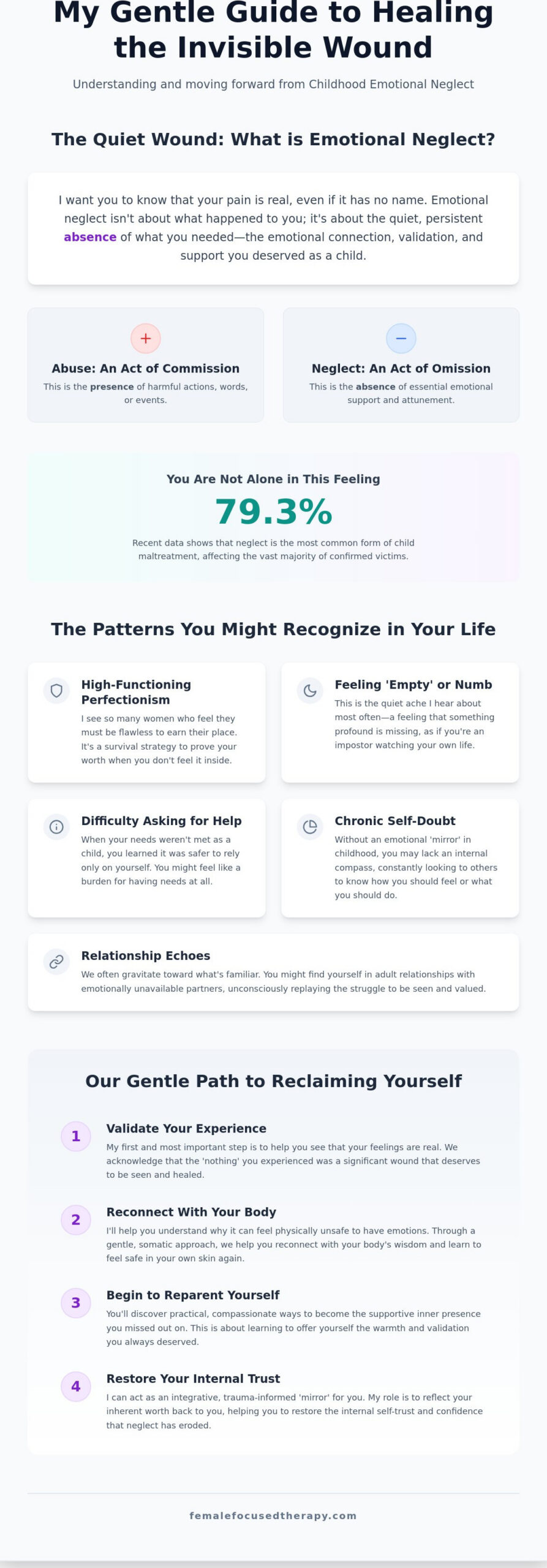
We often dismiss our own struggles because “it wasn’t that bad” or because there wasn’t any overt violence. But Child neglect, particularly the emotional kind, isn’t about what happened to you. It’s about what didn’t happen. It is the absence of emotional attunement, where your feelings weren’t noticed, responded to, or validated by the people who raised you.
In my work as a registered integrative psychotherapist, I often support women through relationship trauma that stems from these early voids. I see this manifest as a persistent sense of “wrongness” or a feeling that you’re performing a role rather than living a life. This is the first step in healing from childhood emotional neglect; acknowledging that the “nothing” you experienced was actually a very significant “something.”
The Difference Between Abuse and Neglect
It’s helpful to think of abuse as an act of commission, something that is present and harmful. Neglect is an act of omission. It is the missing hug after a bad day, the lack of interest in your inner world, or the parent who was physically there but emotionally miles away. Recent data from 2024 suggests that neglect is actually the most common form of child maltreatment, affecting 79.3% of confirmed victims.
You can have “good” parents who were simply ill-equipped to handle emotions. Perhaps they were overwhelmed, struggling with their own history, or simply never taught how to connect. Understanding this distinction is vital for your self-compassion. It allows you to stop blaming yourself for “overreacting” to a past that seemed fine to everyone else. You aren’t being dramatic; you’re responding to a genuine lack of emotional nutrients.
Why It Feels Like ‘Running on Empty’
I often use the metaphor of an empty emotional fuel tank. When a child is mirrored, their parent reflects their emotions back to them, helping them understand who they are. Without that mirroring, you grow up without a clear sense of your own internal landscape. You might feel like you’re constantly searching for a map that everyone else seems to have already.
Childhood emotional neglect is the silent thief of self-worth. You might find yourself constantly checking in with others to see how you should feel or what you should do. It feels like you’re operating without an internal compass, leading to chronic self-doubt. True healing from childhood emotional neglect begins when we stop trying to fill that tank from the outside and start learning to listen to our own internal signals.
How the Absence of Validation Shapes Your Adult World
I often work with women who are incredibly successful in their careers. They are the ones everyone relies on, yet inside, they feel like total frauds. This is a common shadow cast by emotional neglect. When your internal world wasn’t validated as a child, you might have developed a “perfectionist” mask to prove your worth to the world.
You learn to over-function to compensate for a lack of internal safety. It is as if you’re constantly trying to earn the right to exist by being flawless. If you stop doing, if you stop achieving, you fear the “emptiness” will finally catch up with you. This chronic over-achievement is often a survival strategy to avoid the pain of being unseen.
The struggle to ask for help is another hallmark of this experience. When your needs weren’t prioritized as a child, you learned that relying on others was disappointing or even dangerous. You might feel like a burden just for having basic emotional needs. Understanding the Signs, effects, and how to heal from these deep-seated patterns is a vital part of your restoration.
This lack of early validation creates a disconnect between your external success and your internal reality. You might feel like an impostor in your own skin, waiting for someone to realize you don’t actually know what you’re doing. Healing from childhood emotional neglect involves dismantling this mask and realizing that you are worthy of care simply because you exist.
Relationship Echoes: Why We Choose Unavailable Partners
We often gravitate toward what is familiar, even if it is painful. If you were ignored or dismissed as a child, you might find yourself in adult dynamics where you’re still fighting to be seen. I’ve seen many women struggle with relationship trauma because they’ve mistaken emotional unavailability for a “normal” way of being.
You might take on the role of the perpetual emotional caretaker, hoping that if you give enough, you’ll finally be chosen. This pattern keeps you in a cycle of neglect, where your own heart is the last thing to be tended to. Recognizing these echoes is the first step toward choosing partners who can actually mirror your worth.
The ADHD Connection: Sensory Overwhelm and Neglect
As an adult woman with ADHD, I know how neglect compounds the feeling of being “too much.” For girls, emotional dysregulation is often mislabelled as being “dramatic” or “difficult.” When your neurodivergent needs are ignored, you learn to mask even harder to fit into a world that feels loud and confusing.
My work with ADHD in women shows that sensory overwhelm often mirrors the feeling of emotional neglect. Both leave you feeling fundamentally misunderstood and alone in your experience. Reclaiming your narrative means acknowledging both your history and how your brain uniquely processes the world around you.
If you recognize these patterns in your own life, it might be time to find a safe space to unpack them. You don’t have to keep carrying this weight on your own. You can book an online therapy session with me to begin exploring these layers together.
Reconnecting With the Feelings You Learned to Hide
Healing from childhood emotional neglect isn’t just a mental exercise. I believe it has to happen in the body too. If you’ve spent decades being numb, your brain has actually learned to protect you by disconnecting from your physical sensations. This is why you might feel like a “floating head” or find it nearly impossible to describe how you feel beyond being “stressed” or “tired.”
Lowering the emotional wall you built to survive can feel physically unsafe at first. When you’ve muted your pain for so long, any surge of emotion can feel like a tidal wave. This is why pacing is so important. We don’t dive into the deep end all at once. We learn to dip our toes in, testing the temperature of our feelings before we wade further. We go at a speed that feels manageable for your nervous system.
I want to help you move from a state of “surviving” to one of genuine “being.” This shift requires us to move past the intellect and into the visceral experience of your life. It is about creating a safe container where those long-hidden parts of you can finally step into the light without fear of being dismissed or ignored again.
Somatic Awareness: Listening to Your Body’s Whispers
Neglect often leaves physical footprints that we ignore for years. It shows up as a tight chest, a shallow breath, or a persistent knot in your stomach. Sometimes, it is a total lack of sensation, a heavy numbness that makes you feel disconnected from your own skin. Your body is holding the stories that your mind has forgotten or suppressed.
I often use somatic movement to help women gently re-enter their bodies. It isn’t about exercise or “getting fit.” It is about finding a safe way to notice a sensation without being overwhelmed by it. You might start by simply noticing the weight of your feet on the floor or the way your ribs expand with a deep breath. These small check-ins are the building blocks of internal safety.
Naming the Unnameable: Building an Emotional Vocabulary
I’ve found that “fine” is the most dangerous word in the vocabulary of a woman who has been emotionally neglected. It is a placeholder that keeps you from having to look closer. To truly heal, you need a more nuanced way to describe your internal world. In Childhood Emotional Neglect: A Guide to Healing, researchers highlight how identifying specific emotions can reduce their power over us.
Moving from “I’m stressed” to “I feel dismissed” or “I feel lonely” changes how you relate to yourself. Validation is the antidote to neglect. When you can say, “It makes sense that I feel this way,” you are giving yourself the mirroring you missed as a child. This simple act of self-recognition is a profound part of healing from childhood emotional neglect. It tells your system that you are finally safe enough to be seen, even if it’s only by yourself for now.
Practical Steps for Healing Your Inner Emotional Landscape
I want to give you a few realistic things you can do to start the reparenting process. The goal isn’t to reach a state of “perfection,” as that is often just another mask. Instead, the goal is to become the “good enough” parent to yourself that you missed out on as a child. This involves learning to witness your own needs with the warmth and curiosity you deserved years ago.
Focusing on self-compassion is a radical act of rebellion against neglect. When you’ve been taught that your feelings don’t matter, being kind to yourself feels uncomfortable, or even “wrong.” You’re essentially rewiring your brain to believe that you are worth the effort. This is a core part of healing from childhood emotional neglect, as it restores the internal safety that was missing.
Setting boundaries is another essential tool. It is how you protect your newly discovered emotional self from being drained by others. You’re learning that saying “no” to someone else is often a “yes” to your own well-being. It takes practice to stop being the “fixer” for everyone else and start being the advocate for your own heart.
The I.A.L.T. Framework (Identify, Accept, Listen, Trust)
I find that having a simple structure helps when you feel disconnected. You can use this framework anytime you notice a shift in your mood or a physical sensation in your body.
- Identify: Pause and name the sensation. Is it a tightness in your throat? A heaviness in your stomach? Just name it without trying to change it.
- Accept: Give yourself permission to feel it. Say to yourself, “It makes sense that I feel this way right now.” Remove the judgement.
- Listen: Ask what this emotion is trying to tell you about your needs. Does it need quiet? Does it need to express anger? Does it need a break?
- Trust: Act on that information in a small, manageable way. If you need rest, give yourself ten minutes of stillness. Trusting your own signals builds self-reliance.
Creating a ‘Safety Plan’ for Emotional Overwhelm
As you move through the process of healing from childhood emotional neglect, the “numbness” will eventually start to break. When those feelings come flooding in, it can feel overwhelming. It’s helpful to have a plan in place for these moments, such as a specific breathing technique or a safe person you can text.
Rest and “unproductive” time are vital components of your healing journey. Your nervous system needs space to metabolise these new emotional experiences without the pressure of “doing” more. You’re learning to value your being as much as your doing. Self-care is not a luxury or an indulgence, it is a necessary boundary that protects your emotional energy.
If you’re ready to start this reparenting process with professional support, you can book your first therapy session here. We can work together to build these tools at a pace that feels safe and sustainable for you.
Moving Forward With Compassion and Professional Support
I know that doing this work alone can feel incredibly daunting. When you’ve spent a lifetime being your own only source of support, the idea of leaning on someone else can trigger that old fear of being a burden. But healing from childhood emotional neglect isn’t a solo mountain climb. It is a collaborative process of finally being seen by another human being.
An integrative, trauma-informed approach provides the “mirror” you missed in your early years. In our sessions, I don’t just listen to your words; I help you notice how your history lives in your breath, your posture, and your silences. Through individual psychotherapy, we can begin to rebuild that lost self-trust together in a way that feels safe and grounded.
You don’t have to “fix” yourself before you’re worthy of support. Many women wait until they’re at a breaking point to reach out, believing they should be able to handle it all alone. I want to remind you that your worth isn’t tied to your ability to suffer in silence. You deserve a space where your internal restoration is the priority and where your needs are finally placed at the centre of the room.
What to Expect in a Female-Focused Therapeutic Space
I strive to create a boundaried, warm environment where your voice is finally heard and respected without judgement. We don’t just stay in the “logical” mind, as neglect often lives in the parts of us that words can’t quite reach. We weave together evidence-based CBT with mindfulness and somatic work to address the pre-verbal roots of your experience. This multidisciplinary approach ensures we’re tending to both your mind and your body at a manageable speed.
Whether you’re navigating life transitions in Singapore or seeking support from further afield, my online therapy options are designed to meet you exactly where you are. We work at a steady pace that respects your nervous system and prevents you from feeling overwhelmed. You’ll find a safe, confidential container to explore the feelings you’ve kept hidden for so long, allowing them to be processed and integrated.
Your First Step: A Calm Invitation
Healing is a journey, not a destination with a fixed end point. It’s about slowly reclaiming the parts of yourself that were muted to survive your childhood. I encourage you to take one small, realistic step today. Perhaps that is just pausing for three deep, conscious breaths and noticing the sensation of the air moving through your ribs, acknowledging that you are here and you are worthy of care.
There is so much hope for internal restoration and a renewed sense of self-assurance. You’ve already done the hardest part by surviving and acknowledging that you want something different for your adult life. As you move forward, do so with the knowledge that your emotional self is waiting to be reclaimed. I’m here to hold that space for you whenever you’re ready to begin the work.
Reclaiming Your Emotional Self
You’ve spent a long time believing that because your childhood wasn’t “abusive” in the traditional sense, your feelings of emptiness shouldn’t exist. I hope you now see that the absence of emotional mirroring is a profound experience on its own. Healing from childhood emotional neglect begins with this validation; knowing that your internal ache is real and that you deserve to feel whole.
As a registered integrative psychotherapist specialising in female-centric trauma recovery, I know that this journey involves more than just talk. It requires a gentle, somatic reconnection to your body and the courage to become your own “good enough” parent. This internal restoration isn’t a quick fix, but a steady path toward trusting your own intuition and needs again.
You don’t have to navigate this transition alone. I offer warm, boundaried, and ADHD-aware support to help you lower those emotional walls at a pace that feels safe for you. If you’re ready to start hearing your own voice again, I’m here to listen. You can book a consultation with me here.
Common Questions About the Path to Restoration
How do I know if I experienced childhood emotional neglect?
You can identify emotional neglect by looking at your current internal patterns rather than just your memories. If you often feel like an impostor, struggle to name your own needs, or have a persistent sense of “emptiness” despite being successful, these are strong indicators. It is often marked by the feeling that your inner world simply didn’t matter to the people who raised you.
You might also notice that you are an expert at taking care of everyone else but feel completely lost when it comes to self-compassion. Since neglect is about what didn’t happen, you won’t always have a specific “event” to point to. Instead, you’ll find the evidence in your chronic self-doubt and the way you mute your own emotional signals.
Can you heal from emotional neglect without confronting your parents?
Yes, you can absolutely find peace without ever having a conversation with your parents about the past. Healing is an internal process of reparenting yourself and building the self-trust that was missing in your early years. Confrontation is a personal choice, but it isn’t a requirement for your own emotional restoration.
I often work with women who find that focusing on their own growth and boundaries is more productive than seeking validation from parents who may still be emotionally unavailable. Your recovery depends on how you show up for yourself now, not on their ability to acknowledge what they couldn’t provide back then.
Why do I feel guilty for feeling like I was emotionally neglected?
You likely feel guilty because your parents provided for your physical needs, such as food, clothing, and safety. When your childhood looked “fine” from the outside, it feels ungrateful to acknowledge the emotional void. This guilt is a common side effect of the invisibility of neglect; you feel like you’re making a fuss over “nothing.”
It’s important to remember that emotional attunement is a basic human requirement, just like physical safety. Acknowledging that you were neglected isn’t about blaming your parents or being ungrateful for what they did provide. It is simply about being honest about the “nothing” that caused you so much quiet pain.
What are the long-term effects of childhood emotional neglect in women?
In women, the long-term effects often manifest as high-functioning perfectionism and a tendency to over-function in every area of life. You might find it incredibly difficult to trust your own intuition, leading to a cycle of seeking external validation. This often leads to burnout and a feeling of being fundamentally disconnected from your own joy.
For those of us with ADHD, these effects can be even more intense. The lack of early mirroring can make sensory overwhelm and emotional dysregulation feel even more shameful. You might grow up feeling like you are “too much” while simultaneously feeling like you aren’t enough, creating a painful internal tug-of-war.
How long does it take to heal from childhood emotional neglect?
The timeline for healing from childhood emotional neglect is unique to every woman and depends on the depth of the void. It isn’t a quick fix or a destination you reach, but a gradual process of lowering your survival walls. You’ll notice small shifts first, like being able to say “no” without guilt or finally naming a feeling before it boils over.
I encourage you to view this as a journey of restoration rather than a race to be “fixed.” We work at a pace that respects your nervous system, allowing you to integrate these changes sustainably. Over time, the “empty” feeling begins to be replaced by a solid foundation of self-reliance and internal warmth.
Is emotional neglect considered a form of trauma?
Yes, emotional neglect is a form of relational trauma, sometimes referred to as “Type II” or complex trauma. It is the trauma of absence rather than the trauma of an event. Because your brain and nervous system require emotional connection to develop safely, the lack of it creates a lasting stress response.
What is the difference between emotional neglect and emotional abuse?
The primary difference lies in the presence or absence of an action. Emotional abuse is an act of commission, involving harmful behaviours like yelling, belittling, or shaming. Emotional neglect is an act of omission, meaning the necessary emotional support, interest, and validation were simply missing from your life.
While abuse is the presence of something bad, neglect is the absence of something good. Both leave significant wounds, but they require slightly different approaches in therapy. Neglect often requires more somatic work to help you “wake up” the parts of yourself that went numb to survive the silence.
How can therapy help me if I don’t remember much of my childhood?
Therapy for healing from childhood emotional neglect doesn’t rely solely on your memories; it focuses on how you feel in the present moment. Your body holds the “memory” of neglect in the form of tension, numbness, or a shallow breath. We use somatic awareness to trace these physical signals back to their emotional roots.
By noticing how you respond to life today, we can identify the gaps left by your early environment. You don’t need a perfect timeline of your past to begin the work of restoration. We start with where you are right now, using your current experiences as the map to help you find your way back to yourself.

Article by
Cheryl Kennedy MacDonald MA BA (Hons) Pg. Dip. SAC BACP
Cheryl Kennedy MacDonald is a psychotherapist specialising in women’s mental health, relationships, and life transitions. She works with women navigating trauma, relationship breakdown, identity shifts, and midlife change, helping them rebuild self-trust, emotional stability, and a clear sense of who they are and what they want.
With over 20 years’ experience working with women internationally, Cheryl is the founder of YogaBellies, a global women’s yoga school, and the creator of the Birth ROCKS method. Her work sits at the intersection of psychotherapy and embodiment, integrating evidence-based therapeutic approaches with somatic, body-based practices that support deep, lasting change.
Known for her grounded and direct approach, Cheryl moves beyond surface-level insight to address the patterns held in the body and nervous system. Her work supports women to regulate, reconnect, and respond to their lives from a place of clarity, strength, and self-respect.
She is a published author in academic journals and has written multiple books on women’s health, pregnancy, and midlife wellbeing, available on Amazon and leading book retailers worldwide.