
You’ve likely spent hours scrolling through clinical websites, feeling more like a data point than a person. It’s draining to wonder how to find the right therapist in singapore when every profile looks the same and the terminology feels like a maze. You deserve a space where you don’t have to explain the weight of your cultural or gendered experiences before you even begin the work of healing.
I know that feeling of being just a “number” in a large practice, or the deep confusion over whether you actually need a counsellor or a psychotherapist. It’s my goal to help you move past the overwhelm of search results to find a therapeutic connection that truly feels like home. Finding the right fit is about more than just credentials. It’s about feeling safe enough to finally exhale.
In this guide, I’ll share a clear roadmap for evaluating a therapist’s expertise and their “vibe.” We’ll explore how to find a professional who understands trauma-informed, gender-specific care. My hope is to help you find the support you need to feel grounded, seen, and self-assured again.
Key Takeaways
- I’ll explain why the human connection between you and your therapist matters far more for your healing than any clinical title or certificate.
- Learn how to find the right therapist in singapore who truly understands the unique pressures of our fast-paced culture and your specific life transitions.
- I’ll give you five essential questions to ask during your first chat so you can feel empowered to “interview” your potential therapist.
- Discover how to move past the clinical jargon and trust your own intuition to find a therapeutic space that feels like home.
I know how overwhelming it feels to start your search
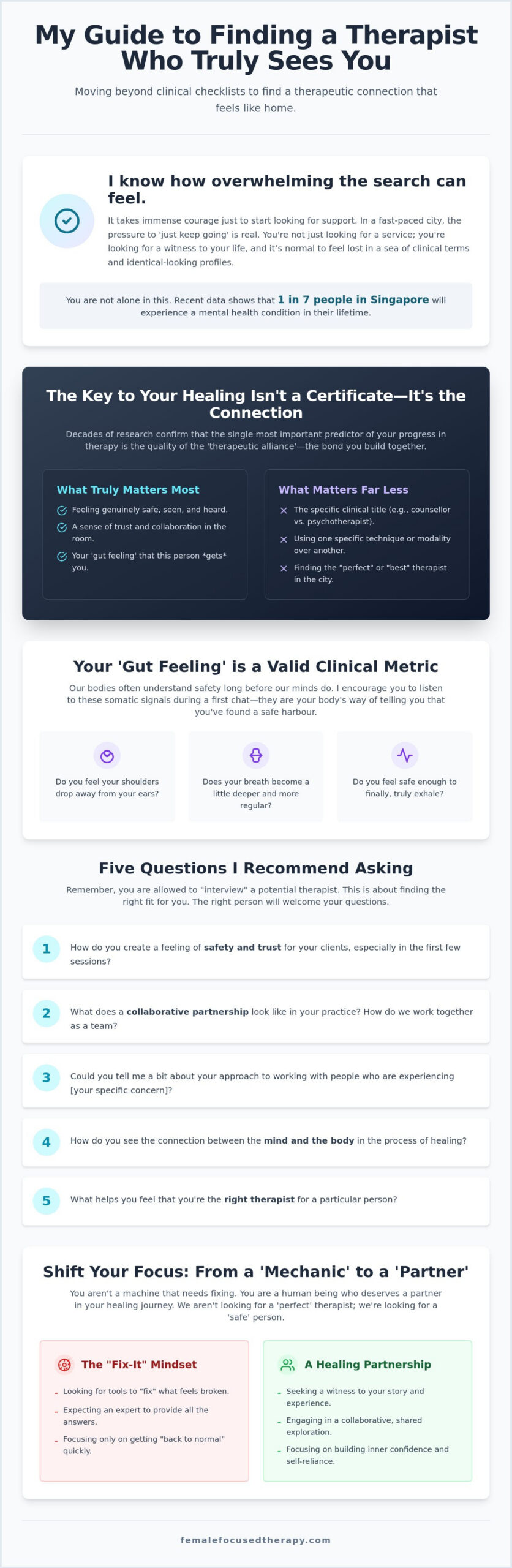
It takes immense courage to admit you need a hand to hold. In a city as fast-paced as ours, there is often a silent pressure to just keep going and perform. I want to acknowledge that you’ve already done the hardest part by deciding to look for support. You aren’t alone in this. Recent data shows that 1 in 7 Singaporeans will experience a mental health condition in their lifetime, yet the path to finding help can feel incredibly lonely.
I know the search feels heavy. You’re likely staring at endless directory listings, trying to figure out how to find the right therapist in singapore while drowning in clinical terms. It’s confusing when every profile looks like a carbon copy of the last one. You might be worried about finding someone who understands the nuances of the female experience or the unique weight of being a high-functioning woman in a high-pressure environment.
Finding a therapist feels high-stakes because it is. You aren’t just looking for a service; you’re looking for a witness to your life. My goal is to help you move away from a rigid checklist and toward a process that honours your intuition. We aren’t looking for a perfect person. We’re looking for a safe person.
Why your ‘gut feeling’ is a valid clinical metric
Therapy is a unique professional relationship because it requires a level of intimacy rarely found elsewhere. While qualifications are vital, the therapeutic alliance, or the bond we build together, is the strongest predictor of your progress. This human connection is what actually facilitates healing, more than any specific technique or modality I might use.
I encourage you to listen to your body during a first session. Do you feel your shoulders drop? Does your breath become a little deeper and more regular? These somatic signals are your body’s way of telling you that you’ve found a safe harbour. As someone who lives with ADHD and practices yoga, I know that our bodies often understand safety long before our logical minds do.
It’s perfectly okay to speak with a few different professionals before making a choice. You are allowed to shop around until you find a voice that resonates with your own. This isn’t about being difficult; it’s about protecting your emotional energy. The right therapist will welcome your questions and respect your need to feel a genuine “click.”
Moving past the ‘fix-it’ mindset to find a partner
Many of the intelligent, self-aware women I work with arrive with a fix-it mindset. They want a set of tools to repair what they feel is broken so they can get back to their busy lives. But you aren’t a machine that needs a mechanic. You’re a human being who deserves a partner in your healing journey.
In my integrative therapy approach, we work collaboratively. We look at the mind and the body together, blending traditional psychotherapy with somatic awareness and rest. This isn’t a top-down relationship where I tell you what to do. Instead, it’s a shared exploration where we rebuild your internal confidence and self-reliance at a pace that feels manageable for you.
Try to shift your focus from finding “the best” therapist in the country to finding “the best for me.” The right person won’t just offer expertise. They will offer a grounded space where you feel completely understood without having to perform or hide the “messy” parts of your story. When you find that partner, the overwhelm of the search finally begins to lift.
Why the therapeutic alliance is the key to your healing
When you start exploring how to find the right therapist in singapore, you’ll likely see many lists of qualifications. While those matter, they aren’t the most important factor in your recovery. In psychotherapy, we talk about the “therapeutic alliance.” This is the unique bond and sense of collaboration between you and me. It’s the feeling that we’re on the same team, working toward your restoration.
Decades of clinical research consistently show that the quality of this “fit” predicts a positive outcome more than any specific type of therapy. Whether a therapist uses one technique or another matters far less than whether you feel safe, heard, and respected in their presence. When you find that connection, your nervous system begins to settle. This state of physiological safety is where real change happens.
In my practice, I foster this alliance through a trauma-informed lens. I create a space where your experiences are validated without judgment. This isn’t just about talking; it’s about building a relationship where your body and mind can finally rest. If you’re curious about how I work, you can read more about my background and approach.
Understanding credentials vs. connection
The mental health landscape here can be confusing. Currently, anyone in Singapore can call themselves a “counsellor” or “therapist” as these titles aren’t yet regulated by law. Psychiatrists are medical doctors who often focus on medication, while psychologists and psychotherapists focus on talk therapies. You can find a helpful guide to mental health services in Singapore provided by the Ministry of Health to understand the different facilities available.
You might also see acronyms like CBT, which focuses on changing thought patterns, or depth psychotherapy, which explores the roots of your feelings. Think of these degrees and modalities as the foundation of a building. They’re necessary for stability, but the therapeutic relationship is the house itself. It’s the actual space where you live, breathe, and heal.
Beyond traditional talk therapies, some people find that addressing subconscious patterns is a vital part of their recovery; if this interests you, check out Heal With Hollie for specialized clinical hypnotherapy.
The importance of a gender-informed perspective
For many women, feeling truly “seen” requires a therapist who understands the specific weight of the female experience. We carry a unique mental load, balancing careers with the invisible labor of home life. We also navigate significant hormonal transitions, from the monthly cycle to menopause, which deeply impact our emotional well-being. A gender-informed perspective acknowledges these realities as central to your story, not as footnotes.
This is especially true when we look at how to find the right therapist in singapore for neurodivergent women. My work with ADHD in women requires a specific type of alliance. It’s one built on the understanding that your brain works differently, and that’s okay. We don’t try to “fix” your neurodivergence; we work together to find somatic and emotional rhythms that actually support your life. If you’re ready to see if we’re a good fit, you can view my current availability for a session.
Navigating the unique mental health landscape here in Singapore
Life in Singapore moves at a relentless pace. Between the pressure to excel at work and the “kiasu” culture that keeps us constantly comparing ourselves, it’s no wonder burnout is so common. Whether you are a local woman balancing family expectations or an expat navigating a new life away from home, the emotional toll is real. Understanding how to find the right therapist in singapore means acknowledging these specific cultural weights.
I often see women who feel they have to keep a “perfect” facade. In our close-knit community, the fear that someone might find out you’re struggling can be a huge barrier. Confidentiality isn’t just a legal requirement for me; it’s the foundation of the safety I provide. You need to know that your story stays within the four walls of our session, especially when life on this small island can feel so interconnected.
Private practice vs. public healthcare
Many people start their journey at a polyclinic or the Institute of Mental Health (IMH). These public services are vital for subsidised care, but they often come with long waiting times. You might also find that you don’t get to choose your specific therapist, which can make building that all-important connection much harder. Research shows that demand is currently outpacing supply in the public sector, leading to significant gaps in care.
Choosing a private practice allows for a more tailored, integrative experience. You have the freedom to select a practitioner whose “vibe” matches yours from the very first consultation. This consistency of care is crucial for long-term healing, as you don’t have to repeat your history to a new face every few months. It allows us to work at a manageable and steady speed that truly supports your nervous system.
Finding a specialist for relationship trauma and ADHD
If you are dealing with the aftermath of relationship trauma or narcissistic abuse, a generalist approach might feel insufficient. These experiences require a deep understanding of complex power dynamics and the specific way they impact your self-trust. You need a witness who understands the nuances of these patterns without you having to over-explain the subtle manipulation you’ve endured.
Similarly, ADHD-focused therapy for women shouldn’t just be a checklist of symptoms. It needs to be an ADHD-informed space that understands how neurodivergence intersects with your hormones and life transitions. I focus on helping you find internal restoration rather than just trying to make you “fit” into a neurotypical world. Finding a specialist who understands these nuances is a key part of how to find the right therapist in singapore.
Five questions I recommend asking during your first consultation
I always tell the women I work with that the first consultation is your interview. You are the boss here. While it’s natural to feel a bit nervous, remember that you’re hiring a professional to support your most precious asset: your emotional well-being. When you are figuring out how to find the right therapist in singapore, these initial minutes are your chance to see if this person can truly hold space for your story.
A good therapist won’t just answer your questions; they’ll welcome them with warmth and patience. Notice how you feel while they speak. Is your body relaxing? Or are you feeling more guarded? Your intuition is a powerful guide in this process. I want you to feel empowered to ask the things that matter to you most.
Observe how they react to your queries. Are they defensive, or do they meet your curiosity with kindness? A grounded professional should be able to explain their process clearly without hiding behind clinical jargon. This is about finding a partner who makes you feel safe enough to be your authentic self.
Practical questions for clarity
Start with the basics to ensure their expertise aligns with your needs. I suggest asking: “What is your experience working with women facing my specific challenge?” Whether it’s relationship trauma or a difficult life transition, you need someone who understands the nuances of the female experience in our specific cultural context.
Next, ask how they integrate mind and body work into their sessions. Healing isn’t just about the thoughts in your head. It’s about how your body carries stress, memory, and tension. In my practice, I blend psychotherapy with somatic awareness. It’s important to know if your therapist has a similar holistic view that respects your physical experience of world.
Finally, ask what a typical path toward restoration looks like in their practice. While every journey is unique, a therapist should be able to describe how they support your progress over time. This gives you a sense of their communication rhythm and whether their approach feels like a steady, manageable speed for you.
Questions to gauge the ‘vibe’ and safety
These questions help you understand the emotional safety of the room. Ask: “How do you handle it if I feel stuck or overwhelmed during a session?” You want to hear that they can stay calm and supportive when things get difficult. You don’t need someone to rush in and “fix” you; you need someone who can sit with you in the quiet moments.
If you are neurodivergent, ask about their stance on supporting women with ADHD. It’s vital to find someone who doesn’t just see a checklist of symptoms but understands the unique emotional landscape of an ADHD brain. This is a huge part of how to find the right therapist in singapore who actually understands your internal world.
If you feel a sense of relief just thinking about these questions, that’s a sign you’re ready to take the next step. You can book a consultation with me to see if my approach and “vibe” feel like the right home for your healing journey.
Trusting your intuition as you begin your healing journey
You’ve done the research and looked at the clinical options. Now, it’s time to listen to that quiet voice inside you. Healing isn’t a race to a finish line; it’s a gentle restoration of your self-trust. When you finally understand how to find the right therapist in singapore, the most important metric isn’t on a certificate. It’s the feeling that you are no longer alone in your struggle.
The right therapist will make you feel seen and heard from the very first interaction. In our sessions, I often weave in gentle breath work and somatic movement to help you stay grounded. This mind-body approach ensures that we aren’t just talking about your challenges, but helping your nervous system feel safe while we do. It’s a steady, manageable way to move forward without feeling overwhelmed.
If you’re ready to take a small step, I recommend booking a pressure-free chat. This isn’t about making a lifelong commitment right away. It’s simply an opportunity to see if my “vibe” and expertise feel like the right home for your healing. You deserve a space where you can finally exhale and be yourself.
What to expect after you’ve made your choice
Once you’ve decided on a path, the first few sessions often bring a profound sense of unburdening. It’s the relief of finally putting down a heavy suitcase you’ve been carrying for years. I see this often with the women I work with; once the secret is shared, the weight begins to lift. You might feel a bit tired after our sessions, and that’s perfectly normal.
Therapy is emotional work, and your body needs time to process the shifts we’re making. I always encourage my clients to plan for a little bit of rest or a quiet walk after we meet. This allows the insights to settle into your system. We’ll move at your pace, ensuring you always feel supported and safe as you rebuild your internal confidence.
A final note on the power of being seen
There is something incredibly transformative about being truly seen by another person without judgment. I see my clients move from a state of high-functioning exhaustion to a place of quiet, grounded self-assurance. It’s a beautiful journey of restoration, and it starts with the courage to look for support. You’ve already started that work just by reading this guide.
I’m here to help you navigate this process whenever you’re ready. Whether we meet in person in Singapore or through online therapy, my goal is to provide a sanctuary for your growth. You don’t have to figure this all out by yourself. Let’s find a rhythm that works for your life and your heart.
Your path toward internal restoration starts here
Finding your way through the maze of mental health support is a deeply personal journey. I hope you now feel more equipped with the knowledge of how to find the right therapist in singapore who truly sees you. Remember that the credentials on the wall are just the beginning; it’s the safety and trust we build together that creates the space for your healing.
As a Registered Integrative Psychotherapist, I focus entirely on the unique challenges women face. Whether you are navigating the heavy aftermath of narcissistic abuse or seeking ADHD-focused support that actually respects how your brain works, you don’t have to carry the weight alone. My trauma-informed approach is designed to help you rebuild your internal confidence at a pace that feels right for your nervous system.
You’ve already taken the most courageous step by looking for a way forward. If my approach resonates with you, I invite you to reach out. Please book a compassionate consultation with me to see if we are the right fit. I’m here to listen, to hold space, and to support you as you find your way back to yourself.
Frequently Asked Questions
How do I know if I need a psychologist or a psychotherapist in Singapore?
The choice depends on the type of support you’re looking for. Psychologists often focus on clinical assessments and specific behavioural strategies. As an integrative psychotherapist, I look at the deeper roots of your emotional patterns and how they live in your body. In Singapore, these titles aren’t legally regulated yet, so I always suggest looking at the practitioner’s specific training and whether their approach feels like a safe harbour for you.
Is it normal to feel nervous before my first therapy session?
It is completely normal and very common to feel a flutter of anxiety before we first meet. You are preparing to share your inner world with a new person, which is a vulnerable act of courage. I always aim to make our first session feel like a soft place to land. We’ll focus on your comfort and building our connection rather than jumping straight into your most difficult stories.
How many sessions will it take before I start feeling better?
Healing is a deeply individual process that happens at its own pace. There is no “fix-it” timeline. Some women feel a sense of relief after just one or two sessions of finally being seen and heard. For deeper restoration from trauma or navigating life with ADHD, we might work together for several months to build lasting internal confidence and stability.
Can I switch therapists if I don’t feel a connection after the first visit?
You absolutely can and should switch if the connection doesn’t feel right. The bond we build together is the most important part of your healing journey. If you don’t feel a “click” or a sense of safety, it is okay to keep looking. When you’re learning how to find the right therapist in singapore, I always encourage you to trust your intuition above everything else.
What is the average cost of a private therapy session in Singapore?
Private therapy rates vary depending on the practitioner’s experience and specialisation. According to 2026 industry data, private counselling often ranges between SGD 100 and 200 per hour. Clinical psychology typically ranges from SGD 150 to 300. It is a significant investment in your well-being, so finding the right fit is essential to ensure you feel the value of our work together.
Does insurance in Singapore typically cover psychotherapy?
Insurance coverage for psychotherapy is currently limited but is slowly improving. some international health plans or corporate Employee Assistance Programs (EAPs) do provide coverage for sessions. I suggest checking directly with your provider to see if they include mental health support. Many women in Singapore still pay out-of-pocket for private care to ensure they can choose their specific therapist.
Is online therapy as effective as meeting in person at a Singapore clinic?
How do I explain to my partner or family that I am starting therapy?
You only need to share as much as you feel comfortable with. Sometimes, simply saying “I’m working on my personal growth” or “I need a professional space to process my stress” is enough. You don’t owe anyone a detailed explanation of your healing journey. I can help you find the words and boundaries that feel safe for your specific relationships as we work together.

Article by
Cheryl Kennedy MacDonald MA BA (Hons) Pg. Dip. SAC BACP
Cheryl Kennedy MacDonald is a psychotherapist specialising in women’s mental health, relationships, and life transitions. She works with women navigating trauma, relationship breakdown, identity shifts, and midlife change, helping them rebuild self-trust, emotional stability, and a clear sense of who they are and what they want.
With over 20 years’ experience working with women internationally, Cheryl is the founder of YogaBellies, a global women’s yoga school, and the creator of the Birth ROCKS method. Her work sits at the intersection of psychotherapy and embodiment, integrating evidence-based therapeutic approaches with somatic, body-based practices that support deep, lasting change.
Known for her grounded and direct approach, Cheryl moves beyond surface-level insight to address the patterns held in the body and nervous system. Her work supports women to regulate, reconnect, and respond to their lives from a place of clarity, strength, and self-respect.
She is a published author in academic journals and has written multiple books on women’s health, pregnancy, and midlife wellbeing, available on Amazon and leading book retailers worldwide.