
You wake up to the humid Singapore morning and the world outside is already rushing, yet your own body feels impossibly heavy. It’s a strange, lonely place to be when you’re carrying a loss that most people can’t see. You might feel the pressure to return to “normal” life, even while you’re struggling with brain fog, and seeking grief counselling after miscarriage singapore is often the first step in acknowledging that your experience as a mother matters.
I understand that your grief isn’t something to just “get over.” I offer a compassionate, safe space to help you navigate these complex emotions and begin your journey toward internal restoration. You deserve to be heard without judgment and supported through the physical heaviness that often follows such a profound loss.
In this article, I’ll share how we can work together to manage the overwhelm, validate your feelings, and slowly learn to trust your body again. We’ll explore a mind-body approach that honours your story and supports your healing at a pace that feels right for you.
Key Takeaways
- Understand that your grief is valid and real, no matter how “invisible” it feels to others or how early the loss occurred.
- Discover how pregnancy loss lives in your body as physical tension, and how specialised grief counselling after miscarriage singapore helps release this heaviness.
- Learn why a dedicated, female-focused space allows you to explore unique fears about the future with vulnerability and safety.
- Identify gentle, somatic ways to practice “radical rest” while your brain and body recover from this major life event.
- Gain clarity on how a warm, non-clinical approach to therapy can help you rebuild internal peace and self-trust at your own pace.
Finding Your Way Through the Quiet Grief of Pregnancy Loss
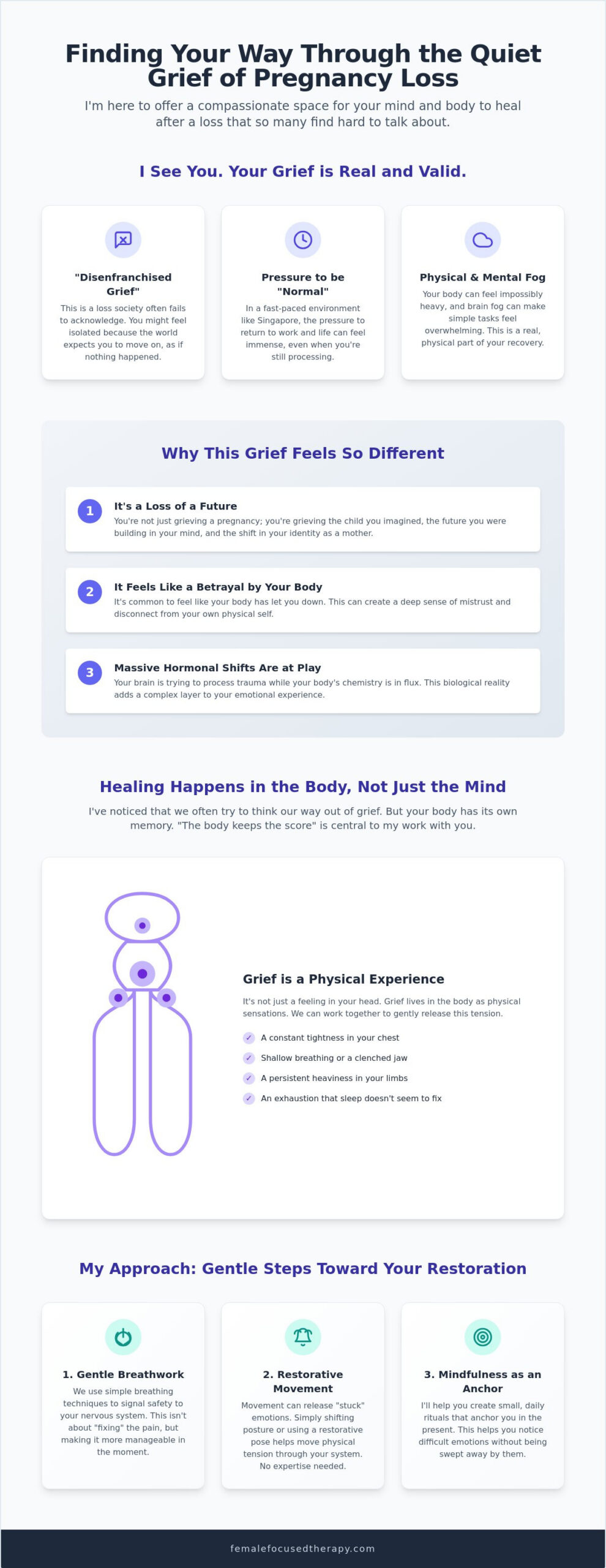
I see you. You might be sitting in a meeting at Raffles Place or Orchard, nodding at your colleagues, while inside, you feel like you’re falling apart. It’s a heavy, silent burden to carry. Miscarriage is what we call “disenfranchised grief.” It’s a loss that society often fails to name or acknowledge properly. Because there was no funeral and perhaps no one else even knew you were pregnant, the world expects you to just keep moving.
I want you to know that your pain is real. It doesn’t matter if you were five weeks or twenty weeks along. You haven’t just lost a pregnancy; you’ve lost the future you were already building in your mind. My role in providing grief counselling after miscarriage singapore is to offer you a dedicated space where that loss is honoured. We don’t need to “fix” it, but we do need to look at it together without judgment.
Why Miscarriage Grief Feels Different
Losing a pregnancy is unique because it’s a biological loss that feels like a personal betrayal. You might find yourself blaming your body or feeling like it has let you down. This sense of betrayal is often compounded by the massive hormonal shifts happening after a loss. Your brain is trying to process a trauma while your chemistry is in flux.
The grieving process after miscarriage is rarely linear. It’s not just about sadness; it’s about the loss of a dream and the sudden, jarring shift in your identity. In my work as an integrative psychotherapist, I help you understand these layers so you can stop fighting your own emotions and start the journey of internal restoration.
The ‘High-Functioning’ Trap in Singapore
In our fast-paced Singapore environment, there’s an unspoken rule to stay productive. You might think that by staying busy, you’re “getting through it.” But often, this just pushes the grief deeper into your body. High-functioning women are particularly good at this. We use our competence as a shield, but that shield eventually gets too heavy to carry.
I’ve seen how “keeping busy” actually delays the healing process. It keeps you in a state of high alert, which leads to the fatigue and brain fog you might be feeling right now. In my practice, I work with women to create a firm boundary between your professional life and your private healing. You don’t have to be “on” when you’re with me. We can use somatic movement and talk therapy to help you find your ground again.
Why Your Body and Mind Need Space to Process Loss
I’ve noticed that many women in Singapore try to think their way out of grief. You might tell yourself that you should be “over it” by now or that you need to focus on work to keep your mind busy. But your body has its own memory. It stores the shock, the sorrow, and the physical stress of the pregnancy loss, even when your mind is trying to move on.
The concept that “the body keeps the score” is central to how I work. Grief isn’t just an emotional state; it’s a physical experience. You might feel a constant tightness in your chest, a persistent heaviness in your limbs, or a type of exhaustion that sleep doesn’t seem to touch. When you seek grief counselling after miscarriage singapore, we don’t just talk about your thoughts. We look at how you’re feeling in your own skin.
The psychological impact of pregnancy loss often leaves you feeling untethered, as if the ground beneath you isn’t quite solid. This is why an integrative approach is so important. We need to combine talk therapy with somatic awareness to help you feel safe in your body again. Healing happens when we create space for both the mind and the body to process what has happened.
The Somatic Side of Grief
During our sessions, I might ask you where you feel your grief. Often, it’s held in a shallow breath or a clenched jaw. These are your nervous system’s ways of protecting you from overwhelming pain. We can use gentle breathwork to signal to your brain that you’re safe in this moment. This isn’t about “fixing” the pain, but about making it more manageable.
Movement can also be a powerful tool for releasing “stuck” emotions. You don’t need to be a yoga expert to benefit from this. Sometimes, simply shifting your posture or practicing a specific restorative pose can help move the physical tension through your system. It’s about learning to listen to your body’s needs with kindness rather than frustration.
Mindfulness as an Anchor
Mindfulness helps you stay present with difficult emotions without being swept away by them. In the fast-paced environment of Singapore, it’s easy to lose touch with the present moment. I’ll help you create small, daily rituals of rest that support your mental restoration. These aren’t just “self-care” tasks; they’re essential components of your healing journey.
I integrate these practices into our work together to provide a holistic experience that respects your intelligence and your sensitivity. If you feel ready to explore this mind-body path to healing, you can book a session with me to begin that conversation. We’ll move at a pace that feels steady and supportive for you.
The Benefits of Female-Focused Grief Counselling
I believe there’s a profound relief in walking into a room where you don’t have to translate your experience. When you’re looking for grief counselling after miscarriage singapore, you’re often looking for more than just a listener. You’re looking for someone who understands the visceral, gendered reality of what you’ve been through. A female-focused space allows for a depth of vulnerability that’s often hard to find in more generic clinical settings.
In Singapore’s high-pressure environment, women are often expected to be “resilient” in a way that leaves no room for the complexity of pregnancy loss. Working within a gender-centric framework means we can address the specific societal expectations placed on you. We look at the intersection of your career, your identity as a woman, and the biological reality of your loss. This isn’t about fitting into a textbook definition of grief; it’s about your unique path to restoration.
We’ll talk about the things that weigh on you most, including the quiet, nagging fears about future pregnancies and your fertility. To complement emotional support with specialized reproductive health insights, you can discover ah! fertility nutrition. It’s about moving beyond simply “coping” with your day-to-day tasks. My goal is to help you move toward internal restoration, where you can start to rebuild your sense of self and trust your body’s wisdom again. You deserve a space where your intelligence and your emotions are equally respected.
Navigating Relationship Strains After Loss
It’s very common for partners to grieve in completely different ways. You might find yourself needing to talk and process, while your partner retreats into work or “fixing” things. This “grief gap” can create a painful sense of distance when you need connection most. It often feels like you’re speaking two different languages during a period of total emotional depletion.
I help you find ways to communicate your needs without feeling like you’re asking for “too much.” We look at how to bridge that gap so you both feel supported rather than isolated. If you feel the distance between you is becoming a source of extra stress, we can also explore support for your relationship to help you navigate this transition together.
Healing from the Trauma of Medical Procedures
The medical side of miscarriage can be incredibly jarring. Whether it was a sudden hospital stay or a scheduled D&C procedure, the clinical nature of these events often feels at odds with the deep emotional loss you’re feeling. These experiences can leave you feeling powerless or even traumatised by the very systems meant to care for you.
I provide a safe, boundaried space to talk through these details. Many women I work with feel they have to “sanitise” their story for others, but in our sessions, you don’t have to do that. We work to ensure the “medical” part of the story doesn’t end up overshadowing your emotional recovery. By naming these experiences in a supportive environment, we start to take away their power to keep you feeling “stuck” in the past.
Gentle Steps Toward Your Emotional Restoration
I want to offer you a few realistic ways to begin being kind to yourself today. In a city as fast-paced as ours, the tendency is to fill our schedules to avoid the silence. But true healing requires what I call radical rest. This isn’t just about taking a nap; it’s about acknowledging that your brain and body are recovering from a major physiological and emotional event.
Setting boundaries is another vital step. You might have well-meaning friends or family members who say things like “at least you know you can get pregnant.” While they usually mean well, these comments can feel like a dismissal of your pain. Many women find that grief counselling after miscarriage singapore provides the specific tools needed to navigate these social complexities with confidence.
Finding a way to honour your loss that feels authentic to you is much more powerful than following a prescribed list of activities. It’s okay to tell people you aren’t ready to talk or to step away from social gatherings that feel too heavy. It’s about creating a path that respects your specific experience rather than just trying to distract yourself from it.
Honouring Your Experience
You might find comfort in creating a small, private ritual to acknowledge your pregnancy and your motherhood. This could be as simple as lighting a candle on a specific day or keeping a small memento. Journaling is also an incredible tool for externalising thoughts that feel too heavy to carry in your mind alone. It gives those feelings a place to live outside of your own head.
Please remember that it’s perfectly okay to “not be okay,” even months after the event. Grief doesn’t have a tidy expiry date. Your experience is valid, and you don’t need to rush your restoration just because the world around you is moving quickly. When you engage in grief counselling after miscarriage singapore, we work together to find these personal touchstones at your own pace.
When to Reach Out for Professional Support
Sometimes, grief can become “stuck.” You might notice prolonged isolation, intense guilt, or a feeling that you’re just going through the motions without any sense of connection. If your daily life feels like an uphill struggle or you’re finding it impossible to trust your body again, professional support can provide the anchor you need to feel grounded once more.
I’ve seen how much difference it makes to have a safe, boundaried space to process these emotions. If you’re curious about how I can help, you can read more about who I work with to see if my approach resonates with you. A consultation is a gentle way to decide if this is the right time for you to begin therapy.
If you’re ready to take that first step toward internal peace, you can schedule a time to talk with me. We’ll focus on your restoration in a way that feels safe, steady, and entirely supportive of your needs.
Taking the First Step Toward Healing Together
Carrying an invisible burden in a city that never seems to stop is exhausting. I am here to hold space for you while you navigate this transition. You don’t have to carry the weight of this loss alone in Singapore. My practice is built on the belief that every woman deserves a safe harbour to process her story without being rushed or judged.
When you seek grief counselling after miscarriage singapore, you might worry about it being another clinical appointment. My sessions are intentionally different. I focus on warmth, safety, and a complete lack of clinical pressure. We aren’t here to “fix” you, because you aren’t broken. We are here to honour your experience and help you find your ground again.
My approach is designed to help you trust your intuition and your body once again. We’ve explored how the body stores the shock of loss; now we focus on how it can slowly release that tension. You deserve to feel grounded and at peace in your own skin. Together, we can work toward a sense of internal restoration that feels sustainable and real.
Starting Our Journey
Booking an initial consultation is a gentle way for us to see if we’re a good fit. It’s an opportunity for you to share a little of your story and for me to explain how I can support you. I offer both online sessions and in-person therapy at my practice here in Singapore. This flexibility ensures you can receive support in a way that feels most comfortable and accessible for you.
If you feel ready to explore how we can work together on your healing, you can book your session today. There’s no pressure to have everything figured out before we meet. We’ll simply start exactly where you are, moving at a pace that respects your emotional energy and your needs.
A Final Note of Reassurance
Healing is not a linear path, but you are already taking the first step by being here. Reading these words and acknowledging your own needs is a brave act of self-compassion. It shows that your resilience is already within you, even if it feels very distant or quiet right now. You have the capacity to heal, and you don’t have to do it by yourself.
I invite you to take a moment of quiet today to simply breathe. Perhaps you can find a small way to be kind to yourself this evening, whether that’s an extra hour of rest or a gentle walk. Honour your journey and allow yourself the grace to move slowly. I am here and ready to support you whenever you feel the time is right to begin.
Rebuilding Your Internal Peace One Step at a Time
I’ve shared how miscarriage is a profound life transition that often feels invisible in our busy city. We’ve looked at how your body stores this grief and why a gender-centric, mind-body approach is so vital for true healing. My goal as a Registered Integrative Psychotherapist is to help you move from simply surviving your day to a place of internal restoration and self-trust.
In my safe, confidential space in the heart of Singapore, I offer specialised support for women’s life transitions. You don’t have to carry the physical heaviness or emotional exhaustion alone. Whether you choose to work with me online or in person, we’ll focus on your recovery at a pace that feels grounded and manageable. I’m here to help you navigate the complexities of your experience with kindness and professional expertise.
If you’re ready to begin this journey, I’m here to listen. You can book a compassionate consultation with me today to discuss how grief counselling after miscarriage singapore can support your unique path. Take a deep breath and remember that your healing is worth the time it takes. You are already making progress just by being here.
Frequently Asked Questions
Is it normal to still feel sad months after a miscarriage?
It is completely normal to feel sadness months or even years after your loss. Grief isn’t a linear process with a set expiry date; it often comes in waves that can be triggered by dates, smells, or social events. In a busy place like Singapore, you might feel pressured to move on, but your heart needs its own time to heal. I encourage you to be patient with yourself and acknowledge that your feelings are valid.
How many sessions of grief counselling will I need?
The number of sessions depends entirely on your unique needs and the depth of the trauma you’ve experienced. Some women find that six to twelve sessions provide a solid foundation for processing the initial shock and building somatic coping tools. Others prefer longer-term support as they navigate subsequent life transitions. We’ll work together at a pace that feels safe for you, ensuring you never feel rushed through your restoration.
Can I attend therapy alone, or should my partner come too?
You are welcome to attend individual sessions to focus purely on your own internal restoration. While miscarriage affects both partners, women often benefit from a dedicated, gender-specific space to explore their physical and emotional experiences. If you feel your relationship needs collective support, I also offer couples therapy to help you bridge the communication gap that often opens up after a shared loss. Both paths are valid for healing.
What is the difference between grief and depression after pregnancy loss?
Grief is a natural, healthy response to loss that often fluctuates in intensity, while depression can feel like a persistent, heavy cloud that affects your ability to function daily. If you’re feeling a total loss of interest in life or constant hopelessness, it might indicate clinical depression. During our sessions, I’ll help you understand these nuances and provide the specific support needed to help you feel like yourself again.
How do I explain my miscarriage to my other children?
Will therapy help me feel less anxious about a future pregnancy?
Therapy provides a safe space to process the trauma of loss, which naturally helps lower the intensity of anxiety regarding future pregnancies. When you engage in grief counselling after miscarriage singapore, we use somatic tools and mindfulness to help you rebuild trust in your body. While some nerves are natural, we’ll work on grounding techniques so that fear doesn’t become the primary driver of your future choices and family planning.
Do you offer online grief counselling for women outside of Singapore?
I offer online therapy sessions for women who are outside of Singapore or those who simply prefer the comfort of their own home. This flexibility allows you to access specialised, female-focused support regardless of your geographical location. My goal is to ensure that every woman has a safe, confidential space to heal, whether we meet in person at my practice or through a secure, private virtual platform that respects your privacy.
What should I look for in a therapist specializing in miscarriage?
You should look for a practitioner who is trauma-informed and understands the unique mind-body connection of pregnancy loss. It’s helpful to find a registered integrative psychotherapist who offers a non-clinical, empathetic environment. When seeking grief counselling after miscarriage singapore, prioritise finding someone you feel safe with; a therapist who validates your experience as a mother and respects the pace of your own individual journey toward restoration and peace.

Article by
Cheryl Kennedy MacDonald MA BA (Hons) Pg. Dip. SAC BACP
Cheryl Kennedy MacDonald is a psychotherapist specialising in women’s mental health, relationships, and life transitions. She works with women navigating trauma, relationship breakdown, identity shifts, and midlife change, helping them rebuild self-trust, emotional stability, and a clear sense of who they are and what they want.
With over 20 years’ experience working with women internationally, Cheryl is the founder of YogaBellies, a global women’s yoga school, and the creator of the Birth ROCKS method. Her work sits at the intersection of psychotherapy and embodiment, integrating evidence-based therapeutic approaches with somatic, body-based practices that support deep, lasting change.
Known for her grounded and direct approach, Cheryl moves beyond surface-level insight to address the patterns held in the body and nervous system. Her work supports women to regulate, reconnect, and respond to their lives from a place of clarity, strength, and self-respect.
She is a published author in academic journals and has written multiple books on women’s health, pregnancy, and midlife wellbeing, available on Amazon and leading book retailers worldwide.