
What if the reason you can’t just walk away isn’t a lack of willpower, but a biological survival response? It’s a heavy realization to face, but healing from a trauma bond starts with understanding that your brain has been rewired by a cycle of intense highs and crushing lows. You aren’t weak; you’re human, and your nervous system is simply trying to keep you safe in an impossible situation.
I know how it feels to live in that constant state of high alert, always scanning for a mood shift or waiting for a crumb of approval. You might feel like a shadow of yourself, physically exhausted and disconnected from the intuition that used to guide you. It’s a lonely, confusing place to be when the person who hurts you is also the one you’re wired to seek comfort from.
I’m here to help you understand the neurobiology behind this attachment and how to gently reclaim your sense of self. We’ll explore practical tools to regulate your nervous system and build a path toward restoring the trust you’ve lost in yourself. You can find your way back to the calm, grounded woman you know is still in there.
Key Takeaways
- Understand why your brain perceives this painful attachment as a survival mechanism rather than a personal weakness.
- Discover how dopamine and intermittent reinforcement make healing from a trauma bond feel like overcoming a physical addiction.
- Learn to recognise the specific cycles of “love bombing” and approval-seeking that keep you tethered to the relationship.
- Explore gentle, practical ways to begin detaching, including how to safely implement low or no contact.
- See how an integrative approach—combining psychotherapy with somatic awareness—helps you reclaim your intuition and sense of self.
Understanding the invisible thread that keeps you tethered to pain
I want to start by acknowledging how heavy this feels for you right now. It is that exhausting, confusing mix of deep love and paralysing fear that leaves you feeling breathless. You might feel like you are walking on eggshells, yet you can’t imagine stepping away from the person who makes you feel so small. It is a lonely place to be, especially when you feel like you’ve lost your own voice in the process.
A trauma bond is a deep, biological attachment to someone who is inconsistent or harmful. It isn’t a sign of weakness or a lack of character; it is actually your brain’s way of trying to survive a chaotic environment. To help you understand the science of this connection: What is a trauma bond? It is a survival mechanism triggered by intermittent reinforcement.
When we begin the work of healing from a trauma bond, we have to look at how your nervous system has been shaped by these cycles. Your body has learned to seek safety from the very person who causes the distress. This creates a physiological loop that is incredibly difficult to break without the right support and a lot of self-compassion.
The difference between healthy love and a trauma bond
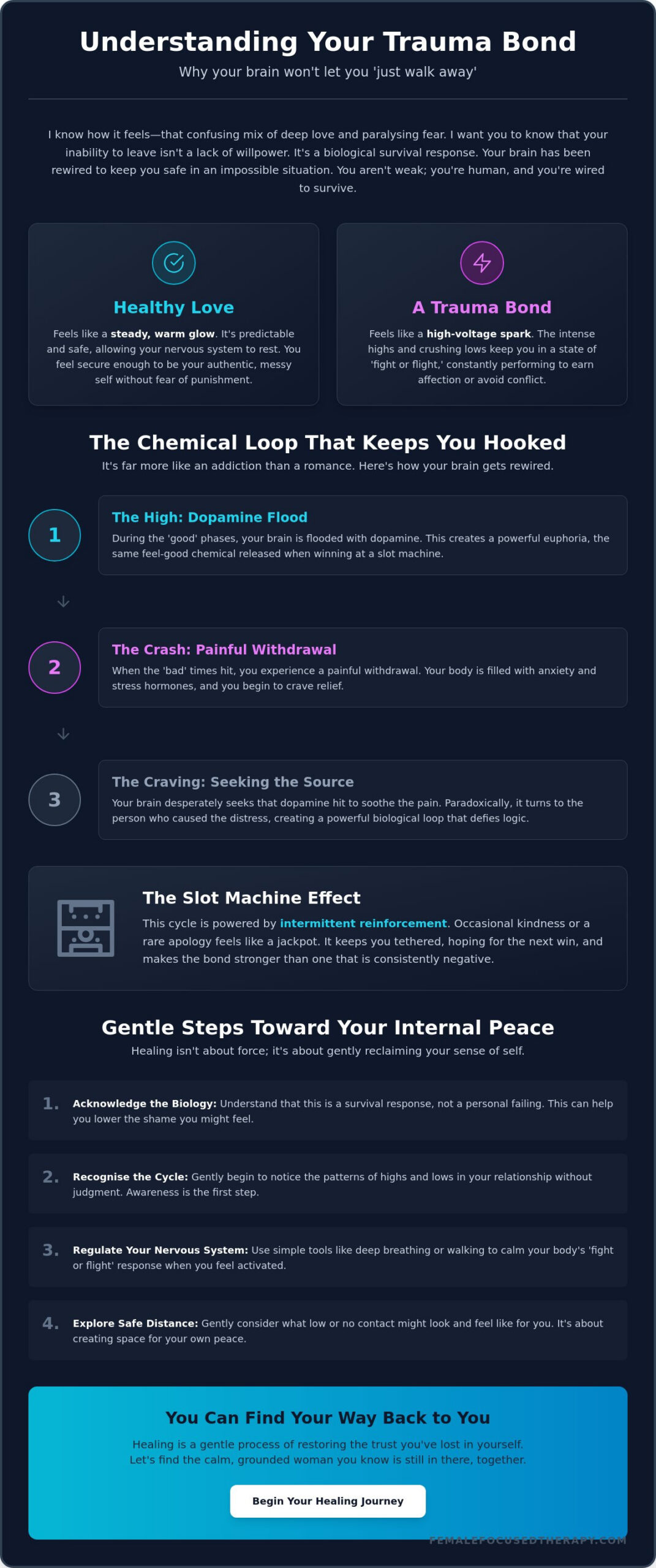
Healthy love feels like a steady, warm glow. It is predictable, safe, and allows your nervous system to rest. A trauma bond, however, feels like a high-voltage spark. I often see women mistake the “intensity” of a bond for the “depth” of love. They feel that if the highs are that high, the connection must be soulmate-level deep.
In a healthy connection, you feel safe to be your messy, authentic self. In a trauma bond, you feel you must perform to earn affection or avoid a conflict. You become an expert at reading their moods, often at the expense of your own needs. This constant state of performance is physically draining and leaves your body in a state of chronic “fight or flight.”
Why high-functioning women are often the most affected
Your ability to “fix” things and empathise can actually keep you stuck in these cycles longer. I’ve worked with many intelligent, self-aware women who feel deep shame about “knowing better” but staying anyway. They think their professional success or intelligence should protect them from this, but trauma doesn’t care about your job title or your IQ.
If you are a high-achiever, you are likely used to working hard to solve problems. You might apply that same “can-do” attitude to a relationship that is fundamentally broken. You try harder, you empathise more, and you search for the “key” to unlock their better side. Recognising that your greatest strengths are being used against you is the first step to your freedom.
Why your brain and body find it so hard to let go
We need to talk about the chemistry of this bond because it is far more like an addiction than a traditional romance. When you are in the “good” phases of the relationship, your brain is flooded with dopamine. This is the same feel-good chemical that spikes when someone wins at gambling or uses a substance, creating a powerful sense of euphoria and relief.
When the “bad” times inevitably hit, your brain goes into a state of withdrawal. You begin to crave that dopamine hit to soothe the pain and anxiety you are feeling. Paradoxically, your brain seeks out the person who caused the distress to get that hit of comfort. This creates a biological loop that makes healing from a trauma bond feel almost impossible through logic alone.
I want you to know that your inability to “just leave” isn’t a flaw in your character. It is a result of your brain being chemically rewired to seek out the source of your pain for its own cure. Understanding this can help lower the shame you might feel about staying or going back, as we recognise that your biology is currently driving the bus.
The power of intermittent reinforcement
Think of this cycle like a slot machine. If the machine never paid out, you would eventually walk away. If it paid out every single time, the excitement would fade. But because it pays out at random, unpredictable intervals, you stay hooked. You keep playing because you remember the one time you won the “jackpot” of their affection.
I see this so often in my practice; a partner’s occasional kindness or a rare, heartfelt apology acts as that jackpot. It keeps you tethered to the relationship, waiting and hoping for the next win. This inconsistency is exactly what makes the bond so much stronger and more resilient than a relationship that is purely negative all the time.
How your nervous system gets hijacked
Your body is likely stuck in a state of high alert, even during the quiet moments. This constant “fight-or-flight” response means your nervous system is perpetually scanning for danger. When your body is focused on survival, your prefrontal cortex—the part of the brain responsible for clear thinking and logic—essentially goes offline.
This is why you might find it so hard to trust your gut or make decisions that you know are best for you. Part of healing from a trauma bond involves moving your body out of this survival mode and back into a state of rest. We use somatic awareness to help your nervous system feel safe enough to breathe again, allowing your intuition to resurface naturally.
If you are struggling to recognize and break a trauma bond, please be gentle with yourself. You are navigating a complex biological response that requires patience and professional support to untangle. If you feel ready to start this journey of internal restoration, you might find it helpful to book a session to talk through what you are experiencing.
Recognising the cycles of intermittent reinforcement in your daily life
I want to help you see these patterns so they begin to lose their power over you. When you are inside the storm, everything feels like a personal failure or a unique tragedy. By stepping back and identifying the rhythm of the cycle of abuse, you can shift from simply “feeling” the relationship to “observing” it. This shift is a vital part of healing from a trauma bond because it gives your logical brain a chance to catch up with your emotions.
It often begins with “love bombing.” This is that intense, overwhelming affection that feels almost too good to be true. You are put on a pedestal, showered with praise, and made to feel like the most important person in the world. It feels like a whirlwind romance, but in reality, it is the setup for the bond. You are being “primed” to crave their approval above all else.
Then, almost without warning, the “devaluation” phase arrives. You find yourself suddenly walking on eggshells, trying to avoid their anger or a cold withdrawal of affection. You spend your days wondering what you did wrong and how to get back to that initial “perfect” version of the relationship. This is where the intermittent reinforcement we discussed earlier really takes hold, keeping you trapped in a loop of trying to “fix” what you didn’t break.
The fog of gaslighting and confusion
Gaslighting is a particularly cruel part of this cycle. It makes you question your own memory, your sanity, and your very reality. Over time, this constant second-guessing erodes your internal compass. You lose the ability to trust your own perceptions because they’ve been constantly challenged or dismissed.
You might find yourself making excuses for their behaviour to your friends, or even to yourself, just to make the pieces fit. It is a protective mechanism to keep the bond intact, but it comes at a high cost to your self-identity. If this sounds familiar, you might want to explore my work on Relationship Trauma and Narcissistic Abuse to see how these dynamics specifically impact women.
Signs your body is telling you what your mind can’t yet accept
Your body often knows a relationship is toxic long before your heart is ready to accept it. Do you have unexplained tension in your shoulders that never seems to go away? Perhaps there is a constant “pit” in your stomach or a feeling of dread when you hear their key in the door. These aren’t just physical inconveniences; they are your nervous system trying to communicate with you.
Learning to listen to these somatic cues is a central part of healing from a trauma bond. My integrative approach focuses on reconnecting you with these physical signals through breath and awareness. When you can trust what your body is telling you, you start to rebuild the self-trust that was taken away. Your body is a wise, grounded guide, and it is time we started listening to its voice again.
Practical steps for detaching and reclaiming your internal peace
Breaking a trauma bond is a process of detoxification. Just as your body needs time and care to clear a substance, your mind and nervous system need space to clear the chemical hooks of this attachment. We have to go slowly and with kindness, acknowledging that there will be days when the “withdrawal” feels overwhelming and your heart feels heavy with the urge to return.
I recommend starting with “Low Contact” or “No Contact” if it is safe for you to do so. This isn’t about being “cold”; it is about creating a protective boundary so your nervous system can finally begin to down-regulate. We must focus on self-regulation, finding ways to calm your heart when the intense panic of separation sets in and your brain starts screaming for that familiar dopamine hit.
The goal isn’t just to leave, but to stay “left” by rebuilding your sense of self from the ground up.
Creating a ‘Reality Log’ to combat the fog
When the fog of gaslighting starts to roll in, I suggest writing down exactly what happened in a “Reality Log.” Record the facts of the arguments, the specific broken promises, and the moments of fear without adding the “but he was stressed” or “she had a hard childhood” excuses. You are documenting the truth of your experience, not the potential of theirs.
Read this log whenever you feel the urge to reach out or when your mind starts romanticising the few “good” moments you shared. It serves as an anchor, grounding your mind in the reality of the relationship when your emotions try to pull you back into the cycle. This practice is a foundational step in healing from a trauma bond because it protects your perception from further manipulation.
Somatic tools for the difficult moments
When you feel the intense “pull” of the bond, I want you to try simple grounding. Feel your feet firmly on the floor and notice the weight of your body in your chair. This brings you back into the present moment and out of the frantic “what if” thoughts. It is a way of telling your body that you are here, you are safe, and you are in control.
I also find the 4-7-8 breath technique incredibly helpful for settling the nervous system in real-time. Breathe in for four counts, hold for seven, and exhale slowly for eight. This simple rhythm sends a direct signal to your brain that the emergency is over. For deeper body-based healing, you might explore Somatic Movement and Yoga to help release the trauma stored in your muscles and tissues.
Building your ‘Circle of Safety’
Identify two or three people who truly see you and won’t judge your struggle. These should be people who can hold space for your pain without shaming you for how long the recovery takes. It’s important to stop seeking validation from the person who is hurting you, as they cannot be the source of the comfort you need.
Healing happens in connection, but it must be the right kind of safe, supportive connection that allows you to trust your own intuition again. If you feel ready to start healing from a trauma bond in a safe, professional space, I invite you to book a psychotherapy session so we can begin this journey of restoration together.
Moving forward with gentle, integrative support for your recovery
I believe that you don’t have to carry this heavy burden alone. While the steps we’ve explored—like using a reality log or practicing grounding—are vital, therapy can provide the dedicated space you need to process the deeper layers of your story. Healing is rarely a straight line, and having a professional guide can make the path feel much less daunting.
My approach to healing from a trauma bond is designed to be as compassionate as it is effective. I combine traditional talk therapy with mindfulness and somatic awareness because I know that your recovery needs to happen in both your mind and your body. We work together to rebuild that trust in yourself that was so carefully dismantled during the relationship.
The goal isn’t just to be “not bonded” anymore. It’s to be fully, vibrantly you again, standing in your own strength with a clear sense of your own worth. We focus on internal restoration, ensuring you feel grounded and self-reliant as you move into this next chapter of your life.
How integrative psychotherapy supports your journey
In our sessions, I use a variety of evidence-based tools tailored to your unique needs. We don’t just talk about the past; we work on how you feel in the present. This often includes:
- Cognitive Behavioural Therapy (CBT): To help you challenge the “scripts” the abuser left behind and replace them with your own truth.
- Mindfulness: To help you stay present in your body and manage moments of high anxiety without becoming overwhelmed.
- Somatic Awareness: To release the physical tension and trauma stored in your nervous system.
If you’re wondering if this approach is right for your specific situation, you can read more about Who I Work With and how I support women through these complex emotional challenges.
Reclaiming your future and your intuition
The final stage of healing from a trauma bond is the beautiful process of rediscovering who you actually are. This means finding out what you like, what you want, and where you want to go next, free from the shadow of someone else’s control. It’s about turning down the volume of their voice so you can finally hear your own.
I often find that major life transitions, such as moving into midlife or navigating menopause, can be a powerful opening for this new chapter. These shifts often demand that we finally put ourselves first and listen to our bodies. You can find more support for these specific stages on my page about Life Transitions and Menopause.
Your next gentle step toward healing
You don’t have to have it all figured out today. You don’t even need to know exactly how the rest of your story goes. You just need to take one small, gentle step toward your own restoration. I invite you to explore my resources or reach out for a quiet, confidential conversation whenever you feel ready.
Book a session with me to start your journey back to yourself.
Reclaiming your space and your story
I want you to remember that the path to healing from a trauma bond is paved with patience and deep self-compassion. You’ve learned that your struggle isn’t a lack of strength; it’s a physiological response to a cycle designed to keep you hooked. By identifying these patterns and using gentle somatic tools to settle your nervous system, you’re already beginning to untangle that invisible thread.
You don’t have to navigate this transition by yourself. With over 20 years of experience in women’s wellness as a registered integrative psychotherapist, I offer a trauma-informed, gender-specific approach that honours both your mind and your body. We can work together to quiet the noise of the past and help you hear your own intuition once again.
If you feel ready to move forward with professional support, I invite you to book a private session with Cheryl Kennedy MacDonald to begin your restoration. Your future is waiting for you; it is a space where you are allowed to be safe, grounded, and entirely yourself.
Frequently Asked Questions
How long does it take to heal from a trauma bond?
Healing doesn’t follow a set calendar; it is as unique as your own story and your nervous system. While some women feel a sense of clarity within a few months, others find the process of rebuilding deep self-trust takes a year or longer. The duration often depends on how long the bond lasted and the level of support you have in place. What matters most is moving at a pace that feels manageable for you.
Can you be trauma bonded to someone you aren’t in a romantic relationship with?
Yes, you can absolutely experience this type of bond with a parent, a sibling, or even a manager at work. Any relationship that involves a power imbalance and a cycle of intermittent reinforcement can create this biological attachment. It is the pattern of the connection that creates the bond, not the romantic nature of the relationship. I often work with women who are untangling these threads in their family lives.
Is it possible to heal a trauma bond while still in the relationship?
It is very difficult to fully heal while the cycle of harm is still active and triggering your survival response. You can begin the process by building awareness and learning to regulate your body, but true restoration usually requires the safety of distance. Healing from a trauma bond often necessitates a clear break to allow your brain chemistry to reset and your nervous system to finally feel safe.
Why do I feel like I’m going through withdrawal when I leave?
You feel like you’re in withdrawal because your brain is chemically addicted to the cycle of the relationship. During the “highs,” your brain released intense hits of dopamine, and now that the source is gone, you’re experiencing a physical crash. This is why healing from a trauma bond feels so much like breaking a physical habit. It is a biological process that requires time, patience, and somatic support to reset.
Does a trauma bond mean I have a ‘victim’ personality?
No, having a trauma bond has nothing to do with your personality type or any perceived weakness. In fact, I find that high-functioning and deeply empathetic women are often the ones who find themselves in these cycles. Your capacity to see the best in people and your desire to fix things are strengths that were unfortunately used against you. It is a survival mechanism, not a character flaw.
How can I tell the difference between a trauma bond and ‘true’ love?
True love feels stable, predictable, and safe, whereas a trauma bond feels like an obsessive, high-stakes rollercoaster. In a healthy connection, you feel like an expanded, more authentic version of yourself. In a bond, you feel like a diminished version, constantly performing to keep the peace. Healthy love allows your nervous system to rest; a bond keeps you in a state of perpetual high alert.
What should I do if I feel the urge to go back to my abuser?
Recognise that the urge is a biological craving, not a sign that the person has changed or that you belong together. When that “pull” hits, reach out to your circle of safety or read your reality log to ground yourself in the truth of your experience. Focus on just one minute of deep breathing to help the wave of panic pass. You only need to get through this one moment at a time.
Can therapy really help me break a bond I’ve had for years?
Therapy is incredibly effective for breaking bonds, even those that have been part of your life for decades. My integrative approach helps you untangle the deep-rooted “scripts” and somatic patterns that have kept you stuck in the cycle. We work to dismantle the old patterns and build a new foundation of self-reliance and internal confidence. It is never too late to reclaim your intuition and find your way back.

Article by
Cheryl Kennedy MacDonald MA BA (Hons) Pg. Dip. SAC BACP
Cheryl Kennedy MacDonald is a psychotherapist specialising in women’s mental health, relationships, and life transitions. She works with women navigating trauma, relationship breakdown, identity shifts, and midlife change, helping them rebuild self-trust, emotional stability, and a clear sense of who they are and what they want.
With over 20 years’ experience working with women internationally, Cheryl is the founder of YogaBellies, a global women’s yoga school, and the creator of the Birth ROCKS method. Her work sits at the intersection of psychotherapy and embodiment, integrating evidence-based therapeutic approaches with somatic, body-based practices that support deep, lasting change.
Known for her grounded and direct approach, Cheryl moves beyond surface-level insight to address the patterns held in the body and nervous system. Her work supports women to regulate, reconnect, and respond to their lives from a place of clarity, strength, and self-respect.
She is a published author in academic journals and has written multiple books on women’s health, pregnancy, and midlife wellbeing, available on Amazon and leading book retailers worldwide.