
You find yourself standing in the kitchen, replaying a conversation for the tenth time and wondering how you could have remembered it so wrong. Your partner seems so certain, yet your gut is screaming that something doesn’t add up. It’s a lonely, disorienting place to be.
I know how heavy that fog feels. It’s exhausting to live in a state of constant second-guessing, where you feel like you can’t do anything right and your own memories feel unreliable. You might be searching for signs you are a victim of gaslighting because you’ve noticed a persistent, unexplained anxiety in your body.
I want to help you move through that haze and find your footing again. We’ll look at the quiet, internal markers of this experience, from the physical tension in your chest to the subtle loss of your self-trust. By understanding the difference between conflict and control, you can begin to reclaim your reality.
Key Takeaways
- I’ll help you understand how gaslighting acts as a systematic erosion of your self-trust, leaving you in a persistent and dazed mental fog.
- You’ll learn to spot the subtle signs you are a victim of gaslighting, including tactics like selective memory and the “emotional volatility” trap.
- I’ll show you how to distinguish between healthy relationship conflict and the manipulative desire for control that defines an abusive dynamic.
- We will look at why your nervous system often knows the truth before your mind does, manifesting as a physical “clench” or tightness in your chest.
- I’ll provide gentle, practical steps to help you reclaim your reality and build a sense of internal restoration using truth anchors and reality journaling.
What Gaslighting Really Feels Like: Moving Through the Fog
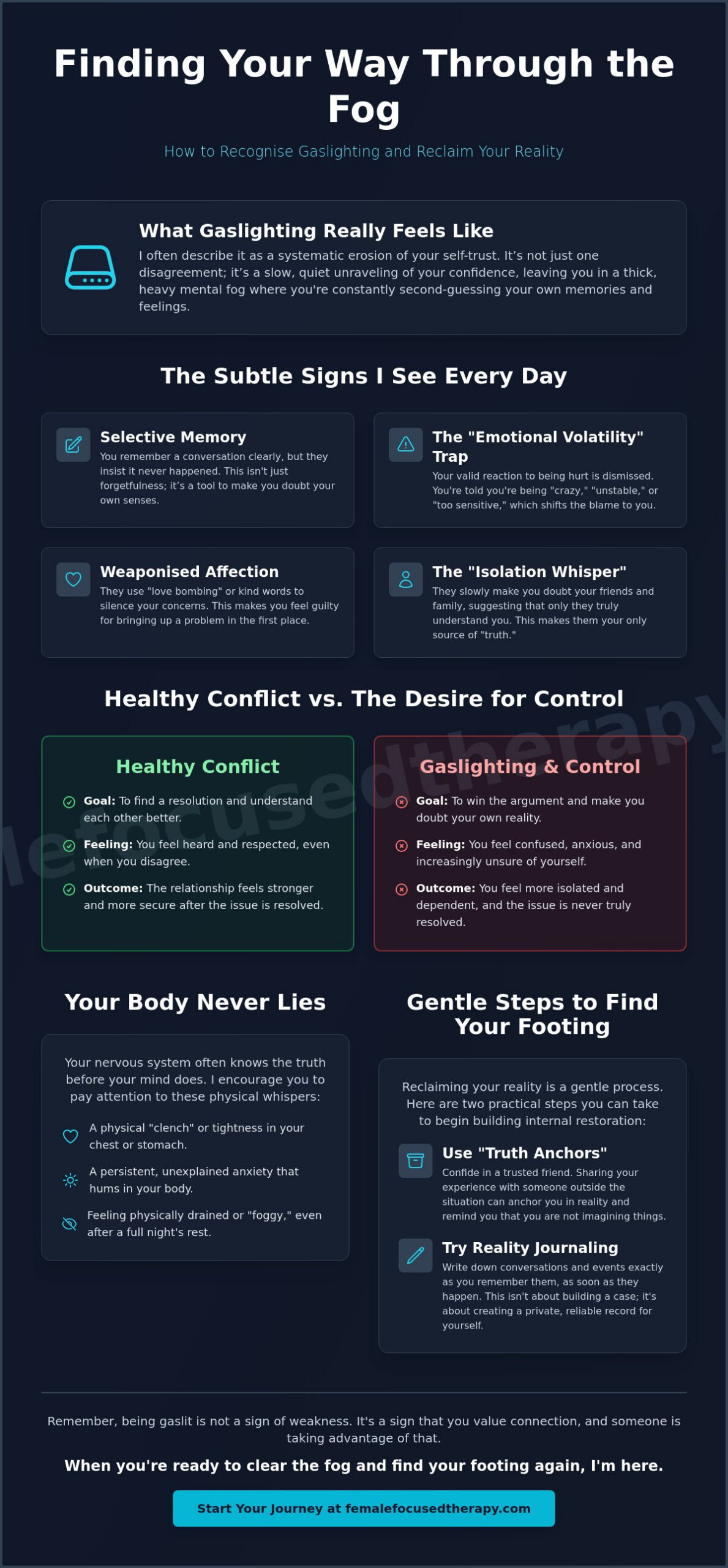
Gaslighting is the systematic erosion of your self-trust. It is not just a simple disagreement or a difference of opinion; it is a slow, quiet unraveling of your confidence in what you know to be true. I often describe it to my clients as a deliberate attempt to make you feel like the ground beneath your feet is constantly shifting.
When you begin to recognise the signs you are a victim of gaslighting, it usually starts with a thick, heavy mental fog. You might feel dazed or find yourself constantly checking your phone to verify dates, times, and old messages. This persistent feeling of being unsure of your own thoughts is exhausting and leaves you feeling emotionally depleted.
I find that intelligent, high-functioning women are often the most targeted by this behaviour. Your strength, empathy, and ability to see multiple perspectives are actually what a gaslighter uses to hook you. Because you are capable and logical, you try to “understand” their point of view, which gives them the space to plant seeds of doubt in your mind.
This is further complicated by the “Dr. Jekyll and Mr. Hyde” dynamic. One moment, your partner is the kind, supportive person you fell in love with; the next, they are cold and denying your reality. This flip-flopping keeps you stuck in a loop of hope, where you are always waiting for the “good” version of them to return while blaming yourself for the bad moments.
The Internal Monologue of a Gaslit Woman
Your mind can become a courtroom where you are constantly preparing a “case” to prove your own experiences. You might find yourself thinking, “I must have misheard,” or “Maybe I am being too sensitive.” These thoughts are not your own; they are the echoes of what has been said to you over and over again.
You may also notice an “apology reflex.” You find yourself saying sorry for things you didn’t even do, or for simply having a feeling. In my work with relationship trauma and narcissistic abuse, I see how this reflex develops as a survival mechanism to keep the peace and avoid further conflict.
Why Your Intelligence Isn’t a Shield
It is a common misconception that only “weak” people are gaslit. In reality, your intelligence can sometimes make the cognitive dissonance even harder to manage. You are trying to apply logic to an illogical and abusive situation. This creates a painful state where you hold two conflicting beliefs: you love this person, but you don’t feel safe with them.
This internal conflict is at the heart of the Gaslighting definition, which focuses on the psychological manipulation used to gain power and control. By making you doubt your perceptions, the other person becomes the only “reliable” source of truth in your life, which is a incredibly isolating experience.
Please remember that being gaslit is not a sign of weakness or a lack of awareness. It is a sign that you are a person who values connection and truth, and someone is unfortunately taking advantage of those qualities. Recognising this is the first step toward clearing the fog and reclaiming your sense of self.
The Subtle Signs You Are Being Gaslit Every Day
I have noticed that gaslighting often lives in the small, quiet moments of your day. It is the “selective memory” tactic where your partner looks you in the eye and insists a conversation you clearly remember never actually happened. This isn’t a simple lapse in memory; it is a tool used to make you doubt your own senses. You might also encounter the “emotional volatility” trap. This is when your valid reaction to being hurt or lied to is dismissed as you being “crazy” or “unstable.”
Another subtle move is weaponised affection. They might use kind words or “love bombing” to silence your concerns, making you feel guilty for even bringing up a problem. Then there is the “isolation whisper.” This is when they slowly make you doubt the support of your friends and family, suggesting that only they truly understand or care for you. Looking at the signs of gaslighting can help you see these patterns for what they are: a strategy for control.
When you are looking for signs you are a victim of gaslighting, pay attention to the frequency of these events. It is rarely one big lie. Instead, it is a steady drip of misinformation that makes you feel like you are losing your grip on what is real. This constant second-guessing is a heavy burden to carry alone.
Recognising the ‘Too Sensitive’ Narrative
When a partner uses your emotional intelligence against you, it feels like death by a thousand cuts. They might tell you that you are “overthinking” or “too sensitive” to dismiss the small lies that build a false reality. When someone tells you how you feel, they are overstepping a fundamental boundary of your personhood. It is a way of erasing your internal experience to make room for their version of the truth.
Gaslighting and the ADHD Experience
As someone who lives with ADHD and works as a therapist, I know how easily our neurodivergence can be exploited. If you already struggle with working memory or focus, a gaslighter might use that as “proof” that you simply forgot what happened. You might find yourself believing them because you are used to misplacing your keys or losing track of time. This makes it even harder to identify the signs you are a victim of gaslighting.
In my work with ADHD women, I see how this creates a unique layer of vulnerability. You start to rely on the gaslighter to be your “external brain,” which only deepens the cycle of dependency. If this feels familiar, it might be time to explore professional support to help you untangle these threads and trust your own mind again.
Healthy Conflict vs. Gaslighting: Knowing the Difference
I want to be very clear: having a disagreement is not the same as abuse. In a healthy partnership, two people can have completely different perspectives on the same event. It is perfectly normal to say, “I remember it differently,” as long as both people feel heard and respected.
The difference lies in the goal of the conversation. In a healthy relationship, you are both working toward a resolution. You want to understand each other so you can move forward together. When you look for signs you are a victim of gaslighting, you will notice the goal is never resolution; it is always about control.
The gaslighter isn’t interested in your perspective or your pain. They want to replace your reality with theirs so they can maintain power in the relationship. This is why accountability is the most important differentiator.
Identifying these signs you are a victim of gaslighting helps you see that a healthy partner takes responsibility for their impact. They do this even if they didn’t intend to cause harm, because they value the relationship more than being right.
What Accountability Looks Like
Imagine a partner who says, “I honestly don’t remember saying that, but I can see I’ve really hurt you. I’m sorry.” This is accountability. It validates your feelings without needing to agree on every single detail of the past. It keeps the connection safe.
In contrast, a gaslighter will use stonewalling or flat-out denial to shut you down. They might use the phrase “I’m sorry you feel that way.” This isn’t a real apology. It is a subtle way of shifting the blame onto your feelings rather than addressing their actions. In my work with relationship trauma, I see how these non-apologies keep women stuck in a cycle of self-blame.
The ‘Too Sensitive’ Objection
You might be sitting there thinking, “But what if I really am the problem? What if I am just too sensitive?” I want you to take a deep breath. Sensitivity is not a flaw. It is a strength that allows you to connect deeply with others and navigate life with empathy.
When someone uses your sensitivity as a reason to dismiss your pain, they are trying to avoid the consequences of their behaviour. You can set a boundary by saying, “My feelings are valid, and I need you to listen to me without labelling me.” This is a vital step toward protecting your internal restoration and self-reliance.
The Body Never Lies: Somatic Signs of Gaslighting
Your mind might be tangled in arguments and “did they say that?” but your body has a different language. It often recognises the truth long before your conscious mind catches up. I’ve found that one of the most reliable signs you are a victim of gaslighting is a physical “clench” or a sudden tightness in your chest when you hear the garage door open or see a name pop up on your phone.
This isn’t just “nerves.” It is your nervous system shifting into a state of hyper-vigilance to protect you from the next psychological blow. This constant state of alert is incredibly draining. It leads to a bone-deep chronic fatigue that no amount of sleep seems to fix, because your body is working overtime to maintain a facade of calm while your internal world is under fire.
We often dismiss our “gut feelings,” but they are actually sophisticated physiological signals from your enteric nervous system. When you feel that sinking sensation in your stomach while your partner tells you that you “imagined” a conversation, that is your body telling you that your reality is being threatened. Your body is trying to keep you safe even when your mind is being manipulated into doubt. To support this biological drive for safety, you can check out Street Safe Self Defence to learn practical ways to reinforce your personal boundaries and physical confidence.
Restoring the Mind-Body Connection
Clearing the fog often requires moving out of the analytical mind and into the physical self. Integrating somatic movement and rest can help you release the physical trauma stored in your tissues. When you feel your reality being challenged, try a simple grounding exercise: press your feet firmly into the floor and name three things you can see right now.
Coming back to the breath isn’t just about relaxation; it is a tool for reclaiming your own space. It reminds your nervous system that you are here, you are real, and you are safe in this moment. This practice helps bridge the gap between your physical sensations and your mental clarity.
Chronic Stress and the Female Body
Long-term gaslighting doesn’t just stay in your head. It can manifest as physical ailments, from digestive issues to tension headaches. I see this often in my work with women navigating life transitions and menopause, where hormonal shifts can already make you feel vulnerable. Stress can exacerbate these symptoms, making it harder to trust your own physical experiences.
Your body communicates through quiet whispers of discomfort before it has to scream. Listening to these signals is a vital part of recognising the signs you are a victim of gaslighting and starting your healing journey. If your body is telling you that something is wrong, I invite you to book a session to explore these somatic signals in a safe, supportive space.
Reclaiming Your Reality: Steps Toward Internal Restoration
The journey out of the fog begins with a single, courageous step: deciding to trust yourself again. Once you’ve identified the patterns of manipulation, the focus shifts from trying to change the other person to protecting your own peace. This is a process of internal restoration, where you slowly rebuild the confidence that has been stripped away.
I often suggest starting a “Reality Journal.” This isn’t just a diary; it’s a private record of events and feelings written down immediately after they happen. When your partner later insists that you “imagined” a certain comment, you can return to your notes. Seeing the truth written in your own hand acts as a powerful antidote to the confusion and helps you bypass the doubt.
You also need “Truth Anchors.” These are the trusted friends or family members who see the real you and validate your experiences. When you’re dealing with someone who manipulates the truth, you might also find it helpful to practise the “Grey Rock” method. This involves becoming as uninteresting and non-responsive as a plain rock during interactions, which helps you preserve your precious emotional energy.
Rebuilding Your Inner Compass
Healing isn’t just about leaving a difficult situation; it’s about returning to yourself. Your intuition is a muscle that has been forced into atrophy; we can strengthen it together. It takes time to listen to that quiet inner voice again, especially after years of being told it’s wrong or “too sensitive.”
In my practice, I find that relationship trauma therapy provides the safe container needed for this delicate work. We look at the patterns of the past and use somatic tools to release the tension held in your body. This integrated approach allows you to move toward a life where you feel grounded in your own reality.
Finding Your Safe Space in Singapore or Online
I work with women every day who feel dazed by the psychological gymnastics of a manipulative relationship. Whether you’re in Singapore or connecting with me through online therapy, my goal is to help you restore your sense of self-reliance. You don’t have to carry this heavy fog alone, and you don’t have to keep questioning your sanity.
If you’re ready to start untangling the confusion and reclaim your voice, the next step is simple. I invite you to book a consultation so we can begin the process of rebuilding your internal peace. You deserve to live a life where your truth is respected and your reality is your own.
Moving Toward Clarity and Peace
Moving through the heavy fog of a manipulative relationship is one of the most exhausting journeys you’ll ever take. We’ve explored how your body often signals the truth before your mind can process it; and how reclaiming your reality starts with small, consistent acts of self-validation. You don’t have to carry the burden of these signs you are a victim of gaslighting on your own.
As a Registered Integrative Psychotherapist and a specialist in narcissistic abuse recovery, I offer a trauma-informed, female-focused approach to help you rebuild your internal stability. My goal is to provide a safe space where your experiences are heard without judgment and your intuition is restored to its rightful place. Healing is a steady process, but it’s one you deserve to experience.
Book your initial consultation with me here to start clearing the confusion and finding your way back to yourself. You are stronger than the fog, and I’m here to walk beside you as you find your footing again.
Frequently Asked Questions
What is the most common sign of gaslighting?
The most common indicator is a persistent sense of self-doubt that makes you question your own memory and sanity. You might find yourself searching for signs you are a victim of gaslighting because you feel like you are constantly “getting it wrong” in your partner’s eyes. This internalised confusion is a hallmark of the experience. It leaves you feeling dazed and unable to trust your own perceptions of reality.
Can someone gaslight you without realising they are doing it?
Yes, some people use these tactics as a learned survival mechanism from their own past without a conscious plan to be abusive. However, it’s important to remember that the impact on you is the same regardless of their intent. Whether they realise it or not, the behaviour is still harmful. My focus is always on helping you find safety and clarity rather than trying to diagnose the other person’s motivations.
How do I know if I’m being gaslit or if I’m just being ‘too sensitive’?
You can tell the difference by looking at how your partner responds to your feelings. In a healthy dynamic, a partner might disagree but will still validate your emotions. A gaslighter will use your sensitivity as a weapon to dismiss your concerns entirely. If you feel like your reality is being systematically denied rather than just debated, you are likely experiencing manipulation rather than just a personality clash.
What should I do if I realise I am a victim of gaslighting?
Your first priority should be your own safety and emotional well-being. Start by reconnecting with people who validate your reality and consider seeking trauma-informed professional support. Recognising the signs you are a victim of gaslighting is a powerful first step. I often work with women to help them build a safe internal space before they make any big external life changes or decisions about the relationship.
Can a relationship survive gaslighting if the other person changes?
A relationship can only survive if the person gaslighting is willing to take full accountability and undergo long-term, specialised therapy. True change is rare because the behaviour is rooted in a deep need for control. Both partners must be committed to a complete restoration of trust and a new way of communicating. Without professional intervention, the old patterns of manipulation almost always return over time.
Is gaslighting a form of domestic abuse?
Yes, gaslighting is officially recognised as a form of domestic abuse and coercive control. In the UK, the Domestic Abuse Act 2021 explicitly includes psychological and emotional abuse in its definition. Research from the National Domestic Violence Hotline shows that 74% of female victims report experiencing gaslighting. It is a serious form of harm that leaves deep emotional scars even when physical violence is not present.
How long does it take to recover from the effects of gaslighting?
Recovery is a personal journey that doesn’t have a fixed timeline. For some, it takes months to clear the initial fog; for others, the process of rebuilding self-trust takes much longer. It depends on the duration of the relationship and the support you have in place. My approach focuses on steady, manageable steps toward internal restoration so you don’t feel overwhelmed as you slowly return to yourself.
What happens if I try to confront a gaslighter about their behaviour?
Confronting a gaslighter often leads to a tactic called DARVO: Deny, Attack, and Reverse Victim and Offender. Instead of getting an apology, you might face more denial or be blamed for the very behaviour you are calling out. This is why I often suggest focusing on your own “Truth Anchors” and internal reality rather than trying to get the gaslighter to admit what they are doing.

Article by
Cheryl Kennedy MacDonald MA BA (Hons) Pg. Dip. SAC BACP
Cheryl Kennedy MacDonald is a psychotherapist specialising in women’s mental health, relationships, and life transitions. She works with women navigating trauma, relationship breakdown, identity shifts, and midlife change, helping them rebuild self-trust, emotional stability, and a clear sense of who they are and what they want.
With over 20 years’ experience working with women internationally, Cheryl is the founder of YogaBellies, a global women’s yoga school, and the creator of the Birth ROCKS method. Her work sits at the intersection of psychotherapy and embodiment, integrating evidence-based therapeutic approaches with somatic, body-based practices that support deep, lasting change.
Known for her grounded and direct approach, Cheryl moves beyond surface-level insight to address the patterns held in the body and nervous system. Her work supports women to regulate, reconnect, and respond to their lives from a place of clarity, strength, and self-respect.
She is a published author in academic journals and has written multiple books on women’s health, pregnancy, and midlife wellbeing, available on Amazon and leading book retailers worldwide.