
What if the “clinging” you feel in your relationships isn’t a personality flaw, but your body’s way of trying to keep you safe? It is incredibly exhausting to live in a state of constant hyper-vigilance, always waiting for the other shoe to drop or for the person you love to simply walk away. You might feel like you’re “too much” for others, or find yourself spiralling into a deep sense of unworthiness whenever you’re left alone.
I understand how heavy this silence feels, and I want you to know that healing is possible. It doesn’t involve “fixing” who you are, but rather learning to listen to what your system is telling you. I’ll help you understand the roots of your fear and share how a gentle, somatic-informed therapy for fear of abandonment can help you rebuild a sense of internal safety from the inside out.
In this guide, we’ll explore how connecting with your body’s signals can transform your relationships. We will look at how you can start feeling truly safe when alone, trusting that loved ones will return, and finally developing a warm but boundaried relationship with yourself.
Key Takeaways
- You will learn why your feelings of clinginess are actually a survival response rooted in earlier relationship trauma.
- I’ll show you how therapy for fear of abandonment uses somatic techniques to help you feel truly safe within your own skin.
- You can learn to recognise your “rejection radar” so you stop pushing people away before they have a chance to leave.
- Explore how listening to your body’s wisdom can help you build a more secure and boundaried relationship with yourself.
- Find out how my integrative approach helps you feel grounded and stable through even the most difficult life transitions.
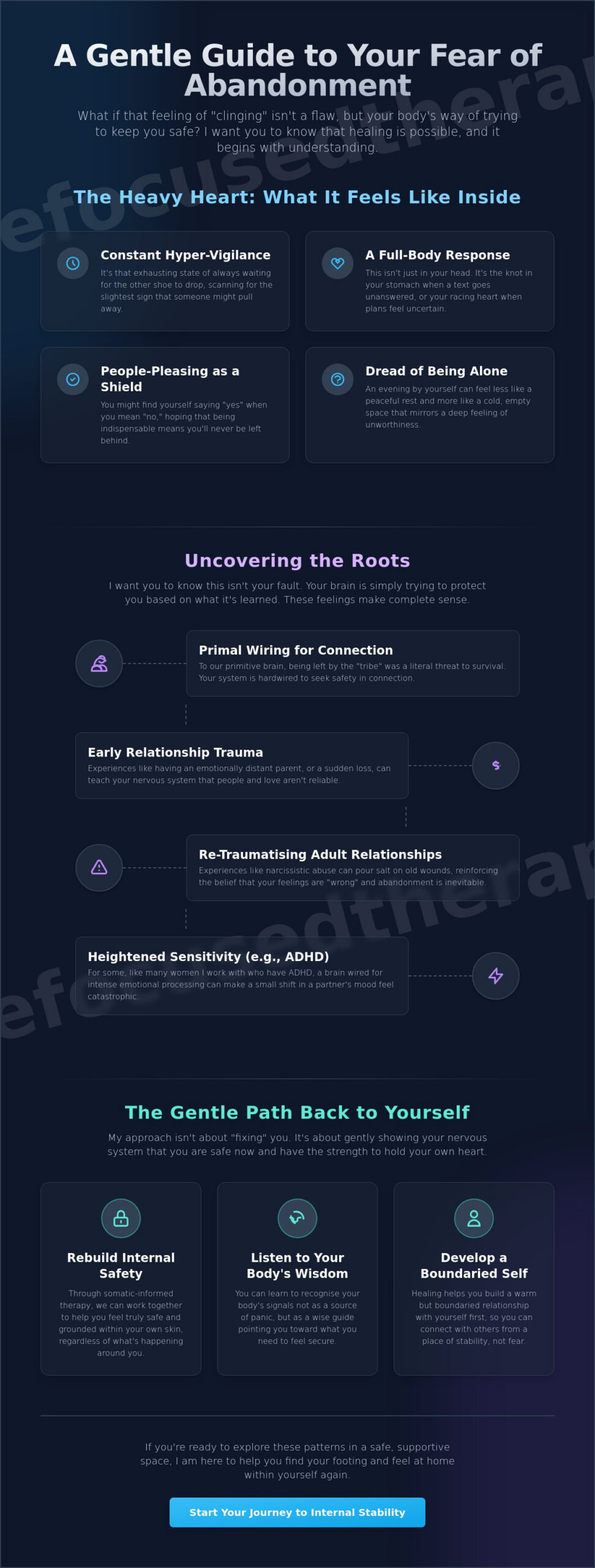
The heavy heart of abandonment: what it feels like to live in fear
I want to start by acknowledging just how exhausting it is to live your life constantly looking for the exit signs. When you live with a deep-seated fear of being left, your mind becomes a master at scanning for the slightest hint of withdrawal. It is a wearying way to exist, always waiting for the moment the person you love decides you are “too much” or simply walks away.
This experience isn’t just a mental worry or a bit of anxiety. It is a visceral, full-body response to a perceived threat. You might know that familiar knot in your stomach that tightens the second a text goes unanswered for too long. Your heart might race, and your thoughts can spiral into a frantic search for what you might have done wrong. In my work, I’ve seen how relationship trauma can leave the nervous system stuck in this high-alert state.
Many of the women I support are incredibly high-functioning. You might be the one everyone leans on, the “helper” who has everything under control. Often, this fear hides behind a mask of perfectionism or being “low maintenance.” You might try to be so helpful and so indispensable that no one would ever dream of leaving you, yet the internal dread remains.
Recognising the signs in your daily life
I often see people-pleasing show up as a primary survival strategy. You might find yourself saying “yes” when you mean “no,” or constantly adjusting your personality to suit the room. This is your “rejection radar” at work. It is a highly tuned sensitivity to a partner’s slight change in tone or a friend’s preoccupied expression.
Spending an evening alone can feel like a mountain to climb. Instead of a peaceful time for rest, it can feel like a cold, empty space that mirrors a deep sense of unworthiness. This is why seeking therapy for fear of abandonment is so important. It isn’t about fixing a flaw, but about learning how to stay with yourself when the silence feels too loud.
Why this fear isn’t your fault
I want you to know that your brain is simply trying to keep you safe. We are biologically wired for connection. To our primitive brain, being left behind by the “tribe” literally equalled danger. If you have experienced emotional abandonment in the past, your system learned that people aren’t reliable.
Your feelings make complete sense given what you have survived. Whether it was a parent who was physically there but emotionally distant, or a sudden loss that shook your world, your body remembers. Through therapy for fear of abandonment, we can gently show your nervous system that you are safe now, and that you have the internal strength to hold your own heart.
Uncovering the roots: why the fear of being left feels so real
I often find that the intense dread you feel today isn’t just about the present moment. It is frequently an echo of earlier, unresolved relationship trauma that has stayed tucked away in your nervous system. These past experiences act like a filter, tinting how you view every text, every silence, and every disagreement in your current life.
Sometimes, abandonment isn’t a dramatic exit. It can be “invisible,” such as growing up with a parent who was physically present but emotionally distant. You may have learned early on that your needs were “too much” or that you had to be perfect to receive any attention. This creates a blueprint where love feels conditional and fragile. There are many paths to overcome fear of abandonment, and understanding this history is a vital first step.
In adulthood, narcissistic abuse can re-traumatise an already sensitive nervous system. If you have been told you are “crazy” for having feelings, your fear of being left becomes a survival mechanism. I have also noticed a significant link between ADHD in women and a heightened sensitivity to rejection. When your brain is wired to process emotions intensely, a small shift in a partner’s mood can feel like an impending catastrophe. Specialized therapy for fear of abandonment helps us unpick these threads with kindness.
The role of attachment styles
You might have heard of anxious attachment. I don’t use this as a label to “fix” you, but as a way to understand your early blueprints for love. These patterns dictate how you show up now. My goal is to help you move toward “earned security,” where you feel grounded regardless of what others do. If you feel ready to explore these patterns in a safe space, you can book a session to begin that work.
Neurodivergence and the fear of rejection
For my neurodivergent clients, we often talk about Rejection Sensitive Dysphoria (RSD). This isn’t just “being sensitive”; it is an overwhelming emotional pain that follows a perceived rejection. The ADHD brain can struggle to regulate these intense feelings, especially when there is societal pressure to be “easy to love.” We work on validating this experience rather than pathologising it, allowing you to breathe through the intensity without spiralling.
The rejection radar: how abandonment fear shapes your relationships
I believe the “rejection radar” is actually a highly developed survival skill. It isn’t a defect in your character or a sign that you are “difficult.” If you’ve survived a history where people weren’t reliable, your brain learned to scan for the smallest signs of withdrawal. This was your way of protecting yourself from the pain of being blindsided.
While this radar is trying to save you, it can often lead to what looks like “self-sabotage.” You might find yourself pushing someone away or picking a fight just to get the “inevitable” ending over with. It feels safer to be the one who leaves first than to be the one left behind. You might also “test” a partner, creating a storm just to see if they will really stay through it.
This fear can also keep you trapped in unhealthy couples dynamics because being alone feels worse than being unhappy. When the thought of an empty house feels like a threat to your safety, you might tolerate treatment you know you don’t deserve. Reading a comprehensive overview of the fear of abandonment can help you see that these choices are understandable survival strategies.
Breaking the cycle of hyper-vigilance
In our sessions, I work with you to notice the “ping” on the radar without immediately reacting to it. We learn to distinguish between a genuine red flag and a shadow of the past. My aim in therapy for fear of abandonment is to help you create a “pause” between the feeling of panic and the urge to cling. This pause is where your new, secure life begins.
Communicating your needs without shame
I also help you find the words to tell a partner, “I’m feeling a bit wobbly today,” instead of lashing out or shutting down. Building a relationship where it is safe to be vulnerable about your fears is life-changing. We’ll explore the power of co-regulation. This is how a safe partner can help soothe your nervous system while you’re still building your own internal stability.
Gentle somatic and mindful steps toward feeling safe within yourself
I believe that true healing happens when we include the body in the conversation. When you’re stuck in a loop of fear, your mind is often screaming for safety while your body is frozen in a past memory. I’ve found that integrating the body into therapy for fear of abandonment is the key to lasting change. Somatic work isn’t about a workout; it’s about listening to your body’s wisdom and teaching it that the threat has passed.
In my sessions, I use the breath to signal to your nervous system that you are safe in this exact moment. This is a core part of my approach to therapy for fear of abandonment. We work on the concept of “internal restoration,” which is the process of rebuilding the home within yourself. The goal is to make your internal world a place where you actually want to spend time, so that being alone no longer feels like an echoing void.
Somatic tools for moments of panic
The “grounding hug” is a simple but powerful way to provide yourself with physical containment when you feel like you’re falling apart. You simply cross your arms and hold your own shoulders, applying a gentle, firm pressure that tells your brain where your body ends and the world begins. Slow, rhythmic movement can help you shake off the freeze response by discharging the pent-up energy of a panic attack.
I also encourage using sensory anchors to ground you. This might be the feel of a soft blanket, the scent of a specific essential oil, or the sound of the birds outside. These anchors bring you back to the “here and now” when the echoes of the past feel too loud to ignore. They provide a physical tether to the present moment, helping you realise that you are not in the past anymore.
The power of rest and stillness
For many women I work with, “doing nothing” can be the hardest and most healing thing to practice. If you’ve spent years in a state of hyper-vigilance, stillness feels dangerous. Yet, it is in these quiet moments that we learn to tolerate the silence of being alone. It’s about finding comfort in the lack of noise.
Restorative movement helps you inhabit your body without the pressure to perform or “fix” anything. I always advocate for a mind-body perspective that doesn’t demand you “think” your way out of pain. If you’re ready to start this journey of internal restoration, you can book your initial session here to begin exploring these tools together.
How I can support your journey back to internal stability
I offer a space that is warm, boundaried, and deeply informed by the unique challenges women in Singapore and beyond face. Whether you are navigating the complexities of an international move or the high-pressure expectations of a professional life, I understand the specific weight you carry. I am Cheryl Kennedy MacDonald, and I am here to hold that space for you while you find your footing.
My approach is integrative, meaning we use what works for your unique story and your specific body. We won’t just talk about the fear; we will work together to transform your relationship with it. Through therapy for fear of abandonment, we move beyond simply “coping” and focus on rebuilding the internal confidence you need to feel secure in yourself.
What to expect in our sessions
In our time together, validation and safety always come first. We go at a pace that feels manageable for you, ensuring your nervous system never feels rushed or overwhelmed. I blend traditional talk therapy with mindfulness and somatic insights to create a path forward that feels natural and grounded. I aim to provide a “secure base” from which you can explore the parts of you that feel most fragile, knowing you are supported.
Taking that first, brave step
I know how hard it is to reach out when you’re afraid of being rejected or misunderstood. It takes immense courage to admit that you’re struggling with the silence and the dread of being left. You don’t have to carry this weight alone anymore; I am here to help you navigate the way back to your own internal home. One realistic next step is to book a gentle consultation with me today.
Taking the first step toward your own internal home
Healing the silence of abandonment isn’t about becoming “less needy” or fixing a flaw in your personality. It is about understanding that your fear is a survival response and learning how to soothe your nervous system from the inside out. We have explored how your history and neurodivergence might shape your “rejection radar,” and how somatic tools can help you find grounding in the present moment.
As a Registered Integrative Psychotherapist, I provide a trauma-informed and gender-centric space for you to do this delicate work. Whether you are seeking therapy for fear of abandonment online from anywhere in the world or in-person in Singapore, I am here to help you rebuild a sense of self-reliance that feels warm and secure.
You don’t have to navigate this heavy dread alone anymore. You are worthy of a relationship with yourself that feels safe, steady, and kind. If you feel ready to move forward with a renewed sense of internal stability, I am here to walk alongside you. I’m ready to start my journey toward internal safety—book a session with Cheryl.
Answering your questions about healing abandonment fear
Is fear of abandonment a mental illness?
Fear of abandonment isn’t a mental illness in its own right; it’s a deeply human response to past trauma or unstable attachment. I see it as your nervous system’s way of trying to protect you from being blindsided by loss again. It often shows up as a symptom of other experiences like relationship trauma or complex grief.
It’s a survival strategy that has outlived its usefulness. While it can feel overwhelming, it is essentially a set of learned patterns and physical responses that we can gently work to unlearn in a safe, therapeutic space.
Can you actually heal from a fear of abandonment?
Yes, you can absolutely move toward a place of “earned security” through dedicated therapy for fear of abandonment. Healing doesn’t mean the memory of the pain disappears, but rather that your system no longer reacts with the same level of panic. You learn to trust your own ability to hold yourself through difficult moments.
This internal restoration changes how you show up in your relationships. Instead of reacting from a place of old wounds, you begin to respond from your present, adult self. You start to feel safe even when you’re alone, knowing you have your own back.
How does ADHD affect my fear of being left?
ADHD can make the fear of being left feel much more intense due to Rejection Sensitive Dysphoria (RSD). As a woman with ADHD myself, I know that our brains process emotional pain in the same areas as physical pain. This makes a perceived slight feel like a visceral wound that is hard to ignore.
Our struggle with emotional regulation can also lead to spirals that make it harder to “bounce back” after a disagreement. We might over-analyse a partner’s tone for hours, unable to shift our focus. Understanding this neurodivergent trait is a huge part of the healing process.
What is the best type of therapy for abandonment issues?
I believe an integrative approach that combines talk therapy with somatic insights is the most effective way forward. While understanding your story is important, we must also address the physical “freeze” or “cling” response in your body. If we only talk about the fear, we leave the body behind.
By combining cognitive understanding with nervous system regulation, we address the roots of the fear rather than just managing the symptoms. This mind-body perspective ensures that the changes you make are felt deeply and aren’t just intellectual realisations.
How do I know if I have abandonment issues or if my partner is just distant?
It’s often a mix of both, but the key is how you react to that distance. If your partner is genuinely withdrawn, a secure response is to address it calmly or set a boundary. If you find yourself spiralling into panic, self-blame, or frantic “testing” of the relationship, that usually points to an internal wound.
In our work, we focus on helping you distinguish your “rejection radar” from actual red flags. This clarity allows you to see the situation for what it is. You’ll learn to trust your intuition rather than your fear.
Can somatic movement really help with relationship anxiety?
Somatic movement is incredibly powerful because it teaches your body that it is safe in the here and now. When relationship anxiety hits, your body is essentially reliving a past trauma. Gentle movement, breathwork, and grounding exercises help discharge that “flight or fight” energy before it takes over.
This allows you to stay present with your partner instead of reacting from a place of old pain. It gives you a physical way to “come home” to yourself when the world feels shaky. It’s about finding stability within your own skin.
What happens during a therapy session for abandonment fear?
In our sessions, we create a “secure base” where you can be completely honest about your fears without judgment. We might explore the roots of your attachment patterns or use somatic tools to ground you if you feel overwhelmed. It’s a collaborative process that respects your pace.
We look at your current relationship challenges through a lens of compassion and practical restoration. You’ll leave with a better understanding of your triggers and real-world tools to help you stay grounded when the fear starts to rise.
How long does it take to feel better in therapy?
There is no fixed timeline for healing, as every woman’s story and nervous system are unique. Some clients start to feel a sense of relief after just a few sessions of therapy for fear of abandonment as they begin to feel seen and validated. It’s a steady journey of restoration.
Deeper restoration of your internal safety usually happens over several months as we work through layers of trauma and build new patterns. The goal isn’t a “quick fix” but a lasting change in how you relate to yourself and others.

Article by
Cheryl Kennedy MacDonald MA BA (Hons) Pg. Dip. SAC BACP
Cheryl Kennedy MacDonald is a psychotherapist specialising in women’s mental health, relationships, and life transitions. She works with women navigating trauma, relationship breakdown, identity shifts, and midlife change, helping them rebuild self-trust, emotional stability, and a clear sense of who they are and what they want.
With over 20 years’ experience working with women internationally, Cheryl is the founder of YogaBellies, a global women’s yoga school, and the creator of the Birth ROCKS method. Her work sits at the intersection of psychotherapy and embodiment, integrating evidence-based therapeutic approaches with somatic, body-based practices that support deep, lasting change.
Known for her grounded and direct approach, Cheryl moves beyond surface-level insight to address the patterns held in the body and nervous system. Her work supports women to regulate, reconnect, and respond to their lives from a place of clarity, strength, and self-respect.
She is a published author in academic journals and has written multiple books on women’s health, pregnancy, and midlife wellbeing, available on Amazon and leading book retailers worldwide.