
An amicable divorce isn’t about liking your ex-partner or pretending the pain doesn’t exist. It’s actually about mastering your own internal state and setting boundaries that protect your peace. You might be sitting there wondering, how do i prepare for an amicable divorce? while feeling like your identity is slipping away. It’s a heavy weight to carry, especially when you’re trying to keep things steady for your children.
I understand how overwhelming the legal noise feels, especially with changes like California’s 2026 joint petition law or Florida’s recent limits on alimony. It’s easy to lose your sense of self in the logistics. I want to help you navigate these emotional and practical steps with kindness and a renewed sense of self-trust.
In this guide, I’ll share how to stay emotionally stable while managing the transition. We will explore ways to maintain a functional co-parenting relationship and ensure your separation remains as peaceful as possible. You deserve to move forward with a sense of internal stability and hope for your next chapter.
In this article, I will help you navigate the emotional and practical steps of ending your marriage with kindness and self-trust. Here is what we will explore together:
- Redefining your divorce as a functional, respectful partnership to protect your peace and your family’s future.
- Practical steps for when you are wondering, how do i prepare for an amicable divorce? and how to shift your mindset from conflict to resolution.
- How I use somatic practices like breathwork and gentle movement to help you release the stress and tension held in your body.
- Establishing clear communication boundaries, including the “Business Partner” rule, to maintain a calm co-parenting relationship.
- Rebuilding your identity and internal self-trust through individual therapy as you move through this major life transition.
What Does an Amicable Divorce Actually Mean for You?
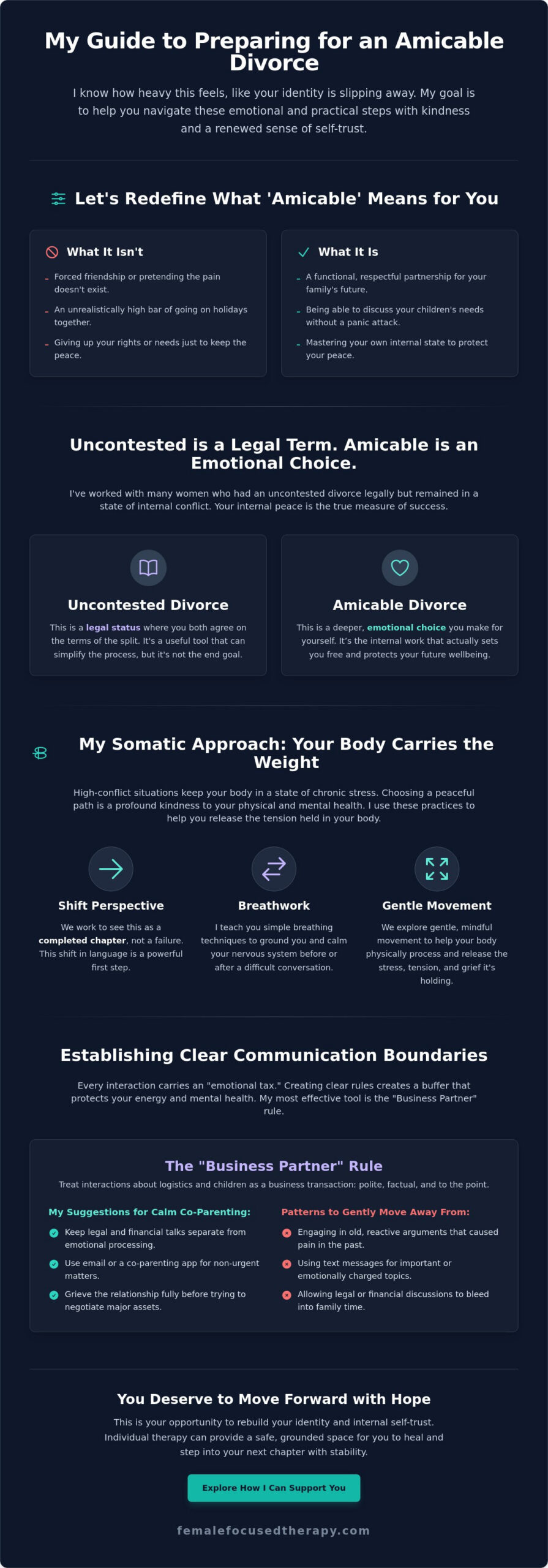
When you ask yourself, how do i prepare for an amicable divorce?, you might imagine a scene where everyone is smiling and sharing coffee. In reality, amicability is much more grounded than that. I define it as a functional, respectful business partnership for the future. It’s about deciding that while the marriage is over, the respect for your shared history remains intact.
In my practice, I focus on the concept of therapeutic justice. This isn’t just about who gets the house or the car. It’s about the emotional foundation of your new life. It’s the belief that the legal process should support your healing, not hinder it. You are closing a chapter, not failing a life test, and that requires a shift in how you view the “end.”
Amicability requires two willing participants, but it always starts with one person choosing to lower the temperature. By deciding to lead with kindness and self-trust, you set a new tone for the entire transition. It’s about holding space for your own emotions while refusing to engage in the old, reactive patterns that caused pain in the past.
The Difference Between Uncontested and Amicable
It’s helpful to understand what an uncontested divorce means in a legal sense. This is simply a status where you both agree on the terms. But being truly amicable is a deeper, emotional choice. I’ve worked with many women who agreed to everything legally but remained trapped in a cycle of internal conflict and resentment.
I often see women confuse “agreeing to everything” with being amicable. You don’t have to give up your rights or your needs to keep the peace. When you are wondering how do i prepare for an amicable divorce?, remember that your internal peace is the true metric of success. A “simplified” legal track is a tool, but the emotional work is what actually sets you free.
Why Amicability is a Gift to Your Future Self
Choosing this path is a profound kindness to your body. High-conflict litigation keeps your cortisol levels spiked for months or even years. This chronic stress affects your sleep, your digestion, and your ability to parent. By choosing a resolution-focused path, you are literally protecting your physical and mental health from the long-term impact of trauma.
You also protect your children from the “loyalty binds” of a parental war. They don’t have to choose a side or carry the weight of your conflict. This approach is central to the relationship trauma support I offer. It helps you move from a state of survival to one of restoration, ensuring you enter your next chapter with your dignity and health intact.
Shifting Your Perspective from Conflict to Resolution
Moving through a split often feels like being caught in a storm. It’s very easy to slip into a “victim versus villain” narrative. While that story might offer a temporary shield for your heart, it rarely helps you find a peaceful exit. I encourage you to view your marriage as a completed chapter rather than a failure. This subtle shift in language allows you to hold your head high while you ask yourself, how do i prepare for an amicable divorce? without carrying the weight of shame.
I know firsthand how difficult it is to focus when your world is changing. My own experience with ADHD means I understand the specific “brain fog” that descends during high-stress transitions. It’s hard to make life-altering decisions when your executive function is offline. This is why I believe it’s vital to grieve the relationship before you sit down at the negotiating table. If you try to talk about finances while you’re still in the rawest stage of shock, the conflict will almost certainly escalate.
Managing the “Emotional Tax” of Divorce
Every interaction with your ex-partner carries an emotional tax. You might find that a simple text message about the children triggers a physical reaction in your gut or chest. I suggest keeping legal discussions strictly separate from your emotional processing. When you use specific communication strategies, you create a buffer that protects your mental health. I often use mindfulness techniques with my clients to help them stay grounded, even when their ex is being particularly difficult or reactive.
Building Your Emotional Support Squad
Your lawyer is there to handle the law, not your heart. One of the most expensive mistakes you can make is using your legal counsel as a therapist. Instead, you need a support squad that champions peace. This means choosing friends who offer a calm ear rather than those who fuel the fire with “team you” aggression. This is where individual psychotherapy becomes such a powerful tool. It provides a safe, boundaried space to rebuild the self-trust that often withers during a split. If you feel like you’re losing your centre, you might find it helpful to explore a supportive space to talk where we can focus on your internal restoration together.
My Somatic Approach to Preparing Your Body for Divorce
Divorce isn’t just a legal event; it’s a physical experience. When you ask yourself, how do i prepare for an amicable divorce?, you might immediately think of spreadsheets and lawyers. But your body is often the first to know something is changing. You might feel a tight jaw, hunched shoulders, or a heavy, dull ache in your womb area. These are the places where “divorce trauma” often settles.
I use breathwork and gentle movement to help you process these physical echoes of stress. If your nervous system is stuck in a state of fight or flight, you cannot negotiate fairly or clearly. Rest becomes a radical act of self-preservation during this transition. It isn’t a luxury; it’s the fuel you need to stay steady and present during mediation sessions.
Understanding how individual therapy supports your physical and mental health is vital. It helps you recognise when your body is reaching its limit before you hit a breaking point. By soothing your nervous system, you can approach the legal process from a place of grounded strength rather than raw panic.
Breath as an Anchor During Negotiation
When an email comes in that makes your heart race, I recommend using a simple 4-7-8 breath. You inhale for four, hold for seven, and exhale slowly for eight. This simple rhythm signals safety to your brain. Staying in your body prevents you from making reactive, fear-based decisions that you might regret later. I often weave these somatic tools into my intensive therapy options for women who need deeper, focused support.
Creating a “Sanctuary” Space at Home
Your home might feel like a battlefield right now. I encourage you to claim at least one room as a sanctuary that is entirely yours. Use soft lighting and familiar scents like lavender or sandalwood to signal safety to your brain. This small, physical boundary helps your nervous system decompress at the end of the day. It’s a space where you can simply be, without the pressure of the ongoing transition.
Don’t underestimate the power of simple movement. Even a short walk in natural light can help clear the brain fog I mentioned earlier. It’s about moving the stagnant energy of conflict through your system so it doesn’t get stuck. This physical clarity often leads to better emotional decisions as you navigate your new path.
Setting Boundaries and Communication Rules for the Process
When you are looking at how do i prepare for an amicable divorce?, one of the most effective tools I recommend is the “Business Partner” rule. It’s a simple but powerful mental filter. If you wouldn’t say a specific sentence to a professional colleague, you shouldn’t say it to your ex-partner. This keeps the focus on the logistics of the split and prevents old emotional wounds from derailing your progress.
I also suggest moving all divorce-related talk out of your personal text messages. Using dedicated email threads or parenting apps creates a digital boundary that protects your daily life. It means you won’t be surprised by a stressful legal question while you’re at work or trying to enjoy a quiet moment. Setting “blackout times” where you do not engage with any messages at all is equally vital for your nervous system.
Many women I work with have spent years in narcissistic patterns where their voice was silenced. If this is your experience, setting these rules might feel terrifying at first. I help women find their voice again and realise that boundaries aren’t an act of aggression; they are an act of self-respect. You are allowed to decide how and when you will communicate during this transition.
The Power of the “Pause” Before Responding
I encourage you to wait 24 hours before replying to any message that feels like a “hook.” When you feel that ADHD impulsivity driving you to defend yourself or lash out, take a breath instead. Ask yourself: “Does this response bring me closer to an amicable end?” If the answer is no, let it sit. Often, the urge to react passes, leaving you with the clarity to respond from a place of grounded strength.
Navigating the Singapore Mediation Process
In Singapore, the Family Justice Courts place a heavy emphasis on mediation to help couples reach a resolution. To prepare, I suggest focusing on your “interests” rather than your “positions.” A position is “I want the house,” while an interest is “I want a stable home for the children.” When you focus on interests, it becomes much easier to find a middle ground that works for everyone involved.
Remember that being “boundaried” is far more effective than just being “nice.” You can be kind and respectful while still being firm about your needs and the future you are building. If you feel you need professional support to hold these boundaries, you can book a session to discuss your communication strategy with me. We can work together to ensure you feel safe and heard throughout the mediation process.
Moving Forward: How Individual Therapy Supports Your New Life
Divorce is more than the end of a legal contract; it’s a profound life transition that asks you to reinvent how you move through the world. This period requires a completely new set of emotional skills. I work with you to rebuild the self-trust that so often withers during a split. When you’ve been part of a marital unit for a long time, trusting your own intuition can feel like learning a new language.
In the previous sections, we talked about being a “business partner” and staying somatic. While those tools help you get through the day, therapy provides the safe container for the “messy” emotions you can’t show your ex. It’s a space where you can be raw, angry, or deeply uncertain without it impacting your mediation. We move together from simply surviving the divorce to thriving in your new-found independence.
If you’re still asking, how do i prepare for an amicable divorce?, remember that the most important preparation is internal. You need a place where your voice is the only one that matters. Rebuilding that internal restoration is the focal point of our work together, ensuring you don’t just finish this process, but you finish it whole.
Reclaiming Your Identity Beyond “Wife”
This is a time to look at your life through a lens of curiosity rather than loss. What does your body need now? What does your mind crave when it isn’t occupied by conflict? By focusing on your own growth, you shift the narrative from “ending” to “beginning.” It’s about honouring the woman you are becoming, rather than just grieving the woman you used to be.
Taking the First Step Toward Peace
I invite you to book a quiet space for yourself today, even if it’s just for fifteen minutes. Use this time to reflect on what you want your life to look like a year from now. While you’re still figuring out how do i prepare for an amicable divorce?, remember that you don’t have to carry the weight alone. I am here to hold that space with you as you navigate this change.
You are likely much stronger and more resilient than you feel in this moment. If you’re ready to start rebuilding your self-assurance, you can book an individual psychotherapy session to begin your journey. We will work at a pace that feels manageable for you, moving steadily toward your new chapter with peace, clarity, and kindness.
Embracing Your New Chapter with Clarity
Choosing an amicable path is a profound act of self-care that ripples out to every area of your life. We’ve explored how shifting your perspective to a business-like partnership protects your peace, while somatic tools help settle a racing heart during difficult moments. You now have a practical framework for setting boundaries that actually work for your unique situation. When you sit with the question, how do i prepare for an amicable divorce?, remember that the answer begins with trusting your own intuition and moving at a pace that feels safe for your nervous system.
I am here to support you through every step of this internal restoration. As a Registered Integrative Psychotherapist and specialist in relationship trauma, I provide a trauma-informed, mind-body approach to help you navigate these complex changes. You don’t have to carry the heavy emotional weight of this transition on your own. I invite you to book a session with me to find your path through this transition. You are incredibly resilient, and I truly believe you can move forward into a life that feels authentic, grounded, and peaceful.
Frequently Asked Questions
How do I prepare for an amicable divorce in Singapore?
I recommend starting by familiarising yourself with the “Simplified Track” offered by the Family Justice Courts. This path is designed for couples who have already reached a full agreement on all ancillary matters, such as child custody and the division of assets. To make this work, I encourage you to focus on the concept of therapeutic justice, ensuring the emotional groundwork is laid before you ever file the formal papers.
Can we have an amicable divorce if we still have disagreements about money?
Yes, you can certainly remain amicable even when you don’t see eye-to-eye on every financial detail. Amicability isn’t about the total absence of conflict; it’s about how you choose to handle those disagreements. If you approach these discussions using the “Business Partner” rule I mentioned earlier, you can negotiate your interests without letting the conversation descend into a personal attack.
How long does an uncontested or amicable divorce typically take?
In Singapore, an uncontested divorce on the simplified track often takes around four to six months to reach the Final Judgment. This is significantly faster than a contested case, which can often drag on for a year or more. When you ask, how do i prepare for an amicable divorce?, remember that being organised with your paperwork and agreements is what keeps this timeline moving at a manageable speed.
What is the very first step I should take if I want a peaceful separation?
The most important first step is to regulate your own nervous system and decide on your “non-negotiables.” I often suggest that women find a safe, therapeutic space to process their initial shock and grief before they even mention the word “divorce” to their partner. This ensures you are speaking from a place of grounded clarity rather than raw, reactive emotion, which sets the tone for everything that follows.
How do I tell my children about our amicable divorce without scaring them?
I believe it’s best to speak to them together as a unified front, using calm and age-appropriate language that they can easily process. You should reassure them that the divorce is a “grown-up problem” and that it is absolutely not their fault. By showing them that you and their father can still communicate respectfully, you reduce the fear and loyalty binds they might otherwise feel about the transition.
Do I still need to hire a lawyer if my husband and I are being amicable?
It’s usually wise to have a lawyer review your agreements to ensure they are legally sound and truly protect your future interests. You don’t necessarily need a high-conflict litigator; instead, you can look for a collaborative professional who supports your goal of a peaceful exit. They can handle the formal filing and legal technicalities while you and your partner handle the heart of the personal agreement.
Is it possible to have an amicable divorce with a partner who has narcissistic traits?
This is incredibly challenging and requires very strict, high-level boundaries to prevent you from being emotionally drained. In these cases, amicability might look more like “parallel parenting” and using the “Grey Rock” method to keep all interactions boring and factual. I work with many women in this situation to help them maintain their internal restoration while navigating a partner who may try to provoke them.
What if I want an amicable divorce but my partner wants to fight?
You can only control your own reactions and your own boundaries, not their desire for conflict. If they refuse to engage respectfully, you may need to rely more heavily on your legal and therapeutic support squads to protect your peace. When you are wondering how do i prepare for an amicable divorce? in this difficult context, the focus shifts entirely to protecting your own stability while staying true to your values.

Article by
Cheryl Kennedy MacDonald MA BA (Hons) Pg. Dip. SAC BACP
Cheryl Kennedy MacDonald is a psychotherapist specialising in women’s mental health, relationships, and life transitions. She works with women navigating trauma, relationship breakdown, identity shifts, and midlife change, helping them rebuild self-trust, emotional stability, and a clear sense of who they are and what they want.
With over 20 years’ experience working with women internationally, Cheryl is the founder of YogaBellies, a global women’s yoga school, and the creator of the Birth ROCKS method. Her work sits at the intersection of psychotherapy and embodiment, integrating evidence-based therapeutic approaches with somatic, body-based practices that support deep, lasting change.
Known for her grounded and direct approach, Cheryl moves beyond surface-level insight to address the patterns held in the body and nervous system. Her work supports women to regulate, reconnect, and respond to their lives from a place of clarity, strength, and self-respect.
She is a published author in academic journals and has written multiple books on women’s health, pregnancy, and midlife wellbeing, available on Amazon and leading book retailers worldwide.