
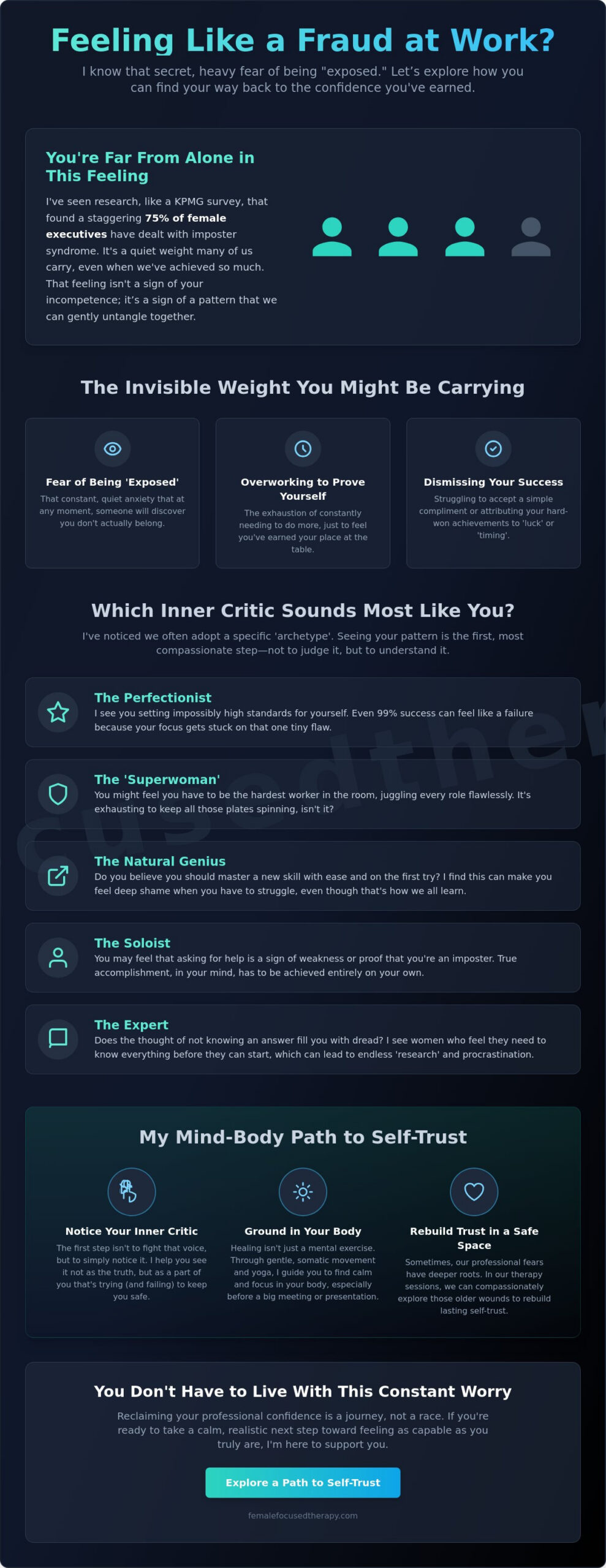
Did you know that a KPMG survey found that 75% of female executives have dealt with the crushing weight of feeling like a fraud? Even though you’ve worked incredibly hard to get where you are, that quiet voice might still whisper that you’re just lucky. I’ve found that overcoming imposter syndrome at work starts with acknowledging that secret, heavy fear of being “exposed” as incompetent.
I know how exhausting it is to carry that anxiety into every meeting and email. It’s draining to over-work just to prove you belong, especially when you can’t seem to internalise your own achievements or accept a simple compliment. This constant pressure often leads to deep burnout and a sense of being perpetually overwhelmed by the very career you built.
You don’t have to live with this constant professional worry or the fear of failure. I’m going to show you how to quiet your inner critic and reclaim your professional confidence through a compassionate, mind-body approach. We’ll explore how to build a healthier relationship with your success so you can finally feel as grounded and capable as you truly are.
Key Takeaways
- Understand why high-achieving women often feel like they’re tricking others and how to shift your perspective on what you’ve earned.
- Explore the connection between professional self-doubt and past experiences of narcissistic abuse or relationship trauma.
- Identify your specific imposter archetype, like the Perfectionist, to understand why you struggle to accept “good enough” results.
- Learn how to use somatic movement and yoga to ground your body and find calm focus before your next big meeting or presentation.
- Discover how overcoming imposter syndrome at work is possible through a safe, therapeutic space that helps you rebuild lasting self-trust.
Feeling Like a Fraud When You Are Doing Your Best
I often sit with women who have achieved incredible things. From the outside, they look composed, capable, and entirely in control of their professional lives. Yet, inside, they feel like they are tricking everyone. They are waiting for the moment someone taps them on the shoulder and says, “We’ve finally realised you don’t belong here.” This secret fear can be incredibly isolating, making every success feel like a lucky fluke rather than the result of your hard work.
This experience, known as Impostor syndrome, is the persistent inability to believe that your success is deserved. It isn’t a simple lack of confidence that a pep talk can fix. I see it as a form of high-functioning anxiety that keeps you in a state of hyper-vigilance. For many of us, this feeling has become a familiar, albeit painful, companion that follows us from one promotion to the next. It whispers that you’re a fraud, even when the evidence of your skill is right in front of you.
The invisible weight of being ‘Superwoman’
I want to talk about the immense pressure we put on ourselves to be perfect in every role we inhabit. Whether you are leading a team or managing a complex project, the expectation to be flawless is crushing. You might feel that making one tiny mistake will cause your whole reputation to crumble. This leads to a constant, quiet exhaustion. You are always self-monitoring at the office, checking your tone and your emails until there is nothing left for yourself at the end of the day.
Recognising this exhaustion is a vital part of overcoming imposter syndrome at work. When you are stuck in “Superwoman” mode, you aren’t just working; you are performing. This performance is a protective shield, but it’s one that prevents you from ever feeling truly secure in your achievements. I’ve found that when we stop trying to be perfect, we finally find the space to be authentic.
Why your ‘inner critic’ is a loud, uninvited guest
I view the inner critic as a part of you that is trying, quite poorly, to keep you safe. It thinks that if it criticises you first, you’ll be prepared for the criticism of others. It is vital to understand that this voice isn’t the truth. Instead, it is a reflection of your stress and perhaps your past experiences. It’s a loud guest that doesn’t know when to leave the party.
The first step in overcoming imposter syndrome at work is noticing the voice without letting it drive the car. You don’t have to argue with it or try to shut it down with force. Simply acknowledging its presence allows you to create a small bit of distance. When you can observe the critic with a sense of curiosity and compassion, it slowly loses its power to dictate how you feel about your career and your worth.
Why the Workplace Triggers Our Deepest Insecurities
I’ve spent many years listening to women describe the boardroom as a place of constant performance. It’s rarely just about the tasks on your to-do list. Instead, the office can feel like a stage where you are being judged or graded at every turn. If you have a sensitive nervous system, these high-stakes environments can feel inherently unsafe, triggering a “fight or flight” response during a simple status update.
In my work with women, I’ve found that our professional fears often have much older roots. If you have a history of relationship trauma or narcissistic abuse, it’s common to doubt your own reality. When someone has spent years undermining your confidence, you carry that ghost into your career. You might find yourself searching for hidden meanings in a manager’s feedback or waiting for the “truth” of your incompetence to be revealed.
This deep-seated doubt makes overcoming imposter syndrome at work feel like an uphill battle. It isn’t just about learning new skills or getting another certification. It’s about addressing the parts of you that learned to stay small to stay safe. When we look at these older wounds with compassion, we can start to dismantle the idea that you are a fraud.
I often see women who are incredibly successful but feel like they are walking on thin ice. They worry that one wrong move will shatter the image they’ve worked so hard to build. This hyper-vigilance isn’t a lack of talent; it is a survival strategy that no longer serves you in the professional world.
The intersection of ADHD and professional self-doubt
If you are a woman with ADHD, imposter syndrome can feel like a daily reality rather than a passing phase. I know this from both my clinical work and my own life. You might spend your entire day “masking” to fit into a neurotypical world, terrified that a slip in executive function will expose you. This constant effort is exhausting and reinforces the feeling that you are just pretending to be capable.
I help my neurodivergent clients see that their brains aren’t broken, just different. We work together to overcome impostor phenomenon by understanding how your unique brain processes information. Once you stop judging yourself by neurotypical standards, the weight of being an “imposter” begins to lift.
How past trauma echoes in the boardroom
If you’ve survived a narcissistic boss or a difficult partner, trust is hard to rebuild. The hyper-vigilance you once used to survive can easily show up as perfectionism at work. You might check a report ten times because you’re afraid of the fallout from a single typo. I believe that healing these wounds is the key to overcoming imposter syndrome at work and feeling solid in your career. If you’re ready to start that journey, we can explore these patterns in individual psychotherapy sessions designed for your specific needs.
Softening the Five Types of Imposter Syndrome
I find it helpful to look at which “imposter archetype” you tend to lean into. Naming these patterns isn’t about giving yourself another label to carry; it’s about understanding the specific flavour of your self-doubt. When we can see these habits clearly, the process of overcoming imposter syndrome at work becomes much more manageable and less like a fight against an invisible enemy.
Most of the women I work with recognise themselves in at least one of these five common patterns:
- The Perfectionist: For you, “good enough” feels like a dangerous failure. You focus on the one minor flaw in a project rather than the 99 things that went perfectly.
- The Expert: You feel you must possess every possible piece of information before you speak up in a meeting. You might have years of experience, yet you still feel like a beginner.
- The Soloist: You believe that asking for help is a sign of weakness or incompetence. You carry the entire weight of a project alone, terrified that leaning on others will “expose” you.
- The Natural Genius: When a task takes effort or time to master, you feel like you’ve failed the talent test. You believe that if you were truly capable, everything would be easy.
Identifying these archetypes allows us to meet them with curiosity rather than judgement. It’s the first step toward reclaiming your confidence and finding a steadier way to work.
Reframing the Superwoman archetype
I see so many women trying to do it all, perfectly, all at once. We often feel we have to work twice as hard as everyone else just to be seen as “enough.” This archetype is particularly heavy because it ties your entire worth to your output. It’s a relentless cycle that leaves no room for rest or mistakes.
Learning to value your humanity over your productivity is a core part of overcoming imposter syndrome at work. You are a person, not a machine. Your value doesn’t fluctuate based on how many emails you’ve sent or how many tasks you’ve ticked off your list today. I help my clients move away from this performance and toward a more sustainable, grounded sense of self.
Why asking for help is an act of self-trust
I often encourage my clients to see collaboration as a professional strength rather than a personal deficit. When you are stuck in the Soloist pattern, you end up burning out in silence. It takes immense self-trust to say, “I need a second pair of eyes on this,” or “I’m not sure how to approach this part.”
It’s interesting how the same concepts of support we explore in couples therapy apply to your professional life too. Learning to lean on others safely is a vital skill. By breaking the cycle of the Soloist, you stop viewing your colleagues as judges and start seeing them as partners, which is essential for long-term career satisfaction.
Practical Ways I Help You Reclaim Your Confidence
I don’t believe in the old “fake it till you make it” advice. It just adds another layer of performance and exhaustion to an already heavy load. Instead, I focus on helping you find your way back to your authentic self. Overcoming imposter syndrome at work isn’t about becoming someone else; it’s about learning to trust the person you already are.
I often suggest my clients start an “Evidence File.” This is a dedicated space, perhaps a digital folder or a physical notebook, where you collect your wins, positive feedback, and successful project outcomes. When your inner critic tells you that you’ve done nothing right, this file provides the physical facts to counter those lies. It helps you internalise your achievements rather than dismissing them as luck.
When you make a mistake, I encourage you to practice “radical self-compassion.” This means treating yourself with the same kindness you would offer a dear friend. Mistakes are part of being human, not proof that you are a fraud. By softening your response to failure, you take away the critic’s most powerful weapon and create a safer internal environment for growth.
Somatic tools: Using the body to calm the mind
I integrate somatic movement and yoga into our work because imposter syndrome isn’t just a thought. You feel it as a tight chest, a racing heart, or a knot in your stomach during a meeting. I often teach my clients a simple “grounding breath” to use the moment that fraud-panic hits. Simply feeling your feet on the floor can interrupt a spiral of self-doubt by sending a signal of safety to your nervous system.
Choosing to rest is a radical act of defiance against the voice that says you must always be doing more to be enough. When we calm the body, the mind often follows. This mind-body approach is essential for overcoming imposter syndrome at work because it addresses the physical stress response that generic “positive thinking” often ignores.
The ‘Good Enough’ revolution
I want to invite you to try being “competently average” for just one day. It sounds terrifying to a high-performer, but there is immense relief in lowering the bar and finding that the world doesn’t actually end. When you allow yourself to be human, you stop the constant self-monitoring that leads to deep professional burnout.
We can work on shifting your focus from “how am I doing?” to “what am I contributing?” This subtle change takes the spotlight off your personal performance and places it back on the value of the work itself. If you’re ready to stop performing and start feeling solid in your career, you can book an online therapy session with me to begin this restorative journey.
Finding Your Way Back to Self-Trust Through Therapy
I believe that you don’t have to carry this heavy secret alone anymore. For many high-achieving women, the fear of being “found out” prevents them from ever truly enjoying the career they’ve built. In our sessions, individual psychotherapy provides a safe, confidential space where you can finally unmask. You don’t have to be the perfect leader, the tireless mother, or the unflappable professional here.
The goal of our work isn’t to make you a perfect version of yourself. Instead, we aim to make you feel safe in your own skin. I’ve seen so many women transform their careers once they stop fighting themselves and start trusting their own intuition. When you stop pouring all your energy into hiding your perceived flaws, you suddenly have so much more room to actually lead and create. This shift isn’t about fixing a deficit; it is about reclaiming the power you already possess.
In our work together, we focus on three main areas of internal restoration:
- Developing a compassionate internal voice that replaces the harsh critic.
- Regulating your nervous system so you can stay calm in high-pressure meetings.
- Internalising your successes so they feel like yours, not just lucky accidents.
How integrative therapy creates lasting change
I combine evidence-based tools like CBT with mindfulness to address both your internal narrative and your nervous system. This multidisciplinary approach is essential for overcoming imposter syndrome at work because it tackles the root of the anxiety rather than just the symptoms. We look at the “why” behind the fraud-panic while giving you practical ways to stay grounded in the moment.
A female-focused approach is vital because high-achieving women face unique pressures, from hormonal transitions to the subtle biases of the corporate world. We work together to rebuild the self-trust that life and work may have eroded over time. This isn’t a quick fix, but a steady journey toward internal restoration and professional self-reliance.
Your first step toward a quieter mind
I invite you to book a consultation if you’re ready to feel differently about your professional life. It’s a brave step to admit you’re struggling, but it’s the only way to move toward lasting stability. You deserve to work without the constant weight of anxiety pressing down on you every morning.
Remember that you are already enough, exactly as you are right now. You don’t need another certification or a perfectly polished presentation to prove your worth. That fraud feeling is a liar, and I am here to help you see the truth of your own competence. Overcoming imposter syndrome at work is possible, and I would be honoured to support you in finding your way back to yourself.
Stepping Into Your Professional Power with Confidence
We’ve explored how identifying your imposter archetype and using somatic grounding tools can begin to shift the heavy weight of feeling like a fraud. It’s about moving away from the performance of perfection and toward a version of success that actually feels safe and sustainable. When you learn to listen to your body and quiet your inner critic, you create space for your true skills to shine.
I know that overcoming imposter syndrome at work is a deeply personal journey that involves both the mind and the body. By softening your response to perceived failures and embracing radical self-compassion, you can finally start to internalise your achievements. You don’t have to navigate this transition alone or carry the secret of your self-doubt in silence anymore.
As a registered integrative psychotherapist with over 20 years of experience, I specialise in supporting women’s mental health, particularly around trauma and ADHD. I’m here to offer a grounded, empathetic space where you can unmask and rebuild your internal stability. If you’re ready to find a quieter mind and a more stable professional life, book your initial consultation with me today. You are already enough, and it’s time you felt it too.
Common Questions About Navigating Professional Self-Doubt
Is imposter syndrome a formal mental health diagnosis?
Imposter syndrome is not a formal mental health diagnosis in the DSM-5; it is a psychological pattern of doubting your accomplishments. I see it as a shared human experience rather than a clinical disorder. Understanding this can take the pressure off, allowing you to view your feelings as a common response to high-pressure environments rather than a personal failing or illness.
Can imposter syndrome at work lead to burnout?
Yes, it absolutely can lead to burnout because of the constant over-working used to compensate for a perceived lack of skill. When you are perpetually trying to stay one step ahead of being “found out,” you never allow yourself to rest. This chronic stress drains your internal resources, eventually making it impossible to maintain your professional performance without sacrificing your health.
How do I tell my boss I’m struggling with imposter feelings?
I usually suggest framing the conversation around professional development and clear performance metrics rather than using the word “fraud.” You might ask for specific feedback on your recent contributions to align your internal perception with their external reality. This approach helps you get the validation you need while maintaining a professional boundary in the workplace.
Is imposter syndrome more common in women with ADHD?
It is very common for women with ADHD to experience these feelings, often due to a lifetime of “masking” their executive function struggles. I find that when you’re working twice as hard to stay organised, it’s easy to feel like you’re tricking everyone. Overcoming imposter syndrome at work often involves accepting that your neurodivergent brain simply processes information differently, not less effectively.
Can therapy actually help me overcome the feeling of being a fraud?
Therapy is incredibly effective because it helps you untangle the roots of your self-doubt and rebuild your internal confidence. We work together to identify where these messages of unworthiness started and how to replace them with a more balanced perspective. It’s a journey of restoration that allows you to work without the constant shadow of anxiety or the fear of failure.
What is the quickest way to calm down when I feel like an imposter during a meeting?
The quickest way to ground yourself is a somatic tool like feeling the weight of your feet firmly on the floor. I encourage you to take one slow, deep breath and notice the physical sensation of the chair supporting you. This simple shift moves your attention away from the “fraud-panic” in your mind and back into the safety of your body.
How do I know if I’m actually underqualified or just experiencing imposter syndrome?
You can distinguish the two by looking at the objective evidence, such as your successful hiring, positive performance reviews, and completed projects. If you were truly underqualified, you wouldn’t be meeting your targets or receiving praise from your peers. Imposter syndrome is the gap between your actual competence and how you feel about it inside.
Will my imposter syndrome ever go away completely?
While the thoughts may occasionally return during big life transitions, overcoming imposter syndrome at work means these feelings no longer control your actions. You learn to hear the voice of the critic and choose to ignore it. Over time, it becomes a quiet, background noise rather than a loud, paralysing force that stops you from pursuing new opportunities.

Article by
Cheryl Kennedy MacDonald MA BA (Hons) Pg. Dip. SAC BACP
Cheryl Kennedy MacDonald is a psychotherapist specialising in women’s mental health, relationships, and life transitions. She works with women navigating trauma, relationship breakdown, identity shifts, and midlife change, helping them rebuild self-trust, emotional stability, and a clear sense of who they are and what they want.
With over 20 years’ experience working with women internationally, Cheryl is the founder of YogaBellies, a global women’s yoga school, and the creator of the Birth ROCKS method. Her work sits at the intersection of psychotherapy and embodiment, integrating evidence-based therapeutic approaches with somatic, body-based practices that support deep, lasting change.
Known for her grounded and direct approach, Cheryl moves beyond surface-level insight to address the patterns held in the body and nervous system. Her work supports women to regulate, reconnect, and respond to their lives from a place of clarity, strength, and self-respect.
She is a published author in academic journals and has written multiple books on women’s health, pregnancy, and midlife wellbeing, available on Amazon and leading book retailers worldwide.