
Have you ever wondered why your heart races for someone who treats you so poorly, or why you can’t seem to stop checking your phone for a message that you know will only end in pain? I know how heavy that shame feels. You might feel like you’ve lost your strength, but I want you to know there’s a biological reason why narcissistic abuse is addictive on a cellular level.
Your struggle isn’t a character flaw; it’s a deeply wired physiological response involving a complex mix of hormones and survival instincts. In this space, I’ll help you understand the biological and emotional reasons why you feel hooked on this toxic cycle. We’ll look at how your nervous system’s been hijacked and how you can begin a gentle, somatic journey toward freedom.
We’ll explore practical ways to calm your body’s alarm system and how to start rebuilding the self-trust that’s been eroded. You deserve to feel grounded and safe in your own skin again. I’m here to guide you through this restoration of your internal confidence and self-reliance at a pace that’s manageable for you.
Key Takeaways
- You’ll discover the biological reasons why narcissistic abuse is addictive, helping you see that your struggle to leave is a physiological response rather than a character flaw.
- I’ll explain how intermittent reinforcement creates a dopamine loop in your brain, which is why those small “breadcrumbs” of affection feel so incredibly powerful and hard to walk away from.
- You will learn why willpower alone isn’t enough to break a trauma bond when your nervous system is stuck in survival modes like fawning or freezing.
- We’ll explore how somatic practices can help you soothe your overworked alarm system, moving the focus from the other person’s behaviour back to your own internal safety.
- I’ll share how an integrative approach to therapy can support you in rebuilding your self-trust and finding your way back to a stable, grounded life.
Why it feels like you are addicted to the person hurting you
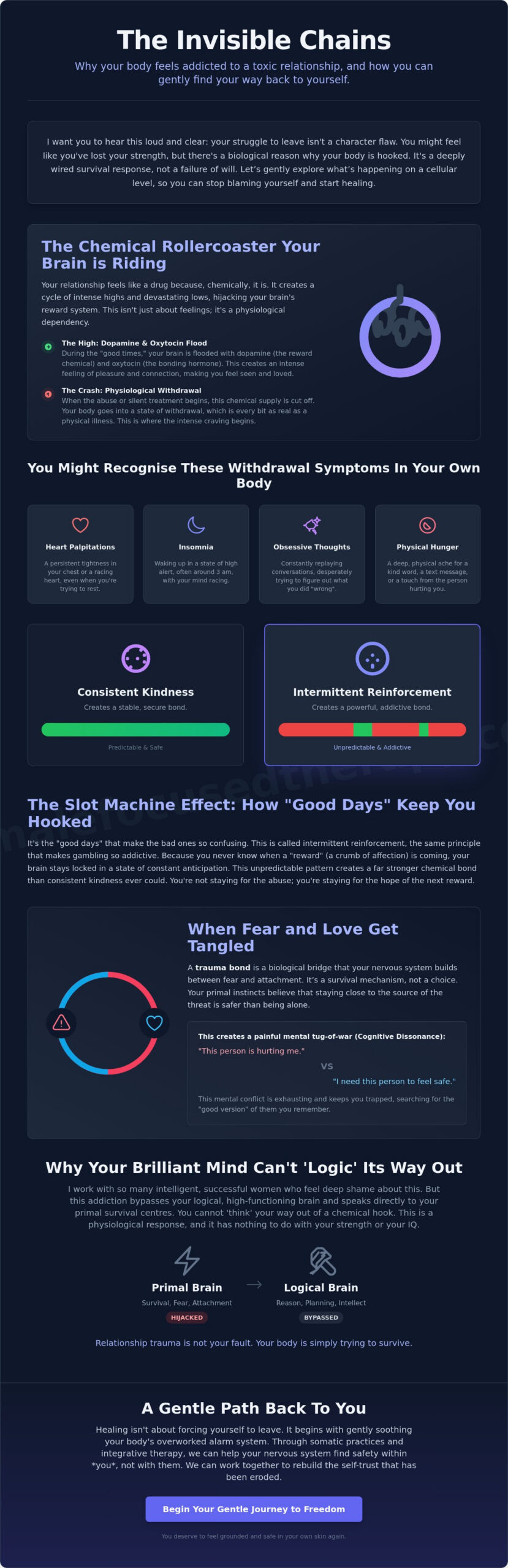
I often hear women describe their relationship as a drug they just can’t quit. They tell me about the intense, physical ache they feel when their partner pulls away or goes cold. I want to validate that this isn’t a sign of weakness or a lack of character. When we look at why narcissistic abuse is addictive, we see that your brain is reacting in the same way it would to a slot machine or a powerful narcotic.
You’re living through a cycle of extreme highs followed by devastating lows. When things are good, your brain is flooded with dopamine, the chemical responsible for reward and pleasure. When the abuse starts or the “silent treatment” begins, that supply is suddenly cut off. This leaves you in a state of physiological withdrawal that is every bit as real as a physical illness.
You might recognise these withdrawal symptoms in your own body:
- Heart palpitations or a persistent tightness in your chest.
- Insomnia or waking up in a state of high alert at 3 am.
- Obsessive thoughts, replaying conversations to find where things went wrong.
- A physical hunger for a kind word or a touch from the person hurting you.
This isn’t just love or passion. It’s a chemical hook that keeps you tethered to a person who isn’t safe for you. It’s like being at a casino where you keep losing, but the memory of that one big win keeps you pulling the lever.
The confusing reality of loving someone who causes pain
Traumatic bonding is a biological bridge that forms between fear and attachment during times of extreme stress. It’s a survival mechanism, not a choice. Your brain tries to find safety by trying to “fix” or please the person who scares it. Your primal instincts believe that staying close to the source of the threat is actually safer than being alone and unprotected.
This creates a painful state of cognitive dissonance. You’re holding two conflicting truths at once: “This person is hurting me” and “I need this person to feel safe.” This mental tug-of-war is exhausting. It keeps you trapped in a loop, constantly searching for the version of them that once made you feel seen and loved.
Why your ‘high-functioning’ brain is struggling to cope
I work with many intelligent, successful women who feel deep shame about being in this position. You might be a leader in your career or a pillar of your community. Yet, you feel completely powerless in this relationship. This happens because the addiction bypasses your logical brain and speaks directly to your primal survival centres.
Your intelligence cannot simply “think” its way out of a chemical hook. It’s a physiological response that has nothing to do with your IQ or your resilience. I want to offer you a gentle reminder that relationship trauma is not your fault. You aren’t weak for feeling this way. Your body is simply trying to survive an impossible situation.
The chemical loop of breadcrumbs and intermittent reinforcement
I’ve noticed that most people expect abuse to be constant, but that’s rarely the case. It’s the “good days” that make the bad ones so confusing. This is known as intermittent reinforcement. It’s the same psychological principle that makes slot machines so hard to walk away from. Because you don’t know when the next reward is coming, your brain stays locked in a state of constant anticipation.
When your partner finally offers a crumb of affection after a period of coldness, your brain receives a massive dopamine spike. This unpredictable reward system is exactly why narcissistic abuse is addictive. It creates a stronger bond than consistent kindness ever could. Understanding the neurobiology of trauma bonds helps us see that this isn’t just about your feelings. It’s about a chemical dependency that your body has developed to survive the stress.
Oxytocin also plays a tricky role here. During moments of physical intimacy or “makeup” sessions, this “cuddle hormone” floods your system. It creates a sense of deep trust and bonding, even if that person was cruel to you only hours before. It effectively blinds you to the reality of the abuse, making you feel tethered to them on a primal level. When the inevitable “discard” or cold phase happens, your system crashes. You aren’t just sad; you’re experiencing a physiological drop in feel-good chemicals.
Dopamine, ADHD, and the intensity of the ‘fix’
As a woman with ADHD, I know that our relationship with dopamine is already a bit complicated. We often seek out high-stimulation environments to regulate our minds. The intense “love-bombing” phase of a narcissistic relationship can feel like the ultimate dopamine fix. You might find yourself hyperfocusing on the relationship, making it your entire world.
The chaos and the “make-up” cycles provide a level of stimulation that a healthy, stable relationship simply doesn’t offer. This can make a peaceful partner feel “boring” or “flat” in comparison. It’s a difficult transition to make, but learning to find safety in calm is a vital part of the recovery process. If you’re feeling overwhelmed by these cycles, we can explore these patterns together in individual psychotherapy sessions.
The ‘breadcrumbs’ of love that keep you waiting
Breadcrumbing is a subtle tool of control where someone gives you just enough attention to keep you interested, but never enough to feel secure. It’s that one kind text after three days of silence, or a sudden compliment after a week of criticism. These tiny gestures are designed to keep your hope alive.
A single kind word can erase weeks of mistreatment in your mind because your brain is starving for that relief. You live in a state of “maybe this time it’s different,” which is incredibly draining for your nervous system. It keeps you waiting for a version of them that doesn’t actually exist, while the real person continues to cause you harm.
Why willpower alone cannot break a trauma bond
I often hear women ask, “Why can’t I just stop?” It’s the most painful question of all because it’s usually followed by a deep sense of shame. You might be someone who manages a team, runs a household, or handles complex projects with ease. Yet, in this one area of your life, you feel like your strength has deserted you.
I want to be very clear: this has nothing to do with your willpower. When we explore why narcissistic abuse is addictive, we find that the bond isn’t held together by your choices, but by your survival instincts. Willpower is a resource of your rational mind. Trauma, however, lives in the primitive parts of your brain that don’t care about logic. They only care about keeping you alive.
When you try to leave, your body doesn’t see “freedom.” It sees a threat to the attachment it has been conditioned to rely on for safety. This triggers a visceral panic response. Your heart races, your breath becomes shallow, and you might feel an overwhelming urge to go back just to make the physical pain stop. This isn’t weakness. It’s a physiological alarm system.
Your nervous system is trying to protect you
You might find yourself “fawning,” which is an instinct to appease or please someone to avoid conflict. If your partner is volatile, your body learns that being “perfect” or extra-attentive is the only way to stay safe. It’s a brilliant survival strategy, but it’s incredibly taxing on your spirit. Understanding why narcissistic abuse is addictive requires us to look at these deep-seated nervous system patterns.
Your body stores the memory of the “cold” periods, those times of silence or cruelty. Because those moments are so terrifying, the “warm” periods feel like a vital necessity for your nervous system to regulate. There is a profound difference between “knowing” a relationship is toxic and “feeling” safe enough to walk away from it. Healing happens when we bridge that gap.
The exhaustion of the high-functioning facade
Many of the women I work with are incredibly high-functioning. You might be carrying this secret while excelling at work, but the internal cost is immense. This constant state of high alert often leads to deep occupational burnout. You simply don’t have the bandwidth to manage a high-pressure career and a traumatic bond at the same time.
The silent struggle of maintaining this facade is exhausting. Your body might already be trying to tell you that it’s reached its limit through chronic fatigue, headaches, or a constant sense of dread. Recognising when your body is saying “no,” even when your heart feels pulled to stay, is a brave and essential part of your journey. You don’t have to carry the weight of “being strong enough” on your own anymore.
Somatic tools to help soothe your overworked nervous system
I know how tempting it is to spend hours analysing their actions. We look for reasons and patterns, hoping that understanding “why” will set us free. But while you’re focused on them, your body’s still stuck in a state of high alert. Understanding why narcissistic abuse is addictive is only the first step; the second step’s learning how to bring your nervous system back to a place of safety.
In my practice, I focus on what we call “bottom-up” healing. This means we start with the physical sensations in your body to calm your mind, rather than the other way around. When you’re caught in a trauma bond, your brain’s too overwhelmed for logic to work effectively. By using somatic movement, we create a safe container for your emotions to settle without you needing to find the “perfect” words for your pain.
Rest’s often the hardest thing for a survivor to achieve, yet it’s a radical act of recovery. Your body’s been conditioned to stay vigilant, waiting for the next “hit” or the next “hurt.” Choosing to slow down’s how you begin to reclaim your agency. It’s a quiet way of telling your system that the war’s over and it’s okay to come home to yourself.
Finding safety through breath and movement
You can start to shift your internal state with very small, intentional actions. If you feel that frantic, itchy urge to check their social media, try a simple grounding breath first. Place one hand on your heart and one on your belly. Breathe in for four counts and out for eight; that long exhale’s a direct signal to your brain that you aren’t in immediate danger.
After a conflict or a stressful interaction, your body’s often flooded with a cortisol spike. I often suggest “shaking” as a way to release this trapped energy. Stand up and gently shake your arms, then your legs, for about sixty seconds. It helps move the stress through your tissues so it doesn’t stay stuck as physical tension.
Finally, try to find a “safety anchor” within yourself. This’s a part of your body that feels neutral or calm, like your earlobes or the soles of your feet. When the world feels chaotic, bring your attention back to that anchor. It’s a reminder that you’ve got a place of peace that’s entirely your own and doesn’t depend on anyone else’s approval.
Micro-moments of rest for the addicted mind
Somatic rest’s the process of teaching your body it’s safe to be still. For an addicted mind, quiet moments can feel threatening because that’s often when obsessive thoughts about the relationship rush in. If the “noise” becomes too much, don’t fight it. Simply acknowledge the thought and gently bring your focus back to the sensation of your weight in your chair.
You can integrate these micro-moments into your day without feeling overwhelmed. It might be thirty seconds of feeling the warmth of your tea or noticing the rhythm of your breath while you wait for a meeting to start. These tiny windows of presence help rebuild the self-trust that narcissistic behaviour often erodes. If you’re ready to explore these somatic tools in a deeper way, you can book a psychotherapy session to begin your journey toward lasting internal restoration.
Rebuilding your life and self-trust through integrative therapy
We’ve looked at the biological mechanics and why narcissistic abuse is addictive. Now, we’re shifting from understanding the cycle to the active work of restoring your sense of self. Healing isn’t just about knowing what happened; it’s about reaching a place where you feel safe and grounded in your own skin again.
Integrative therapy’s effective for recovery because it doesn’t just ask you to talk about your pain. It combines traditional psychotherapy with somatic awareness and mindfulness. This mind-body approach helps you process the trauma at a pace your nervous system can actually handle. It ensures that we’re not just “fixing” a problem, but rather nurturing a deep internal restoration.
The goal’s to rebuild the intuition that the abuse silenced. For a long time, you’ve been conditioned to ignore your gut feelings to keep the peace. Restoration means learning to listen to that inner voice once more and trusting it implicitly. It’s a process of moving from a state of constant reaction back to a state of self-governance.
I want to reassure you that you’re entirely capable of a life that feels calm. The chaos of the past doesn’t have to define your future. You can move beyond the “highs” and “lows” of a toxic cycle and find a steady, sustainable sense of peace that belongs only to you.
Why a female-focused approach matters
I believe it’s vital to work with someone who understands the unique societal and biological pressures women face. Whether you’re navigating career demands, family expectations, or complex life transitions, your experiences are specific and deserve a specialised space. A female-focused perspective acknowledges these layers without you having to explain them.
Having a boundaried, professional space allows you to explore these layers without fear of judgment. Validation from a trauma-informed practitioner can be the turning point in your recovery. It’s the moment you realise you aren’t “crazy” or “weak.” You’re simply a human being responding to an impossible situation, and you deserve support that honours that reality.
Your first step toward internal restoration
If you’ve got that persistent, niggling feeling that something isn’t right, I encourage you to listen to it. That feeling’s your intuition trying to break through the fog of why narcissistic abuse is addictive. It’s the part of you that knows you deserve more than just surviving. Trusting that small spark of awareness is the most powerful thing you can do for yourself today.
You might feel ready to start this journey toward a more stable life right now. I invite you to book a session as a gentle commitment to yourself. It’s a realistic, manageable step toward a future where you’re no longer hooked on someone else’s volatile behaviour.
I want to leave you with a calm closing thought. A future exists where you can wake up without dread and move through your day with a quiet confidence. You’ve got the strength to rebuild, and you don’t have to do it alone. You’ve already taken the first step just by being here and seeking to understand your experience.
Finding your way back to safety and self-trust
It is a long road from feeling trapped to finding your footing again. I hope that by understanding the science of your response, you can begin to let go of the heavy shame you’ve been carrying. We have explored how your nervous system has been trying to protect you and why narcissistic abuse is addictive through the lens of biology and survival. You now know that your struggle isn’t about a lack of strength, but about a body that needs gentle, somatic regulation.
I am here to support you in this next chapter of your life. As a registered integrative psychotherapist with my own lived experience of neurodivergence, I offer a specialised trauma-informed approach designed specifically for women. I provide confidential sessions in Singapore and online globally to help you move forward with a renewed sense of stability.
You don’t have to navigate this restoration alone. When you feel ready, you can book your initial consultation with me to start your journey of restoration. You deserve to live a life that feels calm, safe, and entirely your own. I’m looking forward to holding that space for you.
Frequently Asked Questions
Is it normal to miss my narcissistic ex like an actual drug?
Yes, it is completely normal to experience intense cravings that feel like a physical withdrawal. Your brain has been conditioned by the same chemical reward systems found in gambling or substance use. When the “high” of their affection is removed, your system enters a state of physiological shock. This is a primary reason why narcissistic abuse is addictive; your body is literally mourning the loss of a chemical fix.
How long does it take to break the ‘addiction’ to a narcissist?
There is no fixed calendar for healing, as every woman’s journey is unique to her own circumstances. Some people begin to feel a sense of clarity after a few months of no contact, while for others, the internal restoration takes longer. It’s less about a specific date and more about the steady work of regulating your nervous system. Patience is your greatest ally as your body unlearns years of survival responses.
Can I break a trauma bond while still living with the person?
You can certainly begin the process of emotional detachment even if you aren’t yet able to leave the home. This often involves a technique called “Grey Rocking,” where you become as uninteresting as a plain pebble to avoid triggering their volatility. While full healing usually requires physical distance, you can start reclaiming your internal space by practicing somatic grounding and building a quiet, private support network for yourself.
Why do I feel physically ill when I try to implement ‘No Contact’?
You feel ill because your body is experiencing a massive drop in the stress hormones and “reward” chemicals it has become dependent on. Symptoms like nausea, heart palpitations, or extreme fatigue are signs that your nervous system is in a state of high alarm. Implementing “No Contact” is a radical act of safety, but it often feels like a threat to your primal brain initially. Your body needs time to realise it is safe.
Does having ADHD make it harder to leave a toxic relationship?
Having ADHD can add a layer of complexity to leaving because our brains are naturally wired to seek high-stimulation dopamine hits. The intense “love-bombing” phase can trigger a powerful hyperfocus that makes it difficult to see red flags. We might also struggle with the executive function needed to plan a complex exit. Understanding why narcissistic abuse is addictive for the neurodivergent brain is a key part of the specialised work I do with my clients.
What is the very first thing I should do when I realise I’m addicted to the abuse?
The very first step is to offer yourself a massive amount of compassion and stop the cycle of self-blame. Recognising the addiction is a huge breakthrough, not a sign of failure or weakness. Once you see the pattern, your priority should be finding a safe, confidential space to talk, such as with a trauma-informed therapist. This helps you begin the “bottom-up” work of calming your body’s alarm system so you can think clearly again.
Can a narcissist ever change if they see how much I am hurting?
It is incredibly painful to accept, but seeing your hurt rarely motivates a narcissist to change their behaviour. In fact, they may view your vulnerability as a tool for further control or exploitation rather than a reason to stop. True change requires a level of empathy and self-reflection that is often fundamentally missing in these dynamics. Your healing cannot be dependent on their transformation; it must be built on your own restoration.
Will I ever be able to trust my own judgment again after this?
You absolutely can and will trust yourself again, though it takes time to rebuild the intuition that was silenced by the abuse. Abuse is designed to make you doubt your own reality, but that inner voice is still there; it’s just very quiet right now. Through integrative therapy and somatic practices, we work on turning the volume back up on your gut feelings. Eventually, you’ll find that your intuition is your most reliable guide to safety.

Article by
Cheryl Kennedy MacDonald MA BA (Hons) Pg. Dip. SAC BACP
Cheryl Kennedy MacDonald is a psychotherapist specialising in women’s mental health, relationships, and life transitions. She works with women navigating trauma, relationship breakdown, identity shifts, and midlife change, helping them rebuild self-trust, emotional stability, and a clear sense of who they are and what they want.
With over 20 years’ experience working with women internationally, Cheryl is the founder of YogaBellies, a global women’s yoga school, and the creator of the Birth ROCKS method. Her work sits at the intersection of psychotherapy and embodiment, integrating evidence-based therapeutic approaches with somatic, body-based practices that support deep, lasting change.
Known for her grounded and direct approach, Cheryl moves beyond surface-level insight to address the patterns held in the body and nervous system. Her work supports women to regulate, reconnect, and respond to their lives from a place of clarity, strength, and self-respect.
She is a published author in academic journals and has written multiple books on women’s health, pregnancy, and midlife wellbeing, available on Amazon and leading book retailers worldwide.