
You’re sitting on the edge of the bed, phone in hand, staring at a half-written message you’re too terrified to send. You know you need to go, but your mind is swirling with “what ifs” as you search for how to leave a narcissist without losing your peace. It’s that familiar, frozen feeling where you want to move but your body simply won’t let you.
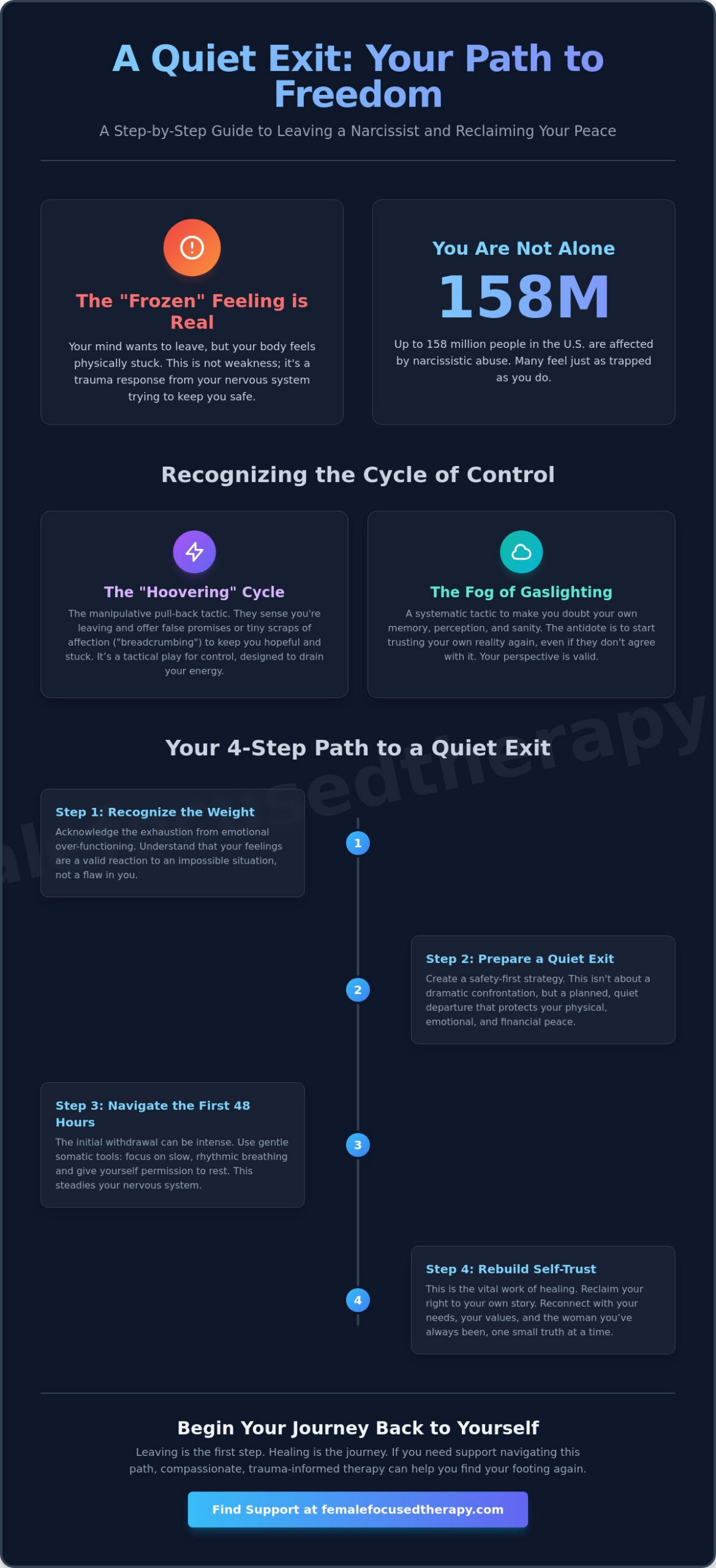
I understand how exhausting it is to feel like you’ve lost the compass to your own life. The fear of their reaction or the dreaded “hoovering” can feel like an invisible wall. You aren’t alone in this; research shows that up to 158 million people in the United States are affected by narcissistic abuse, and many feel just as stuck as you do right now.
I will help you navigate the emotional and practical steps of leaving while gently rebuilding your self-trust. We’ll look at creating a clear, safe path to exit and explore somatic techniques to help your nervous system feel steady again. I’ll show you how to move from a place of fear to a life of clarity and peace.
Key Takeaways
- I’ll help you understand why your body feels frozen and how to recognise the patterns of emotional over-functioning that have drained your spirit.
- We will walk through a practical, safety-first strategy for how to leave a narcissist by planning a quiet exit that protects your peace.
- You’ll learn how to navigate the intense emotional withdrawal of the first 48 hours using gentle somatic tools to steady your breath.
- I will share how you can begin the vital work of rebuilding self-trust and reconnecting with the woman you’ve always been.
Recognising the weight of narcissistic abuse you’ve been carrying
I want you to know that the heavy confusion you’re carrying right now isn’t a flaw in your character. It is a natural response to an unnatural situation. Many of the women I work with are incredibly intelligent and high-functioning, yet they find themselves caught in a cycle of emotional over-functioning. You might spend your days “managing” your partner’s volatile moods, trying to predict their next outburst, or taking the blame for things that aren’t your fault.
This constant vigilance is physically and mentally exhausting. When you are researching how to leave a narcissist, the first step is often just admitting how heavy this weight has actually become. You’ve likely been holding everything together for so long that you’ve forgotten what it feels like to just “be” without being on guard. Gaining a bit of clarity through Understanding Narcissism can help you see that these behaviours aren’t about you; they are ingrained psychological patterns.
You aren’t “crazy” for feeling off-balance or for doubting your own memory of events. You are simply responding to a systematic loss of self-trust caused by deep relationship trauma. This trauma often lives in the body as a tight chest or a constant sense of unease. Recognising that your exhaustion is a valid reaction to an impossible environment is the beginning of your journey back to yourself.
The quiet exhaustion of the ‘hoovering’ cycle
I see how tiring it is to be pulled back in just when you think you’re finally ready to go. This often happens through “breadcrumbing,” where they throw you tiny scraps of affection or false promises of change just to keep you hopeful and stuck. It’s a manipulative dance that drains your energy. The hoovering cycle is ultimately a tactical play for narcissistic supply, designed to bring you back under their control whenever they sense you pulling away.
Breaking through the fog of gaslighting
Breaking through the fog of gaslighting starts with a tiny, quiet decision to trust your own eyes again. When your perspective has been dismissed for years, your brain learns to doubt its own reality. Rebuilding self-trust is the antidote to this mental fog. You can find more support for this journey through my work with relationship trauma and narcissistic abuse. Your perspective is valid, even if it’s been dismissed for a lifetime.
It takes time to clear the air, but every time you acknowledge a truth without seeking their approval, the fog thins. You don’t need them to agree with your reality for it to be real. Understanding how to leave a narcissist involves reclaiming your right to your own story, one small truth at a time.
Why your body stays when your mind wants to go
I often see women whose minds are entirely ready to leave, yet their bodies feel physically “frozen” to the spot. It’s a confusing, painful disconnect. You might have your bags packed in your head, but your legs won’t move toward the door. This isn’t a lack of courage or a sign that you should stay; it’s your nervous system trying to keep you safe by staying small and inconspicuous.
When you’re in a sustained state of high-alert or collapse, willpower alone isn’t enough to override your survival instincts. Relationship trauma often manifests as somatic symptoms like a constant tightness in your chest, shallow breathing, or chronic digestive issues. Your body is communicating that it doesn’t feel safe, and it’s doing its best to protect you from perceived danger. While having a safety plan for leaving an abusive relationship is a vital practical step, we must also address the physical “freeze” that keeps you stuck in place.
Understanding how to leave a narcissist requires us to look at the body as well as the brain. If your system perceives a threat, it may shut down your ability to take action. This is why you might feel physically heavy or unable to make simple decisions about your future. It’s as if your internal alarm system is permanently stuck in the “on” position, draining your battery before you even attempt to move.
Gently waking up your nervous system
We can begin by gently waking up your nervous system through small, intentional movements. If you’re feeling stuck, try focusing on your breath for just a few minutes. Slow, rhythmic exhales tell your brain that the immediate threat has passed, allowing you to feel grounded enough to make a plan. I also believe in “rest as resistance.” When you’re preparing for a major life transition, giving yourself permission to rest isn’t lazy; it’s a way to reclaim the energy you’ll need to figure out your next steps.
Managing the overwhelm of ADHD and trauma
If you navigate life with ADHD, the executive dysfunction caused by trauma can feel doubly heavy. I understand how the emotional intensity of your situation can make the thought of logistics feel like an impossible mountain to climb. When your brain is already wired for overwhelm, the complexity of an exit plan can trigger a total shutdown. This is why we focus on regulation first, allowing your mind the space it needs to organise thoughts without the constant interference of a “fright” response.
We can break this down into tiny, manageable steps that don’t feel like they’re going to break you. If you feel you need a steady hand to help you through this, you might find it helpful to explore supportive therapy options where we can work at a pace that feels safe for you. Reclaiming your life is a journey that happens in both the mind and the body, and you don’t have to navigate it alone.
Preparing your quiet exit with clarity and safety
I recommend a “quiet exit” whenever you are planning how to leave a narcissist. This isn’t about being sneaky; it’s about protecting your emotional and physical safety. When you try to have a “final talk” with someone who uses manipulation, they often use that vulnerability to pull you back in. I’ve seen so many women get caught in a fresh cycle of hoovering just because they wanted a sense of closure that the other person simply isn’t capable of giving.
Your safety plan needs to be quiet and methodical. You’ll need to gather your “village” which includes those few trusted friends, family members, or professionals who truly understand the dynamics of narcissistic abuse. Here in Singapore, we have a strong network of support, but I understand that your privacy is paramount. Identifying your safe people is the first step in ensuring you aren’t navigating this alone.
Practical steps are your anchor during this time. Start by securing your essential documents, like passports and birth certificates, and keep them in a safe place away from the home. If you can, set aside a small amount of money in an account they cannot access. Knowing that the average therapy session in 2026 costs between $100 and $250 can help you budget for the professional support you’ll need once you’ve landed. Having a safe place to land gives your nervous system the signal that there is a way out.
Every small, practical step you take is a building block for your new life. You are moving toward a future where you don’t have to manage someone else’s volatile emotions or live in a state of constant compromise. Each decision you make for your safety is an act of reclaiming your own power.
Creating your emotional and physical sanctuary
Identifying a space where you can feel heard and supported without judgment is essential. This is where you can begin to process the relationship trauma and narcissistic abuse support you truly deserve. Before you move, take a moment to prepare your digital boundaries. Change your passwords, check for location sharing on your devices, and consider a new phone number if you feel it’s necessary for your peace of mind.
The power of the ‘No Contact’ boundary
Block, delete, and breathe. Total silence is often the only way to reclaim your psyche from the constant noise of their demands. It’s very common to feel a surge of guilt when you first implement strict boundaries, but I want you to remember that your silence is a boundary, not a weapon. “No Contact” is a tool for your protection, not a punishment for them. By closing that door, you are finally opening one for yourself.
The first 48 hours: Finding your breath again
I want you to be very gentle with yourself during these first few days of freedom. You’ve just navigated an incredibly taxing transition, and your system needs time to process the shift from high-alert to safety. It’s normal to feel a strange, vibrating mix of adrenaline and total exhaustion as the immediate threat begins to lift.
Expect a “withdrawal” effect in these early hours. Your brain has been conditioned to live in a state of high-intensity drama, and it may actually crave the chaotic cycle you’ve escaped. This is a physiological response to the sudden drop in stress hormones, not a sign that you made a mistake or that you truly want to go back.
Focus on the most basic needs of your body. Drink plenty of water, eat simple, nourishing food, and allow for safe, gentle movement like a short walk or some light stretching. Learning how to leave a narcissist is a process that continues through these quiet, physical moments of reclamation. You are teaching your body that it’s finally safe to come out of hiding.
You might experience a full spectrum of emotions, from soaring relief to profound, heavy grief. Let them come without judgement. You are finally in a space where it is safe to feel everything you had to suppress just to survive the relationship. Honouring these feelings is the first step in finding your way back to yourself.
Self-compassion as your primary tool
This is the time to begin replacing that sharp, critical voice in your head with a tone of kindness and patience. If you feel a frantic urge to check their social media or “just see” how they are, pause and take a deep breath. Acknowledge the impulse without acting on it, and remind yourself that healing happens at a pace that feels safe and sustainable for you.
Grounding techniques for moments of panic
When the “what have I done?” thoughts arrive, try a simple somatic exercise to settle your nervous system. Place one hand on your heart and the other on your belly, feeling the rise and fall of your breath for a few cycles. This helps bring you back to the present moment rather than letting you spiral into the “what ifs” of the future.
Keep your “why” close to your heart during these moments of panic. Remind yourself of the clarity you felt when you decided to leave and the peace you are now building for your future self. If the emotional weight feels too heavy to carry alone right now, you can book a private session to help you navigate these early days of recovery in a safe, supportive space.
Rebuilding self-trust and your life after narcissistic abuse
Healing isn’t a project to “fix” a broken version of yourself. I want you to know that you aren’t broken; you’ve simply been through a system that tried to overwrite your reality. Reconnecting with the woman you’ve always been is the most profound part of this journey. It’s about peeling back the layers of someone else’s expectations to find your own authentic voice again.
The core of long-term recovery is the rebuilding of self-trust. When you were figuring out how to leave a narcissist, your intuition was likely buried under layers of chronic self-blame and confusion. Healing means learning to listen to that quiet inner voice once more. It’s a slow process of proving to yourself that your observations and feelings are, and always were, valid.
This process often coincides with other major life transitions. I work with many women who are navigating menopause or midlife while simultaneously processing relationship trauma. These shifts in hormones and identity can make the emotional weight feel even more intense. Understanding how these biological changes intersect with your recovery is vital for your overall wellbeing.
Trauma-informed therapy offers a way to process these experiences without letting them define your future. It’s about moving through the past at a pace that respects your nervous system and your unique history. You deserve a life that feels steady, clear, and entirely your own. We work together to ensure you feel supported in a safe, grounded space.
Moving from survival to growth
I offer a safe space where I always feel heard and supported, and I want that same feeling of sanctuary for you. Integrating small mindfulness and somatic practices into your day helps anchor your new, peaceful routine. You can see more about the path forward for women in transition by looking at who I work with.
Your realistic next step
You don’t have to figure out the next decade of your life today. You only need to take one small, gentle step toward your own healing. If you feel ready for a deeper dive into your recovery journey, you might consider focused intensive therapy to help clear the path forward. I am here to guide you with warmth and professional insight whenever you feel ready to reach out.
Reclaiming your peace and your future
You’ve already taken the bravest step by simply being here and reading these words. We’ve explored the weight of the abuse you’ve carried, the way your body responds to trauma, and how a quiet exit can protect your energy. Learning how to leave a narcissist is a process of reclaiming your autonomy, one breath at a time.
As a Registered Integrative Psychotherapist, I use a trauma-informed approach specifically for women to help you navigate these difficult transitions. Whether you are with me in-person in Singapore or online from anywhere in the world, my goal is to help you move forward with clarity and confidence. You deserve a space where your voice is heard and your reality is never questioned.
If you are ready to begin rebuilding your self-trust, I invite you to book a consultation with me here. You don’t have to carry this burden alone any longer. There is a life of peace and reconnection waiting for you on the other side of this fog. Be gentle with yourself today. You are doing so much better than you think you are.
Frequently Asked Questions
Is it possible to leave a narcissist if we have children together?
Yes, it is entirely possible, though it requires a shift from “co-parenting” to “parallel parenting.” This approach minimises direct contact and focuses on creating a stable, regulated home environment for your children within your own space. By setting firm legal boundaries and using written communication only, you can protect your peace while being the healthy, present parent your children need during this transition.
Why do I feel so much guilt even though I know the relationship was abusive?
Guilt is a very common side effect of the “fawn” trauma response. You’ve been conditioned for years to take responsibility for their emotions as a survival strategy. This feeling doesn’t mean you’ve done something wrong; it’s simply your nervous system trying to return to a familiar pattern of caretaking. Recognising this guilt as a symptom of the abuse rather than a reflection of your character is a vital step in your recovery.
How can I tell the difference between a narcissist and someone with high-conflict personality?
The main difference lies in empathy and the need for “supply.” A narcissist lacks genuine empathy and requires constant validation to maintain a grandiose sense of self. High-conflict personalities may struggle with emotional regulation and reactivity, but they often retain a capacity for remorse. When you are researching how to leave a narcissist, look for a consistent pattern of entitlement and a total lack of accountability for their actions.
What should I do if the narcissist tries to ‘hoover’ me back after I leave?
The most effective response to hoovering is to maintain absolute silence. This is where your “No Contact” boundary becomes your greatest shield against further manipulation. If they reach out with sudden apologies or manufactured emergencies, remind yourself of the clarity you felt when you decided to go. Lean on your trusted village and your safety plan rather than engaging with their attempts to pull you back into the cycle.
Can I heal from narcissistic abuse without going to therapy?
You can certainly begin the healing process through self-education, somatic practices, and building a supportive community. However, the systematic dismantling of self-trust that happens in these relationships can be very complex to unpick alone. Professional, trauma-informed support provides a safe space to process the deep-seated confusion and help you figure out how to leave a narcissist emotionally as well as physically.
What happens to my body after I leave a long-term narcissistic relationship?
Your body will likely go through a significant period of decompression. After years of living with elevated cortisol and adrenaline, your nervous system must learn how to exist in a state of rest again. It is very common to experience extreme fatigue, changes in your digestive health, or a sudden release of long-held muscle tension. Treat your body with immense kindness during this time as it finally begins to feel safe.
How do I explain my departure to friends and family who don’t see the abuse?
You don’t have to convince everyone of your reality for your experience to be valid. I recommend keeping your explanation simple and boundaried: “The relationship was no longer healthy for me, and I’ve decided to move forward for my own wellbeing.” Those who truly support you will respect your decision without requiring a detailed list of grievances. You are allowed to protect your story and only share it with those who have earned your trust.

Article by
Cheryl Kennedy MacDonald MA BA (Hons) Pg. Dip. SAC BACP
Cheryl Kennedy MacDonald is a psychotherapist specialising in women’s mental health, relationships, and life transitions. She works with women navigating trauma, relationship breakdown, identity shifts, and midlife change, helping them rebuild self-trust, emotional stability, and a clear sense of who they are and what they want.
With over 20 years’ experience working with women internationally, Cheryl is the founder of YogaBellies, a global women’s yoga school, and the creator of the Birth ROCKS method. Her work sits at the intersection of psychotherapy and embodiment, integrating evidence-based therapeutic approaches with somatic, body-based practices that support deep, lasting change.
Known for her grounded and direct approach, Cheryl moves beyond surface-level insight to address the patterns held in the body and nervous system. Her work supports women to regulate, reconnect, and respond to their lives from a place of clarity, strength, and self-respect.
She is a published author in academic journals and has written multiple books on women’s health, pregnancy, and midlife wellbeing, available on Amazon and leading book retailers worldwide.