
You walk past their bedroom and the silence isn’t peaceful; it’s heavy. This quiet is a physical weight that often arrives just as your body is navigating the internal shifts of menopause, making you wonder if therapy for empty nest syndrome could help you find your footing again in a house that feels far too large.
I know that this sense of purposelessness can feel crushing, especially when the world expects you to be celebrating your new freedom. It’s a grief that often feels invisible to everyone else, but I want you to know that what you’re feeling is real, valid, and deeply felt in both your mind and your body.
I’m here to help you move through this transition with compassion and somatic insight. We’ll explore practical ways to manage the overwhelm by reconnecting your breath and your movement, allowing you to gently redefine who you are in this new, quieter chapter of your life. You don’t have to navigate this restoration alone.
Key Takeaways
- I’ll help you recognise that the heavy silence in your home is a valid form of grief and a transition for your body as much as your heart.
- You’ll learn why therapy for empty nest syndrome is particularly effective when you’re also navigating the hormonal shifts of menopause or the complexities of ADHD.
- I’ll share how somatic movement can help you process deep emotions that words alone often cannot reach, helping you move through the fog of transition.
- We’ll explore how to re-introduce yourself to your partner and set new boundaries in a home that no longer revolves around your children’s schedules.
- You will discover a path toward internal restoration, allowing you to rediscover your own identity and sense of purpose in this next chapter.
The Heavy Silence: Acknowledging the Grief of an Empty Nest
I understand how the quiet in your hallways can feel physically heavy. It isn’t just an absence of noise; it’s a presence that sits in your chest and changes the way you move through your rooms. For many of the women I work with, Empty nest syndrome isn’t just a phrase in a book. It’s a profound transition of the heart and body that requires a gentle, steady approach to healing.
You might find yourself feeling a confusing mix of intense pride for your child’s independence and a deep, gut-wrenching personal sorrow. This internal conflict is exhausting. I want to validate that your grief is real, even if people around you suggest it’s “just a stage” of life. When your daily life has revolved around the needs of others for decades, the sudden stop is a shock to your entire nervous system.
The invisible weight of the ‘mother’ identity
For years, your role as a mother has likely been your primary internal compass. It’s the lens through which you’ve viewed your time, your energy, and your purpose. I often see the struggle women face when moving from a life of constant “doing” for others to suddenly being left with themselves. It’s a shift that can leave you feeling adrift and without gravity.
When the daily rhythm you spent decades building vanishes overnight, the loss is felt in your muscles and your bones. You might still listen for the front door to click or find yourself checking the fridge for their favourite snacks. This is why therapy for empty nest syndrome is so important. It provides a safe, boundaried space to acknowledge the loss of that primary role while you begin the slow process of internal restoration.
Why it is okay to not feel ‘free’ just yet
There is a modern “free bird” narrative that puts immense pressure on women to be immediately happy or productive once the kids leave. You might feel like you should be booking holidays or starting a new business, yet you find yourself standing in their empty bedroom feeling stuck. I want you to know that sitting with the sadness is a necessary part of your healing journey.
Normalising the anxiety you may have felt for months before they actually left is part of the work we do together. You don’t have to rush into a “new you” until your body feels safe enough to exhale. Healing doesn’t happen by bypassing the pain; it happens by moving through it at a pace that feels manageable for you. Your feelings of loss are not a sign that you’re failing at this transition, but a testament to the depth of your love.
Why This Transition Hits Differently: Hormones, ADHD, and Identity
The empty nest transition rarely happens in a vacuum. For most of the women I support, it arrives just as their bodies are navigating the profound physiological shifts of midlife. I often call this the “perfect storm” because your children are stepping into their own lives just as your internal chemistry is beginning to change.
I frequently see how these overlapping layers can make your emotional resilience feel much thinner than it used to be. It isn’t just about the quiet rooms; it’s about how your brain and body are processing that quiet. My integrative approach looks at all of these factors together, ensuring we don’t treat your grief as separate from your biology.
The hormonal intersection: Menopause and the empty nest
During perimenopause and menopause, declining oestrogen can significantly amplify feelings of anxiety, irritability, and low mood. When your “feel-good” hormones are in flux, the emotional weight of a child leaving home can feel almost unbearable. It’s as if the tools you once used to manage stress have been temporarily misplaced.
I believe we must address your body’s changes alongside your emotional journey to find true balance. This is why I focus on life transitions and menopause therapy, helping you understand that your feelings are often a mix of natural grief and physical transition. Seeking therapy for empty nest syndrome can provide the necessary space to untangle these threads.
When an ADHD brain meets an empty house
If you’re a woman with ADHD, the loss of the “parenting skeleton” can be particularly jarring. For years, the rigid routines of school runs, meal times, and extracurricular activities likely provided the external structure your brain needed to stay on track. When that structure vanishes, you might find yourself struggling with executive dysfunction in a way you haven’t felt in a long time.
I understand how the sudden lack of stimulation in a quiet house can lead to a sense of paralysis or intense overwhelm. Without the urgent needs of others to drive you, it’s easy to feel lost in the day. Together, we can find new, gentle ways to structure your time that honour your ADHD brain without it feeling like a chore.
If you feel like you’re drowning in this intersection of change, I’m here to help you find your footing. You can book a session with me to start exploring how we can rebuild your internal confidence and self-reliance during this new chapter.
Moving Through the Fog: Somatic Practices for Emotional Restoration
Often, the first thing people tell you when the kids leave is to “stay busy.” They suggest hobbies, volunteering, or travel as a way to fill the void. While these things have their place, I’ve found that constant activity is often just a way of bypassing the deep healing your body actually needs. When we rush to fill the silence, we miss the opportunity to listen to what our internal self is trying to say.
I believe that healing happens in both the body and the mind. When you engage in therapy for empty nest syndrome, we don’t just talk about your feelings; we look at how those feelings show up in your posture, your tension, and your sleep. I use somatic movement to help you process the emotions that words cannot reach. By moving gently, we give your nervous system permission to finally exhale and release the weight it has been carrying.
Grounding your nervous system when it feels overwhelmed
That “flutter” in your chest or the sudden feeling of being untethered is your nervous system looking for safety. I recommend simple breathing techniques, like lengthening your exhale, to signal to your body that you are grounded in this new quiet. It’s about finding your way back to a state of internal stability when your external world has shifted so dramatically.
Using gentle movement helps you reconnect with your physical self after years of focusing entirely on others. My approach to somatic movement and yoga acts as a bridge, helping you move from a state of “doing” for your family into a state of “being” with yourself. This isn’t about fitness; it’s about restoration and learning to trust your own intuition again.
Reclaiming your physical space as a sanctuary
Your home environment plays a huge role in your internal restoration. You might feel a deep emotional weight when you walk past your child’s bedroom. There is no “right” time to change that room; I encourage you to listen to what your body needs from your home right now. If seeing the empty bed causes a physical pang of grief, it is okay to keep the door closed for a while.
Sometimes, reclaiming your space means making small, intentional shifts that signal a new chapter. This could be as simple as moving a chair to a sunnier spot or changing the scent of a room. These small changes tell your brain that your surroundings are evolving with you. It’s a way of gently asserting that this house is now a sanctuary for your own growth and rest.
Redefining Your Partnership and Your Boundaries
When the kids leave, the daily noise that once filled the cracks in your marriage suddenly vanishes. For many years, parenting served as a shared project that allowed you to bypass certain tensions or unmet needs. Now, in the quiet of the house, those cracks can become much more visible and harder to ignore.
I help women navigate this “re-introduction” to their partners. It’s common to feel like you’re living with a stranger, or perhaps you’ve realised you’ve both changed so much that you don’t know how to relate without the children as a buffer. If you’ve experienced relationship trauma, this phase can feel especially isolating or even triggering as old patterns resurface.
Seeking therapy for empty nest syndrome is a powerful way to address these shifts before they become overwhelming. It provides a dedicated space to look at your partnership with fresh eyes and decide how you want this next chapter to look. This is a journey of internal restoration that we navigate together, ensuring you feel safe and supported.
Finding each other again (or for the first time)
This transition is a shared journey, yet you might find you’re grieving in very different ways. I use couples therapy to help you both find a common language for this new silence. We work on communicating the needs and desires you may have suppressed for decades while you were busy raising a family.
It’s important to recognise if the quiet in your home feels like peace or if it feels like a warning sign. I’m here to help you untangle those feelings without judgement. We can explore whether you are rediscovering each other or if you need to build an entirely new foundation for your relationship that honours who you are today.
The ‘Mother’ boundary: Supporting from a distance
Your role is changing, not ending. I often describe this as moving from the ‘manager’ of your child’s life to a ‘consultant.’ This shift requires a new set of boundaries that can feel counter-intuitive at first. I see the struggle when you want to step in and fix things, but your child needs the space to face their own challenges and grow.
I help you manage the urge to over-function, which is often just a way to soothe your own anxiety about the empty house. By finding peace in this evolved connection, you allow your child to spread their wings while you reclaim your own energy. If you’re ready to start this work, you can book a session with me to begin redefining your world and your boundaries.
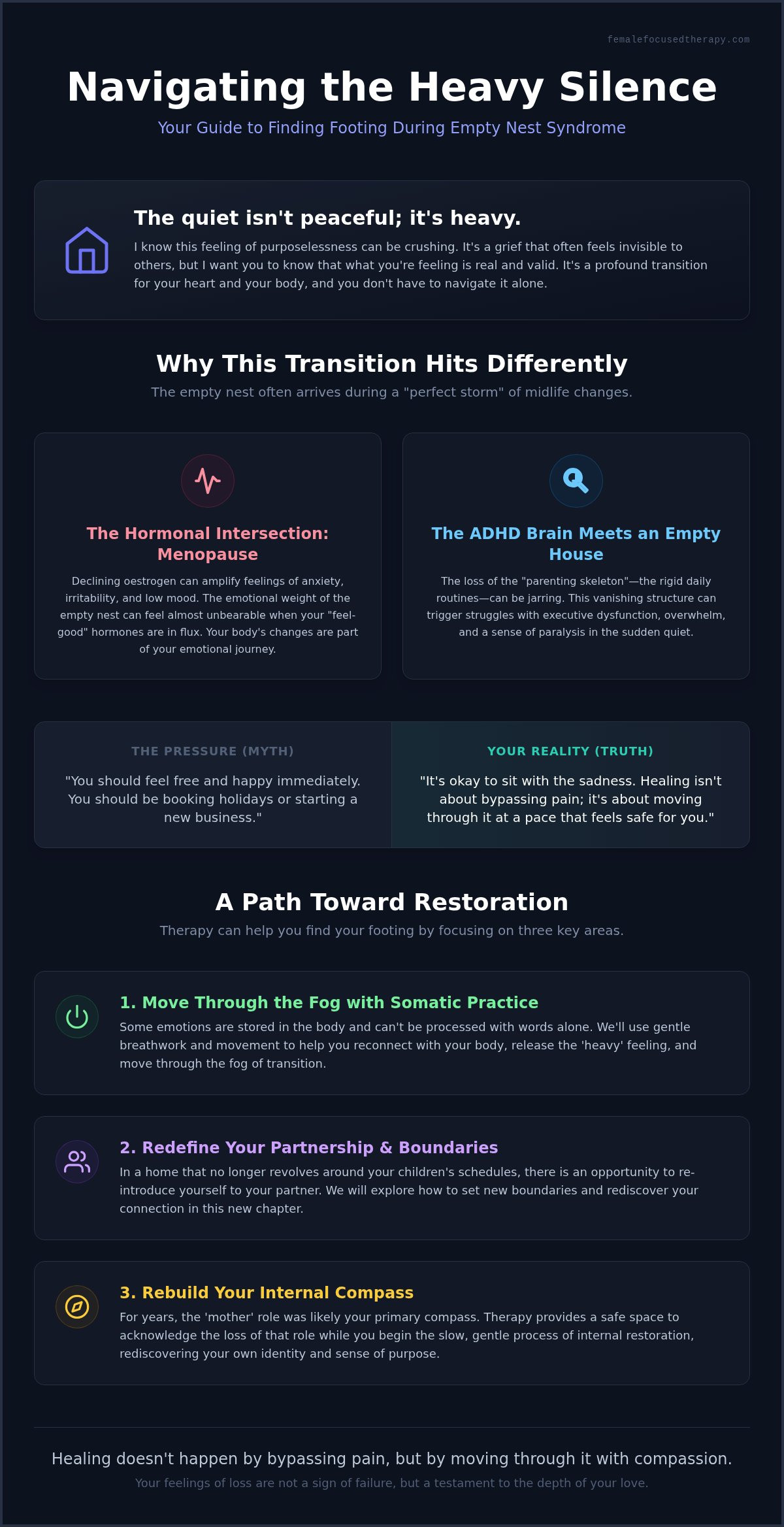
How Therapy Can Help You Rebuild Your Internal Compass
I view therapy not as a way to ‘fix’ you, but as a dedicated space for your internal restoration. After decades of looking outward to meet the needs of your family, it’s natural to feel like you’ve lost your own sense of direction. Together, we work to uncover the version of you that exists beyond your role as a mother.
Having a safe, boundaried space is essential for this exploration. In our sessions, you aren’t just a parent or a partner; you are a woman with your own dreams, fears, and wisdom. My integrative approach combines evidence-based CBT with mindfulness and somatic insight to help you process this change on every level, from your thoughts to your physical sensations.
This multidisciplinary path ensures that we address the cognitive loops of anxiety while also calming the physical tension I mentioned in earlier sections. By choosing therapy for empty nest syndrome, you are taking a courageous first step toward a life that feels authentic and deeply yours. You’re giving yourself permission to be the priority.
A collaborative journey of self-trust
I am here to guide you as you learn to trust your own intuition again. We often spend so much time second-guessing our choices for the sake of our children that we forget how to listen to our own inner voice. Our work together is a collaborative journey where I hold the space while you rediscover your own strength and self-reliance.
Whether we meet in person in Singapore or through online therapy, the goal remains the same: helping you feel grounded and stable. Investing in your own mental wellbeing during this transition isn’t selfish; it’s the kindest thing you can do for yourself. It also sets a beautiful example for your adult children as they navigate their own life transitions.
Your realistic next step
I invite you to take one small, gentle action for yourself today. You don’t have to overhaul your entire life by tomorrow morning. Simply acknowledging that this transition is hard and that your feelings are valid is a significant start. If you aren’t quite ready for a full session, you can explore my free therapy resources as a starting point for your restoration.
When you are ready to talk, I am here to listen and hold space for everything you’re carrying. You can book a consultation with me to discuss how we can work together to rebuild your internal compass and find yourself again in the quiet.
Stepping into Your New, Quieter Rhythm
The heavy silence you feel today doesn’t have to be your permanent reality. I’ve seen how acknowledging your grief and understanding the intersection of midlife transitions can transform this period into a time of profound internal restoration. You’ve spent decades focusing on others; it’s finally time to listen to what your own body and mind need.
As a registered integrative psychotherapist and specialist in women’s life transitions, I use a trauma-informed mind-body approach to help you find your footing. Whether we are untangling the complexities of midlife or using somatic movement to settle your nervous system, therapy for empty nest syndrome provides the safe space you deserve to rediscover your own identity.
You don’t have to navigate this fog alone. When you’re ready to move from simply “doing” to truly “being” again, I am here to support your journey. Book a compassionate therapy session with Cheryl today and let’s start rebuilding your internal compass together. You are capable of finding joy in the quiet.
Frequently Asked Questions
Is empty nest syndrome a clinical mental health diagnosis?
Empty nest syndrome isn’t a formal clinical diagnosis, but that doesn’t mean your experience isn’t significant. It’s a term used to describe the profound feelings of grief, loneliness, and loss of purpose parents feel when their children leave home. I view it as a major life transition rather than a disorder. It’s a time of deep internal shift that requires compassion and space to process without judgement.
How long does it typically take to adjust to an empty nest?
While some research suggests it takes an average of three months and 14 days to adjust, your timeline is entirely your own. Some women feel a sense of relief quickly, while others may feel the weight of the quiet for much longer. I encourage you to move at a pace that feels safe for your nervous system. There is no right way to grieve the end of a daily parenting rhythm.
Can empty nest syndrome cause physical symptoms like insomnia or fatigue?
Yes, this transition can absolutely manifest as physical symptoms like insomnia, fatigue, or a flutter in your chest. Your body and mind are deeply connected, and the stress of a changing home life impacts your nervous system. This is why I integrate somatic practices into my work. Addressing the physical toll of your grief is just as important as talking through the emotions you’re experiencing today.
What is the difference between normal sadness and clinical depression during this time?
Normal sadness often comes in waves and allows for moments of joy or productivity. Clinical depression feels more like a persistent, heavy fog that interferes with your ability to function or care for yourself. If your low mood feels constant or you’ve lost interest in everything, seeking therapy for empty nest syndrome can help you determine if you need more structured support to find your way back to yourself.
How can I support my partner if we are grieving the empty nest differently?
It’s very common for partners to grieve at different speeds or in different ways. One might focus on the new freedom while the other feels a crushing sense of loss. I suggest having open, non-judgemental conversations about your individual experiences. If the silence in your house feels like it’s pulling you apart, couples therapy can provide a safe space to re-introduce yourselves to each other in this new chapter.
Is it normal to feel a sense of identity loss when my kids move out?
It is completely normal to feel lost when your primary role as a daily caregiver ends. For decades, your mother identity likely served as your main internal compass. When that external structure is removed, it’s natural to wonder who you are now. I see this as an opportunity for internal restoration. We work together to uncover the parts of you that have been waiting for space to grow and breathe.
How can somatic therapy help with the feelings of an empty nest?
Somatic therapy helps by processing the emotions that words often can’t reach. When you feel overwhelmed, your body stores that tension in your breath and muscles. I use gentle movement and breathwork to help you release that weight and reconnect with your physical self. It’s a way of calming a nervous system that feels untethered, allowing you to move through the transition with more ease and internal stability.
Can ADHD make the transition to an empty nest more difficult for women?
Yes, ADHD can make this transition particularly challenging because the external structure of parenting often helps manage executive dysfunction. When the house goes quiet and the rigid school schedules vanish, you might feel a sense of paralysis or intense overwhelm. I understand this struggle personally as a woman with ADHD. We can work on finding new, gentle ways to structure your day that honour your brain without adding more stress.

Article by
Cheryl Kennedy MacDonald MA BA (Hons) Pg. Dip. SAC BACP
Cheryl Kennedy MacDonald is a psychotherapist specialising in women’s mental health, relationships, and life transitions. She works with women navigating trauma, relationship breakdown, identity shifts, and midlife change, helping them rebuild self-trust, emotional stability, and a clear sense of who they are and what they want.
With over 20 years’ experience working with women internationally, Cheryl is the founder of YogaBellies, a global women’s yoga school, and the creator of the Birth ROCKS method. Her work sits at the intersection of psychotherapy and embodiment, integrating evidence-based therapeutic approaches with somatic, body-based practices that support deep, lasting change.
Known for her grounded and direct approach, Cheryl moves beyond surface-level insight to address the patterns held in the body and nervous system. Her work supports women to regulate, reconnect, and respond to their lives from a place of clarity, strength, and self-respect.
She is a published author in academic journals and has written multiple books on women’s health, pregnancy, and midlife wellbeing, available on Amazon and leading book retailers worldwide.