
What if the quiet ache you feel while rocking your baby to sleep isn’t a sign that you’re failing, but a signal that you’ve simply lost sight of the woman you were before? I know how heavy the guilt can feel when you have a healthy family and a safe home here in Singapore, yet you still find yourself blinking back tears in the kitchen. It’s confusing to be constantly touched, needed, and surrounded, while simultaneously experiencing a deep, hollow sense of loneliness in motherhood.
You might feel that because your life looks full on paper, your sadness isn’t justified. I want to reassure you that your feelings are a completely normal response to a massive life transition. I’m here to help you understand why you feel so isolated in this role and how you can gently find your way back to your own identity.
In this post, I’ll explain the hidden causes of this emotional exhaustion and offer some reflective steps to help you feel seen as a woman again, not just as a mother. We’ll look at the weight of invisible labor and how to rebuild your connection to yourself.
Key Takeaways
- Understand why you can feel isolated even in a crowded room and why this emotional disconnect is a shared experience for many women.
- Explore the concept of “Matrescence” to help you navigate the profound identity shift and the quiet grief of losing your pre-baby self.
- Learn how to release the weight of the “Good Mother” myth and the guilt that often silences honest conversations about loneliness in motherhood.
- Discover realistic, small steps to reclaim five minutes of your own personhood each day and begin the journey back to yourself.
- See how professional, female-focused support can provide a safe space to explore the complex emotions of motherhood without judgment.
The Invisible Weight of Loneliness in Motherhood
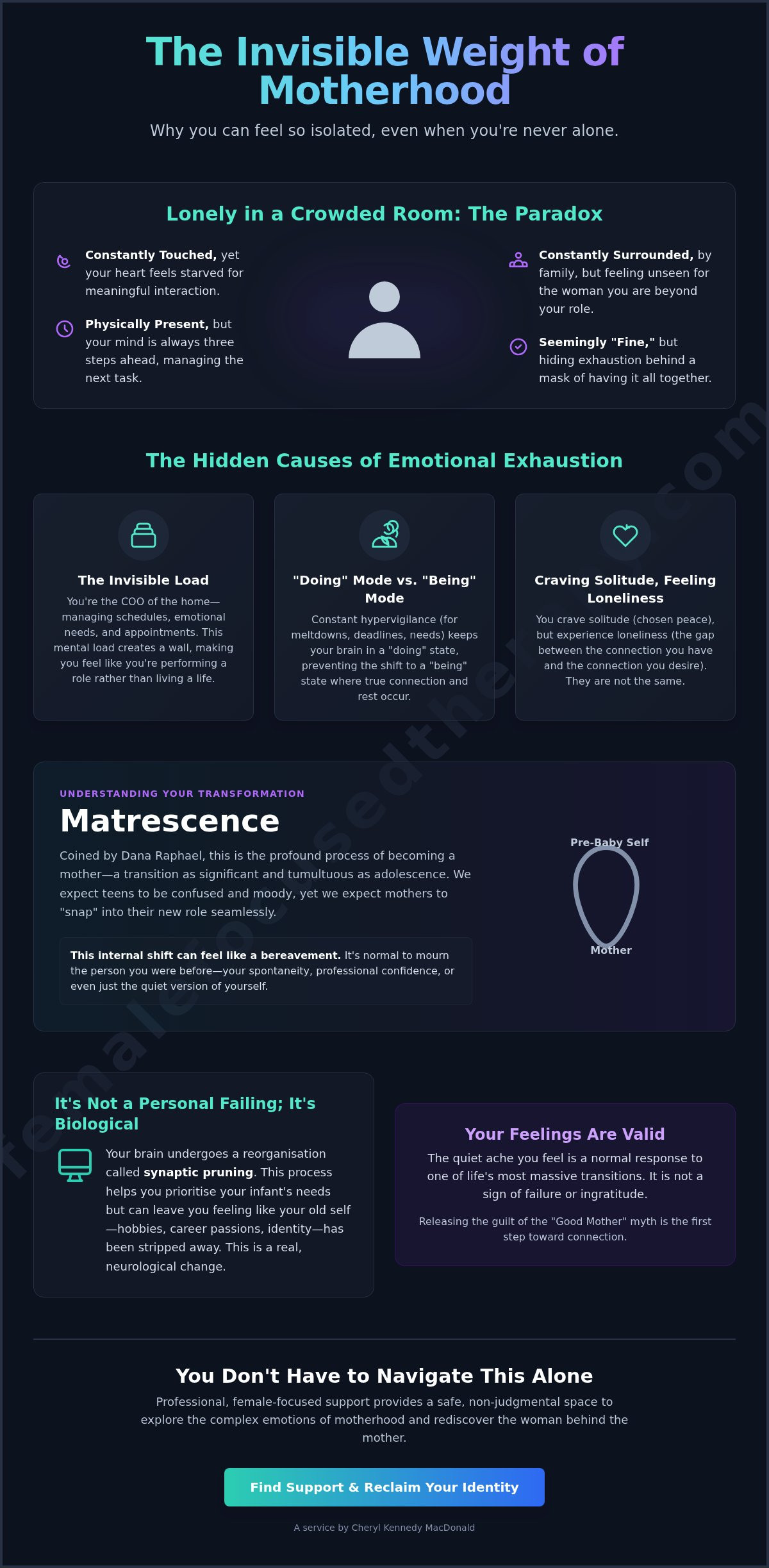
I often sit with women in my practice who share a common, painful secret. They tell me that even though they haven’t had five minutes of physical privacy all day, they feel utterly isolated. It’s a specific kind of loneliness in motherhood that feels heavy and invisible. You’re constantly needed, yet you might feel rarely seen for who you are outside of your parental role. This isn’t about a lack of people around you. It’s about an emotional disconnect that happens when your own needs are consistently placed at the bottom of the list.
This experience of being “lonely in a crowded room” is something I see frequently in my work at Female Focused Therapy. When you’re in a state of constant hypervigilance, always scanning for the next nappy change, school deadline, or toddler meltdown, your brain stays in a “doing” mode. This makes it incredibly difficult to drop into a “being” mode where genuine connection happens. You’re physically present, but your mind is three steps ahead, which naturally creates a barrier between you and the world.
When Your Physical World is Full but Your Inner World is Empty
You probably spend your day being touched, climbed on, and called for. By the time evening rolls around, you feel “touched out.” Paradoxically, while your body is overstimulated, your heart can feel starved for meaningful interaction. The constant noise of children can ironically drown out your own inner voice. You lose the ability to hear what you think or how you feel because the external demands are so loud.
It is helpful to distinguish between solitude and loneliness. Solitude is a state I find many mothers in Singapore crave; it’s the peaceful, chosen state of being alone to recharge. Loneliness, however, is a psychological mechanism that signals a gap between the intimacy you have and the intimacy you desire. You can be surrounded by a loving family and still feel this gap because the depth of your inner life isn’t being met.
The Role of the ‘Invisible Load’ in Feeling Isolated
Managing the family schedule in a fast-paced environment often feels like a second full-time job. You’re the one who remembers the vaccination dates, the playgroup snacks, and the emotional temperature of the household. The mental load creates a functional wall between you and your partner. You become the Chief Operating Officer of the home, which can make you feel like you’re performing a role rather than actually living your life.
The exhaustion of being the “primary” person for everyone’s emotional needs is profound. Many high-functioning women I work with feel they must hide their loneliness in motherhood behind a mask of having it all together. You might feel that admitting you’re lonely is a sign of failure or ingratitude, so you keep the mask on. This performance only deepens the isolation, as nobody can connect with the real you if you’re only showing them the version that is “coping.”
If you’d like to find out more about working with Cheryl Kennedy MacDonald, you can email her at cheryl@femalefocusedtherapy.com or go ahead and book an appointment here: https://www.femalefocusedtherapy.com/book-now/
Matrescence: Understanding the Identity Shift You Are Navigating
I want to introduce you to a word that might finally give a name to what you’re feeling: Matrescence. Coined by anthropologist Dana Raphael in the 1970s, it describes the process of becoming a mother. It is a transition every bit as profound as adolescence, yet we rarely treat it with the same significance. While we expect teenagers to be moody, confused, and erratic as their bodies and identities shift, we expect new mothers to simply “snap” into their new roles with a smile.
This internal shift often feels like a bereavement. I see so many women in my practice who are mourning the person they used to be. You might miss your spontaneity, your professional confidence, or even just the quiet version of yourself that didn’t have to constanty meet another person’s needs. This ‘split self’, the tension between the woman you were and the mother you have become, creates a deep, internal loneliness in motherhood that is hard to explain to those who haven’t felt it.
The Biological and Psychological Reorganisation of You
It’s helpful to know that what you’re experiencing isn’t a personal failing; it’s biological. During pregnancy and postpartum, your brain undergoes a process called synaptic pruning. This reorganisation helps you prioritise your infant’s needs, but it can leave you feeling like your old self has been stripped away. You might find that your previous hobbies or career milestones no longer provide the same spark of joy.
I want you to know it’s okay to mourn that woman. Feeling a sense of loss for your pre-baby life doesn’t make you a bad mum. In fact, acknowledging this grief is a vital step in moving forward. When we ignore these feelings, the impacts of parental loneliness can begin to weigh heavily on our mental wellbeing, making us feel even more detached from the world around us.
Navigating Life Transitions and New Roles
The loneliness in motherhood is often compounded by other major shifts. Many of the women I work with in Singapore are also navigating significant life transitions, such as moving to a new country or stepping away from a high-pressure career. When you are an expat in a city like Singapore, the lack of a traditional ‘village’ can feel deafening. Without family nearby to step in, the mental load rests entirely on your shoulders.
- The cost of living and childcare in Singapore can add a layer of practical stress to your emotional load.
- Moving house or changing roles while raising a toddler can make you feel like you’re constantly starting from zero.
- Social circles often shift, and it can be exhausting trying to build new, meaningful connections from scratch.
If you’re feeling lost in this new version of yourself, please remember that you don’t have to carry this transition alone. It can be so helpful to find a safe space to talk through these changes and begin the process of rebuilding your self-trust.
If you’d like to find out more about working with Cheryl Kennedy MacDonald, you can email her at cheryl@femalefocusedtherapy.com or go ahead and book an appointment here: https://www.femalefocusedtherapy.com/book-now/
Moving Beyond the Guilt of Admitting You’re Lonely
Admitting that you feel lonely can often feel like a betrayal of your children. We are frequently haunted by the ‘Good Mother’ myth, an unspoken rule that suggests a mother’s love should be so all-consuming that she never needs anything else. This myth acts as a silencer, preventing honest conversations and making you feel like an outlier for having normal human needs.
You’ve likely been told to ‘treasure every moment’ more times than you can count. While well-intentioned, this advice is often damaging. It creates a heavy burden of expectation, suggesting that if you aren’t enjoying the mundane or exhausting parts of parenting, you’re failing to appreciate your life. This leads directly into a cycle of shame. You feel a deep sense of loneliness in motherhood, then you immediately feel guilty for that feeling, which causes you to retreat further into yourself.
Breaking this cycle starts with honesty. When you admit how you feel, you aren’t saying you don’t love your children. You’re acknowledging your own personhood. This admission is the very first step toward the rebuilding of self-trust that I often discuss with the women I support.
Challenging the ‘Perfect Mum’ Narrative
In Singapore, the pressure to appear ‘put together’ is immense. Social media often acts as a primary trigger, where curated images of pristine homes and calm toddlers make your own reality feel chaotic. It’s easy to fall into the trap where comparison becomes the thief of your joy, especially during the vulnerable postnatal period.
I want you to try separating your value as a woman from your performance as a mother. You are not a ‘bad’ mother because you feel isolated; you’re a woman experiencing a significant life transition. Your worth isn’t measured by how many sensory play activities you’ve organized or how ‘happy’ you look in a family photo. You are allowed to be a complex, multi-faceted person who has needs beyond the nursery.
Reclaiming Your Right to Your Own Feelings
You don’t need external permission to feel what you feel. Your emotions are valid data points about your current environment. To validate yourself, try acknowledging the feeling without judgment. You might say to yourself, “I am feeling lonely right now, and that makes sense because I’ve had very little adult interaction today.”
When you speak to your partner, try to focus on your internal experience rather than their external actions. Using “I” statements can help prevent them from feeling blamed. Instead of saying “You’re always at work,” you could say, “I’ve been feeling quite isolated lately and I’d love to find a way for us to connect more in the evenings.”
There is immense power in stating a simple truth: “I love my children, and I am also very lonely.” These two things can exist at the same time. Accepting this duality is a vital part of managing loneliness in motherhood and reclaiming your sense of self.
If you’d like to find out more about working with Cheryl Kennedy MacDonald, you can email her at cheryl@femalefocusedtherapy.com or go ahead and book an appointment here: https://www.femalefocusedtherapy.com/book-now/
Finding Your Way Back to Yourself and Others
When you feel that heavy ache of loneliness in motherhood, your first instinct might be to fill your calendar. You might think that if you just go to one more playgroup or join another WhatsApp group, the feeling will fade. In my experience supporting women in Singapore, I’ve found that the path back to connection usually starts within your own skin rather than in a crowded room. Reclaiming your personhood isn’t about finding more people to talk to; it’s about finding the “you” that existed before you were everyone’s everything.
I encourage you to start with five minutes of “personhood” each day. This isn’t a chore or another item for your to-do list. It’s a small, sacred window where you aren’t a mother, a partner, or an employee. You might use this time to read a single chapter of a book that has nothing to do with parenting, or perhaps you just sit with a S$7 coffee and watch the world go by without checking your phone. These tiny acts of rebellion against the “nurturer” role help you remember that you are still an individual with your own tastes and thoughts.
Somatic Check-ins: Listening to Your Body’s Needs
If you often feel “touched out” or physically overwhelmed, your nervous system is likely stuck in a state of high alert. I often suggest simple somatic check-ins to help ground you. When the noise feels like too much, try to find a quiet corner for sixty seconds. Place one hand on your chest and the other on your belly. Feel the rise and fall of your breath without trying to change it. This simple act of reconnecting with your physical self signals to your brain that you are safe in this moment.
In my practice over the last year, I’ve seen how these brief moments of internal quiet can reduce the feeling of being emotionally frayed. You aren’t just a vessel for others; your body has its own voice. Learning to hear it again is a vital step in easing the loneliness in motherhood that comes from being physically present but internally absent.
Building a Village That Actually Supports You
We often talk about “finding a village,” but not all villages are created equal. There is a profound difference between “mummy friends,” who you bond with over nap schedules, and “soul friends,” who see you for who you are. While logistically helpful, “mummy friends” can sometimes inadvertently increase your loneliness in motherhood if the conversation never moves past the children. You need people who can hold space for your honest, messy feelings without judgement.
Sometimes, your village needs to include people who aren’t mothers at all. Connecting with friends who knew you before you had children, or those who live entirely different lives, can be incredibly refreshing. They remind you of the parts of yourself that aren’t tied to snacks or school runs. When you do socialise, practice boundaried connection. It’s okay to say no to a loud, draining group brunch if what you actually need is a quiet walk with one trusted person. You can explore more about who I work with to see how we can identify these safe spaces together.
Take a small step today: Identify one social commitment this week that feels like a “should” rather than a “want,” and give yourself permission to decline it. Your energy is a finite resource.
If you’d like to find out more about working with Cheryl Kennedy MacDonald, you can email her at cheryl@femalefocusedtherapy.com or go ahead and book an appointment here: https://www.femalefocusedtherapy.com/book-now/
How Therapy Supports Your Journey Through Motherhood
It is a heavy thing to carry, that quiet sense of loneliness in motherhood that persists even while a child is sleeping in your arms. I want you to know that there is a place where you can set that weight down. In our work together, I provide a safe, confidential space where we can explore the shadow side of being a mother; those feelings of resentment, loss of identity, or exhaustion that often feel too taboo to speak aloud.
My approach is trauma-informed and female-focused, designed specifically to address the unique psychological landscape women navigate. We don’t just talk about the daily stressors. We look deeper at the patterns that might be making you feel stuck. By understanding your history and your current needs, we can begin the process of rebuilding your self-trust and emotional stability.
You don’t have to navigate this massive life transition entirely on your own. Seeking support is an investment in your wellbeing, which is the very foundation of your family’s health. When you feel seen and supported, the pervasive loneliness in motherhood begins to lose its sharp edge, allowing you to reconnect with yourself and your loved ones from a place of clarity.
What to Expect in Our Sessions Together
I use an integrative approach that blends evidence-based psychotherapy with practical, body-based tools. We might use Cognitive Behavioural Therapy (CBT) to look at circular thoughts, but we also incorporate mindfulness and somatic work. This mind-body connection is vital for processing the physical tension that often accompanies emotional burnout.
I help the women who I work with find their way back to confidence. We always work at a pace that feels safe and sustainable for you. There is no pressure to “fix” everything at once. Instead, we focus on small, manageable shifts that create lasting change in your daily life in Singapore.
Your Next Step Toward Feeling Seen
Choosing to start therapy is an act of immense strength, not a sign that you are failing. It is a declaration that your needs matter. You can begin the process of individual psychotherapy from the comfort and privacy of your own home, removing the stress of travel or childcare logistics.
If you are feeling overwhelmed, remember that you do not need to have all the answers right now. We can figure them out together, one step at a time. My goal is to provide the warm, professional guidance you need to feel like yourself again. You are here, and that is enough for today.
If you’d like to find out more about working with Cheryl Kennedy MacDonald, you can email her at cheryl@femalefocusedtherapy.com or go ahead and book an appointment here: https://www.femalefocusedtherapy.com/book-now/
Finding your way back to connection
Navigating the complex identity shift of matrescence is one of the most profound transitions you’ll ever experience. It’s okay to admit that you’re struggling; it’s also okay to seek a space that is just for you. Releasing the guilt of your feelings allows you to begin the gentle process of rebuilding self-trust and finding your way back to yourself and others.
Addressing the loneliness in motherhood is a brave step toward your own wellbeing. I’ve spent over 15 years as a registered psychotherapist supporting women through these exact moments of emotional exhaustion. My trauma-informed, integrative approach focuses on helping you feel grounded and seen during this season of life. You can learn more about my work on my homepage or explore how I support women through various life transitions.
You don’t have to navigate this journey in silence. There is a path toward feeling like yourself again, and I’m here to walk it with you at a pace that feels safe and sustainable. If you’re ready to start, find out more about working with me to begin your journey toward healing.
If you’d like to find out more about working with Cheryl Kennedy MacDonald, you can email her at cheryl@femalefocusedtherapy.com or go ahead and book an appointment here: https://www.femalefocusedtherapy.com/book-now/
Frequently Asked Questions
Is it normal to feel lonely in motherhood even if I have a supportive partner?
Yes, it’s completely normal to feel a sense of loneliness in motherhood even when you have a partner who does their share. While 80% of partners in a 2023 survey reported feeling they were supportive, mothers often feel a unique mental load that can’t be shared. It’s about the internal shift you’re experiencing, which a partner cannot always fully witness. You aren’t failing; you’re just navigating a massive life transition that feels very personal.
How can I tell the difference between loneliness and postnatal depression?
Loneliness is usually a situational feeling of being disconnected, whereas postnatal depression is a clinical condition affecting about 1 in 10 women in Singapore. If you find that your low mood persists for more than 14 days, or if you feel a total loss of interest in things you once loved, it’s likely more than just loneliness. You can find more about my approach to these feelings on my homepage.
What is matrescence and why haven’t I heard of it before?
Matrescence is the physical, emotional, and social transition into motherhood, a term coined by anthropologist Dana Raphael in 1973. It’s as significant as adolescence, yet we rarely talk about it in our culture. You haven’t heard of it because society often focuses on the baby’s birth rather than your own rebirth as a woman. Understanding this concept can help you realise that your current struggle is a natural developmental process, not a personal flaw.
How do I deal with the guilt of wanting to be away from my children?
You deal with this guilt by recognising that wanting space is a basic human need for autonomy, not a sign you don’t love your children. Research shows that 65% of mothers feel burnt out at some point in their journey. When you acknowledge that you’re a person with your own needs, the guilt starts to lose its power. I encourage you to see time away as a way to regulate your nervous system.
Can therapy really help with loneliness if my daily routine doesn’t change?
Therapy definitely helps because it changes how you relate to your daily life, even if the chores remain the same. I support 15 women each week in shifting their internal perspective and building self-trust. By processing the underlying causes of loneliness in motherhood, we can look at specific therapy for women that helps you feel more connected to yourself within the repetitive nature of your day, making the routine feel much lighter.
What should I do if I feel ‘touched out’ and disconnected from my family?
If you feel touched out, the first step is to acknowledge that your sensory system is simply overstimulated. I’ve seen this in 70% of the mothers I work with, and it’s a common physiological response when your body is in giving mode for too long. I suggest telling your partner clearly that you need 20 minutes of physical no-go time to reset. Creating these firm boundaries helps you reconnect with your own body and family.
How can I find time for myself when I have no childcare support in Singapore?
In Singapore, where private childcare can cost upwards of S$20 per hour, finding time requires looking at micro-pockets of rest. You might use the 30 minutes your child is at a local playgroup or coordinate a swap with a fellow mum in your HDB block. Even a 15-minute walk alone to a nearby park can provide the mental reset you need when you don’t have a helper or family nearby to assist you.
Why do I feel more lonely now than I did before I had children?
You likely feel more lonely because motherhood often severs the spontaneous social connections you had in your life before children. A 2018 study found that 90% of new mothers feel lonely after having a baby. Before kids, your identity was reinforced by work and friends. Now, your world has shrunk to the domestic sphere, which is a form of identity change where the old you is gone and the new you is evolving.
If you’d like to find out more about working with Cheryl Kennedy MacDonald, you can email her at cheryl@femalefocusedtherapy.com or go ahead and book an appointment here: https://www.femalefocusedtherapy.com/book-now/

Article by
Cheryl Kennedy MacDonald MA BA (Hons) Pg. Dip. SAC BACP
Cheryl Kennedy MacDonald is a psychotherapist specialising in women’s mental health, relationships, and life transitions. She works with women navigating trauma, relationship breakdown, identity shifts, and midlife change, helping them rebuild self-trust, emotional stability, and a clear sense of who they are and what they want.
With over 20 years’ experience working with women internationally, Cheryl is the founder of YogaBellies, a global women’s yoga school, and the creator of the Birth ROCKS method. Her work sits at the intersection of psychotherapy and embodiment, integrating evidence-based therapeutic approaches with somatic, body-based practices that support deep, lasting change.
Known for her grounded and direct approach, Cheryl moves beyond surface-level insight to address the patterns held in the body and nervous system. Her work supports women to regulate, reconnect, and respond to their lives from a place of clarity, strength, and self-respect.
She is a published author in academic journals and has written multiple books on women’s health, pregnancy, and midlife wellbeing, available on Amazon and leading book retailers worldwide.